Approaches to
Educational Technology
Dr. Pooja Walia
Assistant Professor
Department of Education
Mizoram University
Educational Technology
Educational Technology is a systematic way of
designing, implementing and evaluating the
total process of teaching-learning in terms of
specific objectives, based on research in human
learning, communication and employing a
combination of human and non-human
resources to bring more effective instructions.
Technology in Education
• The term ‘Technology in Education’ refers to use
of technological advancement such as various
equipments, material machines for educational
purpose.
• It includes tangible aspects of technology as the
application of principles of physical sciences and
engineering in the development of electro-
mechanical equipment used for instructional
purposes.
Technology of Education
The term ‘Technology of Education’ refers to
use of technological approaches such as
instructional technology, teaching technology,
behavioural technology, programmed
learning, micro teaching, system analysis,
management of teaching-learning process and
its components.
Forms of Educational Technology
Teaching technology
Instructional technology
Behavioural technology
Teaching Technology
Teaching technology is concerned with the task of
systematisation of the process of teaching.
Fundamental Principles and characteristics of teaching
technology as suggested by E.G. Vedanayagam (1988);
• Teaching is a scientific process and its major components are
content, communication and feedback.
• There is a close relationship between teaching and learning
• It is possible to modify, improve and develop the teaching-
learning activities.
Teaching Technology
• The terminal behaviour of the learner, in terms
of learning structures, can be established by
appropriate teaching environment.
• Teaching skills can be developed and
strengthened by means of feedback devices.
• Pre-determined learning objectives can be
achieved by designing suitable teaching
activities.
Components of Teaching Technology
• Planning of teaching
• Organisation of teaching
• Leading of teaching
• Controlling of teaching
Instructional Technology
• Instructions stands for a certain type of command meant for
getting specific information, knowledge and understanding
about a thing, system or process.
• Instructional technology is meant for helping the instructor
and the learner in the desired instructional task for the
realisation of the stipulated instructional objectives in a
particular teaching-learning situation.
• e.g. self instructional material through programmed
instructional packages
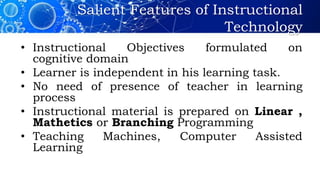
Salient Features of Instructional
Technology
• Instructional Objectives formulated on
cognitive domain
• Learner is independent in his learning task.
• No need of presence of teacher in learning
process
• Instructional material is prepared on Linear ,
Mathetics or Branching Programming
• Teaching Machines, Computer Assisted
Learning
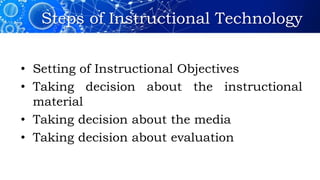
Steps of Instructional Technology
• Setting of Instructional Objectives
• Taking decision about the instructional
material
• Taking decision about the media
• Taking decision about evaluation
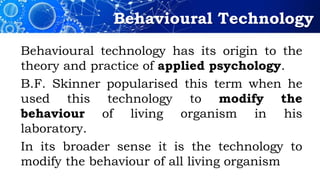
Behavioural Technology
Behavioural technology has its origin to the
theory and practice of applied psychology.
B.F. Skinner popularised this term when he
used this technology to modify the
behaviour of living organism in his
laboratory.
In its broader sense it is the technology to
modify the behaviour of all living organism
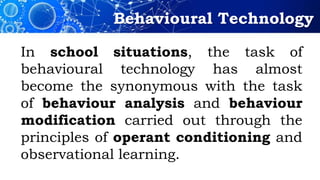
Behavioural Technology
In school situations, the task of
behavioural technology has almost
become the synonymous with the task
of behaviour analysis and behaviour
modification carried out through the
principles of operant conditioning and
observational learning.
Use of Behavioural Technology
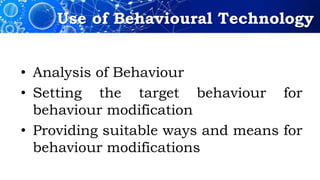
• Analysis of Behaviour
• Setting the target behaviour for
behaviour modification
• Providing suitable ways and means for
behaviour modifications
Approaches of Educational Technology
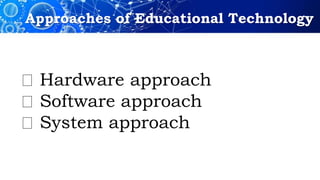
Hardware approach
Software approach
System approach
Hardware Approach
Relative Technology
Hardware Approach
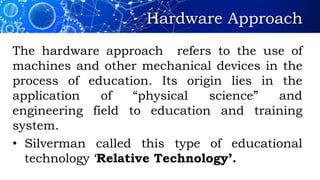
The hardware approach refers to the use of
machines and other mechanical devices in the
process of education. Its origin lies in the
application of “physical science” and
engineering field to education and training
system.
• Silverman called this type of educational
technology ‘Relative Technology’.
Hardware Approach
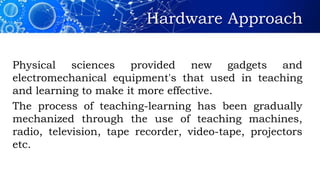
Physical sciences provided new gadgets and
electromechanical equipment's that used in teaching
and learning to make it more effective.
The process of teaching-learning has been gradually
mechanized through the use of teaching machines,
radio, television, tape recorder, video-tape, projectors
etc.
Example of Hardware Approach
The teacher can deal with a larger group of
students at the same time by his discourse
through these machines that reduce the cost.
E.g. use of microphones.
Scope of Hardware Approach in
Education
• Preservation of Knowledge
• Transmission of Knowledge
• Development of Knowledge
Preservation of Knowledge
The history of preservation of the knowledge is
believed to exist since the printing technology
came into existence.
The knowledge is preserved with these machines
in the form of books which are shelved in the
libraries. In modern time we preserve the content
in hard drives, pen drives, CD’s etc., which is
the contribution of engineering and sciences.
Transmission of Knowledge
The second aspect of human knowledge is
transmission. Usually teachers transmit
knowledge themselves to their pupils. Further,
transmission of the knowledge is supported by
machine like mike, radio and television. Now
a large number of students are benefitted with
the help of recorded lectures available online
which they can listen on learning platform with
the use of computing devices.
Development of Knowledge
The third aspect of human knowledge is it’s
development. For this aspect, provisions are
made for research work. In the research
programmes, after collecting data, the main
function is analysis of data. For this purpose,
researchers rely on software like ‘SPSS’, ‘R’
which can run only on computing devices.
Software Approach
Constructive Technology
Software Approach
Software approach is emerged through behavioral
sciences and psychology of learning. Silverman
(1968), called this ‘constructive educational
technology’.
It concentrates on the analysis, selection and
construction of whatever is necessary to meet the
educational needs of the learners.
The software approach means to apply or use some
scientific principles theories and laws to teaching
training and instruction in view to realize objectives.
Software approach
It refers to the application of teaching-learning
principles towards directing and shaping of
behaviour.
It is closely associated with the modern principles
and theories of teaching, instruction, teacher
behaviour and principles of programmed learning.
It sometimes referred to as instructional technology.
teaching technology and behaviour technology.
Software approach
It is characterized by task analysis,
stating objectives in clear terms,
selection of appropriate teaching
strategies, reinforcement for correct
responses, and continuous evaluation.
Interdependence of two Approaches
• The hardware and software approaches are
supplementary to each other. Both software
and hardware approaches are so interlinked
that they cannot be separated from each other.
One without the other is incomplete.
• It is software approach which makes the
hardware function and without the use of
software, hardware alone would have little or
no value.
Interdependence of two Approaches
In hardware approach we are more concerned with
the production and utilization of audio-visual aid
material and sophisticated instruments and
gadgets and mass media for helping the teacher
and learner to achieve better results, in software we
try to exploit psychology of learning for the
production and utilization of software techniques
and material in terms of learning material,
teaching-learning strategies, tools of evaluation and
other devices for smoothening the task of teaching
and learning.
Role of Hardware and Software
Approach in Education
• Individualization of Instruction
• Use the multimedia and multi-sensory
approach to teaching-learning
• Management of the affairs of
educational practices in an efficient
and productive way
Role of Hardware and Software
Approach in Education
• Providing proper input and process for
the best possible outcomes (products)
• Fulfilling the expectations of distance
education
• Making the task of teaching-learning
interesting purposeful and productive
Role of Hardware and Software Approach
Individualization of instruction
• Programmed instruction, programmed books, and programmed
learning modules.
• Teaching machines, computer assisted instruction and computer
managed learning.
• Video and audio recorded learning and instructional material.
• Email, internet, teleconferencing and other online educational
facilities.
• Special aid material, equipment and appliances used for special
education and adjustment measure of for the disabled.
• Special provisions and facilities for the creative and gifted to
nature and develop their individual capacities according to their
pace and interest.
Role of Hardware and Software Approach
Use the multimedia and multi-sensory approach to teaching-learning:
• Hardware and software technologies help the teacher as well as the
learners for making a proper and judicious use of multimedia and multi-
sensory aid material, equipment and principles of teaching-learning,
derived from psychology and technology of teaching.
• Proper utilisation of sensory organs such as sight and hearing for the
acquisition of the desired teaching-learning experiences.
• Multimedia, material and appliance involving hardware and software
technologies for sharing desirable teaching-learning technologies.
• All the relevant and needed teaching-learning methods, devices, and
strategies, well-accompanied and aided by hardware and software
technologies.
Role of Hardware and Software Approach
Management of the affairs of educational practices
in an efficient and productive way: It helps to manage
the following affairs related to his professional
responsibilities in the sphere;
• Planning of teaching-learning
• Organisation of teaching-learning
• Leading teaching-learning
• Controlling teaching-learning
Role of Hardware and Software Approach
Providing proper input and process for the
best possible outcomes (products):
In the true spirit of the system engineering, use
of hardware and software technologies can help
the educational and instruction system to make
all possible efforts for providing adequate and the
needed process organizations to arrive at the best
possible outcomes.
Role of Hardware and Software Approach
Fulfilling the expectation of distances and
correspondence education:
The demands of today’s education and modern
education practices are putting increase
emphasis on the extension of distance education
and correspondence and online education
facilities to the increasing number of learners.
Educational technology (hardware and software)
fulfill the need of such system.
Role of Hardware and Software Approaches
Making the task of teaching-learning interesting,
purposeful and productive:
• Suggesting suitable teaching-learning methods, devices and
strategies based on psychology of teaching-learning.
• Suggesting suitable maxims and principle of teaching-
learning based on the theory and practice of technology of
teaching-learning.
• Putting various types of audio-visual aid and materials and
equipment at the disposal of teachers and learners.
• Providing a variety of instructional and self-learning material
suiting the varying needs of teaching-learning situations and
individuality of the teacher and learners.
System Approach
Management Technology
SYSTEM APPROACH
• System approach is a systematic attempt to
coordinate all aspects of a problem towards
specific objectives.
• System approach is a rational, problem-
solving method of analyzing educational
process and making it more effective.
System Approach
• The system approach involved setting goals and
objectives, analyzing resources, devising a plan of
action and continuous evaluation(Saettler,1990).
• It is also known as Management Technology.
• It has been introduces in the field of education to
manage, control and improve the process and
products of education. It is concerned with
systematic planning, implementing and evaluating
a system like education.
Definition of System approach
Keshaw and Michean(1959) have defined
“ System approach is one of the
techniques which aims at finding the most
efficient and economically intelligent
methods for solving the problems of
education scientifically’.
System approach in education
System approach in education incorporates all its
parts,
• pupils
• teachers
• curriculum
• evaluation
In this case, the system is composed of a teacher,
a student and a programme of instruction, all in a
particular pattern of interaction.
Thanks a lot!
poojawaliakuk@gmail.com