INTERDISCIPLINARY APPROACH
IN TEACHING SCIENCE
INTERDISCIPLINARY APPROACH
 Interdisciplinary approach –involves drawing appropriately from
several disciplines (or separate branches of learning or fields of
expertise) to redefine problems outside of normal boundaries and
reach solutions based on a new understanding of complex situations.
 Defined as “Involving two or more academic disciplines” (Collins
English Dictionary)
INTERDISCIPLINARY APPROACH
• Interdisciplinary learning in science is characterized as a
perspective that integrates two or more disciplines into coherent
connections to enable students to make relevant connections and
generate meaningful associations.
• Interdisciplinary teaching is an approach that integrates two
or more subject areas into a meaningful association to enhance
and enrich learning within each subject area (Cone et al., 1998)
INTERDISCIPLINARY APPROACH
 All the branches of science are interdependent.
 In physical science teaching, we cannot confine ourselves with
physics and chemistry alone, we are to combine and correlate
physics and chemistry with other subjects, and with learner
environment to avoid rote memory and artificial learning. This
is what is known as interdisciplinary approach in science
teaching.
CONCEPT OF INTERDISCIPLINARY
It is a holistic approach with a
tradition in western thought that
comes from Plato’s ideal of
unity as the highest good in
all things. Interdisciplinarity
nurtures a different perspective
with focus on themes and
problems of life experience.
Interdisciplinary education is a
means of communicating
knowledge, know how and life
skills in accordance with
strategy which is not confined
to progression within a single
discipline or several disciplines
considered independently of
one another.
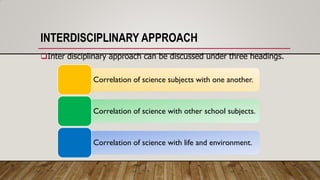
INTERDISCIPLINARY APPROACH
Inter disciplinary approach can be discussed under three headings.
Correlation of science subjects with one another.
Correlation of science with other school subjects.
Correlation of science with life and environment.
RELATIONSHIP OF SCIENCE SUBJECTS WITH ONE
ANOTHER
• Chemistry and biology are interdependent. A biology teacher
while teaching digestion needs to use the knowledge of chemistry.
Further, photosynthesis in Botany is taught by interdisciplinary
approach- Botany and chemistry.
• Similarly, the atomic structure and the electronic configuration of
atoms, of elements, radioactive isotopes are areas common to
physics and chemistry. Hence interdisciplinary approach is essential
for better understanding.
RELATIONSHIP OF SCIENCE WITH OTHER SCHOOL
SUBJECTS
1. Science and Literature. There are excellent writers in Biography and Natural
History and on discoveries and inventions. These can be recommended for
class and home reading as literature.
2. Science and Languages. Elementary books used in foreign countries for
science teaching might occasionally be read. More advanced foreign text books
on special subjects should be placed in the library. Children can’t express
themselves until they develop a good language (both written and spoken) skill.
3. Science and History. The life of a nation is greatly influenced by the
application of scientific discovery to national trade, industry, diet and standards
of living and by the imparting of current scientific thought on the general idea
of the age.
RELATIONSHIP OF SCIENCE WITH OTHER SCHOOL
SUBJECTS
4. Science and Geography. Simple problems connected with the composition,
pressure, temperature and moisture of the air are usually dealt with in science
courses; so also conventional currents in air and in the sea and variation of the
density of water with temperature.
5. Science and Social Studies. Science has changed our way of thinking and
the standard of living. Many superstitious beliefs are vividly explained on the
basis of scientific principles.
6. Science and Fine Arts. The topic of sound can be easily and interestingly
taught, when the topic is compared with musical instruments. Pitch and length
of the string, vibration of air columns and flutes etc., can be demonstrated
easily. Children need skill of drawing
RELATIONSHIP OF SCIENCE WITH OTHER SCHOOL
SUBJECTS
7. Science and Mathematics. Many problems of proportion, inverse
ratio, equations and graphs are constantly in use in science courses.
The early introduction of the ratio of trigonometry is a great help in the
science course and their use in mechanics, magnetism and light give
reality to their meaning.
8. Science with Painting and Drawing. Drawing is of immense
importance for all branches of science, may be physics or chemistry or
biology. Preparations of charts, models, diagrams etc., require skill in
drawing. Diagram in science have important place. Without diagrams,
we cannot grapple with theoretical descriptions.
RELATIONSHIP OF SCIENCE WITH OTHER SCHOOL
SUBJECTS
9. Science and Craft. Correlation between science and craft is possible to a
great extent. Now-a-days improvisation has proved its utility. They learn more
when they do it with their own hands and knowledge of basic principles
underlying the apparatus improvised by them is understood by them.
10. Science and Economics. Science has a profound effect on the economy of a
particular country. India has been able to achieve self sufficiency of food due to
artificial manure and good insecticides. Similarly health of nation is, dependent
upon the knowledge of science in terms of balanced diet food preservation,
canning, medicine etc., Similarly the industrial economy is also dependent upon
the chemical know-how of metals, their ores etc.,
RELATIONSHIP OF SCIENCE WITH LIFE AND
ENVIRONMENT
• For basic needs of life such as food, clothing, shelter, we have to
depend upon science. Science has gone deep in the veins of
modern society. All our daily routine is controlled by science and its
product.
• It is therefore essential on the part of science teacher that he
should make sure that applications of that topic in daily life affects
the thought and actions of students, so that students begin to
understand the implications of the subject.
ADVANTAGES OF INTER DISCIPLINARY APPROACHES
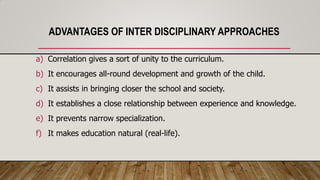
a) Correlation gives a sort of unity to the curriculum.
b) It encourages all-round development and growth of the child.
c) It assists in bringing closer the school and society.
d) It establishes a close relationship between experience and knowledge.
e) It prevents narrow specialization.
f) It makes education natural (real-life).
ADVANTAGES OF INTER DISCIPLINARY APPROACHES
g) It makes the lesson interesting by bringing in the other subjects
and experience.
h) Learning by doing is fostered while organizing projects to
correlate different subjects.
i) It broadens the teachers’ outlook.
j) It helps teachers to learn more from books and keep their
knowledge up-to-date.
AIMS OF INTERDISCIPLINARY EDUCATION
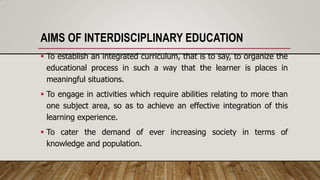
 To establish an integrated curriculum, that is to say, to organize the
educational process in such a way that the learner is places in
meaningful situations.
 To engage in activities which require abilities relating to more than
one subject area, so as to achieve an effective integration of this
learning experience.
 To cater the demand of ever increasing society in terms of
knowledge and population.
OBJECTIVES OF INTERDISCIPLINARY APPROACH
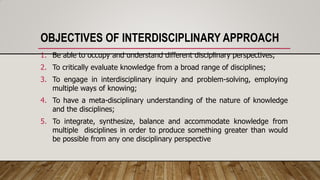
1. Be able to occupy and understand different disciplinary perspectives;
2. To critically evaluate knowledge from a broad range of disciplines;
3. To engage in interdisciplinary inquiry and problem-solving, employing
multiple ways of knowing;
4. To have a meta-disciplinary understanding of the nature of knowledge
and the disciplines;
5. To integrate, synthesize, balance and accommodate knowledge from
multiple disciplines in order to produce something greater than would
be possible from any one disciplinary perspective
NEED OF INTERDISCIPLINARY APPROACH
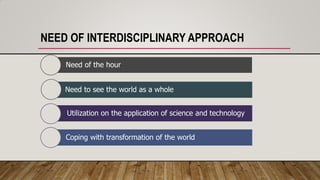
Need of the hour
Need to see the world as a whole
Utilization on the application of science and technology
Coping with transformation of the world
NEED OF THE HOUR
 It is recognized that the problems of the contemporary world are
increasing day by day and their solution do not lie within one
discipline.
 Current problems are interdisciplinary in nature, they must be
tackled through interdisciplinary approach.
 It is also needed to prepare learners more adequately to shape and
choose a future.
NEED TO SEE THE WORLD AS A WHOLE
 The world in which we live is a unity, but that it can be looked at in
a variety of way. The disciplines look at the world from a particular
viewpoint, for a particular purpose.
 If we concentrate in our teaching solely on these individual
approaches, it is difficult for our students to see the world as whole,
and to develop a broad understanding necessary for education.
 The student has to make sense of the world, to be able to operate
successfully as a person, citizen, as a productive worker.
UTILIZATION ON THE APPLICATION OF SCIENCE &
TECHNOLOGY
 Science and technology education should be associated with
productive work, in order to prepare the rising generation to
cope with the problems of everyday life and the community,
and at the same time to foster positive attitudes towards work.
 The importance of an interdisciplinary approach was emphasized as
being essential both in education as a whole, and in the teaching of
science and technology in particular.
COPING WITH THE TRANSFORMATION OF THE WORLD
 Present is less appropriate as a means of preparation for a whole
population, where the emphases need to be broader, including both
intellectual development and aspects of productive work.
 There is an important reason to be prepared to look at the curriculum in
an interdisciplinary way. Our present disciplines arose during the 19th
century, from older ways of describing knowledge.
 Developments of this century cross the old boundaries, in nuclear
technology, in space research, computers and molecular biology. We
cannot restrict the possibilities to dividing lines which may cease to be
relevant. So there is a need for interdisciplinary approach and subjecs.
IMPORTANCE OF INTERDISCIPLINARY APPROACH
 This approach provides greater flexibility in the research.
 Creativity often requires interdisciplinary contributions to their new field.
 Some worthwhile topics of research fall in the intersect among the
traditional disciplines.
 Many intellectual, social and practical problems require interdisciplinary
approaches.
 Interdisciplinary knowledge and research serve to remind us of the unity
in diversity.
BENEFITS OF INTERDISCIPLINARY EDUCATION
1) Interdisciplinary knowledge and application of different discipline can
lead to greater creativity.
2) Students beginning to consolidate learning by synthesizing ideas from
many perspectives and consider an alternative way of acquiring
knowledge.
3) Exploring topics across a range of subjects boundaries motivates
students to pursue new knowledge in different subject area.
4) Worthwhile topics of research can fall in the spaces, between the
traditional disciplines.
BENEFITS OF INTERDISCIPLINARY EDUCATION
5) Transferable skills of critical thinking, synthesis and research are
developed and are applicable to future learning experiences.
6) Critical thinking skills are used and developed as students look across
disciplinary boundaries to consider over viewpoints and also begin to compare
and contrast concepts across subject areas.
7) Students cover topics in more depth because they are considering the many
and varied perspectives from which a topic can be explored.
8) Students are highly motivated when the pursuing topic is interesting to them.
As a result, the content is often rooted in life experiences, giving an authentic
purpose for the learning and connecting it to real world context.
9) Consequently, learning becomes meaningful, purposeful and deeper resulting in
learning experiences that stay with the students for a life time.
END..
THANK U.. QUESTION??

interdisciplinary approach - Copy.pdf

  • 1.
  • 2.
    INTERDISCIPLINARY APPROACH  Interdisciplinaryapproach –involves drawing appropriately from several disciplines (or separate branches of learning or fields of expertise) to redefine problems outside of normal boundaries and reach solutions based on a new understanding of complex situations.  Defined as “Involving two or more academic disciplines” (Collins English Dictionary)
  • 3.
    INTERDISCIPLINARY APPROACH • Interdisciplinarylearning in science is characterized as a perspective that integrates two or more disciplines into coherent connections to enable students to make relevant connections and generate meaningful associations. • Interdisciplinary teaching is an approach that integrates two or more subject areas into a meaningful association to enhance and enrich learning within each subject area (Cone et al., 1998)
  • 4.
    INTERDISCIPLINARY APPROACH  Allthe branches of science are interdependent.  In physical science teaching, we cannot confine ourselves with physics and chemistry alone, we are to combine and correlate physics and chemistry with other subjects, and with learner environment to avoid rote memory and artificial learning. This is what is known as interdisciplinary approach in science teaching.
  • 5.
    CONCEPT OF INTERDISCIPLINARY Itis a holistic approach with a tradition in western thought that comes from Plato’s ideal of unity as the highest good in all things. Interdisciplinarity nurtures a different perspective with focus on themes and problems of life experience. Interdisciplinary education is a means of communicating knowledge, know how and life skills in accordance with strategy which is not confined to progression within a single discipline or several disciplines considered independently of one another.
  • 6.
    INTERDISCIPLINARY APPROACH Inter disciplinaryapproach can be discussed under three headings. Correlation of science subjects with one another. Correlation of science with other school subjects. Correlation of science with life and environment.
  • 7.
    RELATIONSHIP OF SCIENCESUBJECTS WITH ONE ANOTHER • Chemistry and biology are interdependent. A biology teacher while teaching digestion needs to use the knowledge of chemistry. Further, photosynthesis in Botany is taught by interdisciplinary approach- Botany and chemistry. • Similarly, the atomic structure and the electronic configuration of atoms, of elements, radioactive isotopes are areas common to physics and chemistry. Hence interdisciplinary approach is essential for better understanding.
  • 8.
    RELATIONSHIP OF SCIENCEWITH OTHER SCHOOL SUBJECTS 1. Science and Literature. There are excellent writers in Biography and Natural History and on discoveries and inventions. These can be recommended for class and home reading as literature. 2. Science and Languages. Elementary books used in foreign countries for science teaching might occasionally be read. More advanced foreign text books on special subjects should be placed in the library. Children can’t express themselves until they develop a good language (both written and spoken) skill. 3. Science and History. The life of a nation is greatly influenced by the application of scientific discovery to national trade, industry, diet and standards of living and by the imparting of current scientific thought on the general idea of the age.
  • 9.
    RELATIONSHIP OF SCIENCEWITH OTHER SCHOOL SUBJECTS 4. Science and Geography. Simple problems connected with the composition, pressure, temperature and moisture of the air are usually dealt with in science courses; so also conventional currents in air and in the sea and variation of the density of water with temperature. 5. Science and Social Studies. Science has changed our way of thinking and the standard of living. Many superstitious beliefs are vividly explained on the basis of scientific principles. 6. Science and Fine Arts. The topic of sound can be easily and interestingly taught, when the topic is compared with musical instruments. Pitch and length of the string, vibration of air columns and flutes etc., can be demonstrated easily. Children need skill of drawing
  • 10.
    RELATIONSHIP OF SCIENCEWITH OTHER SCHOOL SUBJECTS 7. Science and Mathematics. Many problems of proportion, inverse ratio, equations and graphs are constantly in use in science courses. The early introduction of the ratio of trigonometry is a great help in the science course and their use in mechanics, magnetism and light give reality to their meaning. 8. Science with Painting and Drawing. Drawing is of immense importance for all branches of science, may be physics or chemistry or biology. Preparations of charts, models, diagrams etc., require skill in drawing. Diagram in science have important place. Without diagrams, we cannot grapple with theoretical descriptions.
  • 11.
    RELATIONSHIP OF SCIENCEWITH OTHER SCHOOL SUBJECTS 9. Science and Craft. Correlation between science and craft is possible to a great extent. Now-a-days improvisation has proved its utility. They learn more when they do it with their own hands and knowledge of basic principles underlying the apparatus improvised by them is understood by them. 10. Science and Economics. Science has a profound effect on the economy of a particular country. India has been able to achieve self sufficiency of food due to artificial manure and good insecticides. Similarly health of nation is, dependent upon the knowledge of science in terms of balanced diet food preservation, canning, medicine etc., Similarly the industrial economy is also dependent upon the chemical know-how of metals, their ores etc.,
  • 12.
    RELATIONSHIP OF SCIENCEWITH LIFE AND ENVIRONMENT • For basic needs of life such as food, clothing, shelter, we have to depend upon science. Science has gone deep in the veins of modern society. All our daily routine is controlled by science and its product. • It is therefore essential on the part of science teacher that he should make sure that applications of that topic in daily life affects the thought and actions of students, so that students begin to understand the implications of the subject.
  • 13.
    ADVANTAGES OF INTERDISCIPLINARY APPROACHES a) Correlation gives a sort of unity to the curriculum. b) It encourages all-round development and growth of the child. c) It assists in bringing closer the school and society. d) It establishes a close relationship between experience and knowledge. e) It prevents narrow specialization. f) It makes education natural (real-life).
  • 14.
    ADVANTAGES OF INTERDISCIPLINARY APPROACHES g) It makes the lesson interesting by bringing in the other subjects and experience. h) Learning by doing is fostered while organizing projects to correlate different subjects. i) It broadens the teachers’ outlook. j) It helps teachers to learn more from books and keep their knowledge up-to-date.
  • 15.
    AIMS OF INTERDISCIPLINARYEDUCATION  To establish an integrated curriculum, that is to say, to organize the educational process in such a way that the learner is places in meaningful situations.  To engage in activities which require abilities relating to more than one subject area, so as to achieve an effective integration of this learning experience.  To cater the demand of ever increasing society in terms of knowledge and population.
  • 16.
    OBJECTIVES OF INTERDISCIPLINARYAPPROACH 1. Be able to occupy and understand different disciplinary perspectives; 2. To critically evaluate knowledge from a broad range of disciplines; 3. To engage in interdisciplinary inquiry and problem-solving, employing multiple ways of knowing; 4. To have a meta-disciplinary understanding of the nature of knowledge and the disciplines; 5. To integrate, synthesize, balance and accommodate knowledge from multiple disciplines in order to produce something greater than would be possible from any one disciplinary perspective
  • 17.
    NEED OF INTERDISCIPLINARYAPPROACH Need of the hour Need to see the world as a whole Utilization on the application of science and technology Coping with transformation of the world
  • 18.
    NEED OF THEHOUR  It is recognized that the problems of the contemporary world are increasing day by day and their solution do not lie within one discipline.  Current problems are interdisciplinary in nature, they must be tackled through interdisciplinary approach.  It is also needed to prepare learners more adequately to shape and choose a future.
  • 19.
    NEED TO SEETHE WORLD AS A WHOLE  The world in which we live is a unity, but that it can be looked at in a variety of way. The disciplines look at the world from a particular viewpoint, for a particular purpose.  If we concentrate in our teaching solely on these individual approaches, it is difficult for our students to see the world as whole, and to develop a broad understanding necessary for education.  The student has to make sense of the world, to be able to operate successfully as a person, citizen, as a productive worker.
  • 20.
    UTILIZATION ON THEAPPLICATION OF SCIENCE & TECHNOLOGY  Science and technology education should be associated with productive work, in order to prepare the rising generation to cope with the problems of everyday life and the community, and at the same time to foster positive attitudes towards work.  The importance of an interdisciplinary approach was emphasized as being essential both in education as a whole, and in the teaching of science and technology in particular.
  • 21.
    COPING WITH THETRANSFORMATION OF THE WORLD  Present is less appropriate as a means of preparation for a whole population, where the emphases need to be broader, including both intellectual development and aspects of productive work.  There is an important reason to be prepared to look at the curriculum in an interdisciplinary way. Our present disciplines arose during the 19th century, from older ways of describing knowledge.  Developments of this century cross the old boundaries, in nuclear technology, in space research, computers and molecular biology. We cannot restrict the possibilities to dividing lines which may cease to be relevant. So there is a need for interdisciplinary approach and subjecs.
  • 22.
    IMPORTANCE OF INTERDISCIPLINARYAPPROACH  This approach provides greater flexibility in the research.  Creativity often requires interdisciplinary contributions to their new field.  Some worthwhile topics of research fall in the intersect among the traditional disciplines.  Many intellectual, social and practical problems require interdisciplinary approaches.  Interdisciplinary knowledge and research serve to remind us of the unity in diversity.
  • 23.
    BENEFITS OF INTERDISCIPLINARYEDUCATION 1) Interdisciplinary knowledge and application of different discipline can lead to greater creativity. 2) Students beginning to consolidate learning by synthesizing ideas from many perspectives and consider an alternative way of acquiring knowledge. 3) Exploring topics across a range of subjects boundaries motivates students to pursue new knowledge in different subject area. 4) Worthwhile topics of research can fall in the spaces, between the traditional disciplines.
  • 24.
    BENEFITS OF INTERDISCIPLINARYEDUCATION 5) Transferable skills of critical thinking, synthesis and research are developed and are applicable to future learning experiences. 6) Critical thinking skills are used and developed as students look across disciplinary boundaries to consider over viewpoints and also begin to compare and contrast concepts across subject areas. 7) Students cover topics in more depth because they are considering the many and varied perspectives from which a topic can be explored. 8) Students are highly motivated when the pursuing topic is interesting to them. As a result, the content is often rooted in life experiences, giving an authentic purpose for the learning and connecting it to real world context. 9) Consequently, learning becomes meaningful, purposeful and deeper resulting in learning experiences that stay with the students for a life time.
  • 25.