CRITICAL THINKING
THROUGH
INTERDISCIPLINARY
PROJECTS
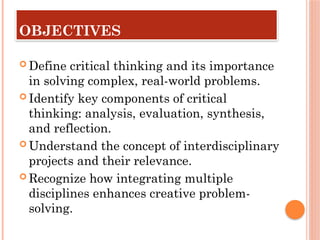
OBJECTIVES
 Define critical thinking and its importance
in solving complex, real-world problems.
 Identify key components of critical
thinking: analysis, evaluation, synthesis,
and reflection.
 Understand the concept of interdisciplinary
projects and their relevance.
 Recognize how integrating multiple
disciplines enhances creative problem-
solving.
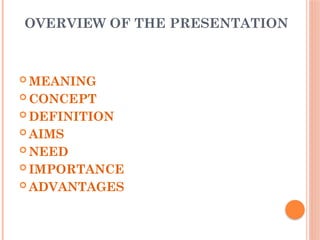
OVERVIEW OF THE PRESENTATION
 MEANING
 CONCEPT
 DEFINITION
 AIMS
 NEED
 IMPORTANCE
 ADVANTAGES
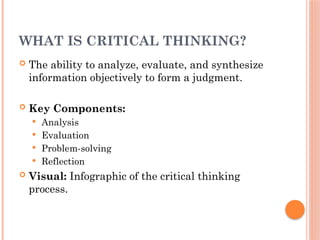
WHAT IS CRITICAL THINKING?
 The ability to analyze, evaluate, and synthesize
information objectively to form a judgment.
 Key Components:
 Analysis
 Evaluation
 Problem-solving
 Reflection
 Visual: Infographic of the critical thinking
process.
MEANING OF INTER-DISCIPLINARY
 In epistemological terms, the concept of
interdisciplinary may be regarded as a form of co-
operation between various disciplines/ subjects which
contribute to the achievement of a common end,
through their association, further the emergence and
advancement of new knowledge.
 It is an approach that consciously applies
methodology and language from more than one
discipline to examine a central theme, issue, problem,
topic, or experience.
CONCEPT OF INTER-DISCIPLINARY
It is a holistic approach with a tradition in
western thought that comes from Plato's ideal
of unity as the highest good in all things.
Interdisciplinarity nurtures a different
perspective with focus on themes and problems of
life experience.
Interdisciplinary education is a means of
communicating knowledge, know how and life
skills in accordance with strategy which is not
confined to progression within a single discipline
or several disciplines considered independently of
one another.
DEFINITION OF
INTERDISCIPLINARY
Interdisciplinary understanding as the
capacity to integrate knowledge and
modes of thinking in two or more
disciplines or established areas of
expertise to produce a cognitive
advancement – such as explaining a
phenomenon, solving a problem, or
creating a product – in ways that would
have been impossible or unlikely
through single disciplinary means.
INTERDISCIPLINARY SUBJECT
Interdisciplinary subjects provide the platform to
students for explore and integrate multiple perspectives
from different disciplines, sub-disciplines and areas of
expertise.
Interdisciplinarity involves a synthesis or balance of
multiple perspectives to produce such things as a deeper
understanding or illumination, a balanced judgement,
viable solution or a product that creatively
accommodates the different perspectives.
It is different from what might be called a
multidisciplinary subject which juxtaposes multiple
perspectives on the same topic without integration.
HOW INTERDISCIPLINARY
PROJECTS ENHANCE CRITICAL
THINKING
 Promotes Deeper Learning-Encourages
connecting concepts across fields.
 Strengthens Problem-Solving-Tackling problems
with multiple approaches.
 Encourages Open-Mindedness-Embracing varied
perspectives and methodologies.
 Visual-Flowchart linking disciplines to outcomes.
AIMS OF INTERDISCIPLINARY
EDUCATION
 To establish an integrated curriculum, that is to
say, to organize the educational process in such a
way that the learner is placed in meaningful
situations.
 To engages in activities which require abilities
relating to more than one subject area, so as to
achieve an effective integration of this learning
experience.
 To cater the demand of ever increasing society in
terms of knowledge and population
OBJECTIVES OF INTER-DISCIPL
INARY APPROACH
 be able to occupy and understand different
disciplinary perspectives;
 be able to critically evaluate knowledge from a broad
range of disciplines;
 be able to engage in interdisciplinary inquiry and
problem-solving, employing multiple ways of knowing;
 to have a meta-disciplinary understanding of the
nature of knowledge and the disciplines;
 be able to integrate, synthesise, balance and
accommodate knowledge from multiple disciplines in
order to produce something greater than would be
possible from any one disciplinary perspective
NEED OF INTERDISCIPLINARY
APPROACH
 Need of the hour
 Need to see World as a whole
 Utilisation of Science
 Copping with transformation of the world
NEED OF THE HOUR
It is recognised that the problems of the
contemporary world are increasing day by day and
their solution do not lie within one discipline.
Current problems are interdisciplinary in nature,
they must be tackled through interdisciplinary
approach. It is also needed to prepare learners more
adequately to shape and choose a future.
NEED TO SEE WORLD AS A
WHOLE
The world in which we live is a unity, but that it can be
looked at in a variety of ways. The disciplines look at
the world from a particular viewpoint, for a particular
purpose. If we concentrate in our teaching solely on
these individual approaches, it is difficult for our
students to see the world as whole, and to develop a
broad understanding necessary for education. The
student has to make sense of the world, to be able to
operate successfully as a person, as a citizen, as a
productive worker. That sense of understanding can be
helped by the capacity to use the disciplines, singly and
in co-operation, as appropriate.
UTILISATION OF APPLICATION
OF SCIENCE & TECHNOLOGY
Science and technology education should be
associated with productive work, in order to
prepare the rising generation to cope with
the problems of everyday life and the
community, and at the same time to foster
positive attitudes towards work. The importance
of an interdisciplinary approach was emphasized
as being essential both in education as a whole,
and in the teaching of science and technology in
particular.
COPPING WITH
TRANSFORMATION OF THE
WORLD
Present curriculum is less appropriate as a means of
preparation for a whole population, where the
emphases need to be broader, including both
intellectual development and aspects of productive
work. There is an important reason to be prepared to
look at the curriculum in an interdisciplinary way.
Our present disciplines arose during the nineteenth
century, from older ways of describing knowledge.
Developments of this century cross the old
boundaries, in nuclear technology, in space research,
computers and molecular biology. We cannot restrict
the possibilities to dividing lines which may cease to
be relevant. So there is a need for interdisciplinary
approach and subjects.
IMPORTANCE OF
INTERDISCIPLINARY APPROACH
 This approach provides greater flexibility in the
research.
 Creativity often requires interdisciplinary
contributions to their new field.
 Some worthwhile topics of research fall in the
intersect among the traditional disciplines.
 Many intellectual, social and practical problems
require interdisciplinary approaches.
 Interdisciplinary knowledge and research serve to
remind us of the unity in diversity.
…..
 Interdisciplinarians often treat themselves to the
intellectual equivalent of travelling in new lands.
 Interdisciplinarians may help to bridge
communication gaps in the modern academy,
thereby helping to mobilize its enormous
intellectual resources in the cause of greater
social rationality and justice.
BENEFITS OF
INTERDISCIPLINARY EDUCATION
 Interdisciplinary knowledge and application of
different discipline can lead to greater creativity
 Students beginning to consolidate learning by
synthesising ideas from many perspectives and
consider an alternative way of acquire knowledge
 Exploring topics across a range of subjects
boundaries motivates students to pursue new
knowledge in different subject area
 Worthwhile topics of research can fall in the spaces,
between the traditional disciplines
 Transferable skills of critical thinking, synthesis
and research are developed and are applicable to
future learning experiences
……
 Critical thinking skills are used and developed as
students look across disciplinary boundaries to
consider over viewpoints and also begin to compare
and contrast concepts across subject areas
 Students cover topics in more depth because they are
considering the many and varied perspectives from
which a topic can be explored
 Students are highly motivated when the pursuing
topic is interesting to them. As a result, the content is
often rooted in life experiences, giving an authentic
purpose for the ;learning and connecting it to real
world context
 Consequently learning becomes meaningful,
purposeful and deeper resulting in learning
experiences that stay with the students for a life time.
GROUP ACTIVITY/OUTPUT
 1. Divide Participants into Groups
 4–6 participants per group, ensuring diversity in expertise or teaching
subjects.
 2. Present the Challenge (10 minutes)
Choose a real-world problem. Examples:
 Climate Change: How can schools contribute to sustainability?
 Health and Well-being: Promote mental health in schools using
creative approaches.
 Community Development: Address a local issue (e.g., water
conservation, road safety).
Each group must:
 Identify Disciplines Involved:
Determine which subjects (e.g., science,
math, art, history) can contribute
solutions.
GROUP ACTIVITY/OUTPUT
 Propose an Interdisciplinary Project:
Design a classroom or school-wide activity that
addresses the problem. The project should:
 Be actionable.
 Engage students in critical thinking (analysis, evaluation,
synthesis).
 Use collaborative approaches.
 Plan the Execution:
 Define roles for teachers and students.
 Set learning objectives.
 Outline key steps or activities.
 Identify expected outcomes and how success will be measured.
 4. Create a Visual Output (15 minutes)
 Use poster paper or digital tools to create a project
plan.
 Include visuals like diagrams, flowcharts, or a timeline.
"THE REAL VOYAGE OF
DISCOVERY CONSISTS NOT IN
SEEKING NEW LANDSCAPES,
BUT IN HAVING NEW EYES.“
— MARCEL PROUST
HOW IT RELATES?
THIS QUOTE HIGHLIGHTS THE
ESSENCE OF CRITICAL THINKING AND
INTERDISCIPLINARY LEARNING—
APPROACHING PROBLEMS WITH FRESH
PERSPECTIVES AND INTEGRATING
KNOWLEDGE FROM DIVERSE DISCIPLINES
TO DISCOVER INNOVATIVE SOLUTIONS.
THANKS A LOT!
poojawaliakuk@gmail.com
8529201718

2 Cultivating Critical thinking.pptx report

  • 1.
  • 2.
    OBJECTIVES  Define criticalthinking and its importance in solving complex, real-world problems.  Identify key components of critical thinking: analysis, evaluation, synthesis, and reflection.  Understand the concept of interdisciplinary projects and their relevance.  Recognize how integrating multiple disciplines enhances creative problem- solving.
  • 3.
    OVERVIEW OF THEPRESENTATION  MEANING  CONCEPT  DEFINITION  AIMS  NEED  IMPORTANCE  ADVANTAGES
  • 4.
    WHAT IS CRITICALTHINKING?  The ability to analyze, evaluate, and synthesize information objectively to form a judgment.  Key Components:  Analysis  Evaluation  Problem-solving  Reflection  Visual: Infographic of the critical thinking process.
  • 5.
    MEANING OF INTER-DISCIPLINARY In epistemological terms, the concept of interdisciplinary may be regarded as a form of co- operation between various disciplines/ subjects which contribute to the achievement of a common end, through their association, further the emergence and advancement of new knowledge.  It is an approach that consciously applies methodology and language from more than one discipline to examine a central theme, issue, problem, topic, or experience.
  • 6.
    CONCEPT OF INTER-DISCIPLINARY Itis a holistic approach with a tradition in western thought that comes from Plato's ideal of unity as the highest good in all things. Interdisciplinarity nurtures a different perspective with focus on themes and problems of life experience. Interdisciplinary education is a means of communicating knowledge, know how and life skills in accordance with strategy which is not confined to progression within a single discipline or several disciplines considered independently of one another.
  • 7.
    DEFINITION OF INTERDISCIPLINARY Interdisciplinary understandingas the capacity to integrate knowledge and modes of thinking in two or more disciplines or established areas of expertise to produce a cognitive advancement – such as explaining a phenomenon, solving a problem, or creating a product – in ways that would have been impossible or unlikely through single disciplinary means.
  • 8.
    INTERDISCIPLINARY SUBJECT Interdisciplinary subjectsprovide the platform to students for explore and integrate multiple perspectives from different disciplines, sub-disciplines and areas of expertise. Interdisciplinarity involves a synthesis or balance of multiple perspectives to produce such things as a deeper understanding or illumination, a balanced judgement, viable solution or a product that creatively accommodates the different perspectives. It is different from what might be called a multidisciplinary subject which juxtaposes multiple perspectives on the same topic without integration.
  • 9.
    HOW INTERDISCIPLINARY PROJECTS ENHANCECRITICAL THINKING  Promotes Deeper Learning-Encourages connecting concepts across fields.  Strengthens Problem-Solving-Tackling problems with multiple approaches.  Encourages Open-Mindedness-Embracing varied perspectives and methodologies.  Visual-Flowchart linking disciplines to outcomes.
  • 10.
    AIMS OF INTERDISCIPLINARY EDUCATION To establish an integrated curriculum, that is to say, to organize the educational process in such a way that the learner is placed in meaningful situations.  To engages in activities which require abilities relating to more than one subject area, so as to achieve an effective integration of this learning experience.  To cater the demand of ever increasing society in terms of knowledge and population
  • 11.
    OBJECTIVES OF INTER-DISCIPL INARYAPPROACH  be able to occupy and understand different disciplinary perspectives;  be able to critically evaluate knowledge from a broad range of disciplines;  be able to engage in interdisciplinary inquiry and problem-solving, employing multiple ways of knowing;  to have a meta-disciplinary understanding of the nature of knowledge and the disciplines;  be able to integrate, synthesise, balance and accommodate knowledge from multiple disciplines in order to produce something greater than would be possible from any one disciplinary perspective
  • 12.
    NEED OF INTERDISCIPLINARY APPROACH Need of the hour  Need to see World as a whole  Utilisation of Science  Copping with transformation of the world
  • 13.
    NEED OF THEHOUR It is recognised that the problems of the contemporary world are increasing day by day and their solution do not lie within one discipline. Current problems are interdisciplinary in nature, they must be tackled through interdisciplinary approach. It is also needed to prepare learners more adequately to shape and choose a future.
  • 14.
    NEED TO SEEWORLD AS A WHOLE The world in which we live is a unity, but that it can be looked at in a variety of ways. The disciplines look at the world from a particular viewpoint, for a particular purpose. If we concentrate in our teaching solely on these individual approaches, it is difficult for our students to see the world as whole, and to develop a broad understanding necessary for education. The student has to make sense of the world, to be able to operate successfully as a person, as a citizen, as a productive worker. That sense of understanding can be helped by the capacity to use the disciplines, singly and in co-operation, as appropriate.
  • 15.
    UTILISATION OF APPLICATION OFSCIENCE & TECHNOLOGY Science and technology education should be associated with productive work, in order to prepare the rising generation to cope with the problems of everyday life and the community, and at the same time to foster positive attitudes towards work. The importance of an interdisciplinary approach was emphasized as being essential both in education as a whole, and in the teaching of science and technology in particular.
  • 16.
    COPPING WITH TRANSFORMATION OFTHE WORLD Present curriculum is less appropriate as a means of preparation for a whole population, where the emphases need to be broader, including both intellectual development and aspects of productive work. There is an important reason to be prepared to look at the curriculum in an interdisciplinary way. Our present disciplines arose during the nineteenth century, from older ways of describing knowledge. Developments of this century cross the old boundaries, in nuclear technology, in space research, computers and molecular biology. We cannot restrict the possibilities to dividing lines which may cease to be relevant. So there is a need for interdisciplinary approach and subjects.
  • 17.
    IMPORTANCE OF INTERDISCIPLINARY APPROACH This approach provides greater flexibility in the research.  Creativity often requires interdisciplinary contributions to their new field.  Some worthwhile topics of research fall in the intersect among the traditional disciplines.  Many intellectual, social and practical problems require interdisciplinary approaches.  Interdisciplinary knowledge and research serve to remind us of the unity in diversity.
  • 18.
    …..  Interdisciplinarians oftentreat themselves to the intellectual equivalent of travelling in new lands.  Interdisciplinarians may help to bridge communication gaps in the modern academy, thereby helping to mobilize its enormous intellectual resources in the cause of greater social rationality and justice.
  • 19.
    BENEFITS OF INTERDISCIPLINARY EDUCATION Interdisciplinary knowledge and application of different discipline can lead to greater creativity  Students beginning to consolidate learning by synthesising ideas from many perspectives and consider an alternative way of acquire knowledge  Exploring topics across a range of subjects boundaries motivates students to pursue new knowledge in different subject area  Worthwhile topics of research can fall in the spaces, between the traditional disciplines  Transferable skills of critical thinking, synthesis and research are developed and are applicable to future learning experiences
  • 20.
    ……  Critical thinkingskills are used and developed as students look across disciplinary boundaries to consider over viewpoints and also begin to compare and contrast concepts across subject areas  Students cover topics in more depth because they are considering the many and varied perspectives from which a topic can be explored  Students are highly motivated when the pursuing topic is interesting to them. As a result, the content is often rooted in life experiences, giving an authentic purpose for the ;learning and connecting it to real world context  Consequently learning becomes meaningful, purposeful and deeper resulting in learning experiences that stay with the students for a life time.
  • 21.
    GROUP ACTIVITY/OUTPUT  1.Divide Participants into Groups  4–6 participants per group, ensuring diversity in expertise or teaching subjects.  2. Present the Challenge (10 minutes) Choose a real-world problem. Examples:  Climate Change: How can schools contribute to sustainability?  Health and Well-being: Promote mental health in schools using creative approaches.  Community Development: Address a local issue (e.g., water conservation, road safety). Each group must:  Identify Disciplines Involved: Determine which subjects (e.g., science, math, art, history) can contribute solutions.
  • 22.
    GROUP ACTIVITY/OUTPUT  Proposean Interdisciplinary Project: Design a classroom or school-wide activity that addresses the problem. The project should:  Be actionable.  Engage students in critical thinking (analysis, evaluation, synthesis).  Use collaborative approaches.  Plan the Execution:  Define roles for teachers and students.  Set learning objectives.  Outline key steps or activities.  Identify expected outcomes and how success will be measured.  4. Create a Visual Output (15 minutes)  Use poster paper or digital tools to create a project plan.  Include visuals like diagrams, flowcharts, or a timeline.
  • 23.
    "THE REAL VOYAGEOF DISCOVERY CONSISTS NOT IN SEEKING NEW LANDSCAPES, BUT IN HAVING NEW EYES.“ — MARCEL PROUST
  • 24.
    HOW IT RELATES? THISQUOTE HIGHLIGHTS THE ESSENCE OF CRITICAL THINKING AND INTERDISCIPLINARY LEARNING— APPROACHING PROBLEMS WITH FRESH PERSPECTIVES AND INTEGRATING KNOWLEDGE FROM DIVERSE DISCIPLINES TO DISCOVER INNOVATIVE SOLUTIONS.
  • 25.