Dr. Pooja Walia
Assistant Professor
Department of Education
Mizoram University
OUTLINES OF THE
PRESENTATION
 Meaning of Pedagogical Analysis
 Stages of Pedagogical Analysis
 Content Analysis
 Formulation of Objectives in Behavioral Terms
 Selection of Appropriate Methods & Techniques
 Selection of appropriate evaluation technique
 Example of Pedagogical Analysis
PEDAGOGICAL ANALYSIS
 Pedagogical analysis (a composition of two words pedagogy and
analysis).
 Pedagogy is the art and as well as science of teaching.
 Analysis is stands for a process of breaking the things into its
smaller parts, elements or constituents .
 Pedagogical analysis is a master-plan that includes a detailed
analysis of what is to be done by a teacher.
MEANING OF
TERMINOLOGY
The word 'Pedagogy' comes from the Greek
word “paidagogos” in which ' ' means
“ ” and 'agog' means “ ” literally
translated “ to lead the child”.
Pedagogy is a science and art of education
specifically instructional theory. It is a
master plan that includes a detailed
analysis of what is to be done by a teacher.
WHAT IS PEDAGOGY?
It is science of teaching. It stands for
the ways and ,means provided to or
utilised by a teacher for managing his
task of teaching as smoothly and
effectively as possible by involving his
least efforts for drawing the maximum
possible better teacher outcome.
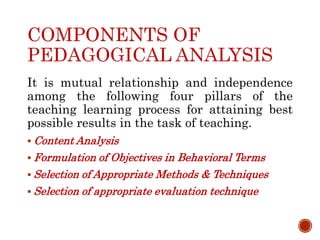
COMPONENTS OF
PEDAGOGICAL ANALYSIS
It is mutual relationship and independence
among the following four pillars of the
teaching learning process for attaining best
possible results in the task of teaching.
 Content Analysis
 Formulation of Objectives in Behavioral Terms
 Selection of Appropriate Methods & Techniques
 Selection of appropriate evaluation technique
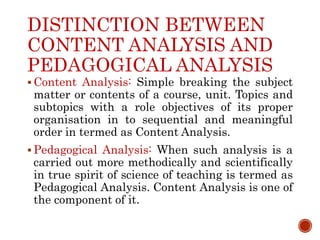
DISTINCTION BETWEEN
CONTENT ANALYSIS AND
PEDAGOGICAL ANALYSIS
 Content Analysis: Simple breaking the subject
matter or contents of a course, unit. Topics and
subtopics with a role objectives of its proper
organisation in to sequential and meaningful
order in termed as Content Analysis.
 Pedagogical Analysis: When such analysis is a
carried out more methodically and scientifically
in true spirit of science of teaching is termed as
Pedagogical Analysis. Content Analysis is one of
the component of it.
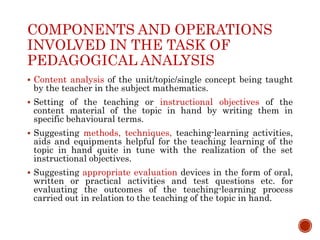
COMPONENTS AND OPERATIONS
INVOLVED IN THE TASK OF
PEDAGOGICAL ANALYSIS
 Content analysis of the unit/topic/single concept being taught
by the teacher in the subject mathematics.
 Setting of the teaching or instructional objectives of the
content material of the topic in hand by writing them in
specific behavioural terms.
 Suggesting methods, techniques, teaching-learning activities,
aids and equipments helpful for the teaching learning of the
topic in hand quite in tune with the realization of the set
instructional objectives.
 Suggesting appropriate evaluation devices in the form of oral,
written or practical activities and test questions etc. for
evaluating the outcomes of the teaching-learning process
carried out in relation to the teaching of the topic in hand.
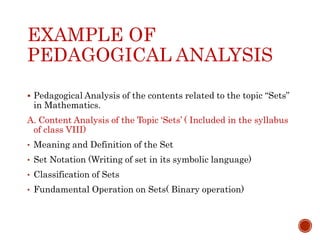
EXAMPLE OF
PEDAGOGICAL ANALYSIS
 Pedagogical Analysis of the contents related to the topic “Sets”
in Mathematics.
A. Content Analysis of the Topic ‘Sets’ ( Included in the syllabus
of class VIII)
• Meaning and Definition of the Set
• Set Notation (Writing of set in its symbolic language)
• Classification of Sets
• Fundamental Operation on Sets( Binary operation)
DETAILED CONTENT
ANALYSIS
1. Meaning and Definition of the term set
I. Examples of collection of objects
II. Examples of well-defined collection of objects
III. Defining the term set
2. Set Notation(Writing a set in its symbolic language)
I. Listing Method or Roster Method
II. Rule Method
DETAILED CONTENT
ANALYSIS
Classification of Sets
I. Empty Sets
II. Single Ton
III. Double Ton
IV. Sets of Number( Natural, Integer, Rational, Irrational and Complex
Numbers)
V. Equal Sets
VI. Equivalent Sets
VII. Sub- Set
VIII. Power Set
IX. Universal Set
X. Complement Set
XI. Disjoint Set
XII. Finite and Infinite Sets
DETAILED CONTENT
ANALYSIS
Fundamental Operation on Sets
 Union of Sets
 Intersection of Sets
 Representation of operation on sets through Ven diagram
B. OBJECTIVES
FORMULATION (LISTING
BEHAVIOURAL
OUTCOMES)
Students of the class VIII after going through the teaching of the
contents to the Topic ”Sets” are expected to demonstrate the
following types of behavioral outcomes
-provide examples of sets from their environmental surroundings
-Distinguish between the collections of objects to be named or not to
be named as sets
-name the two different modes of describing on writing sets
-provide examples of writing a set through rule method
 Distinguish name and provide example of a particular type of set
 Give examples of different type of sets
 Provide definition of the operation ‘ Union’ of the set
C. LISTING TEACHING
METHODS, DEVICES,
ACTIVITIES AND
MATERIAL ETC.
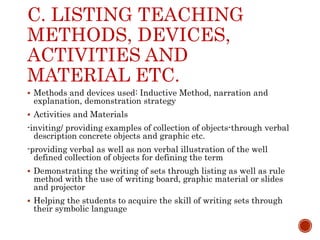
 Methods and devices used: Inductive Method, narration and
explanation, demonstration strategy
 Activities and Materials
-inviting/ providing examples of collection of objects-through verbal
description concrete objects and graphic etc.
-providing verbal as well as non verbal illustration of the well
defined collection of objects for defining the term
 Demonstrating the writing of sets through listing as well as rule
method with the use of writing board, graphic material or slides
and projector
 Helping the students to acquire the skill of writing sets through
their symbolic language
C. LISTING TEACHING
METHODS, DEVICES,
ACTIVITIES AND
MATERIAL ETC.
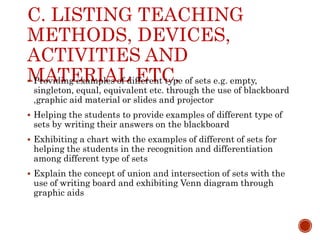
 Providing examples of different type of sets e.g. empty,
singleton, equal, equivalent etc. through the use of blackboard
,graphic aid material or slides and projector
 Helping the students to provide examples of different type of
sets by writing their answers on the blackboard
 Exhibiting a chart with the examples of different of sets for
helping the students in the recognition and differentiation
among different type of sets
 Explain the concept of union and intersection of sets with the
use of writing board and exhibiting Venn diagram through
graphic aids
D. LISTING OF
EVALUATION PROCEDURE
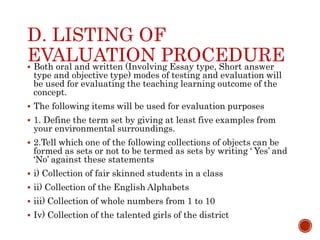
 Both oral and written (Involving Essay type, Short answer
type and objective type) modes of testing and evaluation will
be used for evaluating the teaching learning outcome of the
concept.
 The following items will be used for evaluation purposes
 1. Define the term set by giving at least five examples from
your environmental surroundings.
 2.Tell which one of the following collections of objects can be
formed as sets or not to be termed as sets by writing ‘ Yes’ and
‘No’ against these statements
 i) Collection of fair skinned students in a class
 ii) Collection of the English Alphabets
 iii) Collection of whole numbers from 1 to 10
 Iv) Collection of the talented girls of the district
D. LISTING OF
EVALUATION PROCEDURE
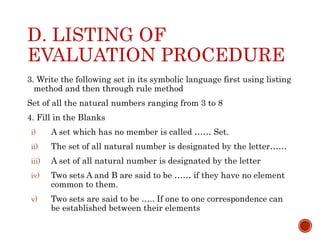
3. Write the following set in its symbolic language first using listing
method and then through rule method
Set of all the natural numbers ranging from 3 to 8
4. Fill in the Blanks
i) A set which has no member is called …… Set.
ii) The set of all natural number is designated by the letter……
iii) A set of all natural number is designated by the letter
iv) Two sets A and B are said to be …… if they have no element
common to them.
v) Two sets are said to be ….. If one to one correspondence can
be established between their elements
D. LISTING OF
EVALUATION PROCEDURE
 5. Give one example each of the following types of sets.
Empty set, Equal Set, Equivalent Set
6. Derive the Union Set and Intersection Sets in the case of the
following pairs of set
i) A={3,5,8} ii) B={2,3,4,5,6} iii) A={a,b,c}
7. Answer the following in one sentence only.
i) What is a set?
ii) What do you mean by the term elements of set?
iii) What is the listing method by the term elements of set?
iv) What do you mean by the term union of Sets?
v) What do you mean by Venn diagram?
THANKS A LOT!
poojawaliakuk@gmail.com

Pedagogical Analysis

  • 1.
    Dr. Pooja Walia AssistantProfessor Department of Education Mizoram University
  • 2.
    OUTLINES OF THE PRESENTATION Meaning of Pedagogical Analysis  Stages of Pedagogical Analysis  Content Analysis  Formulation of Objectives in Behavioral Terms  Selection of Appropriate Methods & Techniques  Selection of appropriate evaluation technique  Example of Pedagogical Analysis
  • 3.
    PEDAGOGICAL ANALYSIS  Pedagogicalanalysis (a composition of two words pedagogy and analysis).  Pedagogy is the art and as well as science of teaching.  Analysis is stands for a process of breaking the things into its smaller parts, elements or constituents .  Pedagogical analysis is a master-plan that includes a detailed analysis of what is to be done by a teacher.
  • 4.
    MEANING OF TERMINOLOGY The word'Pedagogy' comes from the Greek word “paidagogos” in which ' ' means “ ” and 'agog' means “ ” literally translated “ to lead the child”. Pedagogy is a science and art of education specifically instructional theory. It is a master plan that includes a detailed analysis of what is to be done by a teacher.
  • 5.
    WHAT IS PEDAGOGY? Itis science of teaching. It stands for the ways and ,means provided to or utilised by a teacher for managing his task of teaching as smoothly and effectively as possible by involving his least efforts for drawing the maximum possible better teacher outcome.
  • 6.
    COMPONENTS OF PEDAGOGICAL ANALYSIS Itis mutual relationship and independence among the following four pillars of the teaching learning process for attaining best possible results in the task of teaching.  Content Analysis  Formulation of Objectives in Behavioral Terms  Selection of Appropriate Methods & Techniques  Selection of appropriate evaluation technique
  • 7.
    DISTINCTION BETWEEN CONTENT ANALYSISAND PEDAGOGICAL ANALYSIS  Content Analysis: Simple breaking the subject matter or contents of a course, unit. Topics and subtopics with a role objectives of its proper organisation in to sequential and meaningful order in termed as Content Analysis.  Pedagogical Analysis: When such analysis is a carried out more methodically and scientifically in true spirit of science of teaching is termed as Pedagogical Analysis. Content Analysis is one of the component of it.
  • 8.
    COMPONENTS AND OPERATIONS INVOLVEDIN THE TASK OF PEDAGOGICAL ANALYSIS  Content analysis of the unit/topic/single concept being taught by the teacher in the subject mathematics.  Setting of the teaching or instructional objectives of the content material of the topic in hand by writing them in specific behavioural terms.  Suggesting methods, techniques, teaching-learning activities, aids and equipments helpful for the teaching learning of the topic in hand quite in tune with the realization of the set instructional objectives.  Suggesting appropriate evaluation devices in the form of oral, written or practical activities and test questions etc. for evaluating the outcomes of the teaching-learning process carried out in relation to the teaching of the topic in hand.
  • 9.
    EXAMPLE OF PEDAGOGICAL ANALYSIS Pedagogical Analysis of the contents related to the topic “Sets” in Mathematics. A. Content Analysis of the Topic ‘Sets’ ( Included in the syllabus of class VIII) • Meaning and Definition of the Set • Set Notation (Writing of set in its symbolic language) • Classification of Sets • Fundamental Operation on Sets( Binary operation)
  • 10.
    DETAILED CONTENT ANALYSIS 1. Meaningand Definition of the term set I. Examples of collection of objects II. Examples of well-defined collection of objects III. Defining the term set 2. Set Notation(Writing a set in its symbolic language) I. Listing Method or Roster Method II. Rule Method
  • 11.
    DETAILED CONTENT ANALYSIS Classification ofSets I. Empty Sets II. Single Ton III. Double Ton IV. Sets of Number( Natural, Integer, Rational, Irrational and Complex Numbers) V. Equal Sets VI. Equivalent Sets VII. Sub- Set VIII. Power Set IX. Universal Set X. Complement Set XI. Disjoint Set XII. Finite and Infinite Sets
  • 12.
    DETAILED CONTENT ANALYSIS Fundamental Operationon Sets  Union of Sets  Intersection of Sets  Representation of operation on sets through Ven diagram
  • 13.
    B. OBJECTIVES FORMULATION (LISTING BEHAVIOURAL OUTCOMES) Studentsof the class VIII after going through the teaching of the contents to the Topic ”Sets” are expected to demonstrate the following types of behavioral outcomes -provide examples of sets from their environmental surroundings -Distinguish between the collections of objects to be named or not to be named as sets -name the two different modes of describing on writing sets -provide examples of writing a set through rule method  Distinguish name and provide example of a particular type of set  Give examples of different type of sets  Provide definition of the operation ‘ Union’ of the set  Provide definition of the operation ‘ Union’ of the set
  • 14.
    C. LISTING TEACHING METHODS,DEVICES, ACTIVITIES AND MATERIAL ETC.  Methods and devices used: Inductive Method, narration and explanation, demonstration strategy  Activities and Materials -inviting/ providing examples of collection of objects-through verbal description concrete objects and graphic etc. -providing verbal as well as non verbal illustration of the well defined collection of objects for defining the term  Demonstrating the writing of sets through listing as well as rule method with the use of writing board, graphic material or slides and projector  Helping the students to acquire the skill of writing sets through their symbolic language
  • 15.
    C. LISTING TEACHING METHODS,DEVICES, ACTIVITIES AND MATERIAL ETC.  Providing examples of different type of sets e.g. empty, singleton, equal, equivalent etc. through the use of blackboard ,graphic aid material or slides and projector  Helping the students to provide examples of different type of sets by writing their answers on the blackboard  Exhibiting a chart with the examples of different of sets for helping the students in the recognition and differentiation among different type of sets  Explain the concept of union and intersection of sets with the use of writing board and exhibiting Venn diagram through graphic aids
  • 16.
    D. LISTING OF EVALUATIONPROCEDURE  Both oral and written (Involving Essay type, Short answer type and objective type) modes of testing and evaluation will be used for evaluating the teaching learning outcome of the concept.  The following items will be used for evaluation purposes  1. Define the term set by giving at least five examples from your environmental surroundings.  2.Tell which one of the following collections of objects can be formed as sets or not to be termed as sets by writing ‘ Yes’ and ‘No’ against these statements  i) Collection of fair skinned students in a class  ii) Collection of the English Alphabets  iii) Collection of whole numbers from 1 to 10  Iv) Collection of the talented girls of the district
  • 17.
    D. LISTING OF EVALUATIONPROCEDURE 3. Write the following set in its symbolic language first using listing method and then through rule method Set of all the natural numbers ranging from 3 to 8 4. Fill in the Blanks i) A set which has no member is called …… Set. ii) The set of all natural number is designated by the letter…… iii) A set of all natural number is designated by the letter iv) Two sets A and B are said to be …… if they have no element common to them. v) Two sets are said to be ….. If one to one correspondence can be established between their elements
  • 18.
    D. LISTING OF EVALUATIONPROCEDURE  5. Give one example each of the following types of sets. Empty set, Equal Set, Equivalent Set 6. Derive the Union Set and Intersection Sets in the case of the following pairs of set i) A={3,5,8} ii) B={2,3,4,5,6} iii) A={a,b,c} 7. Answer the following in one sentence only. i) What is a set? ii) What do you mean by the term elements of set? iii) What is the listing method by the term elements of set? iv) What do you mean by the term union of Sets? v) What do you mean by Venn diagram?
  • 19.