Interdisciplinary
Approaches to Education
Shree Prasad Devkota
Mphil Candidate (2013)
Development Study
School of Education
Kathmandu University
Scopes
1. Related Terminology
2. Concept
3. Interdisciplinary approach in Nepalese curriculum
4. Perspectives in Interdisciplinary Learning
5. Significance learning
6. Strengths and Weakness of Interdisciplinary Education
Related Terminology
• A disciplinary or holistic courses attempt to gain
comprehensive picture without specific
attention to disciplines or professional fields.
• Multi-disciplinary: a term used to study different
disciplines or subject separately to understand
phenomena
Interdisciplinary
• Science becoming more interdisciplinary because many
problems, challenges facing society are so complex that
they cannot be answered by a single discipline.
• It integrates information, perspectives, concepts or
theories from two or more disciplines of specialized
knowledge to advance fundamental understanding or
to solve problems whose solutions are beyond the
scope of a single discipline (Johnes, Aug 2012)
Interdisciplinary
• Two or more disciplines are brought together,
preferably in such a way that the disciplines interact
with one another and have some effect on one
another's perspectives (Rowntree, 1982, p. 135)
• Integration of multidisciplinary knowledge across a
central program (Ivanistskyaya, Clark, Montgomery and
Primeau, 2002)
• Involvement of several different professional areas
(Ivanistskyaya, Clark, Montgomery and Primeau, 2002)
Interdisciplinary
• It is understanding as the capacity to integrate
knowledge and modes of thinking in two or
more disciplines or established areas of
expertise to produce a cognitive advancement
– such as explaining a phenomenon, solving a
problem, or creating a product (Mansilla &
Duraising, 2007 Cited in Golding, 2009)
Social marketing demands
Interdisciplinary Approach
1. Commercial marketing
2. Social anthropology
3. Behavioral psychology
4. Communication theory
5. Education
Medical Knowledge
Psychological understanding
Sociological knowledge
Communication Skill
Research knowledge
Management Skill
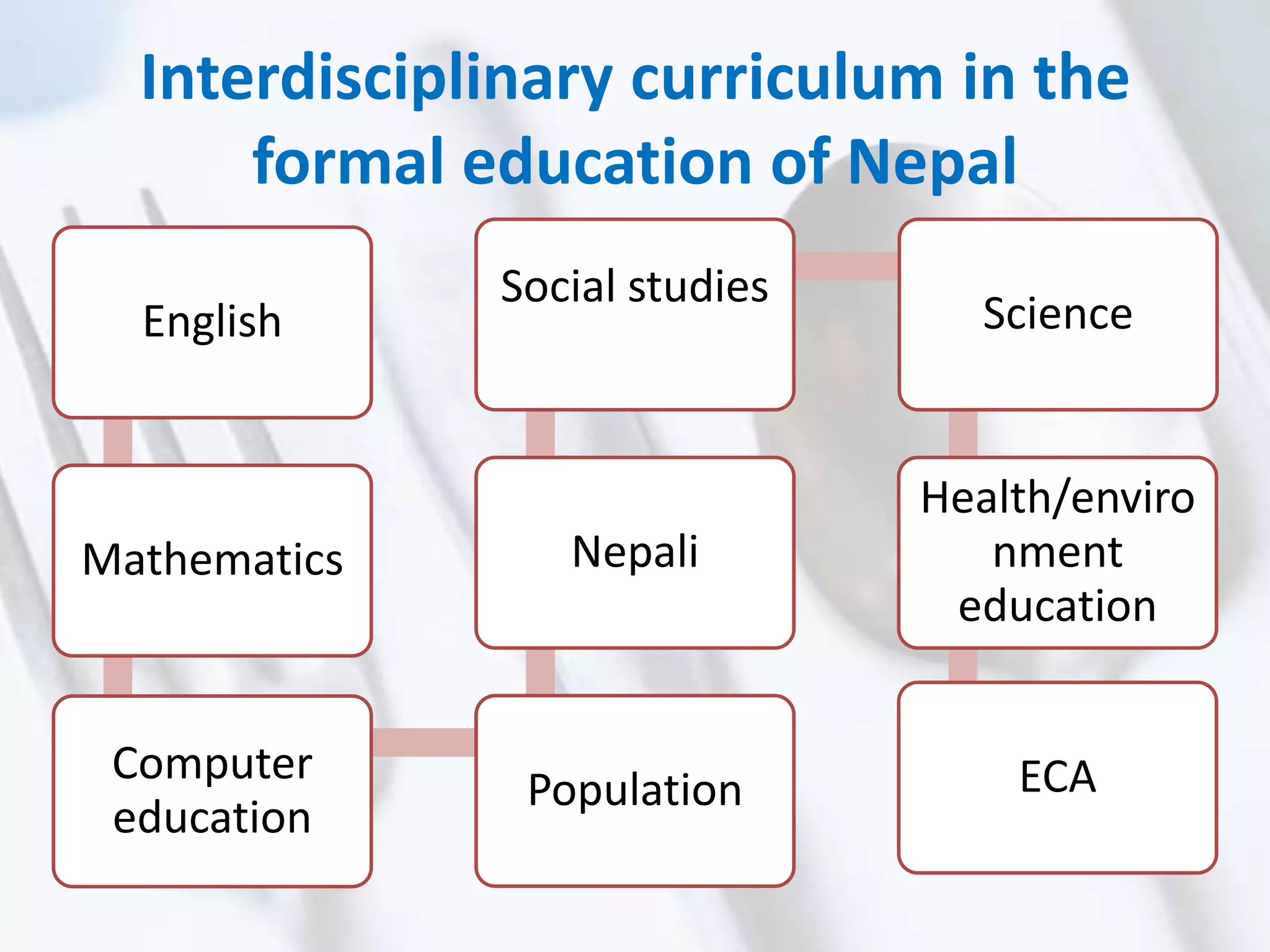
Interdisciplinary curriculum in the
formal education of Nepal
English
Mathematics
Computer
education
Population
Nepali
Social studies
Science
Health/enviro
nment
education
ECA
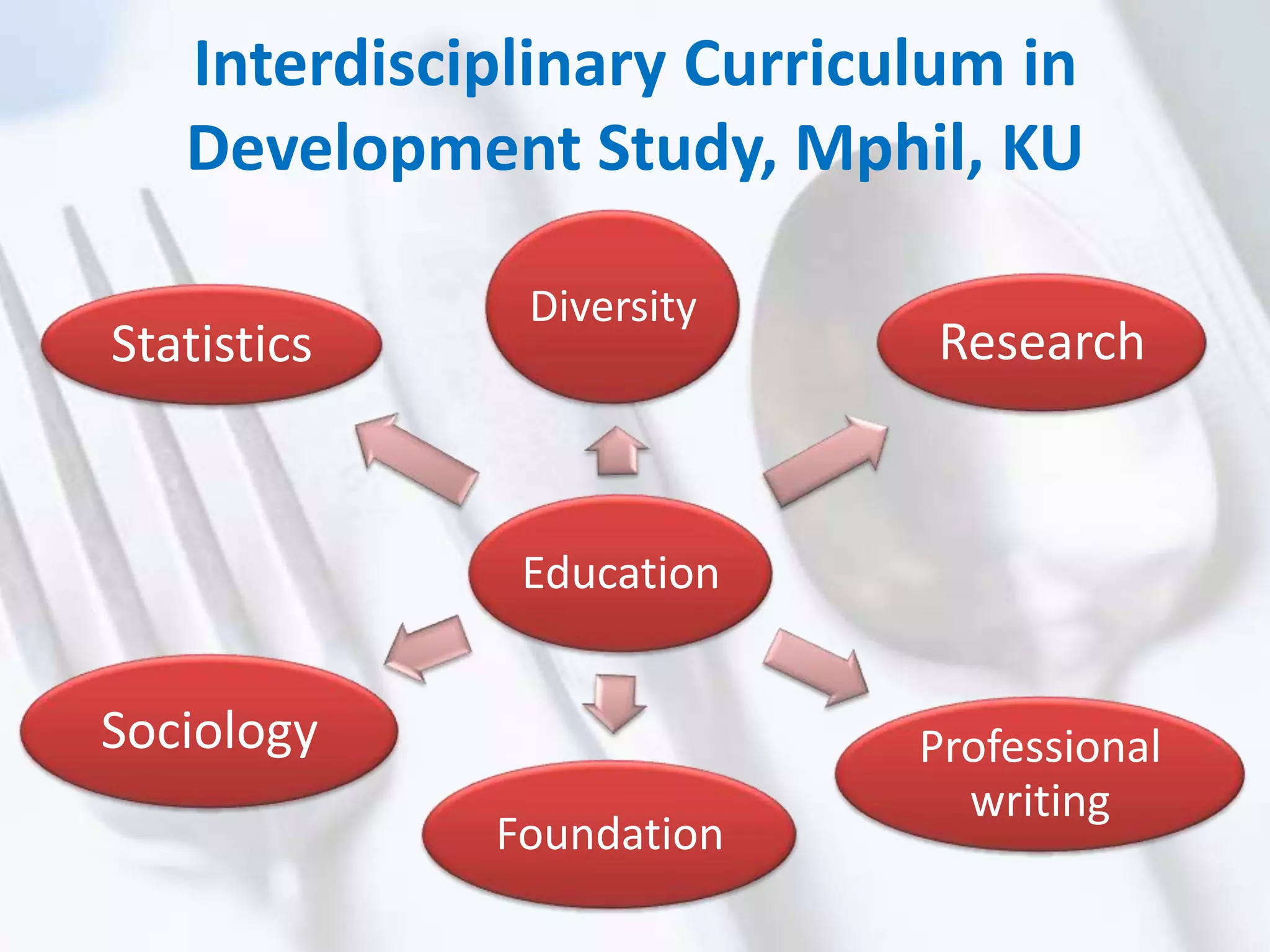
Interdisciplinary Curriculum in
Development Study, Mphil, KU
Education
Sociology Professional
writing
ResearchStatistics
Foundation
Diversity
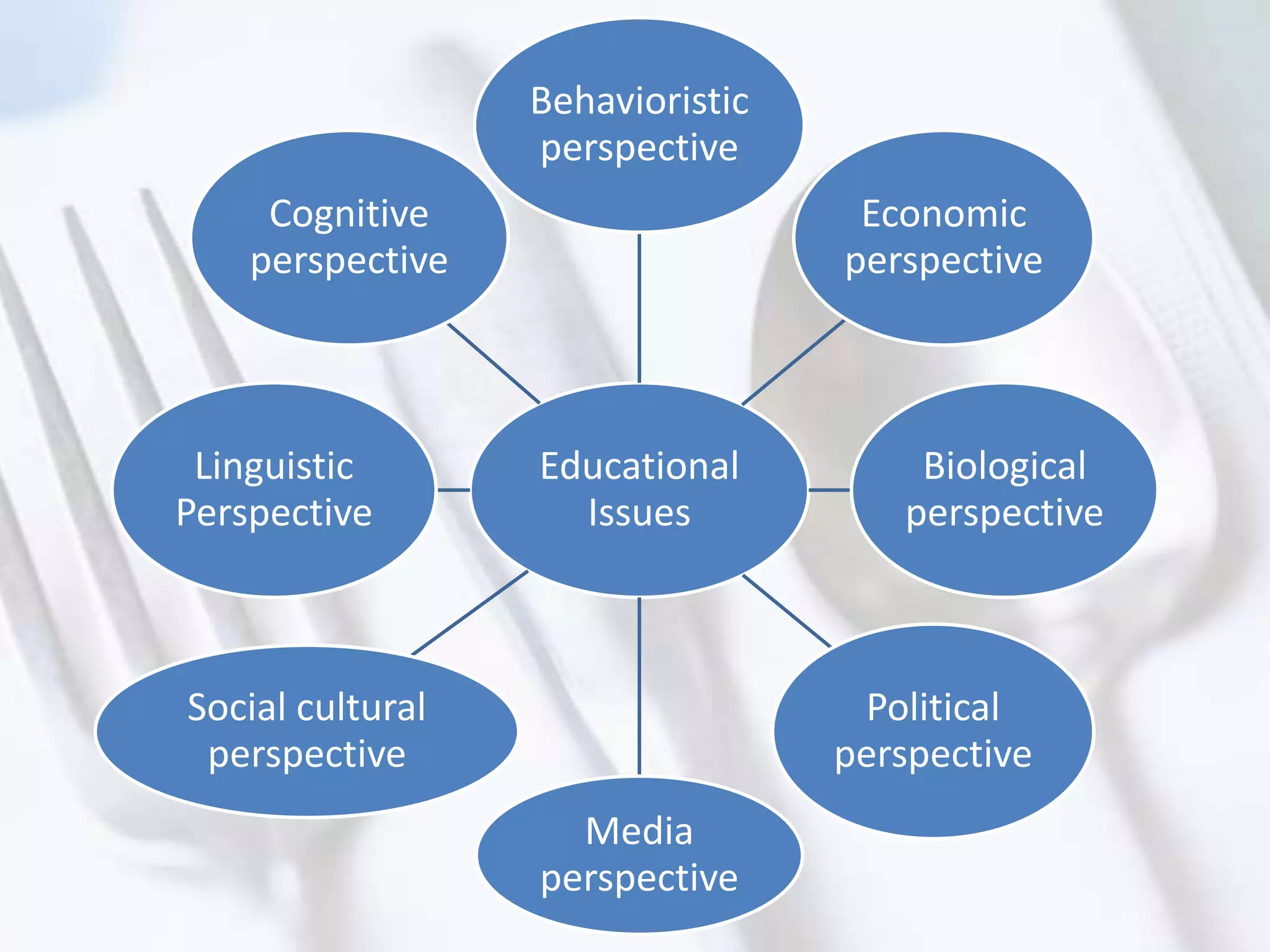
Educational
Issues
Behavioristic
perspective
Economic
perspective
Biological
perspective
Political
perspective
Media
perspective
Social cultural
perspective
Linguistic
Perspective
Cognitive
perspective
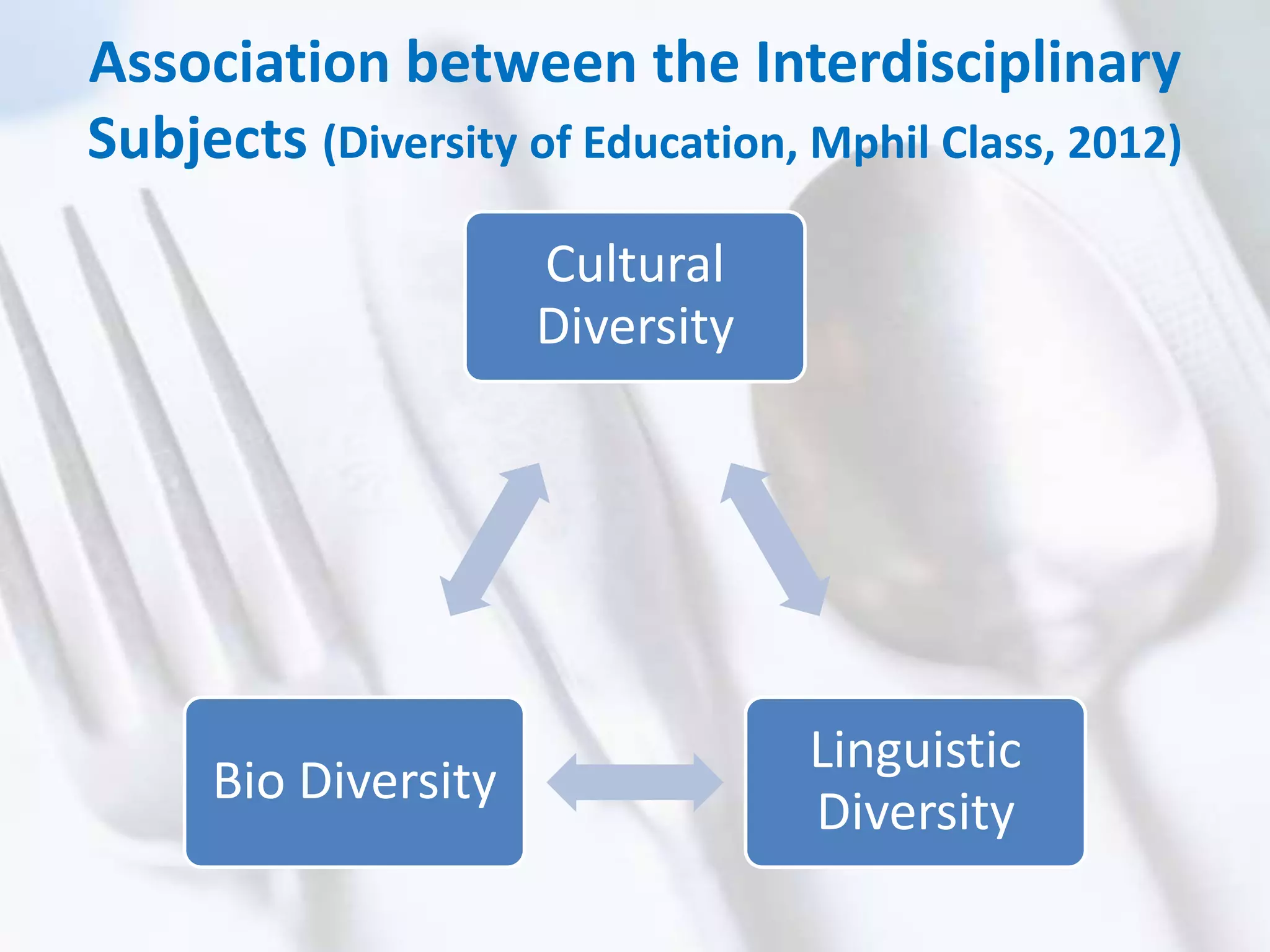
Association between the Interdisciplinary
Subjects (Diversity of Education, Mphil Class, 2012)
Cultural
Diversity
Linguistic
Diversity
Bio Diversity
Perspectives in Interdisciplinary
Learning
1. It facilitates the development of structural
knowledge: an understanding of higher-order
relationships and organizing principles
2. Encourage to perceive the connections between
seemingly unrelated domains, thereby facilitating
a personalized process of organizing knowledge.
3. Assimilate newly integrated concepts with prior
knowledge and experience
Interdisciplinary Promotes Significant
Learning
1. Foundational Knowledge acquiring information and
understanding ideas
2. Application – acquiring an understanding of how and when to
use skills
3. Integration – the capacity to connect ideas
4. Human Dimension - recognition of the social and personal
implications of issues
5. Learning How-to-Learn – obtaining insights into the process of
learning
To apply interdisciplinary approach
one needed to:1. Understand several important disciplinary perspectives are relevant to
every environmental decision
2. Understand the perspective of each relevant discipline
3. Judge how important each perspective is for the issue at hand
4. Evaluate the evidence or reasons supporting each of the perspectives
5. Balance, weigh-up or accommodate the pressures from the different
perspectives in order to reach a reasonable and creative decision or
outcome;
6. Make a case for why this decision or outcome is better than
alternatives.
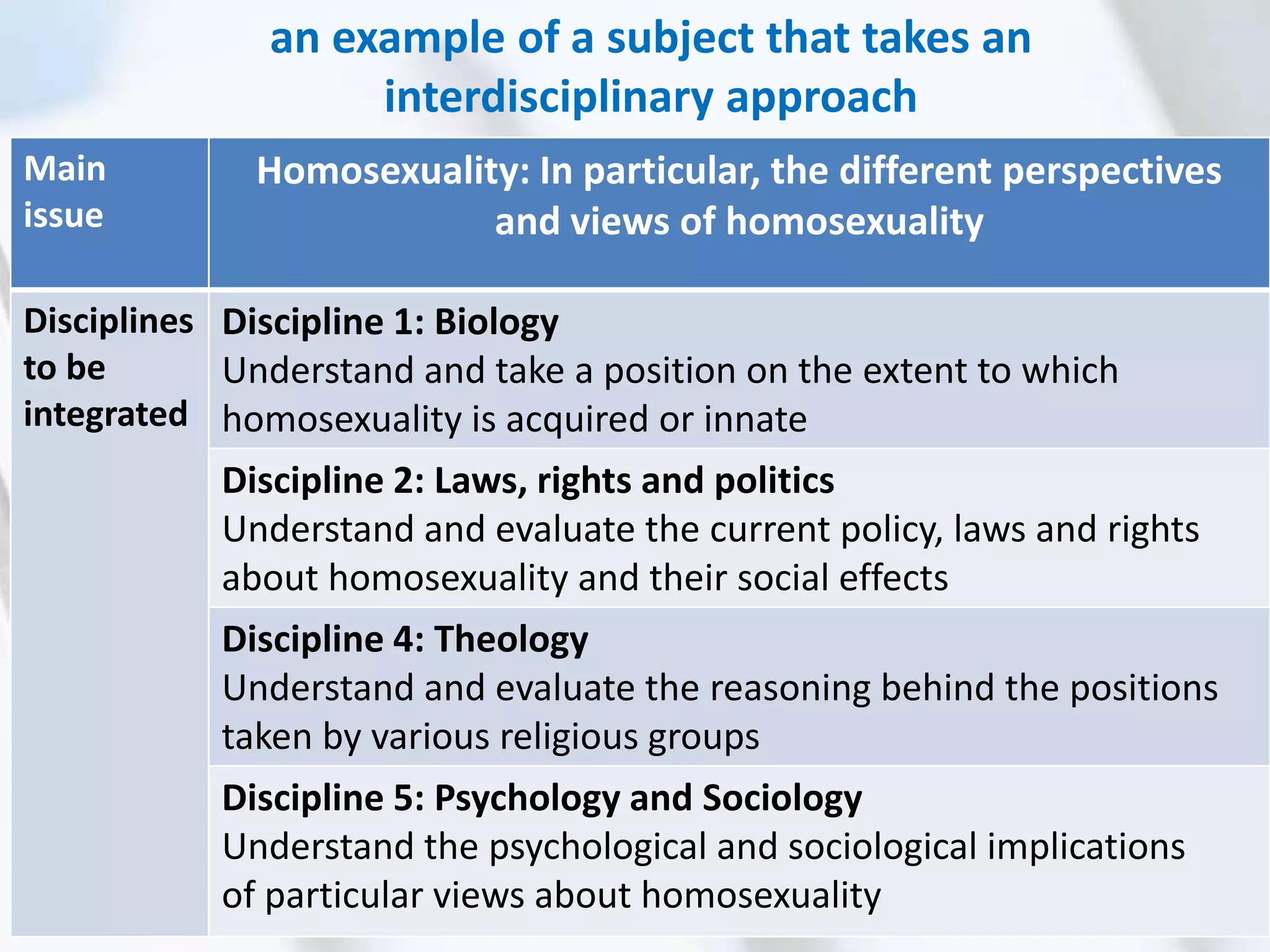
an example of a subject that takes an
interdisciplinary approach
Main
issue
Homosexuality: In particular, the different perspectives
and views of homosexuality
Disciplines
to be
integrated
Discipline 1: Biology
Understand and take a position on the extent to which
homosexuality is acquired or innate
Discipline 2: Laws, rights and politics
Understand and evaluate the current policy, laws and rights
about homosexuality and their social effects
Discipline 4: Theology
Understand and evaluate the reasoning behind the positions
taken by various religious groups
Discipline 5: Psychology and Sociology
Understand the psychological and sociological implications
of particular views about homosexuality
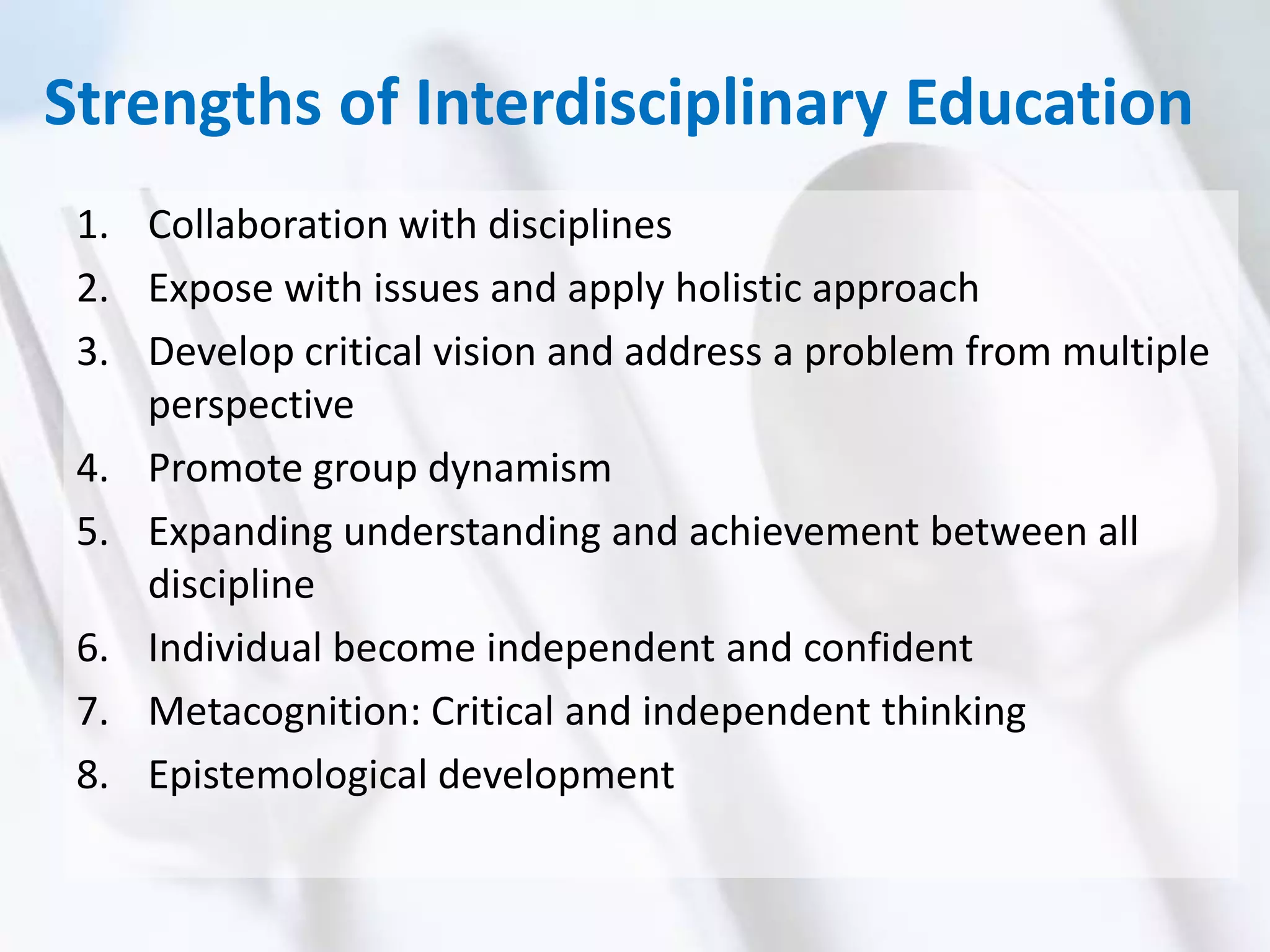
Strengths of Interdisciplinary Education
1. Collaboration with disciplines
2. Expose with issues and apply holistic approach
3. Develop critical vision and address a problem from multiple
perspective
4. Promote group dynamism
5. Expanding understanding and achievement between all
discipline
6. Individual become independent and confident
7. Metacognition: Critical and independent thinking
8. Epistemological development
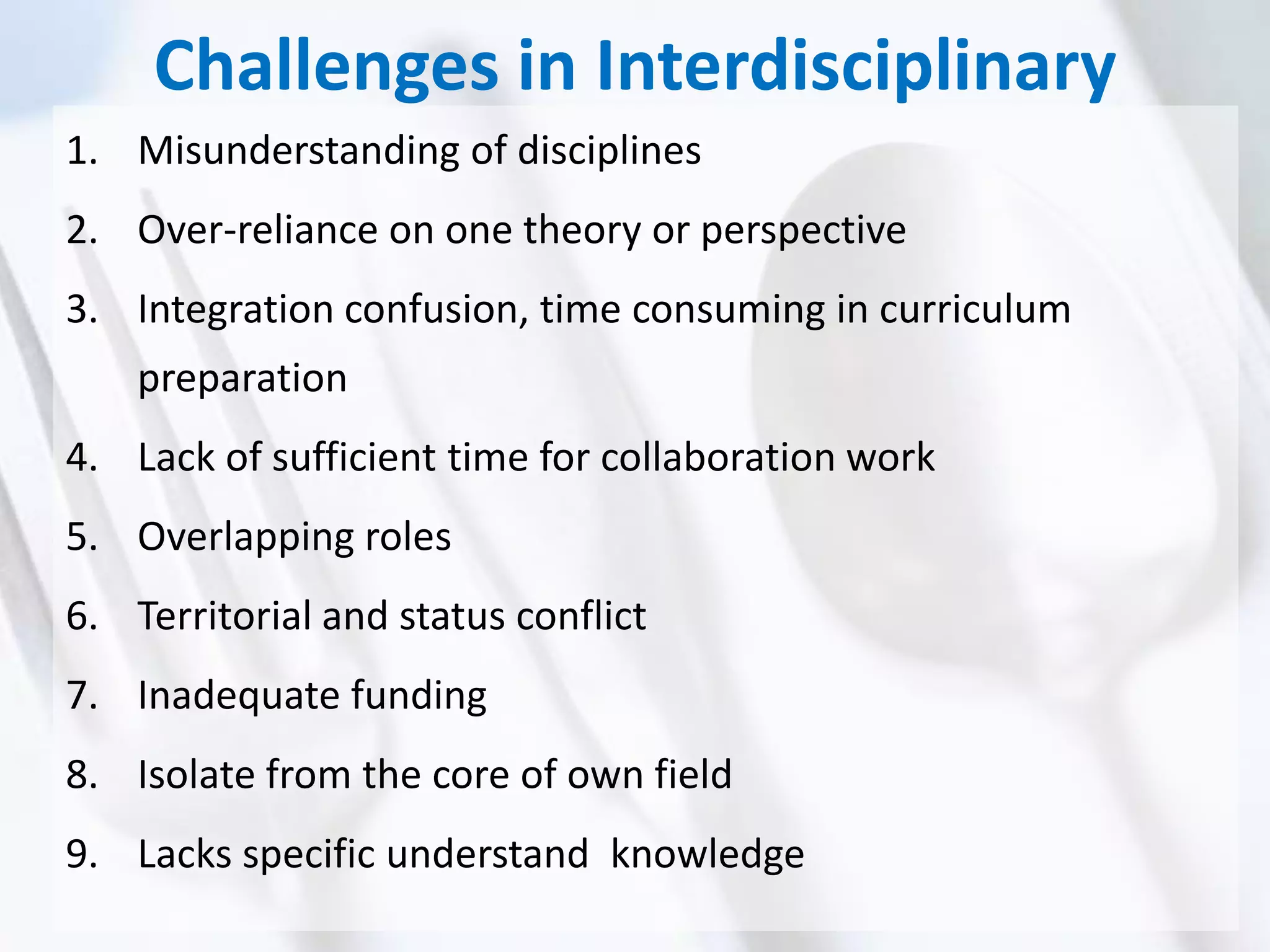
Challenges in Interdisciplinary
1. Misunderstanding of disciplines
2. Over-reliance on one theory or perspective
3. Integration confusion, time consuming in curriculum
preparation
4. Lack of sufficient time for collaboration work
5. Overlapping roles
6. Territorial and status conflict
7. Inadequate funding
8. Isolate from the core of own field
9. Lacks specific understand knowledge
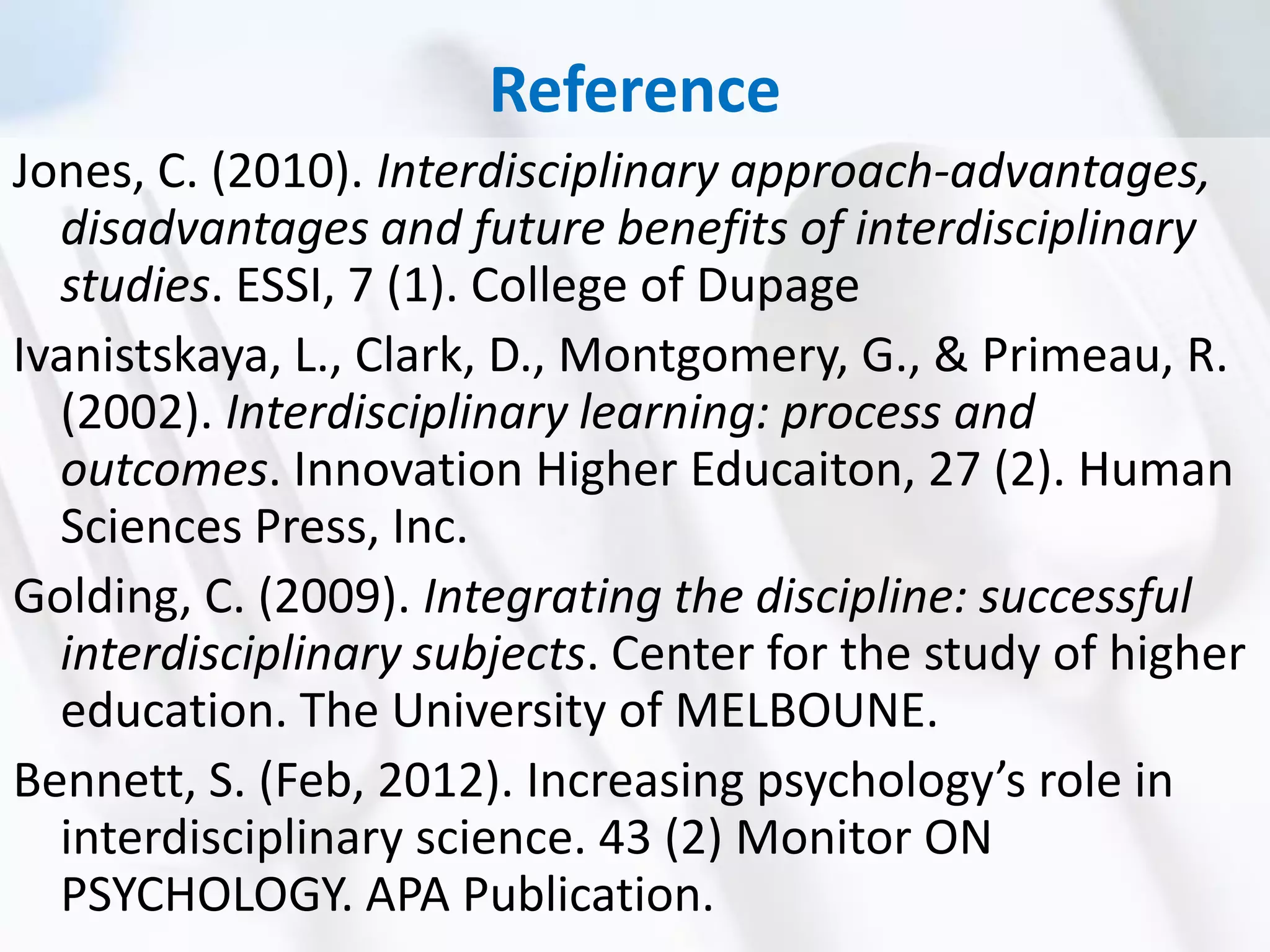
Reference
Jones, C. (2010). Interdisciplinary approach-advantages,
disadvantages and future benefits of interdisciplinary
studies. ESSI, 7 (1). College of Dupage
Ivanistskaya, L., Clark, D., Montgomery, G., & Primeau, R.
(2002). Interdisciplinary learning: process and
outcomes. Innovation Higher Educaiton, 27 (2). Human
Sciences Press, Inc.
Golding, C. (2009). Integrating the discipline: successful
interdisciplinary subjects. Center for the study of higher
education. The University of MELBOUNE.
Bennett, S. (Feb, 2012). Increasing psychology’s role in
interdisciplinary science. 43 (2) Monitor ON
PSYCHOLOGY. APA Publication.

Diversity presentation on interdisciplinary education

  • 1.
    Interdisciplinary Approaches to Education ShreePrasad Devkota Mphil Candidate (2013) Development Study School of Education Kathmandu University
  • 2.
    Scopes 1. Related Terminology 2.Concept 3. Interdisciplinary approach in Nepalese curriculum 4. Perspectives in Interdisciplinary Learning 5. Significance learning 6. Strengths and Weakness of Interdisciplinary Education
  • 3.
    Related Terminology • Adisciplinary or holistic courses attempt to gain comprehensive picture without specific attention to disciplines or professional fields. • Multi-disciplinary: a term used to study different disciplines or subject separately to understand phenomena
  • 4.
    Interdisciplinary • Science becomingmore interdisciplinary because many problems, challenges facing society are so complex that they cannot be answered by a single discipline. • It integrates information, perspectives, concepts or theories from two or more disciplines of specialized knowledge to advance fundamental understanding or to solve problems whose solutions are beyond the scope of a single discipline (Johnes, Aug 2012)
  • 5.
    Interdisciplinary • Two ormore disciplines are brought together, preferably in such a way that the disciplines interact with one another and have some effect on one another's perspectives (Rowntree, 1982, p. 135) • Integration of multidisciplinary knowledge across a central program (Ivanistskyaya, Clark, Montgomery and Primeau, 2002) • Involvement of several different professional areas (Ivanistskyaya, Clark, Montgomery and Primeau, 2002)
  • 6.
    Interdisciplinary • It isunderstanding as the capacity to integrate knowledge and modes of thinking in two or more disciplines or established areas of expertise to produce a cognitive advancement – such as explaining a phenomenon, solving a problem, or creating a product (Mansilla & Duraising, 2007 Cited in Golding, 2009)
  • 7.
    Social marketing demands InterdisciplinaryApproach 1. Commercial marketing 2. Social anthropology 3. Behavioral psychology 4. Communication theory 5. Education
  • 8.
    Medical Knowledge Psychological understanding Sociologicalknowledge Communication Skill Research knowledge Management Skill
  • 9.
    Interdisciplinary curriculum inthe formal education of Nepal English Mathematics Computer education Population Nepali Social studies Science Health/enviro nment education ECA
  • 10.
    Interdisciplinary Curriculum in DevelopmentStudy, Mphil, KU Education Sociology Professional writing ResearchStatistics Foundation Diversity
  • 11.
  • 12.
    Association between theInterdisciplinary Subjects (Diversity of Education, Mphil Class, 2012) Cultural Diversity Linguistic Diversity Bio Diversity
  • 13.
    Perspectives in Interdisciplinary Learning 1.It facilitates the development of structural knowledge: an understanding of higher-order relationships and organizing principles 2. Encourage to perceive the connections between seemingly unrelated domains, thereby facilitating a personalized process of organizing knowledge. 3. Assimilate newly integrated concepts with prior knowledge and experience
  • 14.
    Interdisciplinary Promotes Significant Learning 1.Foundational Knowledge acquiring information and understanding ideas 2. Application – acquiring an understanding of how and when to use skills 3. Integration – the capacity to connect ideas 4. Human Dimension - recognition of the social and personal implications of issues 5. Learning How-to-Learn – obtaining insights into the process of learning
  • 15.
    To apply interdisciplinaryapproach one needed to:1. Understand several important disciplinary perspectives are relevant to every environmental decision 2. Understand the perspective of each relevant discipline 3. Judge how important each perspective is for the issue at hand 4. Evaluate the evidence or reasons supporting each of the perspectives 5. Balance, weigh-up or accommodate the pressures from the different perspectives in order to reach a reasonable and creative decision or outcome; 6. Make a case for why this decision or outcome is better than alternatives.
  • 16.
    an example ofa subject that takes an interdisciplinary approach Main issue Homosexuality: In particular, the different perspectives and views of homosexuality Disciplines to be integrated Discipline 1: Biology Understand and take a position on the extent to which homosexuality is acquired or innate Discipline 2: Laws, rights and politics Understand and evaluate the current policy, laws and rights about homosexuality and their social effects Discipline 4: Theology Understand and evaluate the reasoning behind the positions taken by various religious groups Discipline 5: Psychology and Sociology Understand the psychological and sociological implications of particular views about homosexuality
  • 17.
    Strengths of InterdisciplinaryEducation 1. Collaboration with disciplines 2. Expose with issues and apply holistic approach 3. Develop critical vision and address a problem from multiple perspective 4. Promote group dynamism 5. Expanding understanding and achievement between all discipline 6. Individual become independent and confident 7. Metacognition: Critical and independent thinking 8. Epistemological development
  • 18.
    Challenges in Interdisciplinary 1.Misunderstanding of disciplines 2. Over-reliance on one theory or perspective 3. Integration confusion, time consuming in curriculum preparation 4. Lack of sufficient time for collaboration work 5. Overlapping roles 6. Territorial and status conflict 7. Inadequate funding 8. Isolate from the core of own field 9. Lacks specific understand knowledge
  • 19.
    Reference Jones, C. (2010).Interdisciplinary approach-advantages, disadvantages and future benefits of interdisciplinary studies. ESSI, 7 (1). College of Dupage Ivanistskaya, L., Clark, D., Montgomery, G., & Primeau, R. (2002). Interdisciplinary learning: process and outcomes. Innovation Higher Educaiton, 27 (2). Human Sciences Press, Inc. Golding, C. (2009). Integrating the discipline: successful interdisciplinary subjects. Center for the study of higher education. The University of MELBOUNE. Bennett, S. (Feb, 2012). Increasing psychology’s role in interdisciplinary science. 43 (2) Monitor ON PSYCHOLOGY. APA Publication.