Dr. Pooja Walia
Assistant Professor
Department of Education, Mizoram University, Aizawl
The first MOOCs emerged from the open educational
resources (OER) movement, which was sparked by MIT
Open Course Ware project. The term MOOC was coined
in 2008 by Dave Cormier of the University of Prince
Edward Island in response to a course called
Connectivism and Connective Knowledge (also known as
CCK08). CCK08, which was led by George Siemens of
Athabasca University and Stephen Downes of the
National Research Council, consisted of 25 tuition-
paying students in Extended Education at the
University of Manitoba, as well as over 2200 online
students from the general public who paid nothing.
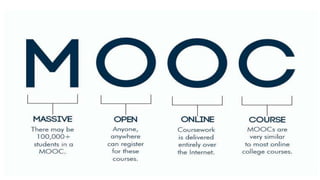
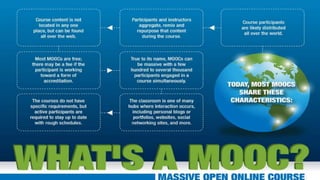
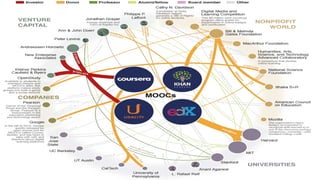
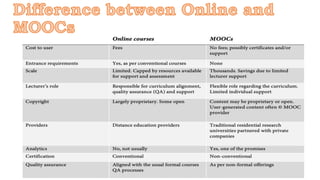
Massive open online courses (MOOCs) are a flexible and
open form of self-directed, online learning designed for mass
participation. There are no fees or entry requirements and
no formal academic credit is available. While completion
rates are low (on average ten per cent1) due to varying
motivations for enrolling in a MOOC, absolute numbers of
participants who complete are usually high.
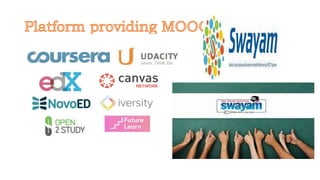
While access to the course material is free, MOOC platform
providers often offer certificates of completion at a cost.
MOOC platforms provide institutions with cloud-based
hosting environments for delivering courses, offering scale
and functionality while the institution provides the course
material and reputational value.
MOOC's can be categorisd in to two
Early MOOCs ( ): Open-access features,
such as open licensing of content, structure and
learning goals, to promote the reuse and remixing
of resources.
Later MOOCs ( ): closed licenses for their
course materials while maintaining free access for
students.
cMOOCs are based on principles from
connectivist pedagogy indicating that material
should be remixable, re-purposable, and feeding
forward.
cMOOC instructional design approaches attempt
to connect learners to each other to answer
questions or collaborate on joint projects. This
may include emphasizing collaborative
development of the MOOC.
xMOOCs have a much more traditional course structure.
They are characterized by a specified aim of completing the
course obtaining certain knowledge certification of the
subject matter. They are presented typically with a clearly
specified syllabus of recorded lectures and self-test
problems.
However, some providers require paid subscriptions for
acquiring graded materials and certificates. They employ
elements of the original MOOC, but are, in some effect,
branded IT platforms that offer content distribution
partnerships to institutions.
• Improving access to higher education: MOOCs may be regarded as
contributing to the democratisation of HE, not only locally or regionally
but globally as well. Students are able to access complete courses offered
by universities all over the world.
• Providing an affordable alternative to formal education: MOOCs are
for large numbers of participants, can be accessed by anyone anywhere
as long as they have an Internet connection, are open to everyone
without entry qualifications and offer a full/complete course experience
online for free
• Sustainable development goals: MOOCs can be seen as a form of open
education offered for free through online platforms. The (initial)
philosophy of MOOCs is to open up quality higher education to a wider
audience. As such, MOOCs are an important tool to achieve goal 4 of the
2030 Agenda for Sustainable Development
• Offers a flexible learning schedule: Certain lectures,
videos, and tests through MOOCs can be accessed at any
time compared to scheduled class times. By allowing
learners to complete their coursework in their own time,
this provides flexibility to learners based on their own
personal schedules.
• Online collaboration: The learning environments of
MOOCs make it easier for learners across the globe to
work together on common goals. Instead of having to
physically meet one another, online collaboration creates
partnerships among learners.
email ID: poojawaliakuk@gmail.com