
ModSimWorld Montreal, Quebec June 8-9, 2009 A Modelling Framework: Supporting Evidence-Based Decisions
Main Messages Models are needed to understand and predict the behavior of complex systems.  Models are needed to fulfill an agency’s  mandate and support its core business. Inadequate or incorrect use of models wastes resources, results in errors, and exposes an agency to liability.   Models should be  used   wisely
Outline I.  Underlying Concepts Scientific underpinning II. Decision Guide Decision making III. Glossary Common understanding
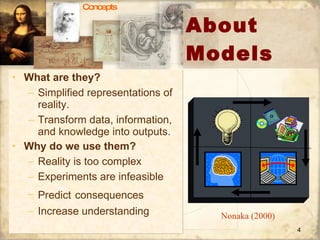
About Models What are they?   Simplified representations of reality. Transform data, information, and knowledge into outputs. Why do we use them? Reality is too complex Experiments are infeasible  Predict   consequences Increase understanding Nonaka (2000) Concepts ..
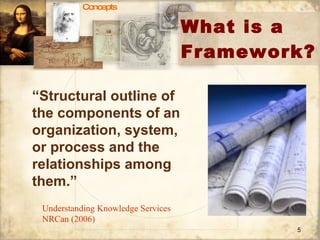
What is a Framework? “ Structural outline of the components of an organization, system, or process and the relationships among them.” Understanding Knowledge Services NRCan (2006) Concepts
Framework Objectives Support needs-driven  and  science-driven analysis. Promote dialogue among modelers, managers, & users. Reduce wasted time, effort, & money. Provide a basis for planning and action.  Document and justify decisions.   Concepts
Framework Design Reflect modelling, management, and user perspectives. Balance efficiency and effectiveness with cost and effort. Applicable to both demand and supply approaches to modelling. Applicable to both logical and computational models Concepts
Different Perspectives Concepts What developers proposed What managers funded What stakeholders wanted What users needed
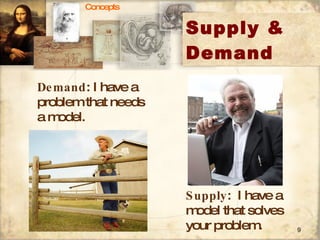
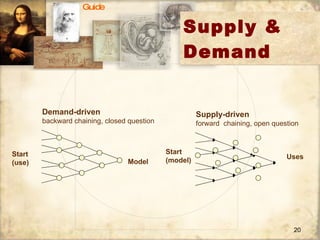
Supply & Demand Concepts Supply :  I have a model that solves your problem. Demand : I have a problem that needs a model.
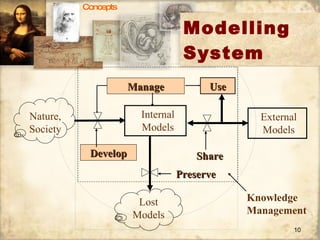
Modelling System Concepts External Models Develop Nature, Society Internal Models Use Manage Lost Models Share Preserve Knowledge Management
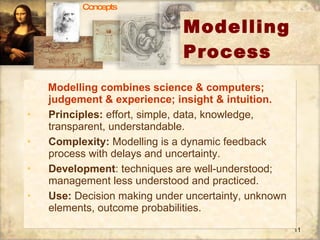
Modelling Process Modelling combines science & computers; judgement & experience; insight & intuition. Principles:  effort, simple, data, knowledge, transparent, understandable. Complexity:  Modelling is a dynamic feedback process with delays and uncertainty. Development : techniques are well-understood; management less understood and practiced. Use:  Decision making under uncertainty, unknown elements, outcome probabilities. Concepts
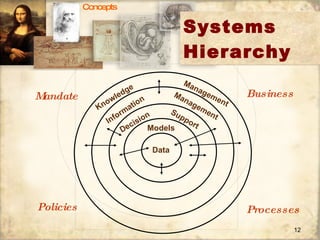
Systems Hierarchy Concepts Data Models Decision  Support Information Knowledge Management Management Mandate Business Policies Processes
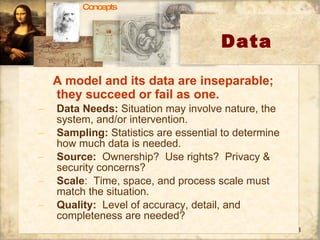
Data   A model and its data are inseparable; they succeed or fail as one. Data Needs:  Situation may involve nature, the system, and/or intervention. Sampling:  Statistics are essential to determine how much data is needed. Source:   Ownership?  Use rights?  Privacy & security concerns? Scale :  Time, space, and process scale must match the situation. Quality:   Level of accuracy, detail, and completeness are needed? Concepts
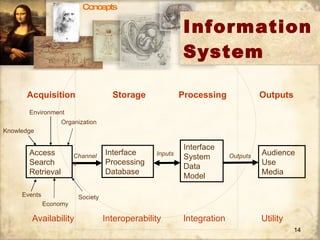
Information System Audience  Use Media Concepts Outputs Acquisition Processing Storage Knowledge Organization Society Environment Events Economy Channels Access Search Retrieval Interface Processing Database Inputs Interface System Data Model Outputs Interoperability Integration Availability Utility
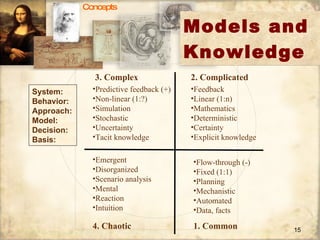
Models and Knowledge   System: Behavior: Approach: Model: Decision: Basis: Concepts 1. Common  Flow-through (-) Fixed (1:1) Planning Mechanistic Automated Data, facts 2. Complicated  Feedback Linear (1:n) Mathematics Deterministic Certainty Explicit knowledge 3. Complex  Predictive feedback (+) Non-linear (1:?) Simulation Stochastic Uncertainty  Tacit knowledge 4. Chaotic  Emergent Disorganized Scenario analysis Mental Reaction Intuition
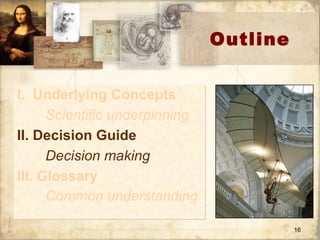
Outline I.  Underlying Concepts Scientific underpinning II. Decision Guide Decision making III. Glossary Common understanding
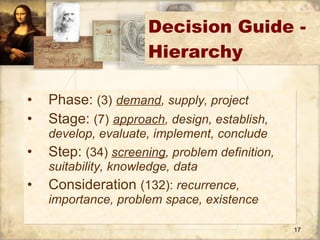
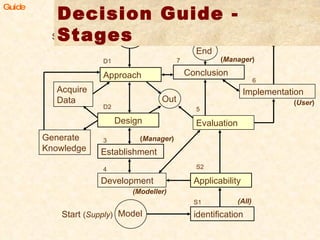
Decision Guide - Hierarchy Phase:  (3)   demand , supply, project Stage:  (7)   approach , design, establish, develop, evaluate, implement, conclude Step:  (34)  screening , problem definition, suitability, knowledge, data Consideration  (132):  recurrence, importance, problem space, existence
Decision Guide - Stages Guide Design Acquire Data Generate Knowledge Approach Out Evaluation Issue Start:  ( Demand ) Implementation Outputs Conclusion End Development (Modeller) ( Manager ) ( User ) D1 D2 3 Applicability S2 Model Start   ( Supply ) identification S1 5 7 6 Establishment 4 ( Manager ) (All)
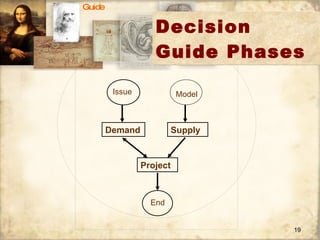
Decision Guide Phases Guide Issue Model Demand Supply Project End
Supply & Demand Guide Start (use) Demand-driven backward chaining, closed question Model Supply-driven forward  chaining, open question Start (model) Uses
Demand Phase Guide Issue D1 .  Approach D2 .  Design Development Acquire Data Generate Knowledge Out
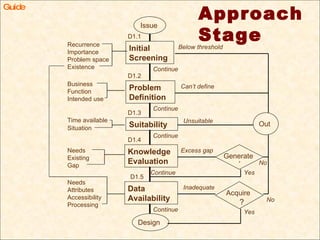
Guide Approach Stage Issue Initial Screening Problem Definition Suitability Knowledge Evaluation Data Availability Design Recurrence Importance Problem space Existence Business Function Intended use Time available   Situation Needs Existing Gap Needs Attributes Accessibility Processing Continue Continue Continue Continue Continue Below threshold Can’t define Unsuitable Excess gap Inadequate Generate ? Acquire ? Yes Yes Out No No D1.1 D1.2 D1.3 D1.4 D1.5
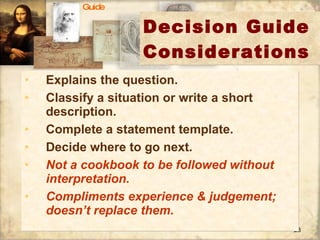
Decision Guide Considerations Explains the question. Classify a situation or write a short description. Complete a statement template. Decide where to go next. Not a cookbook to be followed without interpretation. Compliments experience & judgement; doesn’t replace them. Guide
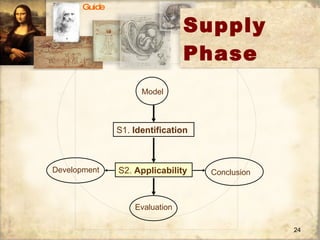
Supply Phase Guide Development Model S1.  Identification S2.  Applicability Evaluation Conclusion
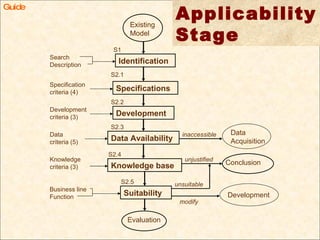
Applicability Stage Guide Existing Model Knowledge base Suitability Evaluation Specification criteria (4) Knowledge criteria (3) Business line Function Development S2.2 S2.3 S2.4 Identification Search Description S1 modify Data Availability Data criteria (5) Data Acquisition inaccessible Conclusion unsuitable unjustified Specifications S2.1 Development criteria (3) Development S2.5
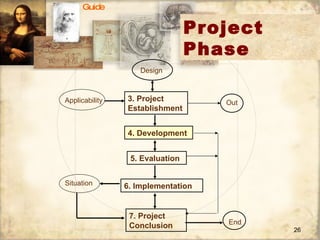
Project   Phase Guide End Design Applicability 4. Development 5. Evaluation 6. Implementation 7. Project Conclusion Out 3. Project Establishment Situation
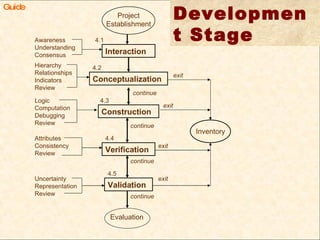
Development Stage Guide Project Establishment Hierarchy Relationships Indicators Review Logic Computation Debugging Review Attributes Consistency Review Uncertainty Representation Review Conceptualization Construction Evaluation Verification Validation Inventory exit exit exit exit 4.2 4.3 4.4 4.5 continue continue continue continue Interaction Awareness Understanding Consensus 4.1
Outline I.  Underlying Concepts Scientific underpinning II. Decision Guide Decision making III. Glossary Common understanding
Glossary Background   (introduction, methods, references). Taxonomy  (organization, nature, risk analysis, content, modelling, concepts).   Definitions  -  650 terms from six sources. Links   to taxonomy and related terms. Glossary
Sample Definition Model:  Abstract and simplified construct or representation of reality in the form of a pattern, description, or definition that shows the essential structure, relationships, and workings of a concept, process, or system.  (see  modelling approach , function, modelling methods, process, relationship, representation, system) Glossary
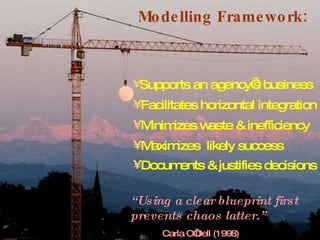
Modelling Framework: Supports an agency’s business Facilitates horizontal integration Minimizes waste & inefficiency  Maximizes  likely success  Documents & justifies decisions   “ Using a clear blueprint first prevents chaos latter.” Carla O’Dell (1998)

Modeling Framework to Support Evidence-Based Decisions

  • 1.
    ModSimWorld Montreal, QuebecJune 8-9, 2009 A Modelling Framework: Supporting Evidence-Based Decisions
  • 2.
    Main Messages Modelsare needed to understand and predict the behavior of complex systems. Models are needed to fulfill an agency’s mandate and support its core business. Inadequate or incorrect use of models wastes resources, results in errors, and exposes an agency to liability. Models should be used wisely
  • 3.
    Outline I. Underlying Concepts Scientific underpinning II. Decision Guide Decision making III. Glossary Common understanding
  • 4.
    About Models Whatare they? Simplified representations of reality. Transform data, information, and knowledge into outputs. Why do we use them? Reality is too complex Experiments are infeasible Predict consequences Increase understanding Nonaka (2000) Concepts ..
  • 5.
    What is aFramework? “ Structural outline of the components of an organization, system, or process and the relationships among them.” Understanding Knowledge Services NRCan (2006) Concepts
  • 6.
    Framework Objectives Supportneeds-driven and science-driven analysis. Promote dialogue among modelers, managers, & users. Reduce wasted time, effort, & money. Provide a basis for planning and action. Document and justify decisions. Concepts
  • 7.
    Framework Design Reflectmodelling, management, and user perspectives. Balance efficiency and effectiveness with cost and effort. Applicable to both demand and supply approaches to modelling. Applicable to both logical and computational models Concepts
  • 8.
    Different Perspectives ConceptsWhat developers proposed What managers funded What stakeholders wanted What users needed
  • 9.
    Supply & DemandConcepts Supply : I have a model that solves your problem. Demand : I have a problem that needs a model.
  • 10.
    Modelling System ConceptsExternal Models Develop Nature, Society Internal Models Use Manage Lost Models Share Preserve Knowledge Management
  • 11.
    Modelling Process Modellingcombines science & computers; judgement & experience; insight & intuition. Principles: effort, simple, data, knowledge, transparent, understandable. Complexity: Modelling is a dynamic feedback process with delays and uncertainty. Development : techniques are well-understood; management less understood and practiced. Use: Decision making under uncertainty, unknown elements, outcome probabilities. Concepts
  • 12.
    Systems Hierarchy ConceptsData Models Decision Support Information Knowledge Management Management Mandate Business Policies Processes
  • 13.
    Data A model and its data are inseparable; they succeed or fail as one. Data Needs: Situation may involve nature, the system, and/or intervention. Sampling: Statistics are essential to determine how much data is needed. Source: Ownership? Use rights? Privacy & security concerns? Scale : Time, space, and process scale must match the situation. Quality: Level of accuracy, detail, and completeness are needed? Concepts
  • 14.
    Information System Audience Use Media Concepts Outputs Acquisition Processing Storage Knowledge Organization Society Environment Events Economy Channels Access Search Retrieval Interface Processing Database Inputs Interface System Data Model Outputs Interoperability Integration Availability Utility
  • 15.
    Models and Knowledge System: Behavior: Approach: Model: Decision: Basis: Concepts 1. Common Flow-through (-) Fixed (1:1) Planning Mechanistic Automated Data, facts 2. Complicated Feedback Linear (1:n) Mathematics Deterministic Certainty Explicit knowledge 3. Complex Predictive feedback (+) Non-linear (1:?) Simulation Stochastic Uncertainty Tacit knowledge 4. Chaotic Emergent Disorganized Scenario analysis Mental Reaction Intuition
  • 16.
    Outline I. Underlying Concepts Scientific underpinning II. Decision Guide Decision making III. Glossary Common understanding
  • 17.
    Decision Guide -Hierarchy Phase: (3) demand , supply, project Stage: (7) approach , design, establish, develop, evaluate, implement, conclude Step: (34) screening , problem definition, suitability, knowledge, data Consideration (132): recurrence, importance, problem space, existence
  • 18.
    Decision Guide -Stages Guide Design Acquire Data Generate Knowledge Approach Out Evaluation Issue Start: ( Demand ) Implementation Outputs Conclusion End Development (Modeller) ( Manager ) ( User ) D1 D2 3 Applicability S2 Model Start ( Supply ) identification S1 5 7 6 Establishment 4 ( Manager ) (All)
  • 19.
    Decision Guide PhasesGuide Issue Model Demand Supply Project End
  • 20.
    Supply & DemandGuide Start (use) Demand-driven backward chaining, closed question Model Supply-driven forward chaining, open question Start (model) Uses
  • 21.
    Demand Phase GuideIssue D1 . Approach D2 . Design Development Acquire Data Generate Knowledge Out
  • 22.
    Guide Approach StageIssue Initial Screening Problem Definition Suitability Knowledge Evaluation Data Availability Design Recurrence Importance Problem space Existence Business Function Intended use Time available Situation Needs Existing Gap Needs Attributes Accessibility Processing Continue Continue Continue Continue Continue Below threshold Can’t define Unsuitable Excess gap Inadequate Generate ? Acquire ? Yes Yes Out No No D1.1 D1.2 D1.3 D1.4 D1.5
  • 23.
    Decision Guide ConsiderationsExplains the question. Classify a situation or write a short description. Complete a statement template. Decide where to go next. Not a cookbook to be followed without interpretation. Compliments experience & judgement; doesn’t replace them. Guide
  • 24.
    Supply Phase GuideDevelopment Model S1. Identification S2. Applicability Evaluation Conclusion
  • 25.
    Applicability Stage GuideExisting Model Knowledge base Suitability Evaluation Specification criteria (4) Knowledge criteria (3) Business line Function Development S2.2 S2.3 S2.4 Identification Search Description S1 modify Data Availability Data criteria (5) Data Acquisition inaccessible Conclusion unsuitable unjustified Specifications S2.1 Development criteria (3) Development S2.5
  • 26.
    Project Phase Guide End Design Applicability 4. Development 5. Evaluation 6. Implementation 7. Project Conclusion Out 3. Project Establishment Situation
  • 27.
    Development Stage GuideProject Establishment Hierarchy Relationships Indicators Review Logic Computation Debugging Review Attributes Consistency Review Uncertainty Representation Review Conceptualization Construction Evaluation Verification Validation Inventory exit exit exit exit 4.2 4.3 4.4 4.5 continue continue continue continue Interaction Awareness Understanding Consensus 4.1
  • 28.
    Outline I. Underlying Concepts Scientific underpinning II. Decision Guide Decision making III. Glossary Common understanding
  • 29.
    Glossary Background (introduction, methods, references). Taxonomy (organization, nature, risk analysis, content, modelling, concepts). Definitions - 650 terms from six sources. Links to taxonomy and related terms. Glossary
  • 30.
    Sample Definition Model: Abstract and simplified construct or representation of reality in the form of a pattern, description, or definition that shows the essential structure, relationships, and workings of a concept, process, or system. (see modelling approach , function, modelling methods, process, relationship, representation, system) Glossary
  • 31.
    Modelling Framework: Supportsan agency’s business Facilitates horizontal integration Minimizes waste & inefficiency Maximizes likely success Documents & justifies decisions “ Using a clear blueprint first prevents chaos latter.” Carla O’Dell (1998)