Kingdom Of Saudi Arabia
          Al-Imam Muhammad Ibn Saud Islamic University
           College of Computer and Information Sciences
                  Information System Department
                     2nd semester, 2010 – 2011
                 IS 332: Decision Support Systems


Decision Support Systems And
    Business Intelligence
Chapter 1 in “DECISION SUPPORT AND BUSINESS INTELLIGENCE
                          SYSTEMS”


                         T. Hala AL-Rumaih                 1
Introduction
• Organizations feel increasing pressures that force them to
 respond quickly to changing the way they operate.
• Making such decisions may require relevant data,..
• Processing these, must be done quickly, frequently, in real
 time and requires computerized support.
• This course will taking about using business intelligence
 as a computerized support for decision making.


                                                                2
Changing Business Environments and
Computerized Decision Support
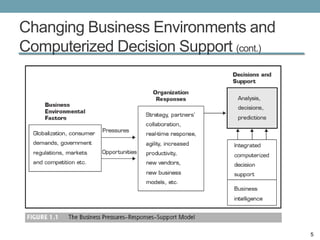
• To understand why companies are embracing
 computerized support, a model has been developed
 called the Business Pressures-Responses-Support
 Model.

• The Business Pressures-Responses-Support Model:


 1. The business environment
   • Business environment factors divided into four
    categories: markets, consumer
    demands, technology, and societal.

                                                      3
Changing Business Environments and
Computerized Decision Support (cont.)
 2. Organizational responses: be
   reactive, anticipative, adaptive, and proactive
       • Employ strategic planning
       • Use new and innovative business model
       • Restructure business process
       • Use new IT to improve communication.
       •:
       •:

 3. Computerized support
   •    It used to facilitate closing the gap between the
        current performance and the desired performance

                                                            4
Changing Business Environments and
Computerized Decision Support (cont.)


                                        5
Managerial Decision Making
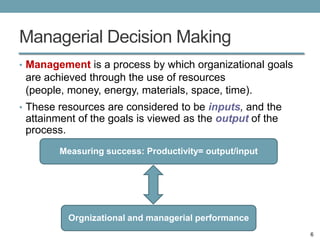
• Management is a process by which organizational goals
 are achieved through the use of resources
 (people, money, energy, materials, space, time).
• These resources are considered to be inputs, and the
 attainment of the goals is viewed as the output of the
 process.
        Measuring success: Productivity= output/input


          Orgnizational and managerial performance
                                                          6
Managerial Decision Making (cont.)
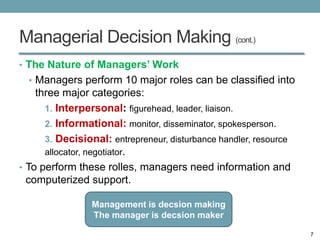
• The Nature of Managers’ Work
  • Managers perform 10 major roles can be classified into
    three major categories:
      1. Interpersonal: figurehead, leader, liaison.
      2. Informational: monitor, disseminator, spokesperson.
      3. Decisional: entrepreneur, disturbance handler, resource
      allocator, negotiator.
• To perform these rolles, managers need information and
  computerized support.

                 Management is decsion making
                 The manager is decsion maker

                                                                   7
Managerial Decision Making (cont.)
• The process of decision making:
   1.   Defining the problem (i.e., a decision situation that
        may deal with some difficulty or with an opportunity)
   2.   Constructing a model that describes the real-world
        problem
   3.   Identifying possible solutions to the modeled
        problem and evaluating the solutions
   4.   Comparing, choosing, and recommending a
        potential solution to the problem


                                                                8
Managerial Decision Making (cont.)
• Factors Affecting Decision-Making:
• Environmental factors make the evaluation process
 difficult for the following reasons:
  1. New technologies and better information distribution
       have resulted in more alternatives for management.
  2. Increasing governmental regulation coupled with
       political destabilization have caused great uncertainty.
  3. Other factors are the need to make rapid
       decisions, the frequent and unpredictable
       changes, and the potential costs of making mistakes.
  4. These environments are growing more
       complex, making decision today is indeed a complex
       task.

                                                                  9
Computerized Support For Decision
Making
• Computer applications have moved from transaction
 processing and monitoring activities to problem analysis
 and solution applications.
• BI tools such data warehousing, data mining, online
 analytical processing,……, are the cornerstones of
 today’s modern management.


                                                            10
Computerized Support For Decision
Making (cont.)
• Why We Use Computerized Decision Support Systems?
   • Speedy computations
   • Improved communication and collaboration
   • Increased productivity of group members
   • Improved data management
   • Managing giant data warehouses
   • Quality support
   • Agility Support
   • Overcoming cognitive limits in processing and storing
     information
   • Using the Web
   • Anywhere, anytime support


                                                             11
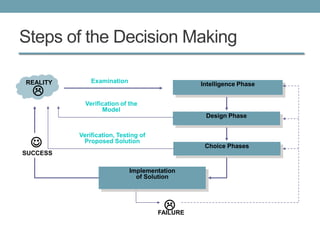
Steps of the Decision Making

REALITY       Examination                      Intelligence Phase
  
            Verification of the
                  Model
                                                Design Phase


          Verification, Testing of
          Proposed Solution
                                                Choice Phases
SUCCESS

                            Implementation
                              of Solution


                                      
                                     FAILURE
Steps of the Decision Making (cont.)
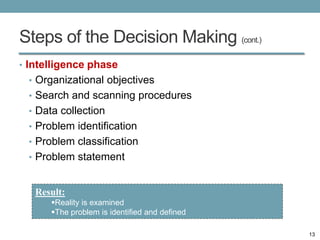
• Intelligence phase
 • Organizational objectives
 • Search and scanning procedures
 • Data collection
 • Problem identification
 • Problem classification
 • Problem statement


   Result:
      Reality is examined
      The problem is identified and defined

                                               13
Steps of the Decision Making (cont.)
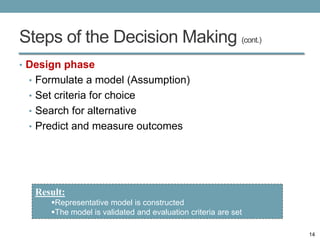
• Design phase
 • Formulate a model (Assumption)
 • Set criteria for choice
 • Search for alternative
 • Predict and measure outcomes


  Result:
      Representative model is constructed
      The model is validated and evaluation criteria are set

                                                                14
Steps of the Decision Making (cont.)
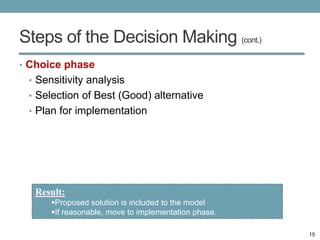
• Choice phase
 • Sensitivity analysis
 • Selection of Best (Good) alternative
 • Plan for implementation


  Result:
      Proposed solution is included to the model
      If reasonable, move to implementation phase.

                                                      15
Steps of the Decision Making (cont.)
• Implementation phase
 • Put solution into action


  Result:
      Solution to the original problem


                                          16
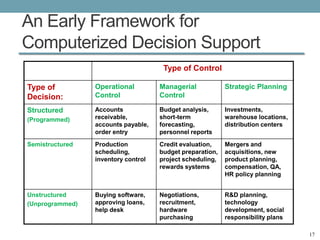
An Early Framework for
Computerized Decision Support
                                      Type of Control

Type of          Operational         Managerial            Strategic Planning
Decision:        Control             Control

Structured       Accounts            Budget analysis,      Investments,
(Programmed)     receivable,         short-term            warehouse locations,
                 accounts payable,   forecasting,          distribution centers
                 order entry         personnel reports
Semistructured   Production          Credit evaluation,    Mergers and
                 scheduling,         budget preparation,   acquisitions, new
                 inventory control   project scheduling,   product planning,
                                     rewards systems       compensation, QA,
                                                           HR policy planning


Unstructured     Buying software,    Negotiations,         R&D planning,
(Unprogrammed)   approving loans,    recruitment,          technology
                 help desk           hardware              development, social
                                     purchasing            responsibility plans

                                                                                  17
An Early Framework for Computerized
Decision Support (cont.)
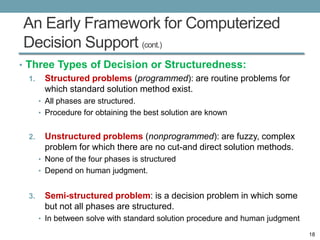
• Three Types of Decision or Structuredness:
  1. Structured problems (programmed): are routine problems for
     which standard solution method exist.
       • All phases are structured.
       • Procedure for obtaining the best solution are known


  2.    Unstructured problems (nonprogrammed): are fuzzy, complex
        problem for which there are no cut-and direct solution methods.
       • None of the four phases is structured
       • Depend on human judgment.


  3.    Semi-structured problem: is a decision problem in which some
        but not all phases are structured.
       • In between solve with standard solution procedure and human judgment

                                                                                18
An Early Framework for Computerized
Decision Support (cont.)
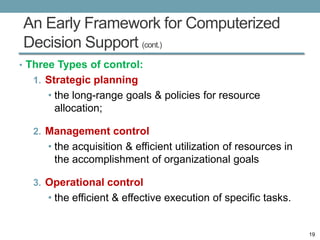
• Three Types of control:
  1. Strategic planning
     • the long-range goals & policies for resource
       allocation;

  2. Management control
     • the acquisition & efficient utilization of resources in
       the accomplishment of organizational goals

  3. Operational control
     • the efficient & effective execution of specific tasks.


                                                                 19
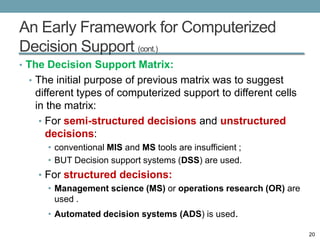
An Early Framework for Computerized
Decision Support (cont.)
• The Decision Support Matrix:
 • The initial purpose of previous matrix was to suggest
   different types of computerized support to different cells
   in the matrix:
    • For semi-structured decisions and unstructured
      decisions:
     • conventional MIS and MS tools are insufficient ;
     • BUT Decision support systems (DSS) are used.
   • For structured decisions:
     • Management science (MS) or operations research (OR) are
       used .
     • Automated decision systems (ADS) is used.

                                                                 20
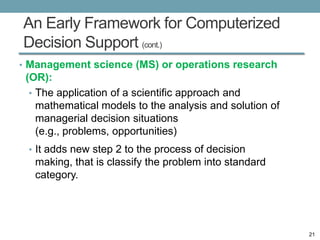
An Early Framework for Computerized
Decision Support (cont.)
• Management science (MS) or operations research
 (OR):
  • The application of a scientific approach and
    mathematical models to the analysis and solution of
    managerial decision situations
    (e.g., problems, opportunities)
 • It adds new step 2 to the process of decision
   making, that is classify the problem into standard
   category.


                                                          21
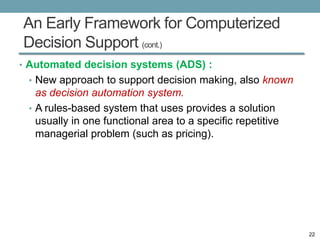
An Early Framework for Computerized
Decision Support (cont.)
• Automated decision systems (ADS) :
 • New approach to support decision making, also known
   as decision automation system.
 • A rules-based system that uses provides a solution
   usually in one functional area to a specific repetitive
   managerial problem (such as pricing).


                                                             22
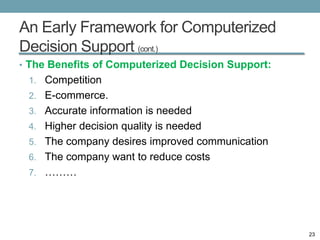
An Early Framework for Computerized
Decision Support (cont.)
• The Benefits of Computerized Decision Support:
 1. Competition
 2. E-commerce.
 3. Accurate information is needed
 4. Higher decision quality is needed
 5. The company desires improved communication
 6. The company want to reduce costs
 7. ………


                                                   23
The Concept of Decision Support
Systems (cont.)
• Decision support systems (DSS) are “interactive
 computer-based systems, which help decision makers
 utilize data and models to solve unstructured problems”.
• DSS are used to make business decision often based
 on data collected by On-Line-Analytical-Processing
 system (OLAP)
• DSS as an Umbrella term: Describes any computerized
 system that supports decision making in an organization


                                                            24
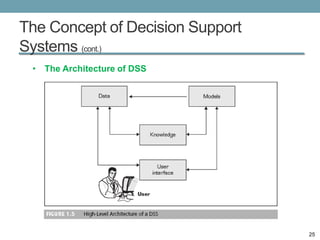
The Concept of Decision Support
Systems (cont.)
 • The Architecture of DSS


                                  25
A Framework for Business Intelligence
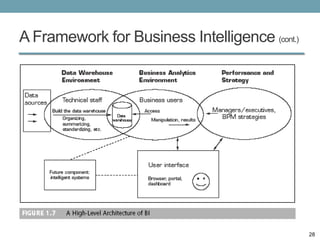
• Business intelligence (BI)
   • An umbrella term that combines
     architectures, tools, databases, applications, and methodologies


• BI’s major objective:
   • Enable interactive access to data
   • Enable manipulation of data
   • Give the ability to conduct appropriate analysis.
   • Enable to make more informed and better decisions


          BI = data  information decisions  actions


                                                                        26
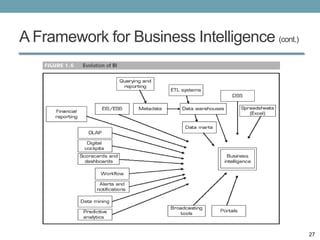
A Framework for Business Intelligence (cont.)


                                                27
A Framework for Business Intelligence (cont.)


                                                28
A Framework for Business Intelligence (cont.)
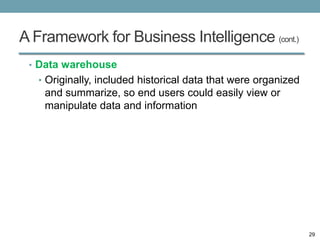
 • Data warehouse
   • Originally, included historical data that were organized
    and summarize, so end users could easily view or
    manipulate data and information


                                                                29
A Framework for Business Intelligence (cont.)
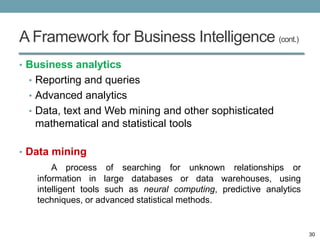
• Business analytics
 • Reporting and queries
 • Advanced analytics
 • Data, text and Web mining and other sophisticated
   mathematical and statistical tools

• Data mining
       A process of searching for unknown relationships or
   information in large databases or data warehouses, using
   intelligent tools such as neural computing, predictive analytics
   techniques, or advanced statistical methods.


                                                                      30
A Framework for Business Intelligence (cont.)
• Business performance management (BPM)
 An advanced performance measurement and analysis
 approach that embraces planning and strategy
 • BPM extends the monitoring, measuring, and
  comparing of sales, profit, cost, profitability, and other
  performance indicators by introducing the concept of
  “management and feedback
 • BPM provides a top-down enforcement of corporate-
  wide strategy


                                                               31
A Framework for Business Intelligence (cont.)
• Benefits of BI
   • Faster, more accurate reporting
   • Improved decision making
   • Improved customer service
   • Increased revenue


                                                32

IS332_Chapter 1

  • 1.
    Kingdom Of SaudiArabia Al-Imam Muhammad Ibn Saud Islamic University College of Computer and Information Sciences Information System Department 2nd semester, 2010 – 2011 IS 332: Decision Support Systems Decision Support Systems And Business Intelligence Chapter 1 in “DECISION SUPPORT AND BUSINESS INTELLIGENCE SYSTEMS” T. Hala AL-Rumaih 1
  • 2.
    Introduction • Organizations feelincreasing pressures that force them to respond quickly to changing the way they operate. • Making such decisions may require relevant data,.. • Processing these, must be done quickly, frequently, in real time and requires computerized support. • This course will taking about using business intelligence as a computerized support for decision making. 2
  • 3.
    Changing Business Environmentsand Computerized Decision Support • To understand why companies are embracing computerized support, a model has been developed called the Business Pressures-Responses-Support Model. • The Business Pressures-Responses-Support Model: 1. The business environment • Business environment factors divided into four categories: markets, consumer demands, technology, and societal. 3
  • 4.
    Changing Business Environmentsand Computerized Decision Support (cont.) 2. Organizational responses: be reactive, anticipative, adaptive, and proactive • Employ strategic planning • Use new and innovative business model • Restructure business process • Use new IT to improve communication. •: •: 3. Computerized support • It used to facilitate closing the gap between the current performance and the desired performance 4
  • 5.
    Changing Business Environmentsand Computerized Decision Support (cont.) 5
  • 6.
    Managerial Decision Making •Management is a process by which organizational goals are achieved through the use of resources (people, money, energy, materials, space, time). • These resources are considered to be inputs, and the attainment of the goals is viewed as the output of the process. Measuring success: Productivity= output/input Orgnizational and managerial performance 6
  • 7.
    Managerial Decision Making(cont.) • The Nature of Managers’ Work • Managers perform 10 major roles can be classified into three major categories: 1. Interpersonal: figurehead, leader, liaison. 2. Informational: monitor, disseminator, spokesperson. 3. Decisional: entrepreneur, disturbance handler, resource allocator, negotiator. • To perform these rolles, managers need information and computerized support. Management is decsion making The manager is decsion maker 7
  • 8.
    Managerial Decision Making(cont.) • The process of decision making: 1. Defining the problem (i.e., a decision situation that may deal with some difficulty or with an opportunity) 2. Constructing a model that describes the real-world problem 3. Identifying possible solutions to the modeled problem and evaluating the solutions 4. Comparing, choosing, and recommending a potential solution to the problem 8
  • 9.
    Managerial Decision Making(cont.) • Factors Affecting Decision-Making: • Environmental factors make the evaluation process difficult for the following reasons: 1. New technologies and better information distribution have resulted in more alternatives for management. 2. Increasing governmental regulation coupled with political destabilization have caused great uncertainty. 3. Other factors are the need to make rapid decisions, the frequent and unpredictable changes, and the potential costs of making mistakes. 4. These environments are growing more complex, making decision today is indeed a complex task. 9
  • 10.
    Computerized Support ForDecision Making • Computer applications have moved from transaction processing and monitoring activities to problem analysis and solution applications. • BI tools such data warehousing, data mining, online analytical processing,……, are the cornerstones of today’s modern management. 10
  • 11.
    Computerized Support ForDecision Making (cont.) • Why We Use Computerized Decision Support Systems? • Speedy computations • Improved communication and collaboration • Increased productivity of group members • Improved data management • Managing giant data warehouses • Quality support • Agility Support • Overcoming cognitive limits in processing and storing information • Using the Web • Anywhere, anytime support 11
  • 12.
    Steps of theDecision Making REALITY Examination Intelligence Phase  Verification of the Model Design Phase Verification, Testing of  Proposed Solution Choice Phases SUCCESS Implementation of Solution  FAILURE
  • 13.
    Steps of theDecision Making (cont.) • Intelligence phase • Organizational objectives • Search and scanning procedures • Data collection • Problem identification • Problem classification • Problem statement Result: Reality is examined The problem is identified and defined 13
  • 14.
    Steps of theDecision Making (cont.) • Design phase • Formulate a model (Assumption) • Set criteria for choice • Search for alternative • Predict and measure outcomes Result: Representative model is constructed The model is validated and evaluation criteria are set 14
  • 15.
    Steps of theDecision Making (cont.) • Choice phase • Sensitivity analysis • Selection of Best (Good) alternative • Plan for implementation Result: Proposed solution is included to the model If reasonable, move to implementation phase. 15
  • 16.
    Steps of theDecision Making (cont.) • Implementation phase • Put solution into action Result: Solution to the original problem 16
  • 17.
    An Early Frameworkfor Computerized Decision Support Type of Control Type of Operational Managerial Strategic Planning Decision: Control Control Structured Accounts Budget analysis, Investments, (Programmed) receivable, short-term warehouse locations, accounts payable, forecasting, distribution centers order entry personnel reports Semistructured Production Credit evaluation, Mergers and scheduling, budget preparation, acquisitions, new inventory control project scheduling, product planning, rewards systems compensation, QA, HR policy planning Unstructured Buying software, Negotiations, R&D planning, (Unprogrammed) approving loans, recruitment, technology help desk hardware development, social purchasing responsibility plans 17
  • 18.
    An Early Frameworkfor Computerized Decision Support (cont.) • Three Types of Decision or Structuredness: 1. Structured problems (programmed): are routine problems for which standard solution method exist. • All phases are structured. • Procedure for obtaining the best solution are known 2. Unstructured problems (nonprogrammed): are fuzzy, complex problem for which there are no cut-and direct solution methods. • None of the four phases is structured • Depend on human judgment. 3. Semi-structured problem: is a decision problem in which some but not all phases are structured. • In between solve with standard solution procedure and human judgment 18
  • 19.
    An Early Frameworkfor Computerized Decision Support (cont.) • Three Types of control: 1. Strategic planning • the long-range goals & policies for resource allocation; 2. Management control • the acquisition & efficient utilization of resources in the accomplishment of organizational goals 3. Operational control • the efficient & effective execution of specific tasks. 19
  • 20.
    An Early Frameworkfor Computerized Decision Support (cont.) • The Decision Support Matrix: • The initial purpose of previous matrix was to suggest different types of computerized support to different cells in the matrix: • For semi-structured decisions and unstructured decisions: • conventional MIS and MS tools are insufficient ; • BUT Decision support systems (DSS) are used. • For structured decisions: • Management science (MS) or operations research (OR) are used . • Automated decision systems (ADS) is used. 20
  • 21.
    An Early Frameworkfor Computerized Decision Support (cont.) • Management science (MS) or operations research (OR): • The application of a scientific approach and mathematical models to the analysis and solution of managerial decision situations (e.g., problems, opportunities) • It adds new step 2 to the process of decision making, that is classify the problem into standard category. 21
  • 22.
    An Early Frameworkfor Computerized Decision Support (cont.) • Automated decision systems (ADS) : • New approach to support decision making, also known as decision automation system. • A rules-based system that uses provides a solution usually in one functional area to a specific repetitive managerial problem (such as pricing). 22
  • 23.
    An Early Frameworkfor Computerized Decision Support (cont.) • The Benefits of Computerized Decision Support: 1. Competition 2. E-commerce. 3. Accurate information is needed 4. Higher decision quality is needed 5. The company desires improved communication 6. The company want to reduce costs 7. ……… 23
  • 24.
    The Concept ofDecision Support Systems (cont.) • Decision support systems (DSS) are “interactive computer-based systems, which help decision makers utilize data and models to solve unstructured problems”. • DSS are used to make business decision often based on data collected by On-Line-Analytical-Processing system (OLAP) • DSS as an Umbrella term: Describes any computerized system that supports decision making in an organization 24
  • 25.
    The Concept ofDecision Support Systems (cont.) • The Architecture of DSS 25
  • 26.
    A Framework forBusiness Intelligence • Business intelligence (BI) • An umbrella term that combines architectures, tools, databases, applications, and methodologies • BI’s major objective: • Enable interactive access to data • Enable manipulation of data • Give the ability to conduct appropriate analysis. • Enable to make more informed and better decisions BI = data  information decisions  actions 26
  • 27.
    A Framework forBusiness Intelligence (cont.) 27
  • 28.
    A Framework forBusiness Intelligence (cont.) 28
  • 29.
    A Framework forBusiness Intelligence (cont.) • Data warehouse • Originally, included historical data that were organized and summarize, so end users could easily view or manipulate data and information 29
  • 30.
    A Framework forBusiness Intelligence (cont.) • Business analytics • Reporting and queries • Advanced analytics • Data, text and Web mining and other sophisticated mathematical and statistical tools • Data mining A process of searching for unknown relationships or information in large databases or data warehouses, using intelligent tools such as neural computing, predictive analytics techniques, or advanced statistical methods. 30
  • 31.
    A Framework forBusiness Intelligence (cont.) • Business performance management (BPM) An advanced performance measurement and analysis approach that embraces planning and strategy • BPM extends the monitoring, measuring, and comparing of sales, profit, cost, profitability, and other performance indicators by introducing the concept of “management and feedback • BPM provides a top-down enforcement of corporate- wide strategy 31
  • 32.
    A Framework forBusiness Intelligence (cont.) • Benefits of BI • Faster, more accurate reporting • Improved decision making • Improved customer service • Increased revenue 32