Information and Knowledge Services:  Finding Structure in Complexity Albert Simard presented to  GTEC   Ottawa, ON, Oct. 23, 2006
An opening thought… “ One of the saddest features of the real world is that goods do not spontaneously present themselves for distribution”   The Economist (Nov. 5, 1994)
NRCan Knowledge Services Task Group Mandate “ Examine the nature of science-related programs in Natural Resources Canada, describe appropriate elements in the context of Government of Canada Service Transformation, and submit a report.” Background Understanding Knowledge Services NRCan (2006)
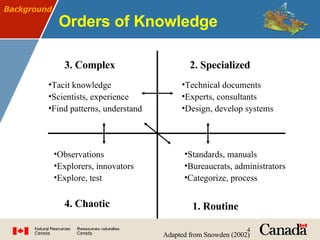
Orders of Knowledge   Adapted from Snowden (2002) Background 1. Routine Standards, manuals Bureaucrats, administrators Categorize, process 2. Specialized Technical documents Experts, consultants Design, develop systems 3. Complex Tacit knowledge Scientists, experience Find patterns, understand  4. Chaotic Observations Explorers, innovators Explore, test
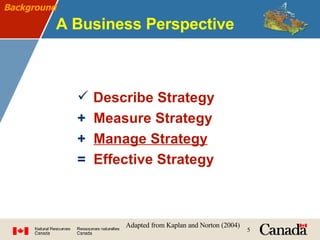
A Business Perspective Describe Strategy  +   Measure Strategy  +   Manage Strategy   =   Effective Strategy  Adapted from Kaplan and Norton (2004) Background
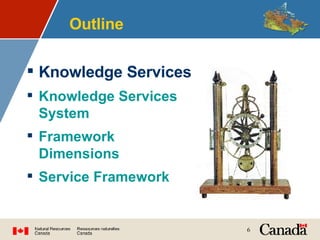
Outline Knowledge Services Knowledge Services System Framework Dimensions Service Framework
What is Content ? Collections  –  objects, artifacts:   books, documents, rocks, minerals, insects, plant materials, diseased tissue, seeds Data  –  facts, observations :  elements, files, records, datasets, databases, statistics Information  –  meaning, context:  records, documents, reports, photos, maps, brochures, presentations, recordings  Knowledge  –  understanding, predictability : equations, models, scientific publications, experience, know-how Services
Content Value Chain “ Flow of content through sequential stages, each of which changes its form and increases its usefulness and value.”   (NRCan, 2006) “ Embedded value in the form of the message or signal contained within all elements of the content value chain.” Services Objects Data Information Knowledge Wisdom
Knowledge Services Services Direction Plans Operations Positions Coordination Accomplishments Answers Advice Teaching Facilitation Support Laboratory Database Scientific article Technical report Outreach material Geospatial products Statistical products Standards Policies Regulations Systems Devices Objects Data Information Knowledge  Wisdom Solutions Services Products Content
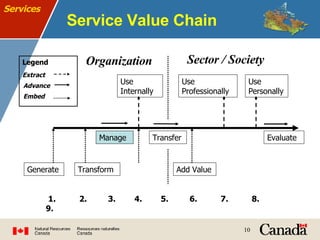
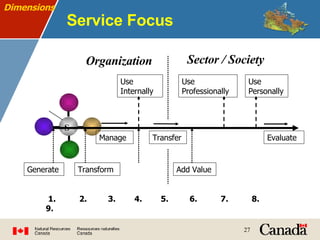
Service Value Chain 1.  2.  3.  4.  5.  6.  7.  8.  9. Services Use Internally Use Professionally Use Personally Generate Transform Add Value Transfer Evaluate Manage Extract Advance Embed Legend Organization Sector / Society
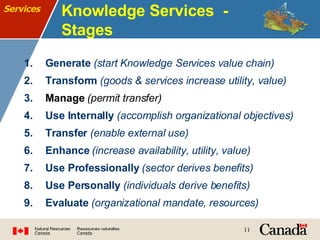
Knowledge Services  - Stages Generate   (start Knowledge Services value chain) Transform   (goods & services increase utility, value) Manage   (permit transfer) Use Internally   (accomplish organizational objectives) Transfer   (enable external use) Enhance   (increase availability, utility, value)   Use Professionally   (sector derives benefits) Use Personally   (individuals derive benefits) Evaluate  (organizational mandate, resources) Services
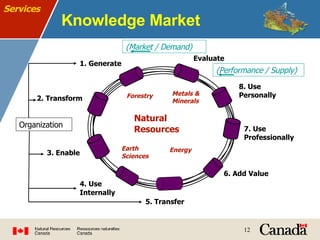
Knowledge Market  Services (Performance / Supply) (Market / Demand) 6. Add Value 7. Use Professionally 8. Use Personally Evaluate Natural   Resources Forestry Metals & Minerals Earth   Sciences Energy 1. Generate 2. Transform 3. Enable 4. Use   Internally 5. Transfer Organization
Outline Knowledge Services Knowledge Services System Framework Dimensions Service Framework ..
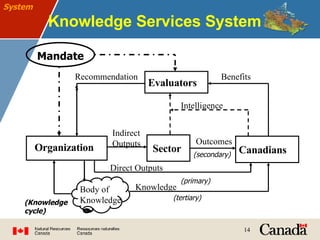
Knowledge Services System System Indirect Outputs Sector Outcomes Canadians Intelligence Organization Mandate Body of Knowledge (Knowledge cycle) Direct Outputs Evaluators Recommendations Benefits (tertiary) (secondary) (primary) Knowledge
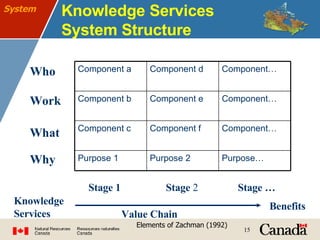
Knowledge Services System Structure Elements of Zachman (1992) System Component… Component f Component c Component… Component e Component b Purpose… Purpose 2 Purpose 1 Component… Component d Component a Stage 1 Stage  2 Stage … Knowledge Services Value Chain Benefits Who Work What Why
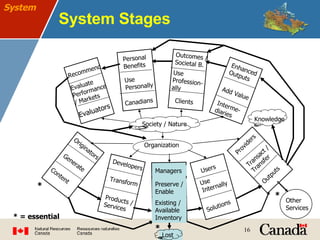
System Stages * = essential System Organization Society / Nature Interme-diaries Add Value Enhanced Outputs Developers Transform Products / Services Users Use Internally  Solutions Evaluators Evaluate Performance/ Markets Recommend Clients Use Profession-ally Outcomes / Societal B. Canadians Use Personally  Personal Benefits Originators Generate Content * Providers Transact / Transfer Outputs Knowledge * Other Services Lost Managers Preserve / Enable Existing / Available Inventory *
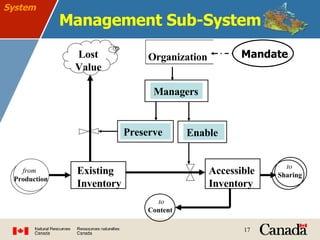
Management Sub-System System to   Content from   Production Existing Inventory Managers Lost Value Preserve Enable Accessible Inventory Organization Mandate to   Sharing
Manage Content System Existing: Content Products Services Accessible: Content Products Services Establish programs Implement  programs Persevere Manage: IT infrastructure libraries collections data records information knowledge Inventory Prioritize Capture Record Organize Store Senior manager Manager IT manager Champion Curator Data manager Information manager Knowledge manager Inventory Enable Preserve Managers
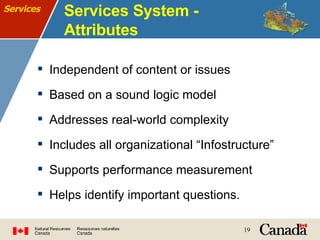
Services System - Attributes Independent of content or issues Based on a sound logic model Addresses real-world complexity Includes all organizational “Infostructure” Supports performance measurement Helps identify important questions. Services
Outline Knowledge Services Knowledge Services System Framework Dimensions Service Framework
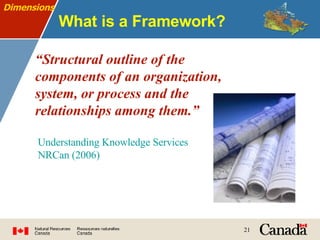
What is a Framework? “ Structural outline of the components of an organization, system, or process and the relationships among them.” Dimensions Understanding Knowledge Services NRCan (2006)
Why a Framework? Provides structure in a complex world  Shows what the picture looks like Describes how things are related Lists everything that is included Basis for planning and action. Dimensions
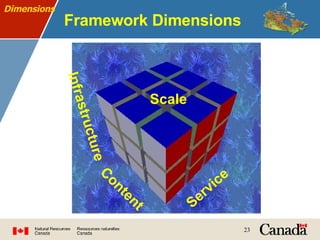
Framework Dimensions Content Service Scale Infrastructure Dimensions
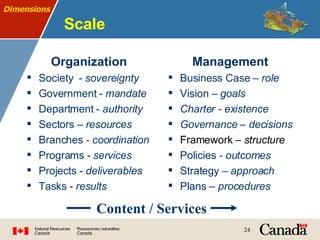
Scale   Organization Society  -  sovereignty Government -  mandate Department -  authority Sectors –  resources Branches  - coordination Programs -  services Projects -  deliverables Tasks -  results Management Business Case  – role  Vision –  goals Charter - existence Governance – decisions Framework  – structure Policies  - outcomes Strategy –  approach Plans  – procedures Dimensions Content / Services
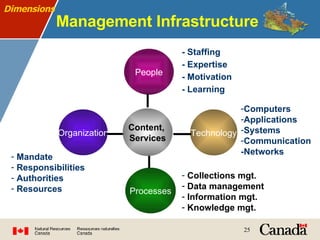
Management Infrastructure Dimensions Collections mgt.  Data management  Information mgt. Knowledge mgt. Processes - Staffing - Expertise - Motivation - Learning  People Mandate  Responsibilities Authorities Resources Organization Content,  Services Technology Computers Applications Systems  Communication -Networks
Content Focus   Dimensions Policy Executive Operational Statistics Communication Science C Industry
Service Focus Dimensions S 1.  2.  3.  4.  5.  6.  7.  8.  9. Use Internally Use Professionally Use Personally Generate Transform Add Value Transfer Evaluate Manage Organization Sector / Society
Primary Dimension ? Infrastructure Content organization  management supply Services clients markets demand Scale Cost of running the business Investing in the business Dimensions
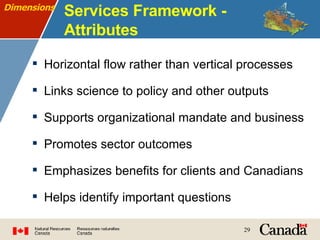
Services Framework - Attributes Horizontal flow rather than vertical processes Links science to policy and other outputs Supports organizational mandate and business  Promotes sector outcomes Emphasizes benefits for clients and Canadians Helps identify important questions  Dimensions
Outline Knowledge Services Knowledge Services System Framework Dimensions Service Framework
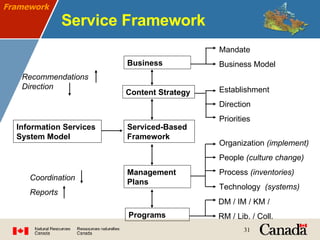
Service Framework   Framework Information Services System Model Serviced-Based Framework Management Plans Programs Content Strategy Business Mandate Business Model Establishment Direction Priorities Organization  (implement) People  (culture change) Process  (inventories) Technology  (systems) DM / IM / KM /  RM / Lib. / Coll. Recommendations Direction Coordination Reports
Important Questions Framework Access Interoperability Privacy Security Information Rights Reach Richness Communication Strategy Knowledge Markets Role, Approach
Organizational Role in Knowledge Markets? Content   -   provider, user, intermediary Participant -  owner, manager, developer, member Support -  champion, facilitator, funding, infrastructure Framework
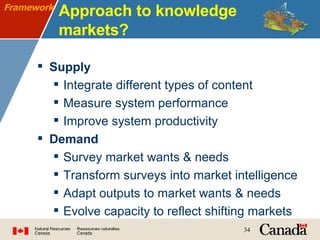
Approach to knowledge markets? Supply Integrate different types of content Measure system performance Improve system productivity Demand Survey market wants & needs Transform surveys into market intelligence Adapt outputs to market wants & needs Evolve capacity to reflect shifting markets Framework
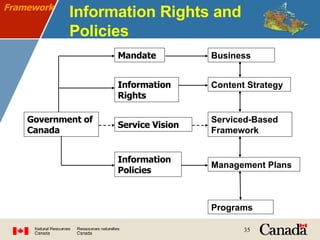
Information Rights and Policies Government of Canada Framework Mandate Information Rights Information Policies Management Plans Programs Content Strategy Business Serviced-Based Framework Service Vision
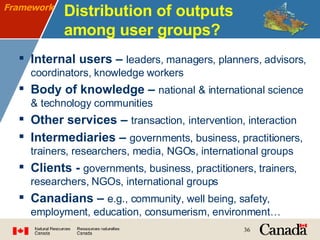
Distribution of outputs among user groups?   Internal users –  leaders, managers, planners, advisors, coordinators, knowledge workers Body of knowledge –  national & international science & technology communities Other services –  transaction,   intervention, interaction Intermediaries –  governments, business, practitioners, trainers, researchers, media, NGOs, international groups Clients -  governments, business, practitioners, trainers, researchers, NGOs, international groups Canadians –  e.g., community, well being, safety, employment, education, consumerism, environment…  Framework
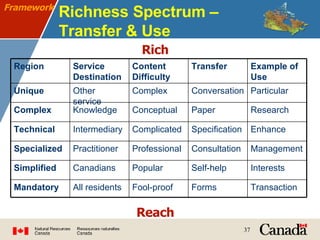
Richness Spectrum – Transfer & Use Framework Rich Reach Forms Self-help  Consultation Specification Paper Conversation Transfer All residents Canadians Practitioner Intermediary Knowledge Other service Service Destination Transaction Fool-proof Mandatory Interests Popular Simplified Management Professional Specialized Enhance Complicated Technical Research Conceptual Complex Particular Complex Unique Example of Use Content Difficulty  Region
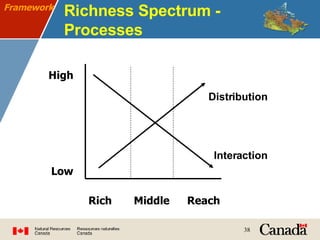
Richness Spectrum - Processes Framework Distribution Interaction High Low Rich Reach Middle
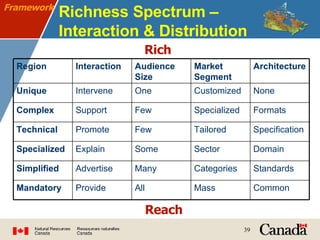
Richness Spectrum – Interaction & Distribution Framework Reach Rich Provide Advertise Explain Promote Support Intervene Interaction Common Mass All Mandatory Standards Categories Many Simplified Domain Sector Some Specialized Specification Tailored Few Technical Formats Specialized Few Complex None Customized One Unique Architecture Market Segment Audience Size Region
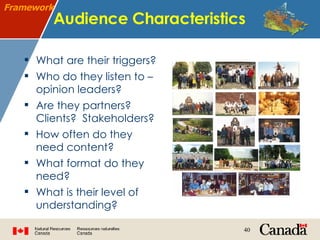
Audience Characteristics What are their triggers? Who do they listen to – opinion leaders? Are they partners? Clients?  Stakeholders? How often do they  need content?  What format do they need? What is their level of understanding? Framework
Channels On-line On-site Off-site Kiosk Mail E-mail Telephony Fax Framework How will outputs and services be provided? One way or many? Push or pull? Synchronous or asynchronous?
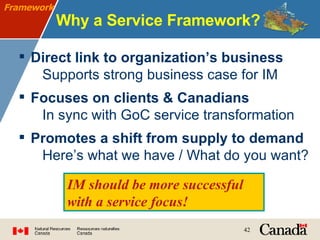
Why a Service Framework? Direct link to organization’s business Supports strong business case for IM Focuses on clients & Canadians In sync with GoC service transformation Promotes a shift from supply to demand Here’s what we have / What do you want? IM should be more successful with a service focus! Framework
A Final Thought… “ The first task of any theory is to clarify terms and concepts that are confused… Only after agreement has been reached regarding terms and concepts can we hope to consider the issues easily and clearly and expect to share the same viewpoint.” Karl Von Clausewitz (1780-1831)

Information and Knowledge Services: finding Structure in Complexity

  • 1.
    Information and KnowledgeServices: Finding Structure in Complexity Albert Simard presented to GTEC Ottawa, ON, Oct. 23, 2006
  • 2.
    An opening thought…“ One of the saddest features of the real world is that goods do not spontaneously present themselves for distribution” The Economist (Nov. 5, 1994)
  • 3.
    NRCan Knowledge ServicesTask Group Mandate “ Examine the nature of science-related programs in Natural Resources Canada, describe appropriate elements in the context of Government of Canada Service Transformation, and submit a report.” Background Understanding Knowledge Services NRCan (2006)
  • 4.
    Orders of Knowledge Adapted from Snowden (2002) Background 1. Routine Standards, manuals Bureaucrats, administrators Categorize, process 2. Specialized Technical documents Experts, consultants Design, develop systems 3. Complex Tacit knowledge Scientists, experience Find patterns, understand 4. Chaotic Observations Explorers, innovators Explore, test
  • 5.
    A Business PerspectiveDescribe Strategy + Measure Strategy + Manage Strategy = Effective Strategy Adapted from Kaplan and Norton (2004) Background
  • 6.
    Outline Knowledge ServicesKnowledge Services System Framework Dimensions Service Framework
  • 7.
    What is Content? Collections – objects, artifacts: books, documents, rocks, minerals, insects, plant materials, diseased tissue, seeds Data – facts, observations : elements, files, records, datasets, databases, statistics Information – meaning, context: records, documents, reports, photos, maps, brochures, presentations, recordings Knowledge – understanding, predictability : equations, models, scientific publications, experience, know-how Services
  • 8.
    Content Value Chain“ Flow of content through sequential stages, each of which changes its form and increases its usefulness and value.” (NRCan, 2006) “ Embedded value in the form of the message or signal contained within all elements of the content value chain.” Services Objects Data Information Knowledge Wisdom
  • 9.
    Knowledge Services ServicesDirection Plans Operations Positions Coordination Accomplishments Answers Advice Teaching Facilitation Support Laboratory Database Scientific article Technical report Outreach material Geospatial products Statistical products Standards Policies Regulations Systems Devices Objects Data Information Knowledge Wisdom Solutions Services Products Content
  • 10.
    Service Value Chain1. 2. 3. 4. 5. 6. 7. 8. 9. Services Use Internally Use Professionally Use Personally Generate Transform Add Value Transfer Evaluate Manage Extract Advance Embed Legend Organization Sector / Society
  • 11.
    Knowledge Services - Stages Generate (start Knowledge Services value chain) Transform (goods & services increase utility, value) Manage (permit transfer) Use Internally (accomplish organizational objectives) Transfer (enable external use) Enhance (increase availability, utility, value) Use Professionally (sector derives benefits) Use Personally (individuals derive benefits) Evaluate (organizational mandate, resources) Services
  • 12.
    Knowledge Market Services (Performance / Supply) (Market / Demand) 6. Add Value 7. Use Professionally 8. Use Personally Evaluate Natural Resources Forestry Metals & Minerals Earth Sciences Energy 1. Generate 2. Transform 3. Enable 4. Use Internally 5. Transfer Organization
  • 13.
    Outline Knowledge ServicesKnowledge Services System Framework Dimensions Service Framework ..
  • 14.
    Knowledge Services SystemSystem Indirect Outputs Sector Outcomes Canadians Intelligence Organization Mandate Body of Knowledge (Knowledge cycle) Direct Outputs Evaluators Recommendations Benefits (tertiary) (secondary) (primary) Knowledge
  • 15.
    Knowledge Services SystemStructure Elements of Zachman (1992) System Component… Component f Component c Component… Component e Component b Purpose… Purpose 2 Purpose 1 Component… Component d Component a Stage 1 Stage 2 Stage … Knowledge Services Value Chain Benefits Who Work What Why
  • 16.
    System Stages *= essential System Organization Society / Nature Interme-diaries Add Value Enhanced Outputs Developers Transform Products / Services Users Use Internally Solutions Evaluators Evaluate Performance/ Markets Recommend Clients Use Profession-ally Outcomes / Societal B. Canadians Use Personally Personal Benefits Originators Generate Content * Providers Transact / Transfer Outputs Knowledge * Other Services Lost Managers Preserve / Enable Existing / Available Inventory *
  • 17.
    Management Sub-System Systemto Content from Production Existing Inventory Managers Lost Value Preserve Enable Accessible Inventory Organization Mandate to Sharing
  • 18.
    Manage Content SystemExisting: Content Products Services Accessible: Content Products Services Establish programs Implement programs Persevere Manage: IT infrastructure libraries collections data records information knowledge Inventory Prioritize Capture Record Organize Store Senior manager Manager IT manager Champion Curator Data manager Information manager Knowledge manager Inventory Enable Preserve Managers
  • 19.
    Services System -Attributes Independent of content or issues Based on a sound logic model Addresses real-world complexity Includes all organizational “Infostructure” Supports performance measurement Helps identify important questions. Services
  • 20.
    Outline Knowledge ServicesKnowledge Services System Framework Dimensions Service Framework
  • 21.
    What is aFramework? “ Structural outline of the components of an organization, system, or process and the relationships among them.” Dimensions Understanding Knowledge Services NRCan (2006)
  • 22.
    Why a Framework?Provides structure in a complex world Shows what the picture looks like Describes how things are related Lists everything that is included Basis for planning and action. Dimensions
  • 23.
    Framework Dimensions ContentService Scale Infrastructure Dimensions
  • 24.
    Scale Organization Society - sovereignty Government - mandate Department - authority Sectors – resources Branches - coordination Programs - services Projects - deliverables Tasks - results Management Business Case – role Vision – goals Charter - existence Governance – decisions Framework – structure Policies - outcomes Strategy – approach Plans – procedures Dimensions Content / Services
  • 25.
    Management Infrastructure DimensionsCollections mgt. Data management Information mgt. Knowledge mgt. Processes - Staffing - Expertise - Motivation - Learning People Mandate Responsibilities Authorities Resources Organization Content, Services Technology Computers Applications Systems Communication -Networks
  • 26.
    Content Focus Dimensions Policy Executive Operational Statistics Communication Science C Industry
  • 27.
    Service Focus DimensionsS 1. 2. 3. 4. 5. 6. 7. 8. 9. Use Internally Use Professionally Use Personally Generate Transform Add Value Transfer Evaluate Manage Organization Sector / Society
  • 28.
    Primary Dimension ?Infrastructure Content organization management supply Services clients markets demand Scale Cost of running the business Investing in the business Dimensions
  • 29.
    Services Framework -Attributes Horizontal flow rather than vertical processes Links science to policy and other outputs Supports organizational mandate and business Promotes sector outcomes Emphasizes benefits for clients and Canadians Helps identify important questions Dimensions
  • 30.
    Outline Knowledge ServicesKnowledge Services System Framework Dimensions Service Framework
  • 31.
    Service Framework Framework Information Services System Model Serviced-Based Framework Management Plans Programs Content Strategy Business Mandate Business Model Establishment Direction Priorities Organization (implement) People (culture change) Process (inventories) Technology (systems) DM / IM / KM / RM / Lib. / Coll. Recommendations Direction Coordination Reports
  • 32.
    Important Questions FrameworkAccess Interoperability Privacy Security Information Rights Reach Richness Communication Strategy Knowledge Markets Role, Approach
  • 33.
    Organizational Role inKnowledge Markets? Content - provider, user, intermediary Participant - owner, manager, developer, member Support - champion, facilitator, funding, infrastructure Framework
  • 34.
    Approach to knowledgemarkets? Supply Integrate different types of content Measure system performance Improve system productivity Demand Survey market wants & needs Transform surveys into market intelligence Adapt outputs to market wants & needs Evolve capacity to reflect shifting markets Framework
  • 35.
    Information Rights andPolicies Government of Canada Framework Mandate Information Rights Information Policies Management Plans Programs Content Strategy Business Serviced-Based Framework Service Vision
  • 36.
    Distribution of outputsamong user groups? Internal users – leaders, managers, planners, advisors, coordinators, knowledge workers Body of knowledge – national & international science & technology communities Other services – transaction, intervention, interaction Intermediaries – governments, business, practitioners, trainers, researchers, media, NGOs, international groups Clients - governments, business, practitioners, trainers, researchers, NGOs, international groups Canadians – e.g., community, well being, safety, employment, education, consumerism, environment… Framework
  • 37.
    Richness Spectrum –Transfer & Use Framework Rich Reach Forms Self-help Consultation Specification Paper Conversation Transfer All residents Canadians Practitioner Intermediary Knowledge Other service Service Destination Transaction Fool-proof Mandatory Interests Popular Simplified Management Professional Specialized Enhance Complicated Technical Research Conceptual Complex Particular Complex Unique Example of Use Content Difficulty Region
  • 38.
    Richness Spectrum -Processes Framework Distribution Interaction High Low Rich Reach Middle
  • 39.
    Richness Spectrum –Interaction & Distribution Framework Reach Rich Provide Advertise Explain Promote Support Intervene Interaction Common Mass All Mandatory Standards Categories Many Simplified Domain Sector Some Specialized Specification Tailored Few Technical Formats Specialized Few Complex None Customized One Unique Architecture Market Segment Audience Size Region
  • 40.
    Audience Characteristics Whatare their triggers? Who do they listen to – opinion leaders? Are they partners? Clients? Stakeholders? How often do they need content? What format do they need? What is their level of understanding? Framework
  • 41.
    Channels On-line On-siteOff-site Kiosk Mail E-mail Telephony Fax Framework How will outputs and services be provided? One way or many? Push or pull? Synchronous or asynchronous?
  • 42.
    Why a ServiceFramework? Direct link to organization’s business Supports strong business case for IM Focuses on clients & Canadians In sync with GoC service transformation Promotes a shift from supply to demand Here’s what we have / What do you want? IM should be more successful with a service focus! Framework
  • 43.
    A Final Thought…“ The first task of any theory is to clarify terms and concepts that are confused… Only after agreement has been reached regarding terms and concepts can we hope to consider the issues easily and clearly and expect to share the same viewpoint.” Karl Von Clausewitz (1780-1831)

Editor's Notes

  • #2 A Natural Resources Canada - Knowledge Services Task Group has been, in the words of Treasury Board, “wrestling with the conundrum” of understanding information and knowledge services. The Task Group was established by NRCan to try and bridge the gap between science-based departments and the Government’s Service Transformation Vision. It became apparent that the knowledge services model would be a useful framework for integrating IM, KM, IT, and several other letters in the alphabet Today, I’d like to talk about using a service approach for managing an organization’s content.