Knowledge Markets:   More than Providers and Users Presented to:   IPSI Montreal  June 30 to July 3, 2006 Albert Simard Director, Knowledge Strategies Natural Resources Canada
Presentation Outline Background Knowledge Markets Knowledge Services System Application
An Opening Thought… “ One of the saddest features of the real world is that goods do not spontaneously present themselves for distribution.”      The Economist (Nov. 5, 1994) Background
Task Group Mandate “ Examine the nature of science-related programs in Natural Resources Canada, describe appropriate elements in the context of Government of Canada Service Transformation, and submit a report.” Background
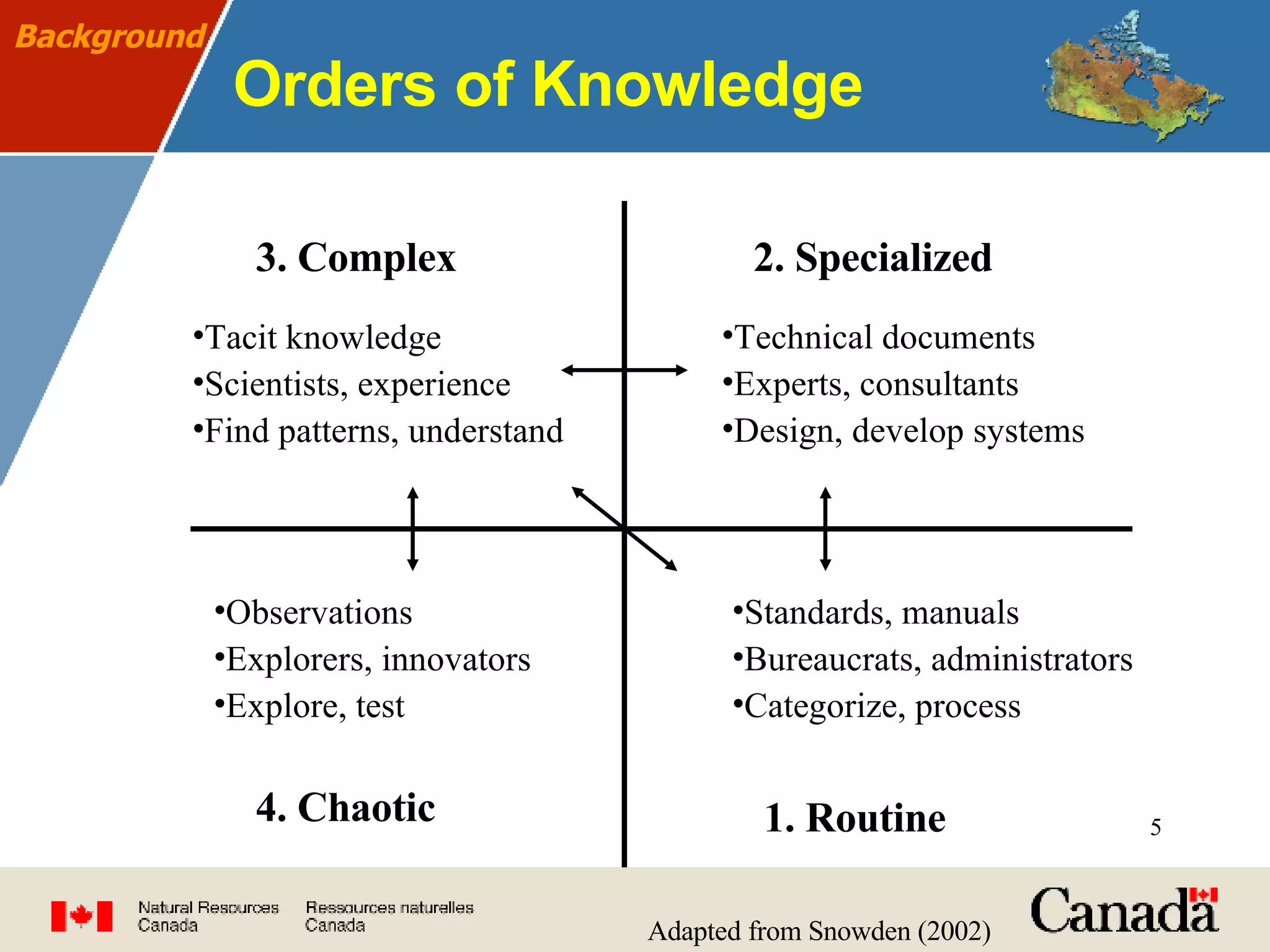
Orders of Knowledge   Adapted from Snowden (2002) Background 1. Routine Standards, manuals Bureaucrats, administrators Categorize, process 2. Specialized Technical documents Experts, consultants Design, develop systems 3. Complex Tacit knowledge Scientists, experience Find patterns, understand  4. Chaotic Observations Explorers, innovators Explore, test
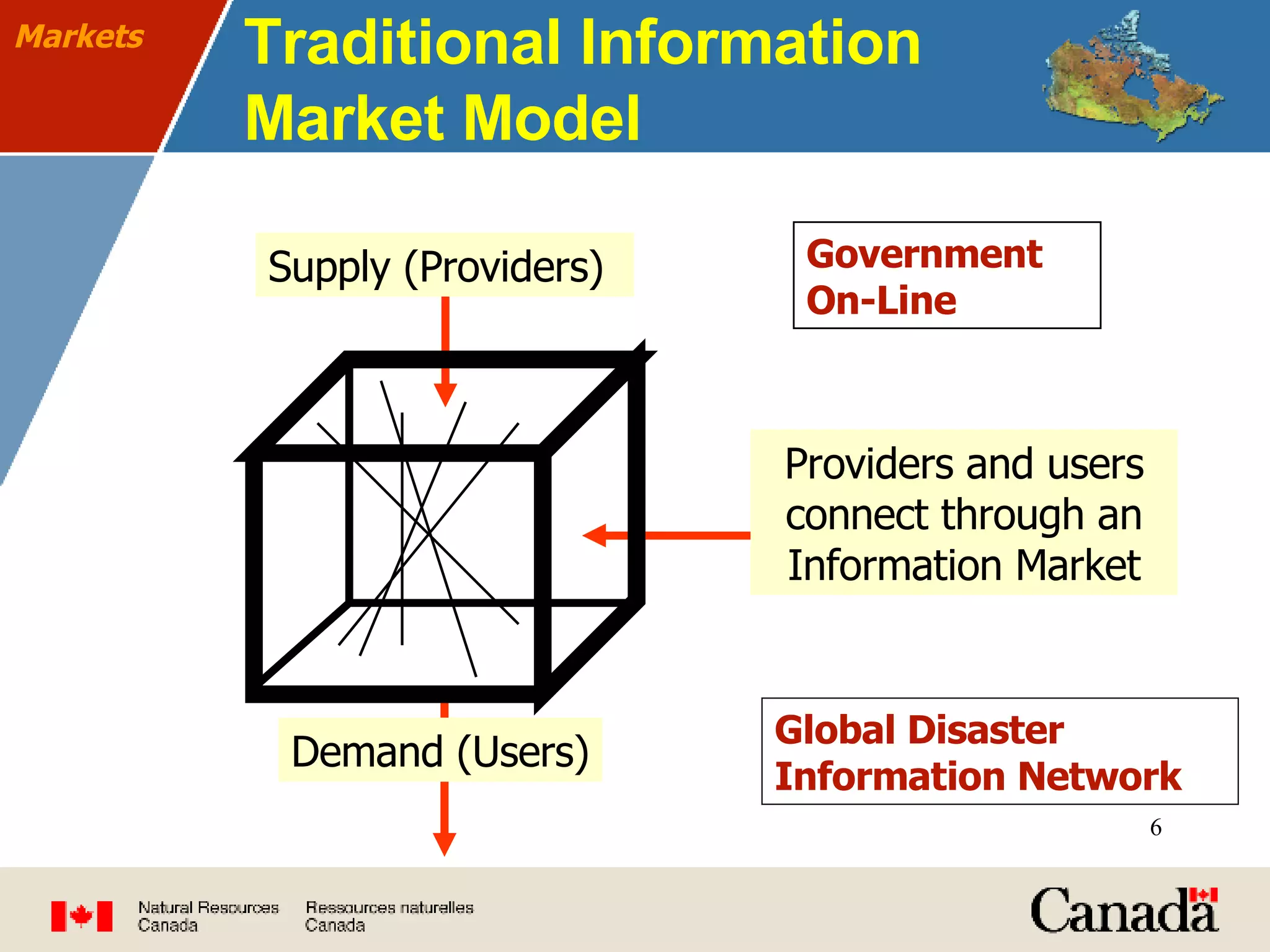
Traditional Information  Market Model   Government On-Line Global Disaster Information Network Markets Demand (Users) Supply (Providers) Providers and users connect through an Information Market
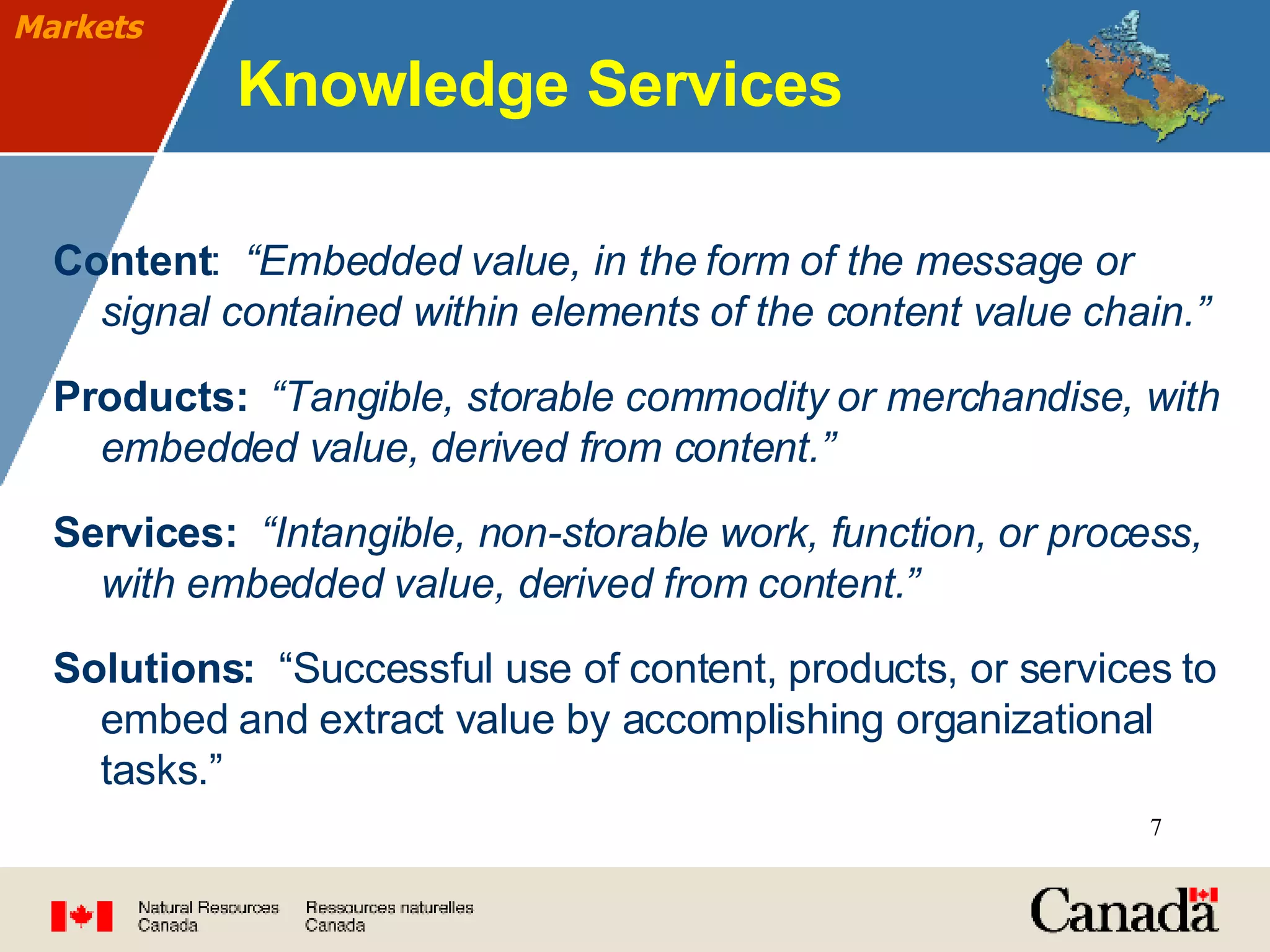
Knowledge Services Content :  “Embedded value, in the form of the message or signal contained within elements of the content value chain.”   Products:   “Tangible, storable commodity or merchandise, with embedded value, derived from content.”   Services:   “Intangible, non-storable work, function, or process, with embedded value, derived from content.” Solutions:  “Successful use of content, products, or services to embed and extract value by accomplishing organizational tasks.” Markets
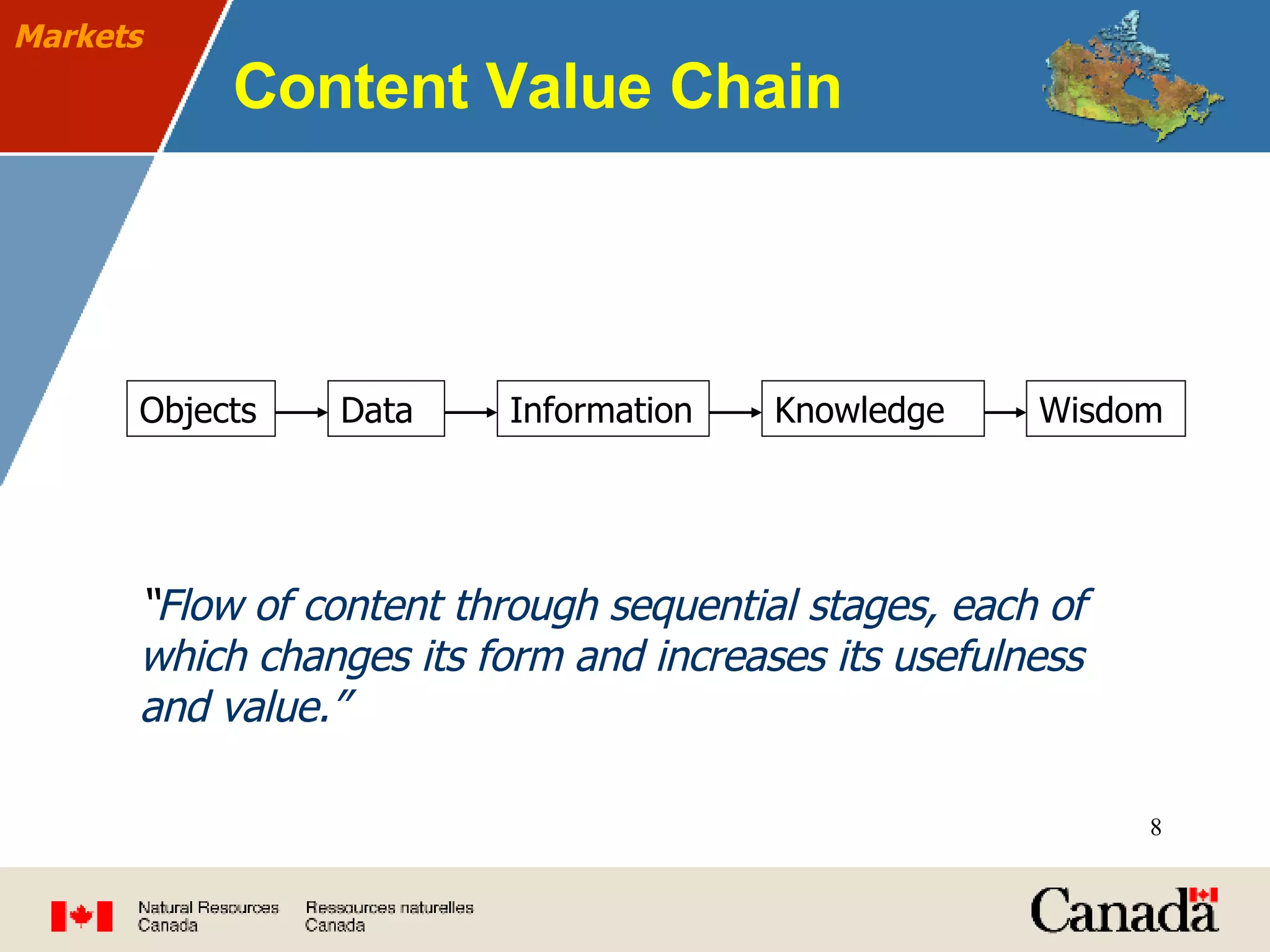
Content Value Chain “ Flow of content through sequential stages, each of which changes its form and increases its usefulness and value.” Markets Objects Data Information Knowledge Wisdom
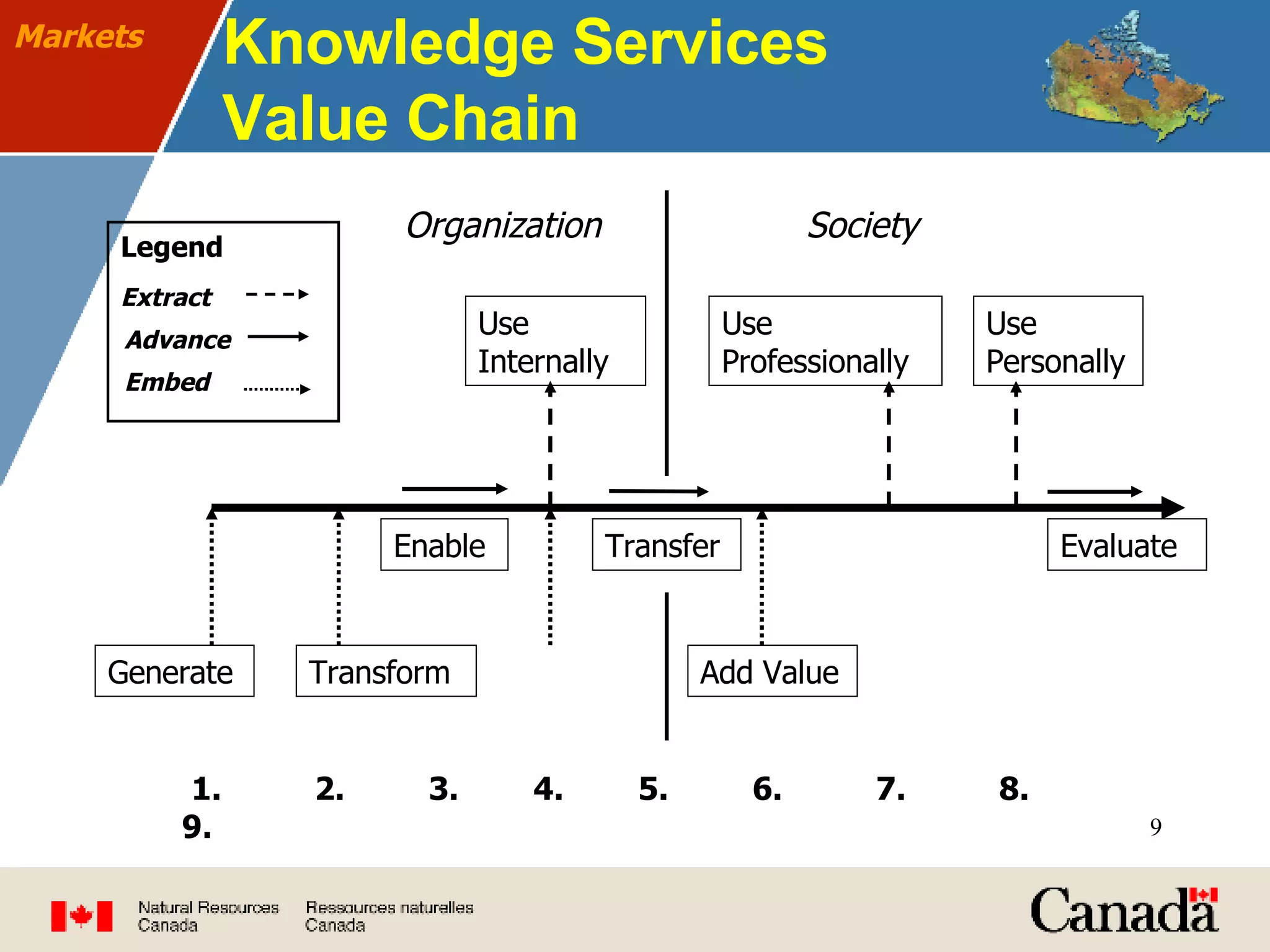
Knowledge Services Value Chain 1.  2.  3.  4.  5.  6.  7.  8.  9. Markets Generate Transform Add Value Use Internally Use Professionally Use Personally Transfer Evaluate Enable Extract Advance Embed Legend Organization Society
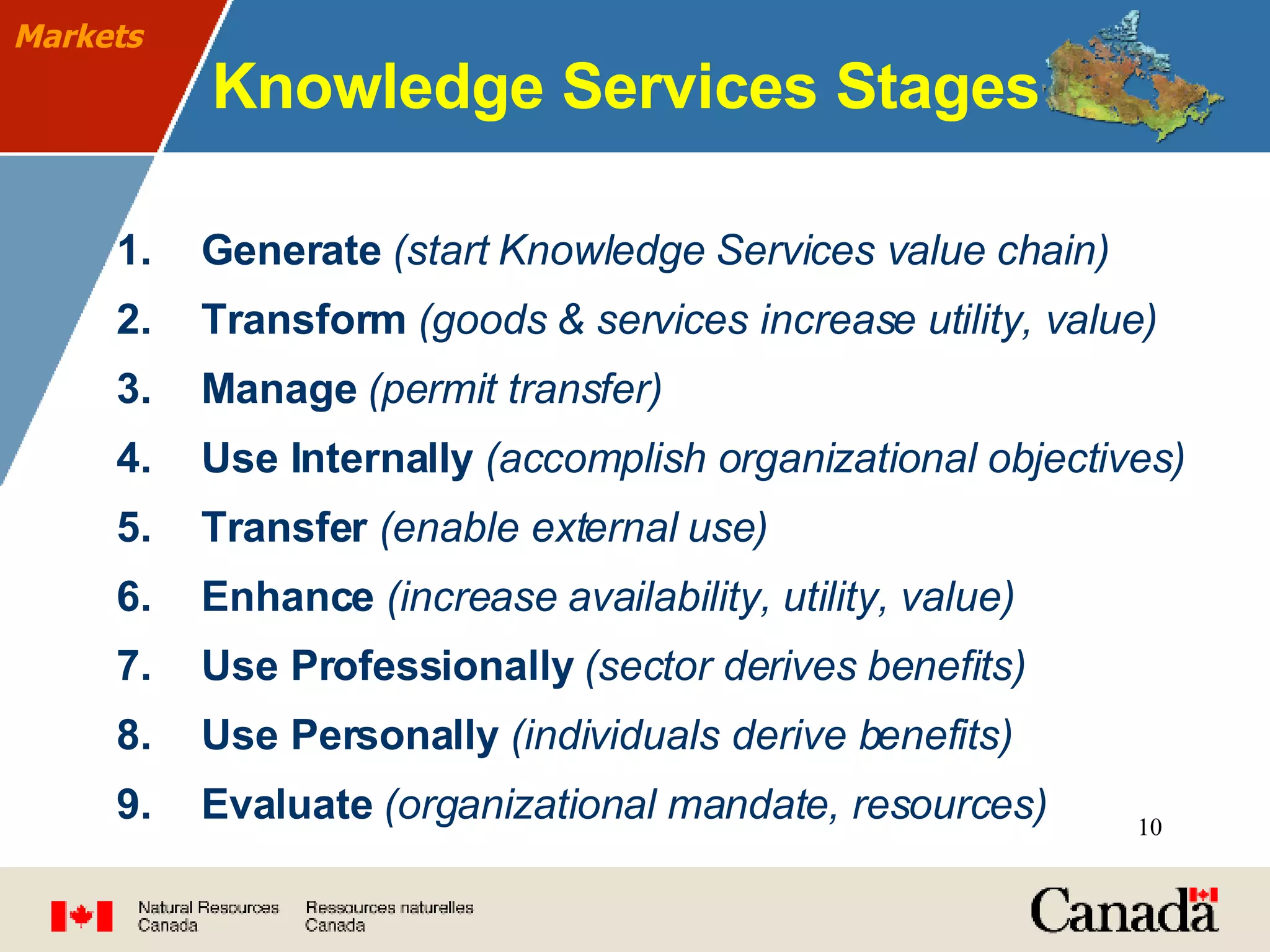
Knowledge Services Stages Generate   (start Knowledge Services value chain) Transform   (goods & services increase utility, value) Manage   (permit transfer) Use Internally   (accomplish organizational objectives) Transfer   (enable external use) Enhance   (increase availability, utility, value)   Use Professionally   (sector derives benefits) Use Personally   (individuals derive benefits) Evaluate  (organizational mandate, resources) Markets
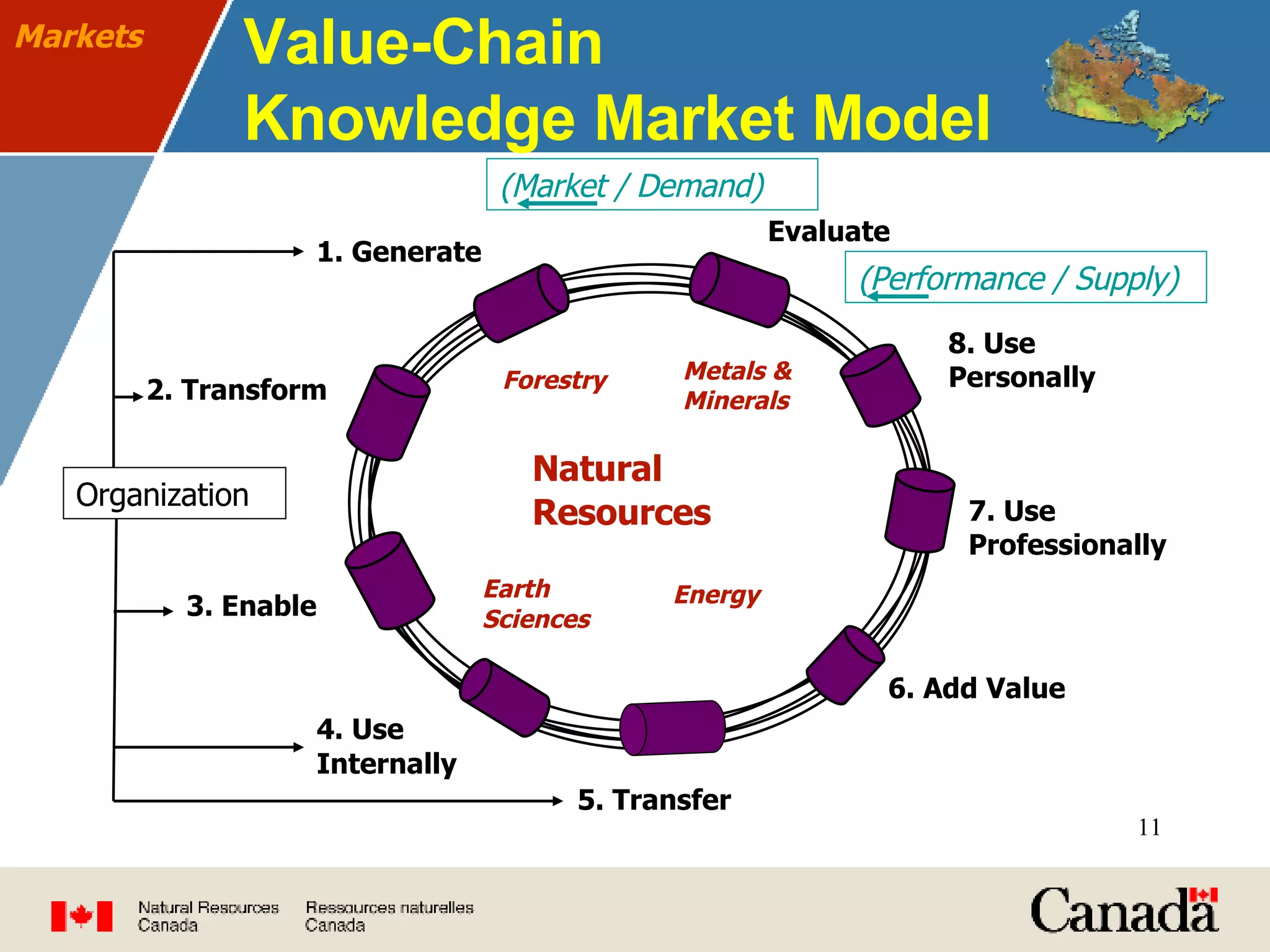
Value-Chain  Knowledge Market Model Markets (Performance / Supply) (Market / Demand) 6. Add Value 7. Use Professionally 8. Use Personally Evaluate Natural   Resources Forestry Metals & Minerals Earth   Sciences Energy 1. Generate 2. Transform 3. Enable 4. Use   Internally 5. Transfer Organization
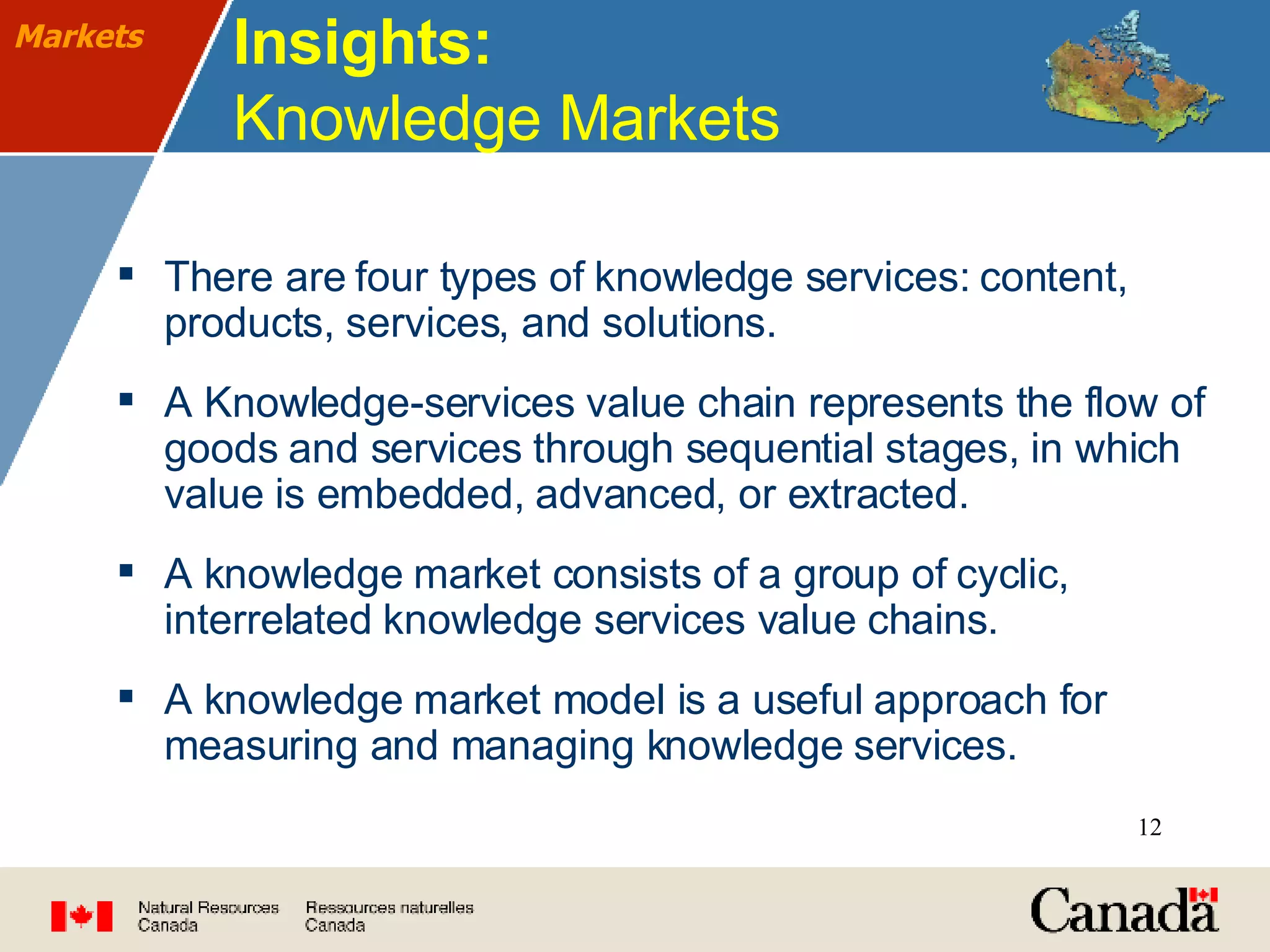
Insights:  Knowledge Markets There are four types of knowledge services: content, products, services, and solutions. A Knowledge-services value chain represents the flow of goods and services through sequential stages, in which value is embedded, advanced, or extracted. A knowledge market consists of a group of cyclic, interrelated knowledge services value chains. A knowledge market model is a useful approach for measuring and managing knowledge services. Markets
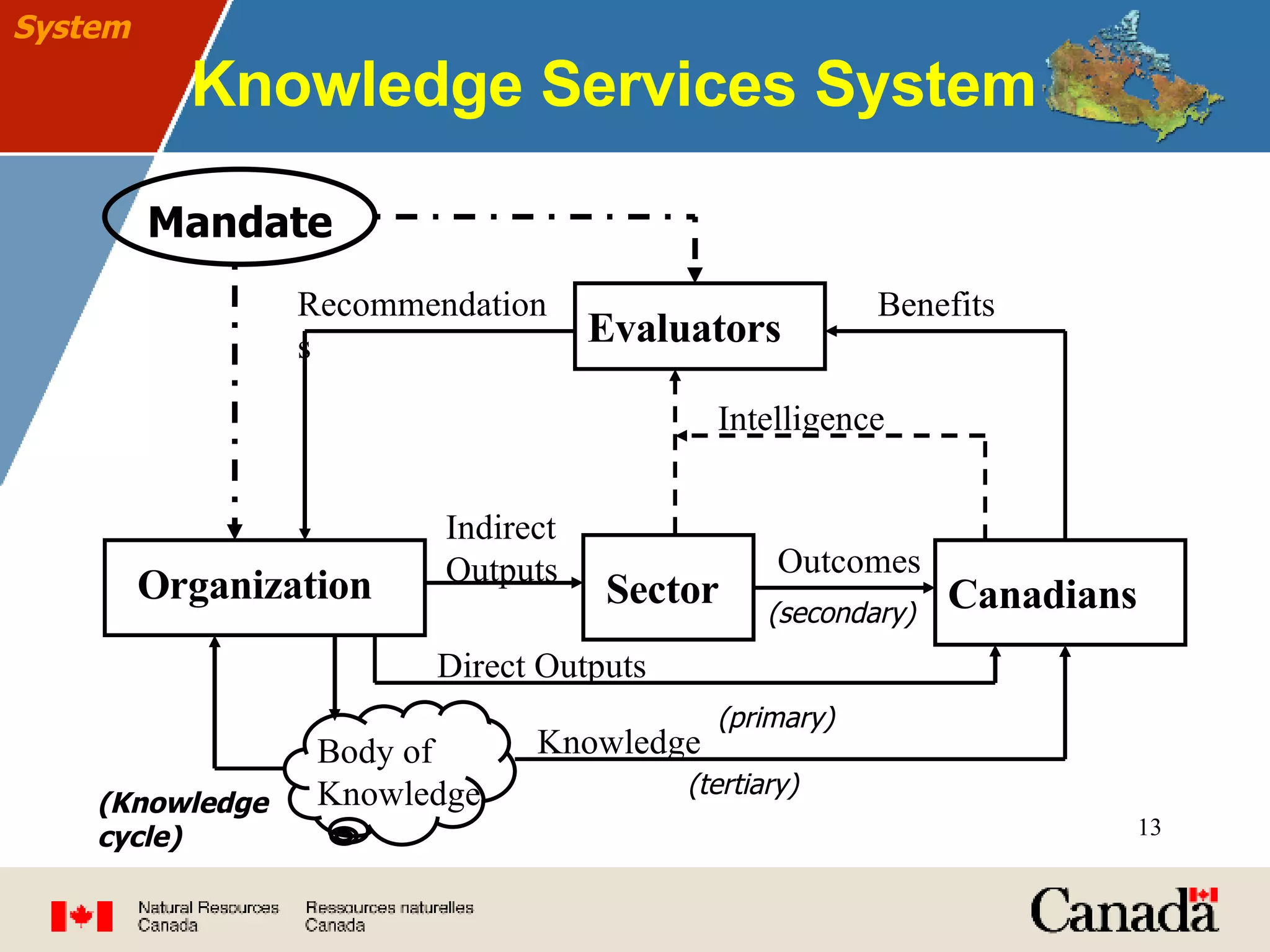
Knowledge Services System System Indirect Outputs Sector Outcomes Canadians Intelligence Organization Mandate Body of Knowledge (Knowledge cycle) Direct Outputs Evaluators Recommendations Benefits (tertiary) (secondary) (primary) Knowledge
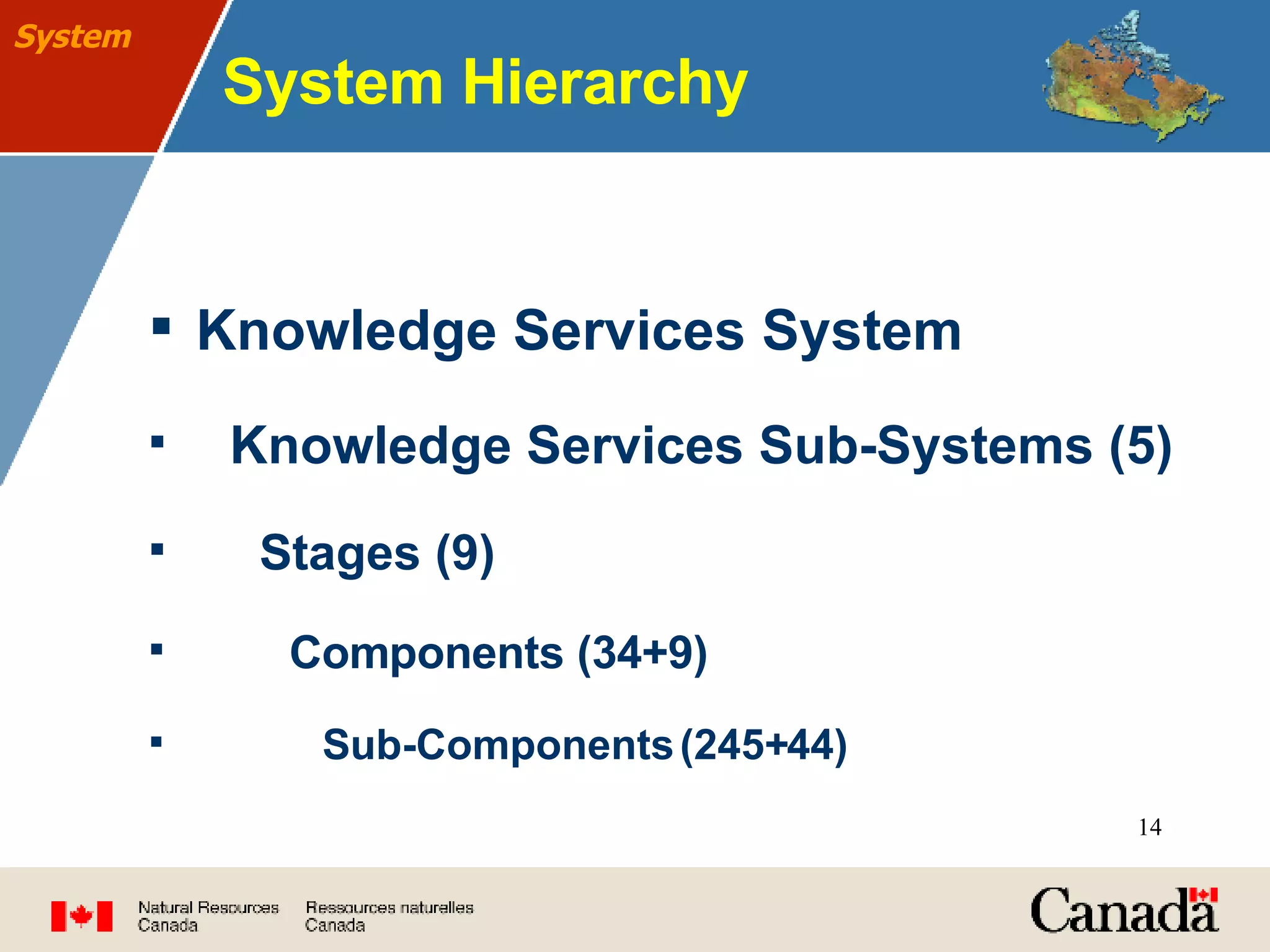
System Hierarchy Knowledge Services System Knowledge Services Sub-Systems (5) Stages (9) Components (34+9) Sub-Components (245+44) System
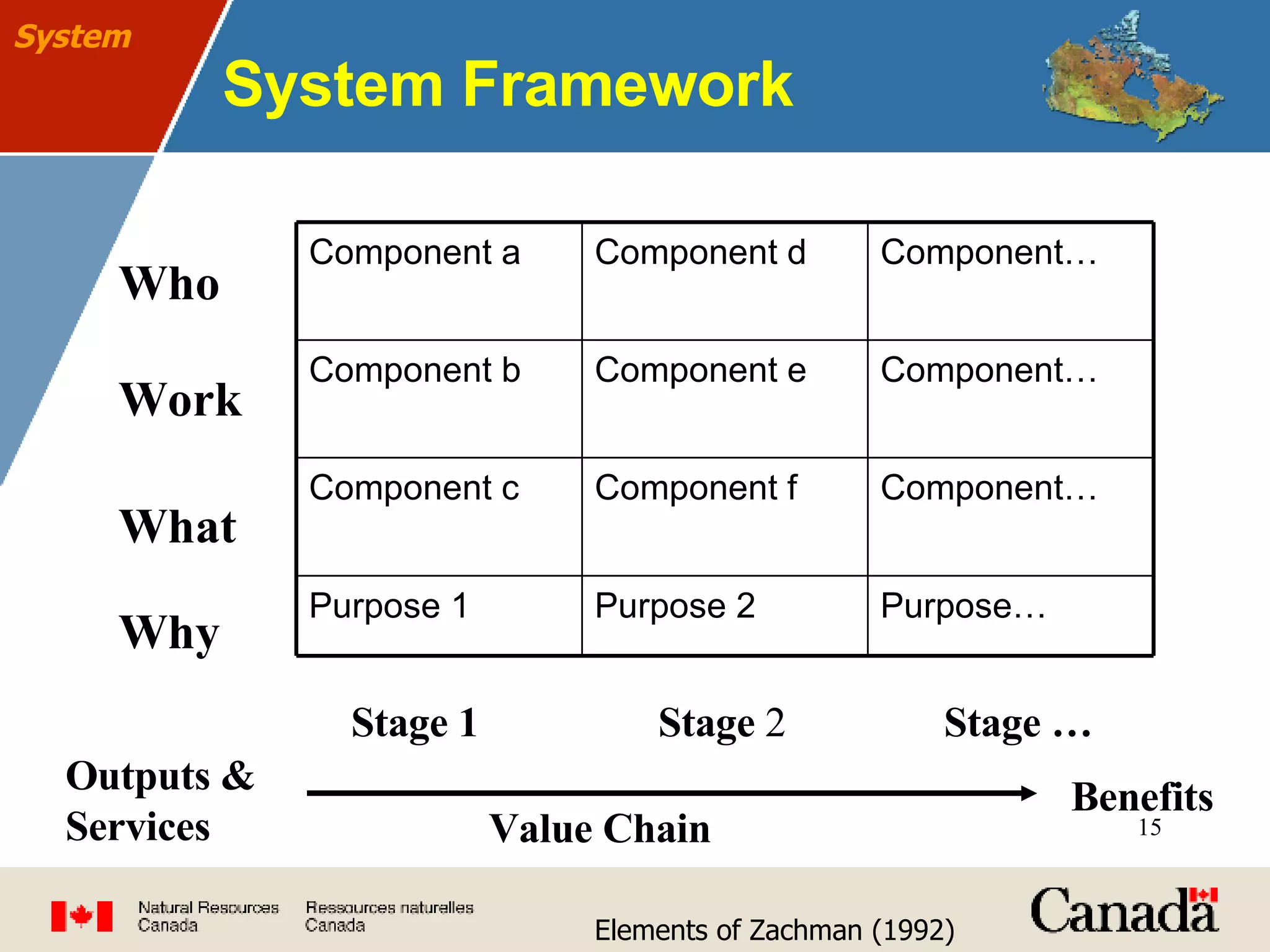
System Framework Elements of Zachman (1992) System Component… Component f Component c Component… Component e Component b Purpose… Purpose 2 Purpose 1 Component… Component d Component a Stage 1 Stage  2 Stage … Outputs & Services Value Chain Benefits Who Work What Why
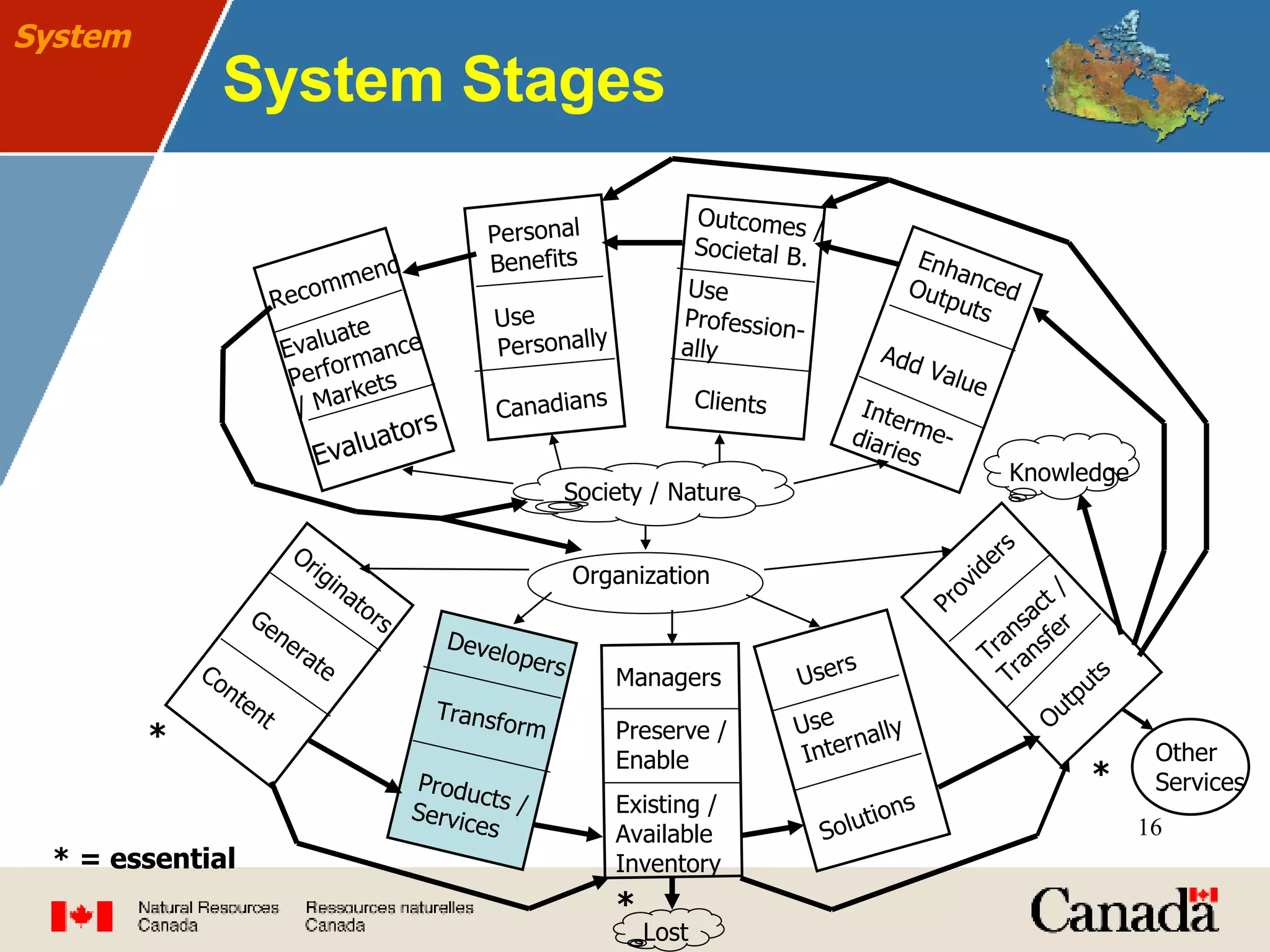
System Stages * = essential System Organization Society / Nature Interme-diaries Add Value Enhanced Outputs Developers Transform Products / Services Users Use Internally  Solutions Evaluators Evaluate Performance/ Markets Recommend Clients Use Profession-ally Outcomes / Societal B. Canadians Use Personally  Personal Benefits Originators Generate Content * Lost Managers Preserve / Enable Existing / Available Inventory * Providers Transact / Transfer Outputs Knowledge * Other Services
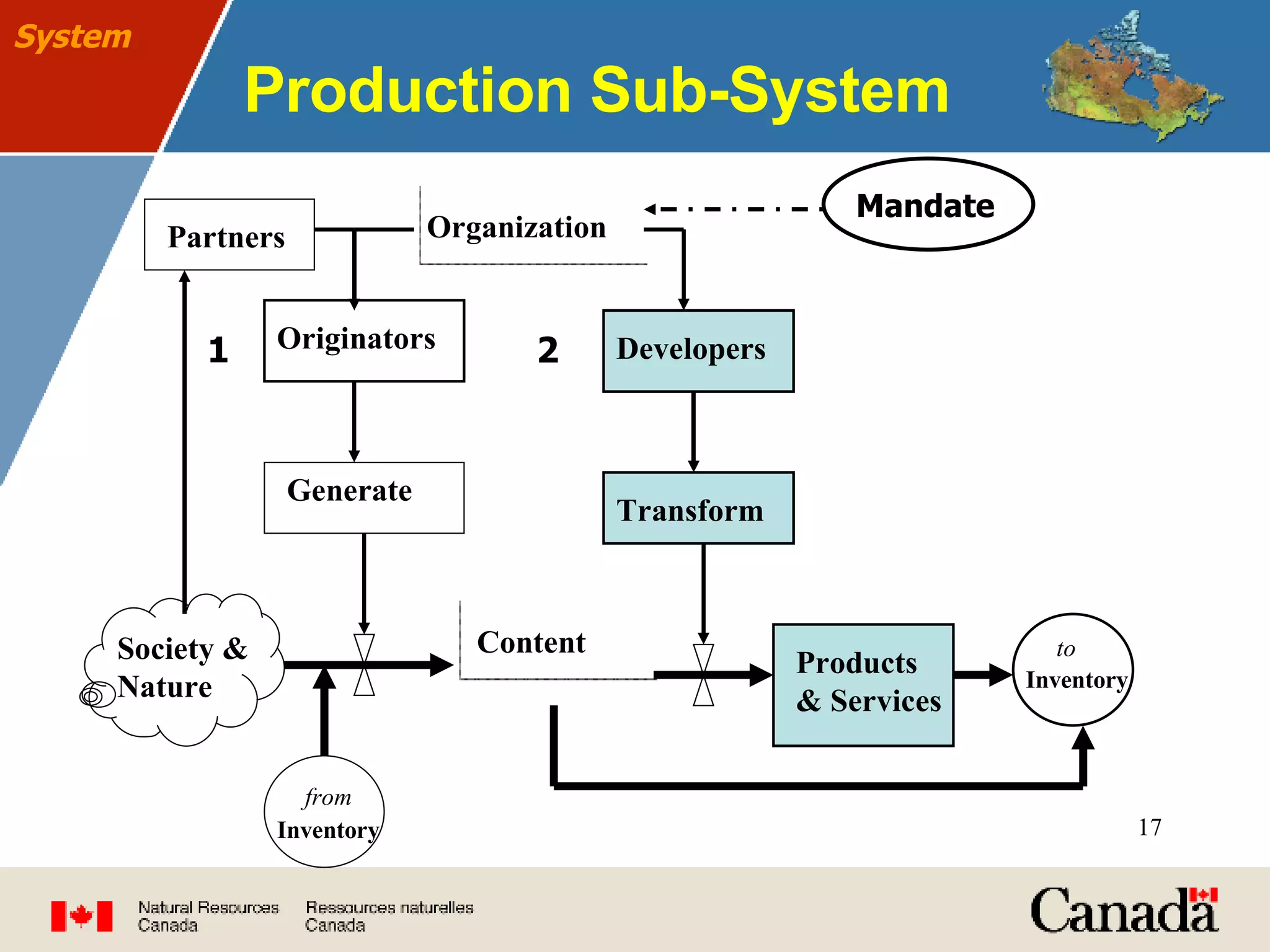
Production Sub-System System to  Inventory from   Inventory Society & Nature Content Generate Originators 1 Partners Organization Mandate 2 Products & Services Transform Developers
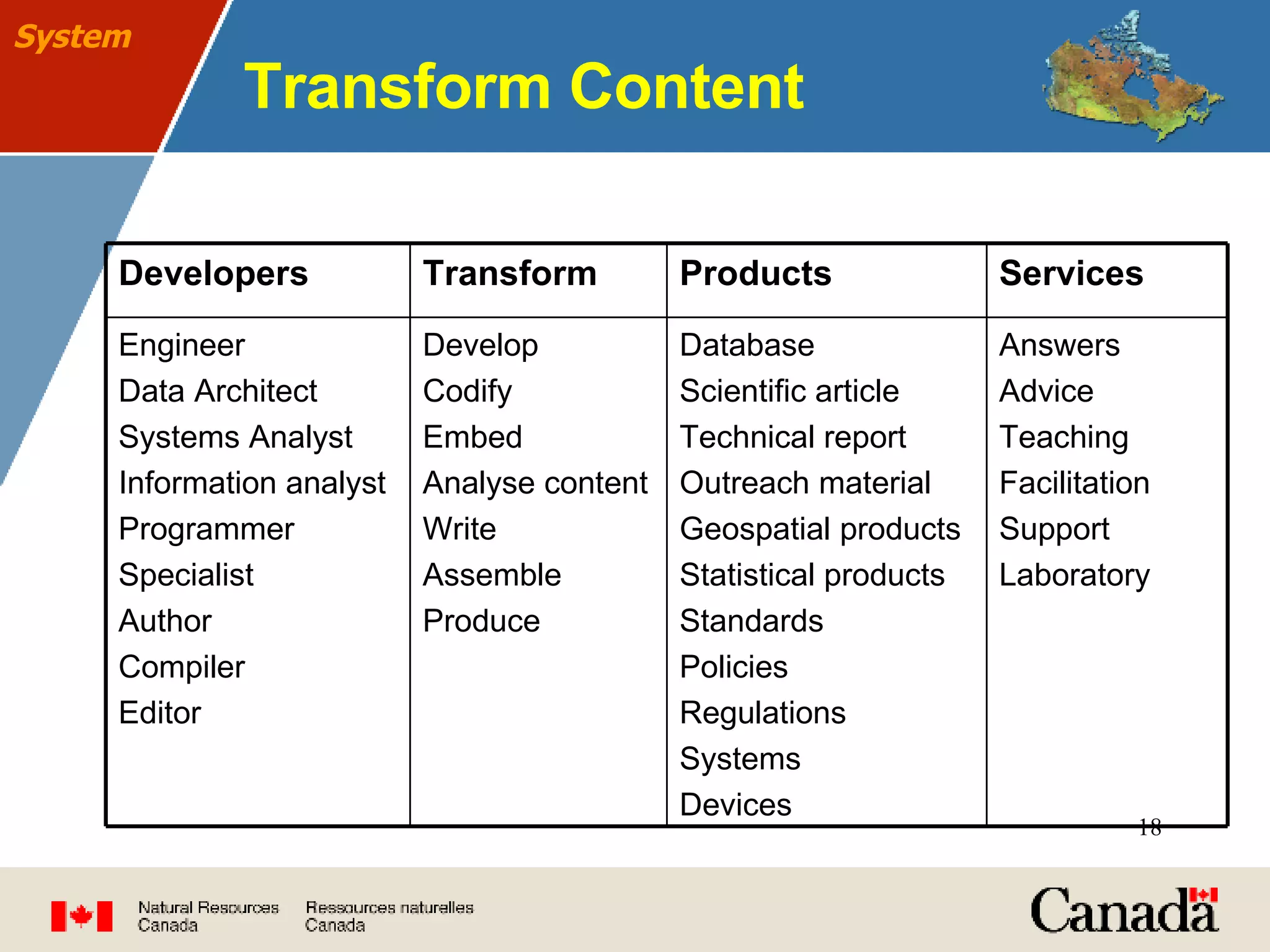
Transform Content System Answers Advice Teaching Facilitation Support Laboratory Database Scientific article Technical report Outreach material Geospatial products Statistical products Standards Policies Regulations Systems Devices Develop Codify Embed Analyse content Write Assemble Produce Engineer Data Architect Systems Analyst Information analyst Programmer Specialist Author  Compiler Editor Services Products Transform Developers
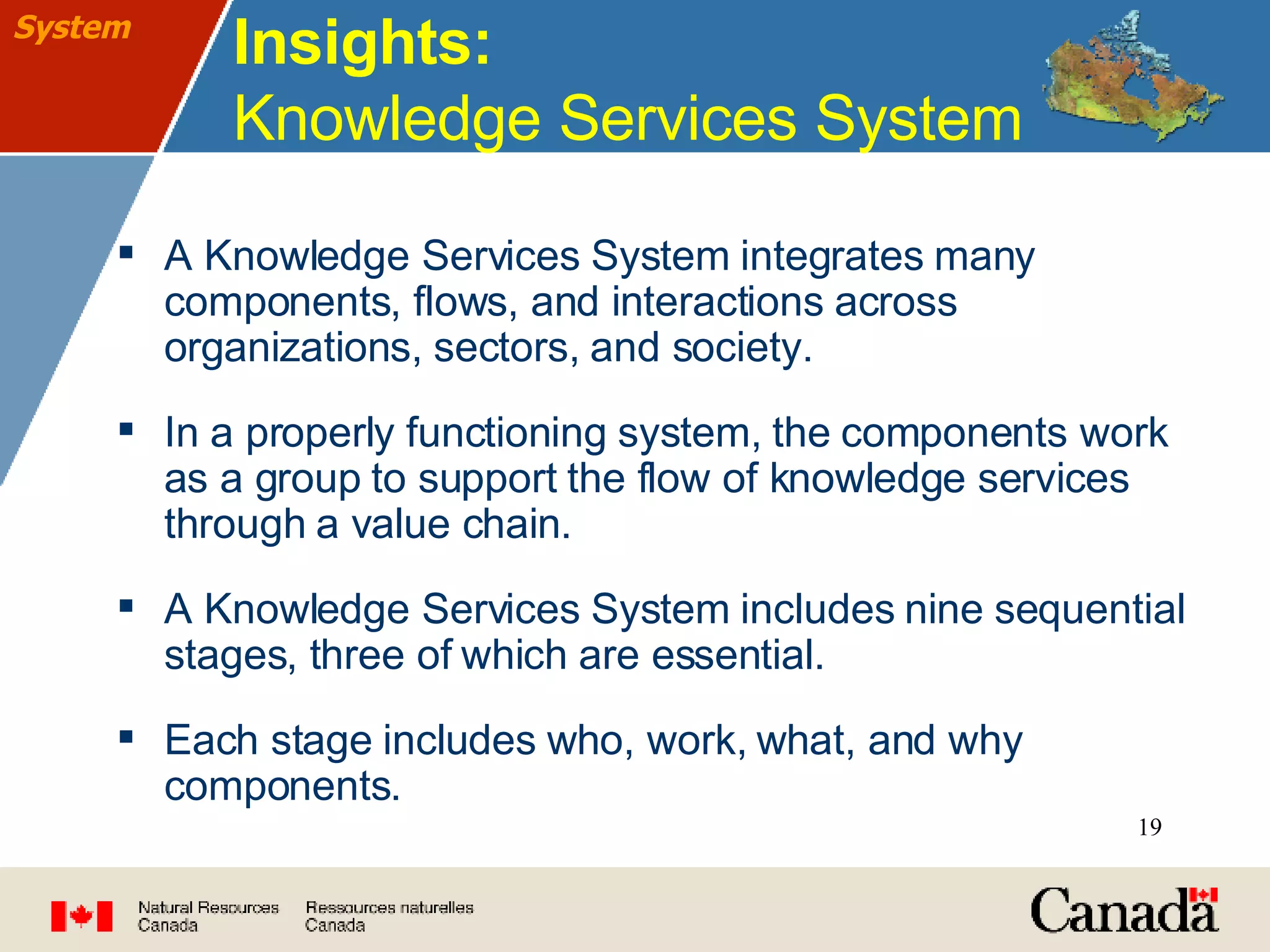
Insights:  Knowledge Services System A Knowledge Services System integrates many components, flows, and interactions across organizations, sectors, and society. In a properly functioning system, the components work as a group to support the flow of knowledge services through a value chain. A Knowledge Services System includes nine sequential stages, three of which are essential. Each stage includes who, work, what, and why components. System
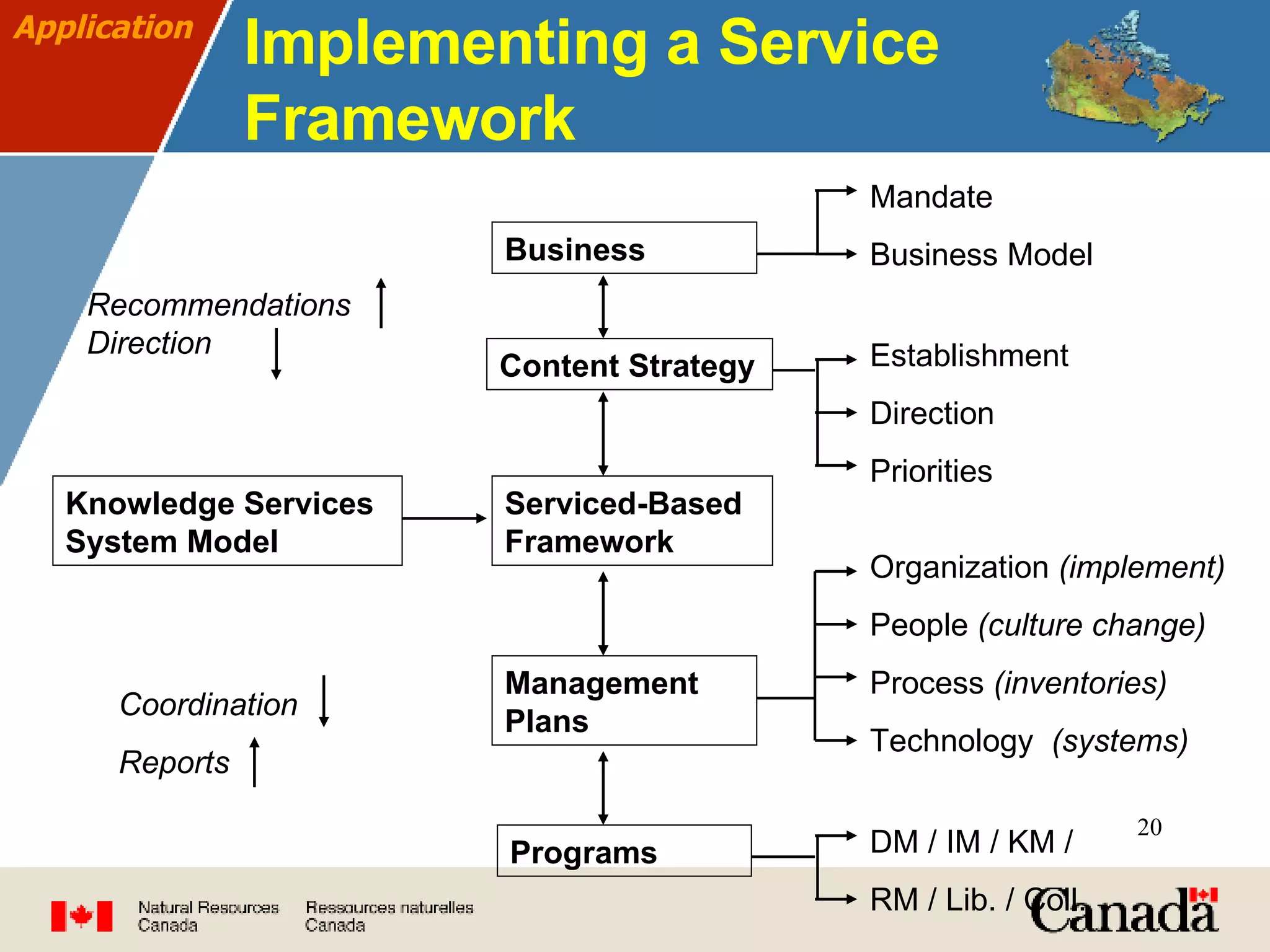
Implementing a Service Framework   Application Knowledge Services System Model Serviced-Based Framework Management Plans Programs Content Strategy Business Mandate Business Model Establishment Direction Priorities Organization  (implement) People  (culture change) Process  (inventories) Technology  (systems) DM / IM / KM /  RM / Lib. / Coll. Recommendations Direction Coordination Reports
Some Strategic Questions Organizational role in information and knowledge markets? Balance between supply- and demand-driven approaches to knowledge markets? Distribution of outputs among different user groups?  Position of outputs and services along a spectrum from rich to reach? Functional or service framework for managing content? Application
A Final Thought… “ The first task of any theory is to clarify terms and concepts that are confused… Only after agreement has been reached regarding terms and concepts can we hope to consider the issues easily and clearly and expect to share the same viewpoint.” Karl Von Clausewitz (1780-1831)

Knowledge Markets

  • 1.
    Knowledge Markets: More than Providers and Users Presented to: IPSI Montreal June 30 to July 3, 2006 Albert Simard Director, Knowledge Strategies Natural Resources Canada
  • 2.
    Presentation Outline BackgroundKnowledge Markets Knowledge Services System Application
  • 3.
    An Opening Thought…“ One of the saddest features of the real world is that goods do not spontaneously present themselves for distribution.”      The Economist (Nov. 5, 1994) Background
  • 4.
    Task Group Mandate“ Examine the nature of science-related programs in Natural Resources Canada, describe appropriate elements in the context of Government of Canada Service Transformation, and submit a report.” Background
  • 5.
    Orders of Knowledge Adapted from Snowden (2002) Background 1. Routine Standards, manuals Bureaucrats, administrators Categorize, process 2. Specialized Technical documents Experts, consultants Design, develop systems 3. Complex Tacit knowledge Scientists, experience Find patterns, understand 4. Chaotic Observations Explorers, innovators Explore, test
  • 6.
    Traditional Information Market Model Government On-Line Global Disaster Information Network Markets Demand (Users) Supply (Providers) Providers and users connect through an Information Market
  • 7.
    Knowledge Services Content: “Embedded value, in the form of the message or signal contained within elements of the content value chain.” Products: “Tangible, storable commodity or merchandise, with embedded value, derived from content.” Services: “Intangible, non-storable work, function, or process, with embedded value, derived from content.” Solutions: “Successful use of content, products, or services to embed and extract value by accomplishing organizational tasks.” Markets
  • 8.
    Content Value Chain“ Flow of content through sequential stages, each of which changes its form and increases its usefulness and value.” Markets Objects Data Information Knowledge Wisdom
  • 9.
    Knowledge Services ValueChain 1. 2. 3. 4. 5. 6. 7. 8. 9. Markets Generate Transform Add Value Use Internally Use Professionally Use Personally Transfer Evaluate Enable Extract Advance Embed Legend Organization Society
  • 10.
    Knowledge Services StagesGenerate (start Knowledge Services value chain) Transform (goods & services increase utility, value) Manage (permit transfer) Use Internally (accomplish organizational objectives) Transfer (enable external use) Enhance (increase availability, utility, value) Use Professionally (sector derives benefits) Use Personally (individuals derive benefits) Evaluate (organizational mandate, resources) Markets
  • 11.
    Value-Chain KnowledgeMarket Model Markets (Performance / Supply) (Market / Demand) 6. Add Value 7. Use Professionally 8. Use Personally Evaluate Natural Resources Forestry Metals & Minerals Earth Sciences Energy 1. Generate 2. Transform 3. Enable 4. Use Internally 5. Transfer Organization
  • 12.
    Insights: KnowledgeMarkets There are four types of knowledge services: content, products, services, and solutions. A Knowledge-services value chain represents the flow of goods and services through sequential stages, in which value is embedded, advanced, or extracted. A knowledge market consists of a group of cyclic, interrelated knowledge services value chains. A knowledge market model is a useful approach for measuring and managing knowledge services. Markets
  • 13.
    Knowledge Services SystemSystem Indirect Outputs Sector Outcomes Canadians Intelligence Organization Mandate Body of Knowledge (Knowledge cycle) Direct Outputs Evaluators Recommendations Benefits (tertiary) (secondary) (primary) Knowledge
  • 14.
    System Hierarchy KnowledgeServices System Knowledge Services Sub-Systems (5) Stages (9) Components (34+9) Sub-Components (245+44) System
  • 15.
    System Framework Elementsof Zachman (1992) System Component… Component f Component c Component… Component e Component b Purpose… Purpose 2 Purpose 1 Component… Component d Component a Stage 1 Stage 2 Stage … Outputs & Services Value Chain Benefits Who Work What Why
  • 16.
    System Stages *= essential System Organization Society / Nature Interme-diaries Add Value Enhanced Outputs Developers Transform Products / Services Users Use Internally Solutions Evaluators Evaluate Performance/ Markets Recommend Clients Use Profession-ally Outcomes / Societal B. Canadians Use Personally Personal Benefits Originators Generate Content * Lost Managers Preserve / Enable Existing / Available Inventory * Providers Transact / Transfer Outputs Knowledge * Other Services
  • 17.
    Production Sub-System Systemto Inventory from Inventory Society & Nature Content Generate Originators 1 Partners Organization Mandate 2 Products & Services Transform Developers
  • 18.
    Transform Content SystemAnswers Advice Teaching Facilitation Support Laboratory Database Scientific article Technical report Outreach material Geospatial products Statistical products Standards Policies Regulations Systems Devices Develop Codify Embed Analyse content Write Assemble Produce Engineer Data Architect Systems Analyst Information analyst Programmer Specialist Author Compiler Editor Services Products Transform Developers
  • 19.
    Insights: KnowledgeServices System A Knowledge Services System integrates many components, flows, and interactions across organizations, sectors, and society. In a properly functioning system, the components work as a group to support the flow of knowledge services through a value chain. A Knowledge Services System includes nine sequential stages, three of which are essential. Each stage includes who, work, what, and why components. System
  • 20.
    Implementing a ServiceFramework Application Knowledge Services System Model Serviced-Based Framework Management Plans Programs Content Strategy Business Mandate Business Model Establishment Direction Priorities Organization (implement) People (culture change) Process (inventories) Technology (systems) DM / IM / KM / RM / Lib. / Coll. Recommendations Direction Coordination Reports
  • 21.
    Some Strategic QuestionsOrganizational role in information and knowledge markets? Balance between supply- and demand-driven approaches to knowledge markets? Distribution of outputs among different user groups? Position of outputs and services along a spectrum from rich to reach? Functional or service framework for managing content? Application
  • 22.
    A Final Thought…“ The first task of any theory is to clarify terms and concepts that are confused… Only after agreement has been reached regarding terms and concepts can we hope to consider the issues easily and clearly and expect to share the same viewpoint.” Karl Von Clausewitz (1780-1831)

Editor's Notes

  • #2 Today, I’d like to go beyond knowledge management to discuss knowledge services and knowledge markets.