Knowledge Management: Overview  By M. SURULINATHI Assistant Librarian [email_address]
What is Knowledge Management?   Knowledge Management is planning, designing, building, operating and maintaining the knowledge Management System.   Knowledge Management is managing knowledge of  ·  Information in Document   (Sounds, Images and Text)
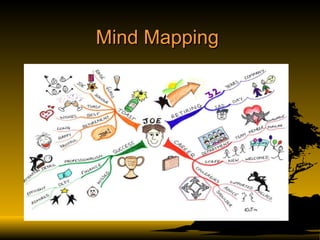
Knowledge in People Heads   -Collaboration -Storytelling -Mind mapping Organizational Memory -Knowledge Re-use -Community of Practice -Lesson Learning
Conversion of Information to Knowledge -Logical intelligence -Collaborative Intelligence -Sensory Experience -Intuition and Technology Experience Learning Methods -Discovery Learning -Constructivist Learning -Task-based Learning -Goal-based Learning
Definition of Knowledge Management   According to Ouitas et al. (1997) Knowledge Management is to discover, develop, utilize, deliver and absorb knowledge inside and outside the organization through an appropriate management process to meet current and future needs
Types of Knowledge Explicit Knowledge Tacit Knowledge
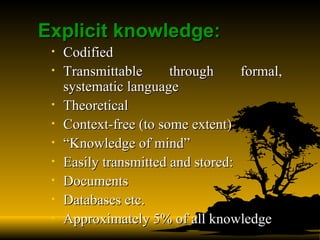
Explicit knowledge:   Codified Transmittable through formal, systematic language Theoretical Context-free (to some extent) “ Knowledge of mind” Easily transmitted and stored: Documents Databases etc. Approximately 5% of all knowledge
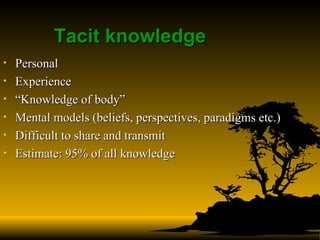
Tacit knowledge  Personal Experience “ Knowledge of body” Mental models (beliefs, perspectives, paradigms etc.) Difficult to share and transmit Estimate: 95% of all knowledge
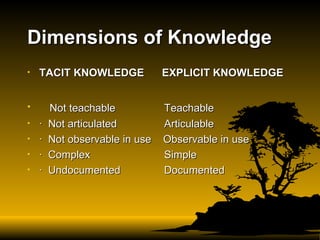
Dimensions of Knowledge TACIT KNOWLEDGE  EXPLICIT KNOWLEDGE Not teachable    Teachable ·  Not articulated    Articulable ·  Not observable in use  Observable in use ·  Complex    Simple ·  Undocumented    Documented
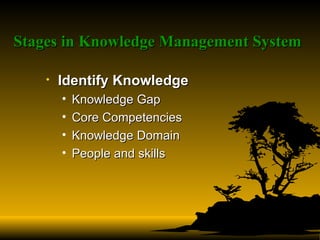
Stages in Knowledge Management System   Identify Knowledge Knowledge Gap Core Competencies Knowledge Domain People and skills
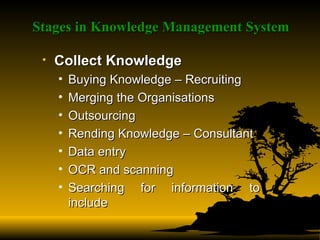
Stages in Knowledge Management System Collect Knowledge Buying Knowledge – Recruiting Merging the Organisations Outsourcing Rending Knowledge – Consultant Data entry  OCR and scanning  Searching for information to include
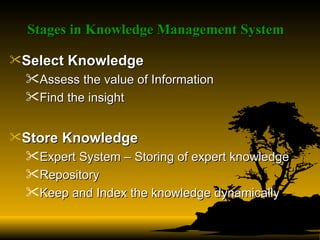
Stages in Knowledge Management System Select Knowledge Assess the value of Information Find the insight Store Knowledge Expert System – Storing of expert knowledge Repository Keep and Index the knowledge dynamically
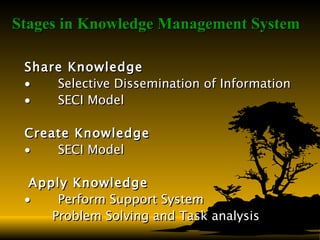
Stages in Knowledge Management System Share Knowledge           Selective Dissemination of Information           SECI Model   Create Knowledge           SECI Model     Apply Knowledge           Perform Support System Problem Solving and Task analysis
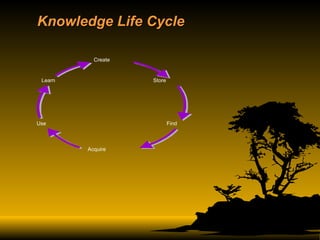
Knowledge Life Cycle Create Store Find Acquire Use Learn
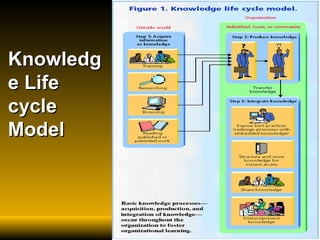
Knowledge Life cycle Model
Learning styles and Knowledge Management "Learning Styles" are a way to help improve learning performance.
What are learning styles?   Learning styles are simply different approaches or ways of learning.
What are the types of learning styles?   Visual Learners - Visual Learning Auditory Learners - Auditory Learning Tactile Learners - Tactile Learning
Visual Learners:  learn through seeing   These learners need to see the teacher's body language and facial expression to fully understand the content of a lesson.   They may think in pictures and learn best from visual displays including: diagrams, illustrated text books, overhead transparencies and videos etc… 
Auditory Learners:  learn through listening   These learners often benefit from reading text aloud and using a tape recorder. They learn best through verbal lectures, discussions, talking things through and listening to what others have to say.
Tactile Learners: Learn through, moving, doing and touching.  Tactile persons learn best through a hands-on approach, actively exploring the physical world around them.
Learning Methods Discovering Learning Constructionist Learning  Task-based Learning Goal-based Learning
Learning Management System  ( LMS)   LMS is a complete, secure, web-based training and e-learning solution that employs a simple user interface.
Free & Open Source Software for LMS   Moodle - an open source learning management system -  http:// moodle.org / Dokeos - Open Source Learning & Knowledge Management -  http:// www.dokeos.com / Formagri/Ceres -  http:// www.formagri.educagri.fr RELOAD: Reusable Learning Object Authoring and Delivery -  http:// www.reload.ac.uk / TinyLMS -  http:// www.randelshofer.ch/tinylms/download.html Fle3 Learning Environment -  http://fle3.uiah.fi COL Learning Object Repository -  http://www.col.org/lor OLAT - Online Learning And Training -  http:// www.olat.org eXe (e-Learning XHTML Editor) -  http:// exelearning.org
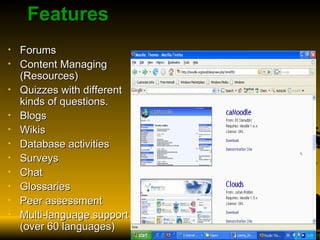
Moodle Course Management Software   Moodle is designed to help educators create online courses with opportunities for rich interaction.  It is bringing together users and developers from all over the world into discussions about using and developing as their platform of choice for internet-based learning.
Features Forums Content Managing (Resources) Quizzes with different kinds of questions. Blogs Wikis Database activities Surveys Chat Glossaries Peer assessment Multi-language support (over 60 languages)
Mind Mapping
Storytelling Storytelling as a valuable Knowledge Management technique for sharing knowledge Benefits of Storytelling Communicate quickly  Communicate naturally  Communicate clearly  Communicate truthfully  Communicate collaboratively  Communicate accurately  Communicate entertainingly  Communicate movingly  Communicate feelingly  Communicate intuitively
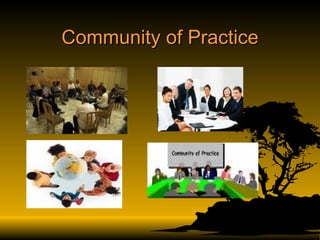
Community of Practice
KM Software- Microsoft Office SharePoint Server   To facilitate collaboration, provide content management features, implement business processes, and supply access to information that is essential to organizational goals and processes.
http://www.microsoft.com/sharepoint/capabilities/portals/demos.mspx
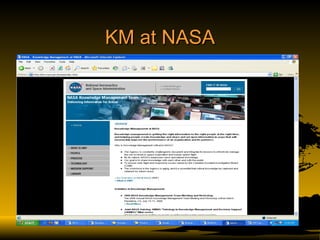
KM at NASA
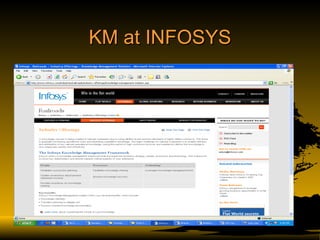
KM at INFOSYS
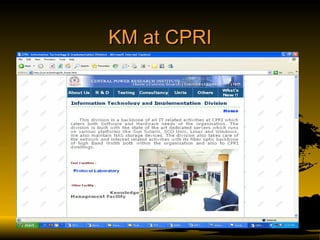
KM at CPRI
Knowledge Management in Libraries Libraries should be developed and maintained an integrated online public access catalogue (OPAC) with both internal and external resources as well as printed and other formats of knowledge. Useful websites and knowledge sources should be regularly searched and selected from the internet
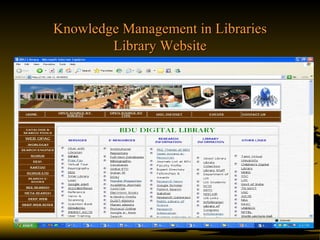
Knowledge Management in Libraries Going beyond explicit knowledge, libraries should also develop to capture all that tacit knowledge that is of importance to their users, their organizations, and to the internal operations of libraries. The website of each library should serve as a “portal” for all sources of relevant knowledge and information whether explicit or tacit, whether on site or remote and in all formats.
Knowledge Management in Libraries Library Website
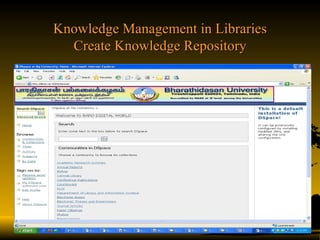
Knowledge Management in Libraries Create Knowledge Repository
Success Factors of Knowledge Management   The success of a KM initiative depends on many factors  Leadership  ( leaders model the behavior = CoP) Culture – ( reward systems ) Structure, roles and responsibilities –(steering committee, a central KM support group  etc) Information Technology Infrastructure etc…
Characteristics Of Knowledge Management In Libraries The role of KM in Libraries will become more and more important along with the development of knowledge economy. It is a new management mode. The following superiority and characteristics are incomparable with conventional management. Information technology is a tool for KM Human resource management in KM User Services in KM Knowledge Resource Management Resource Sharing and Networking
Technologies for the knowledge management. Intranet within an organization •  Document management systems •  Information retrieval systems •  Relational and object databases •  Electronic publishing •  Groupware and work flow systems •  Push technologies •  Help desk applications •  Brain storming applications •  Data warehousing and data mining
Advantages of Knowledge Management   Knowledge has been and continues to be the key to success and competitive advantage for every organization.  Effectively managing the processes of actively disseminating and of actively applying knowledge to making an organization successful is Knowledge Management (KM).
Conclusion In summary, Knowledge Management   involves connecting people with people, as well as people with information. They have to transform information and knowledge into action  The best knowledge creators are academics.
Conclusion Knowledge creation is best performed by universities.  As a learning and knowledge organization, universities should empower their libraries to develop campus-wide knowledge management systems.  It is now time for libraries to reposition themselves in the central stage of and as a leading player in knowledge management.
Reference http:// www.providersedge.com/kma/km_overview.htm http://defcon.sdsu.edu/1/objects/km/defining/index.htm#qgAn http://www.providersedge.com/docs/km_articles/Critical_Success_Factors_of_KM.pdf http://www.providersedge.com/docs/km_articles/KM_-_The_Road_Ahead_for_Success.pdf http://www.unsw.adfa.edu.au/units/research/BAM2005%202.pdf
THANK YOU

Knowledge Management Overview

  • 1.
    Knowledge Management: Overview By M. SURULINATHI Assistant Librarian [email_address]
  • 2.
    What is KnowledgeManagement? Knowledge Management is planning, designing, building, operating and maintaining the knowledge Management System. Knowledge Management is managing knowledge of ·  Information in Document (Sounds, Images and Text)
  • 3.
    Knowledge in PeopleHeads -Collaboration -Storytelling -Mind mapping Organizational Memory -Knowledge Re-use -Community of Practice -Lesson Learning
  • 4.
    Conversion of Informationto Knowledge -Logical intelligence -Collaborative Intelligence -Sensory Experience -Intuition and Technology Experience Learning Methods -Discovery Learning -Constructivist Learning -Task-based Learning -Goal-based Learning
  • 5.
    Definition of KnowledgeManagement According to Ouitas et al. (1997) Knowledge Management is to discover, develop, utilize, deliver and absorb knowledge inside and outside the organization through an appropriate management process to meet current and future needs
  • 6.
    Types of KnowledgeExplicit Knowledge Tacit Knowledge
  • 7.
    Explicit knowledge: Codified Transmittable through formal, systematic language Theoretical Context-free (to some extent) “ Knowledge of mind” Easily transmitted and stored: Documents Databases etc. Approximately 5% of all knowledge
  • 8.
    Tacit knowledge Personal Experience “ Knowledge of body” Mental models (beliefs, perspectives, paradigms etc.) Difficult to share and transmit Estimate: 95% of all knowledge
  • 9.
    Dimensions of KnowledgeTACIT KNOWLEDGE EXPLICIT KNOWLEDGE Not teachable Teachable · Not articulated Articulable · Not observable in use Observable in use · Complex Simple · Undocumented Documented
  • 10.
    Stages in KnowledgeManagement System Identify Knowledge Knowledge Gap Core Competencies Knowledge Domain People and skills
  • 11.
    Stages in KnowledgeManagement System Collect Knowledge Buying Knowledge – Recruiting Merging the Organisations Outsourcing Rending Knowledge – Consultant Data entry OCR and scanning Searching for information to include
  • 12.
    Stages in KnowledgeManagement System Select Knowledge Assess the value of Information Find the insight Store Knowledge Expert System – Storing of expert knowledge Repository Keep and Index the knowledge dynamically
  • 13.
    Stages in KnowledgeManagement System Share Knowledge          Selective Dissemination of Information          SECI Model   Create Knowledge          SECI Model     Apply Knowledge          Perform Support System Problem Solving and Task analysis
  • 14.
    Knowledge Life CycleCreate Store Find Acquire Use Learn
  • 15.
  • 16.
    Learning styles andKnowledge Management "Learning Styles" are a way to help improve learning performance.
  • 17.
    What are learningstyles? Learning styles are simply different approaches or ways of learning.
  • 18.
    What are thetypes of learning styles? Visual Learners - Visual Learning Auditory Learners - Auditory Learning Tactile Learners - Tactile Learning
  • 19.
    Visual Learners: learn through seeing These learners need to see the teacher's body language and facial expression to fully understand the content of a lesson. They may think in pictures and learn best from visual displays including: diagrams, illustrated text books, overhead transparencies and videos etc… 
  • 20.
    Auditory Learners: learn through listening These learners often benefit from reading text aloud and using a tape recorder. They learn best through verbal lectures, discussions, talking things through and listening to what others have to say.
  • 21.
    Tactile Learners: Learnthrough, moving, doing and touching. Tactile persons learn best through a hands-on approach, actively exploring the physical world around them.
  • 22.
    Learning Methods DiscoveringLearning Constructionist Learning Task-based Learning Goal-based Learning
  • 23.
    Learning Management System ( LMS) LMS is a complete, secure, web-based training and e-learning solution that employs a simple user interface.
  • 24.
    Free & OpenSource Software for LMS Moodle - an open source learning management system - http:// moodle.org / Dokeos - Open Source Learning & Knowledge Management - http:// www.dokeos.com / Formagri/Ceres - http:// www.formagri.educagri.fr RELOAD: Reusable Learning Object Authoring and Delivery - http:// www.reload.ac.uk / TinyLMS - http:// www.randelshofer.ch/tinylms/download.html Fle3 Learning Environment - http://fle3.uiah.fi COL Learning Object Repository - http://www.col.org/lor OLAT - Online Learning And Training - http:// www.olat.org eXe (e-Learning XHTML Editor) - http:// exelearning.org
  • 25.
    Moodle Course ManagementSoftware Moodle is designed to help educators create online courses with opportunities for rich interaction. It is bringing together users and developers from all over the world into discussions about using and developing as their platform of choice for internet-based learning.
  • 26.
    Features Forums ContentManaging (Resources) Quizzes with different kinds of questions. Blogs Wikis Database activities Surveys Chat Glossaries Peer assessment Multi-language support (over 60 languages)
  • 27.
  • 28.
    Storytelling Storytelling asa valuable Knowledge Management technique for sharing knowledge Benefits of Storytelling Communicate quickly Communicate naturally Communicate clearly Communicate truthfully Communicate collaboratively Communicate accurately Communicate entertainingly Communicate movingly Communicate feelingly Communicate intuitively
  • 29.
  • 30.
    KM Software- MicrosoftOffice SharePoint Server To facilitate collaboration, provide content management features, implement business processes, and supply access to information that is essential to organizational goals and processes.
  • 31.
  • 32.
  • 33.
  • 34.
  • 35.
    Knowledge Management inLibraries Libraries should be developed and maintained an integrated online public access catalogue (OPAC) with both internal and external resources as well as printed and other formats of knowledge. Useful websites and knowledge sources should be regularly searched and selected from the internet
  • 36.
    Knowledge Management inLibraries Going beyond explicit knowledge, libraries should also develop to capture all that tacit knowledge that is of importance to their users, their organizations, and to the internal operations of libraries. The website of each library should serve as a “portal” for all sources of relevant knowledge and information whether explicit or tacit, whether on site or remote and in all formats.
  • 37.
    Knowledge Management inLibraries Library Website
  • 38.
    Knowledge Management inLibraries Create Knowledge Repository
  • 39.
    Success Factors ofKnowledge Management The success of a KM initiative depends on many factors Leadership ( leaders model the behavior = CoP) Culture – ( reward systems ) Structure, roles and responsibilities –(steering committee, a central KM support group etc) Information Technology Infrastructure etc…
  • 40.
    Characteristics Of KnowledgeManagement In Libraries The role of KM in Libraries will become more and more important along with the development of knowledge economy. It is a new management mode. The following superiority and characteristics are incomparable with conventional management. Information technology is a tool for KM Human resource management in KM User Services in KM Knowledge Resource Management Resource Sharing and Networking
  • 41.
    Technologies for theknowledge management. Intranet within an organization • Document management systems • Information retrieval systems • Relational and object databases • Electronic publishing • Groupware and work flow systems • Push technologies • Help desk applications • Brain storming applications • Data warehousing and data mining
  • 42.
    Advantages of KnowledgeManagement Knowledge has been and continues to be the key to success and competitive advantage for every organization. Effectively managing the processes of actively disseminating and of actively applying knowledge to making an organization successful is Knowledge Management (KM).
  • 43.
    Conclusion In summary,Knowledge Management involves connecting people with people, as well as people with information. They have to transform information and knowledge into action The best knowledge creators are academics.
  • 44.
    Conclusion Knowledge creationis best performed by universities. As a learning and knowledge organization, universities should empower their libraries to develop campus-wide knowledge management systems. It is now time for libraries to reposition themselves in the central stage of and as a leading player in knowledge management.
  • 45.
    Reference http:// www.providersedge.com/kma/km_overview.htmhttp://defcon.sdsu.edu/1/objects/km/defining/index.htm#qgAn http://www.providersedge.com/docs/km_articles/Critical_Success_Factors_of_KM.pdf http://www.providersedge.com/docs/km_articles/KM_-_The_Road_Ahead_for_Success.pdf http://www.unsw.adfa.edu.au/units/research/BAM2005%202.pdf
  • 46.