What is asystem?
“A system is an interconnected set of
elements that is coherently organized in
a way that achieves something”
Donella H. Meadows, Thinking in Systems: A Primer (Chelsea Green
Publishing, 2008) 11
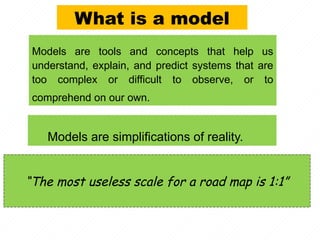
Models are toolsand concepts that help us
understand, explain, and predict systems that are
too complex or difficult to observe, or to
comprehend on our own.
“The most useless scale for a road map is 1:1”
What is a model
Models are simplifications of reality.
Problem perception
• Definitionof the scope of the model
• Clearly define your objectives
• Allow for incremental model definition
(don’t start with a model which is too
complex)
• Work in strict co-operation with the
Decision Makers
13.
Limits to modelling
•We tend to think linear
• System structure influences behaviour
• Structure in human system is subtle
• Leverage often comes from new ways of
thinking
• Reductionist thinking is often hampering
14.
Systems thinking
• forseeing wholes, counteract reductionism
• relationships rather than things
• patterns of change rather than static snapshots
• seeing circles of causality
• dealing with complexity and delays
• acknowledging both hard and soft components
15.
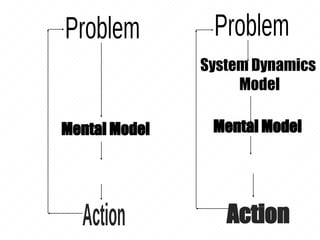
What is amodel?
• A model is any understanding which is used
to reach a conclusion or a solution
• Only mental models exist; all models rest in
the human mind
• There are no computer models, these are
mere mechanical and mathematical pictures
of mental models
• If a model is ”wrong”, then the underlying
understanding is to blame
The quality ofa model
is determined by
• how useful it is for it’s purpose
• how well users understand the model and
have trust in it
• NOT the number of details
18.
Simplicity and participation
•The major result is understanding (not the
models themselves)
• Simple models ensure understanding
• Modelling is not a one man work!
• The process is everything!
(”The road is the goal”)
19.
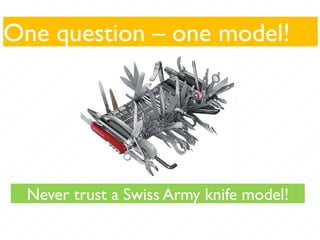
One question –one model!
Never trust a Swiss Army knife model!
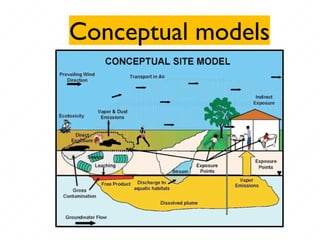
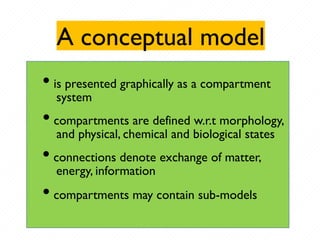
A conceptual model
•is presented graphically as a compartment
system
• compartments are defined w.r.t morphology,
and physical, chemical and biological states
• connections denote exchange of matter,
energy, information
• compartments may contain sub-models
25.
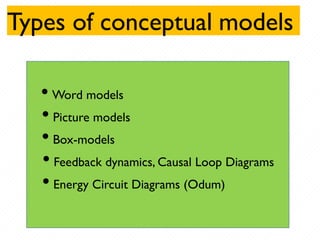
Types of conceptualmodels
• Word models
• Picture models
• Box-models
• Feedback dynamics, Causal Loop Diagrams
• Energy Circuit Diagrams (Odum)
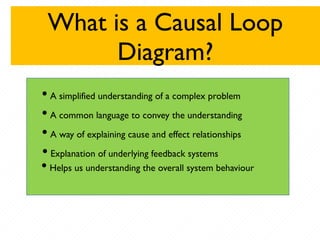
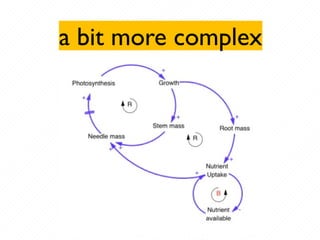
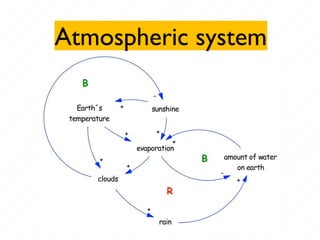
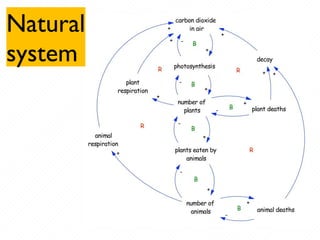
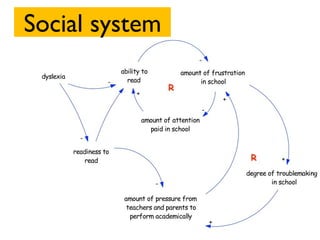
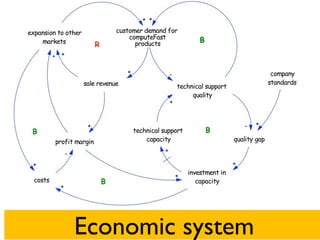
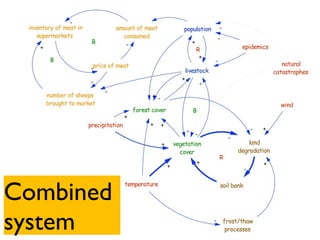
What is aCausal Loop
Diagram?
• A simplified understanding of a complex problem
• A common language to convey the understanding
• A way of explaining cause and effect relationships
• Explanation of underlying feedback systems
• Helps us understanding the overall system behaviour
28.
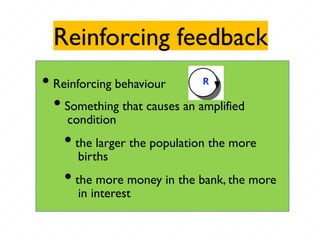
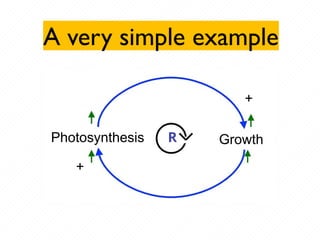
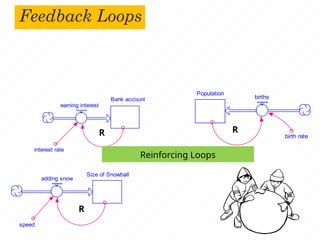
Reinforcing feedback
R
• Reinforcingbehaviour
• Something that causes an amplified
condition
• the larger the population the more
births
• the more money in the bank, the more
in interest
29.
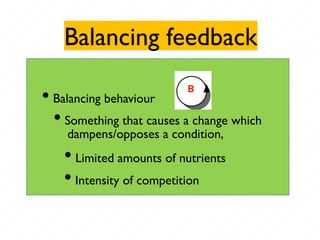
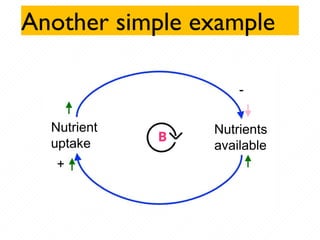
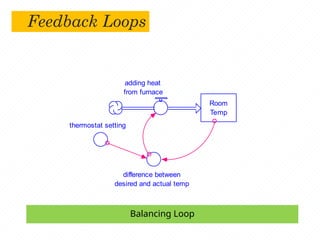
Balancing feedback
B
• Balancingbehaviour
• Something that causes a change which
dampens/opposes a condition,
• Limited amounts of nutrients
• Intensity of competition
30.
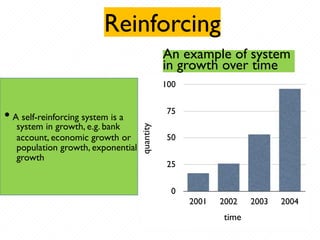
Reinforcing
An example ofsystem
in growth over time
100
75
• A self-reinforcing system is a
system in growth, e.g. bank
account, economic growth or
population growth, exponential
growth
50
25
0
2001 2002
time
2003 2004
31.
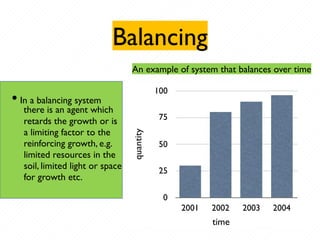
Balancing
An example ofsystem that balances over time
100
• In a balancing system
there is an agent which
retards the growth or is
a limiting factor to the
reinforcing growth, e.g.
limited resources in the
soil, limited light or space
for growth etc.
75
50
25
0
2001 2002
time
2003 2004
32.
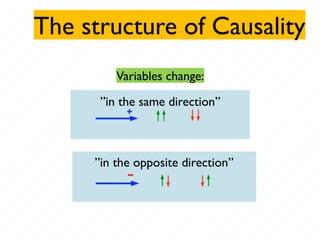
The structure ofCausality
Variables change:
”in the same direction”
”in the opposite direction”
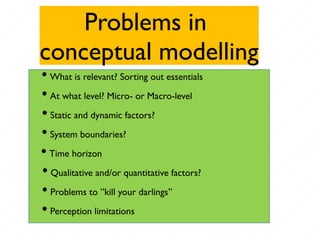
Problems in
conceptual modelling
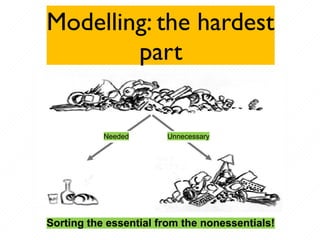
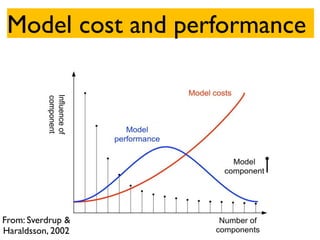
•What is relevant? Sorting out essentials
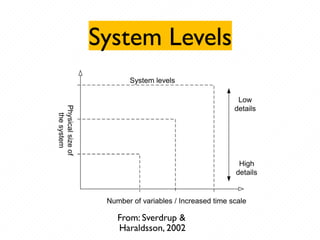
• At what level? Micro- or Macro-level
• Static and dynamic factors?
• System boundaries?
• Time horizon
• Qualitative and/or quantitative factors?
• Problems to ”kill your darlings”
• Perception limitations
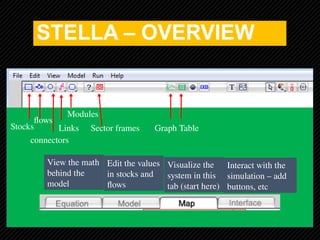
STELLA – OVERVIEW
Stocks
connectors
LinksSector frames Graph Table
View the math
behind the
model
Edit the values
in stocks and
flows
Visualize the
system in this
tab (start here)
Interact with the
simulation – add
buttons, etc
flows
Modules
#2 “A system is an interconnected set of elements that is coherently organized in a way that achieves something”
Donella H. Meadows, Thinking in Systems: A Primer (Chelsea Green Publishing, 2008) 11
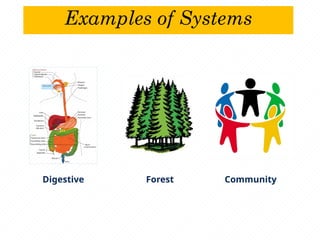
#3 Examples of Systems
elements, interconnected, function
- Digestive system (teeth, enzymes, stomach, intestines)
- Forest (plants & trees, animals, sunlight, water)
- Community (people, spaces, resources)
(Slinky - structure determines behavior)
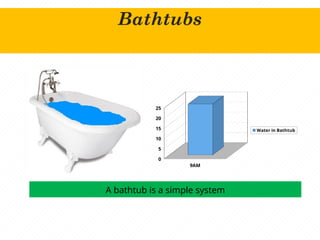
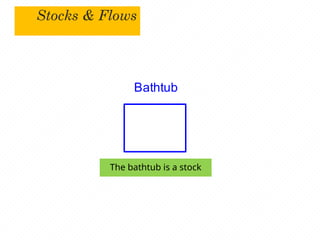
#4 A bathtub is a simple system
(Half full bath tub bar chart)
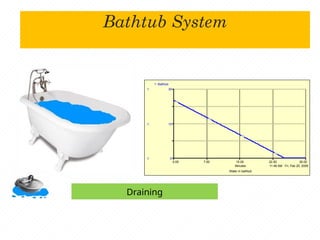
#5 (Bathtub with faucet off and drain on)
(Line chart of draining process)
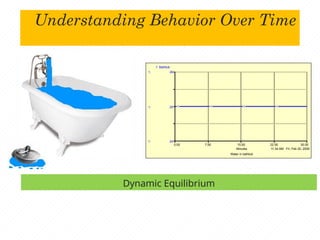
#6 (Half full bathtub with faucet on and drain on)
(Line graph of water half full)
Dynamic Equilibrium
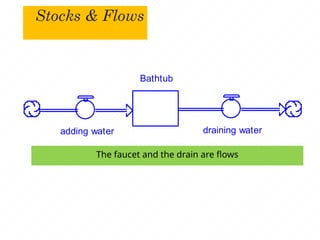
#62 The faucet and drain are flows
(Picture of stock and flows)
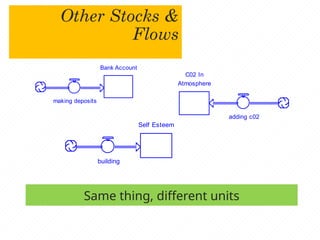
#63 Here are some other types of stocks and flows
(Money in bank account)
(C02 In Atmosphere)
(Self Esteem in teenager)
Same thing, different units!
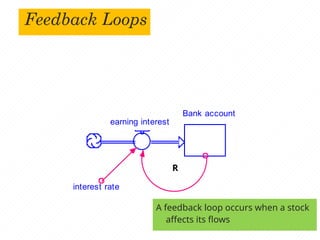
#64 A feedback loop occurs when a stock affects it's flow(s)
(Bank account interest)
(To STELLA model, simulate)
#65 Reinforcing Loop
(Bank account interest)
(Population)
(Snowball down the hill)
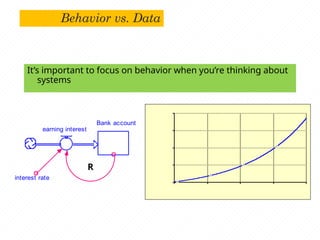
#66 Behavior vs. Data
It's important to observe behavior when you're thinking about systems
(To STELLA bank account example, change initial values, change rates -- curves are the same)