Canadian Forest Service Access to Knowledge:  Policy and Guidelines Presentation to  Canadian Forest Service Senior Management Committee September 28, 2004
Outline Background Policy statements Guidelines Implications Knowledge Asset Inventory
Why Develop a Policy? Opportunities Increase CFS visibility, leadership, influence Enhance information & knowledge sharing Promote synergy, integration, innovation Capture & mobilize CFS’s most valuable asset Risks of non action Central agencies will drive S&T policy agenda Information sharing culture will not evolve  Information business line will fail CFS knowledge remains invisible
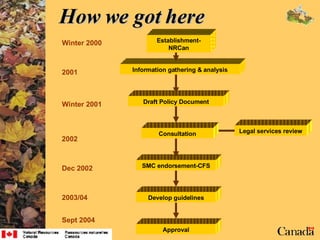
How we got here Approval Information gathering & analysis Develop guidelines SMC endorsement-CFS Establishment-NRCan Draft Policy Document Consultation Legal services review Winter 2000 2001 Dec 2002 Winter 2001 2003/04 2002 Sept 2004
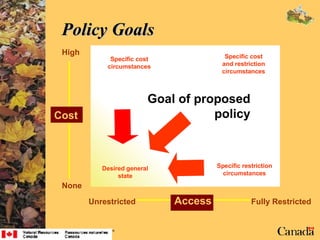
Policy Goals Access None High Fully Restricted Unrestricted Desired general state Specific cost circumstances Specific restriction circumstances Specific cost and restriction circumstances Goal of proposed policy Cost
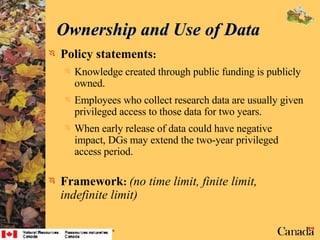
Ownership and Use of Data  Policy statements : Knowledge created through public funding is publicly owned. Employees who collect research data are usually given privileged access to those data for two years. When early release of data could have negative impact, DGs may extend the two-year privileged access period. Framework :   (no time limit, finite limit, indefinite limit)
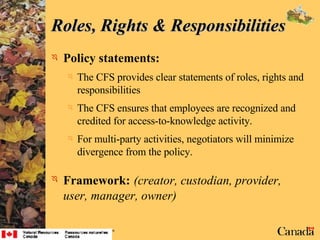
Policy statements: The CFS provides clear statements of roles, rights and responsibilities The CFS ensures that employees are recognized and credited for access-to-knowledge activity. For multi-party activities, negotiators will minimize divergence from the policy. Framework:   (creator, custodian, provider, user, manager, owner) Roles, Rights & Responsibilities
Level of Access Policy statements: The CFS provides unrestricted access to as many of its knowledge assets as  possible Where access must be restricted, we try to remove restriction should circumstances allow Framework :   (unrestricted, specific groups, participants in agreements, internal CFS use, legal & security constraints)
Accessibility Policy statement: Where there is some limitation to accessibility and use of a knowledge asset, the CFS will attempt to overcome it, on a case-by-case basis.  Framework :   (media, format, location, technology)
Service to Clients Policy statement: We provide service to our clients that is consistent with generally accepted best practices . Framework :   (effectiveness, user satisfaction, usefulness, reliability, transactions)
Cost Recovery Policy statements: The CFS will make as many of its knowledge assets as possible available free of charge or at minimal cost. Where some cost recovery is appropriate, the CFS will be open in its dealings and explain what costs are being recovered and why Framework :  (none, partial, full)
Guidelines  Inclusions & Exclusions CFS-created knowledge ( included ). Majority CFS-created knowledge ( normally included ) Minority CFS-created knowledge ( normally excluded ) CFS as secretariat ( excluded ) CFS acquired knowledge ( acquisition agreement ) Legislated protection ( excluded ) Classified assets ( excluded ) Material protected by copyright ( excluded )
Guidelines Common sense and judgement Interpretation and application Spirit and intent of the policy Explanations for classifying knowledge assets Examples of classified knowledge assets Recommendations and suggestions Let managers manage; expect them to manage
Implications - Corporate Oversight (SMC) Administration (KM Div.) Internal & external communications  Service standards Performance indicators, audit HR rewards & recognition
Implications  -  Management Managers Authorise and document exceptions to the “two-year rule” Minimise divergence from policy Ensure that staff declare knowledge assets Implement HR procedures & incentives Knowledge Workers Incorporate access into project plans Declare knowledge assets
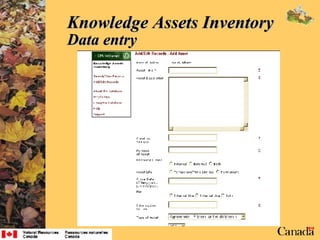
Knowledge Assets Inventory Data entry
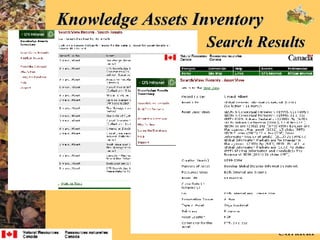
Knowledge Assets Inventory Search Results
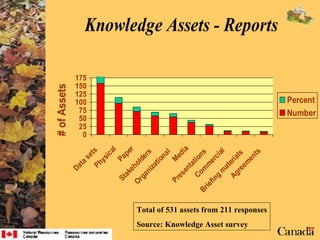
Total of 531 assets from 211 responses Source: Knowledge Asset survey
Next Steps Approval (Sept 28, 2004) Editing (Oct) Translation (Nov) Knowledge Asset Inventory (Nov-March) Communication Plan (Dec) Document production (Dec-Jan) Publication (March) Implementation (2005)
Summary Promotes cultural transformation  Supports business rejuvenation Key to success of information business line Consensus across Regions and Branches Management has broad discretionary authority Not etched in stone; can be revised any time Little or no cost ;  all we need is the will Let’s just Do it!

Access to Knowledge Policy

  • 1.
    Canadian Forest ServiceAccess to Knowledge: Policy and Guidelines Presentation to Canadian Forest Service Senior Management Committee September 28, 2004
  • 2.
    Outline Background Policystatements Guidelines Implications Knowledge Asset Inventory
  • 3.
    Why Develop aPolicy? Opportunities Increase CFS visibility, leadership, influence Enhance information & knowledge sharing Promote synergy, integration, innovation Capture & mobilize CFS’s most valuable asset Risks of non action Central agencies will drive S&T policy agenda Information sharing culture will not evolve Information business line will fail CFS knowledge remains invisible
  • 4.
    How we gothere Approval Information gathering & analysis Develop guidelines SMC endorsement-CFS Establishment-NRCan Draft Policy Document Consultation Legal services review Winter 2000 2001 Dec 2002 Winter 2001 2003/04 2002 Sept 2004
  • 5.
    Policy Goals AccessNone High Fully Restricted Unrestricted Desired general state Specific cost circumstances Specific restriction circumstances Specific cost and restriction circumstances Goal of proposed policy Cost
  • 6.
    Ownership and Useof Data Policy statements : Knowledge created through public funding is publicly owned. Employees who collect research data are usually given privileged access to those data for two years. When early release of data could have negative impact, DGs may extend the two-year privileged access period. Framework : (no time limit, finite limit, indefinite limit)
  • 7.
    Policy statements: TheCFS provides clear statements of roles, rights and responsibilities The CFS ensures that employees are recognized and credited for access-to-knowledge activity. For multi-party activities, negotiators will minimize divergence from the policy. Framework: (creator, custodian, provider, user, manager, owner) Roles, Rights & Responsibilities
  • 8.
    Level of AccessPolicy statements: The CFS provides unrestricted access to as many of its knowledge assets as possible Where access must be restricted, we try to remove restriction should circumstances allow Framework : (unrestricted, specific groups, participants in agreements, internal CFS use, legal & security constraints)
  • 9.
    Accessibility Policy statement:Where there is some limitation to accessibility and use of a knowledge asset, the CFS will attempt to overcome it, on a case-by-case basis. Framework : (media, format, location, technology)
  • 10.
    Service to ClientsPolicy statement: We provide service to our clients that is consistent with generally accepted best practices . Framework : (effectiveness, user satisfaction, usefulness, reliability, transactions)
  • 11.
    Cost Recovery Policystatements: The CFS will make as many of its knowledge assets as possible available free of charge or at minimal cost. Where some cost recovery is appropriate, the CFS will be open in its dealings and explain what costs are being recovered and why Framework : (none, partial, full)
  • 12.
    Guidelines Inclusions& Exclusions CFS-created knowledge ( included ). Majority CFS-created knowledge ( normally included ) Minority CFS-created knowledge ( normally excluded ) CFS as secretariat ( excluded ) CFS acquired knowledge ( acquisition agreement ) Legislated protection ( excluded ) Classified assets ( excluded ) Material protected by copyright ( excluded )
  • 13.
    Guidelines Common senseand judgement Interpretation and application Spirit and intent of the policy Explanations for classifying knowledge assets Examples of classified knowledge assets Recommendations and suggestions Let managers manage; expect them to manage
  • 14.
    Implications - CorporateOversight (SMC) Administration (KM Div.) Internal & external communications Service standards Performance indicators, audit HR rewards & recognition
  • 15.
    Implications - Management Managers Authorise and document exceptions to the “two-year rule” Minimise divergence from policy Ensure that staff declare knowledge assets Implement HR procedures & incentives Knowledge Workers Incorporate access into project plans Declare knowledge assets
  • 16.
  • 17.
  • 18.
    Total of 531assets from 211 responses Source: Knowledge Asset survey
  • 19.
    Next Steps Approval(Sept 28, 2004) Editing (Oct) Translation (Nov) Knowledge Asset Inventory (Nov-March) Communication Plan (Dec) Document production (Dec-Jan) Publication (March) Implementation (2005)
  • 20.
    Summary Promotes culturaltransformation Supports business rejuvenation Key to success of information business line Consensus across Regions and Branches Management has broad discretionary authority Not etched in stone; can be revised any time Little or no cost ; all we need is the will Let’s just Do it!

Editor's Notes

  • #2 There are two things that I propose to do under this agenda item. First, I’ll describe the proposed CFS Access to Knowledge Policy and related documents and tools Second, I am looking for final approval from this committee to adopt the Policy