A Proposal Global Disaster Information Marketplace: Presented to: United Nations  World Conference on Disaster Reduction January 18-22, 2005 Albert J. Simard
Outline Sharing information Information market Market infrastructure
Benefits Making disaster information more readily available when, where, and as needed. Lowering the cost of producing, providing, and using disaster information. Leveraging the efforts of existing disaster information and relief networks. Supporting more timely and better coordinated disaster response. Creating synergy to enable the production of new kinds of information.  Sharing Information
Barriers  Information is fragmented and hard to find Different languages, cultures, and mandates Lack of methods to integrate information Information is often not formatted to be useful when and where needed Sharing information
Principles People Knowledge must be volunteered; it cannot be conscripted People need time to provide and search for knowledge Sharing must be recognized, rewarded, and facilitated A champion is insufficient; a majority must participate Infrastructure Build a real /virtual  “place” for exchanging knowledge IT greatly increases market efficiency Don’t force fluid knowledge into rigid structures Don’t focus on systems; also consider content Sharing information
Mechanisms Talking (real, virtual) E-mail (individuals, list servers, distribution lists) Chat rooms, forums, discussion groups Communities of interest, informal networks Groupware (teams, working groups) Conferences, workshops, knowledge fairs Data bases, information bases, knowledge bases Digital libraries (repositories, search, retrieval) Sharing Information
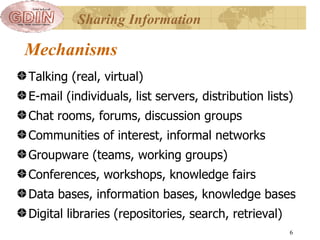
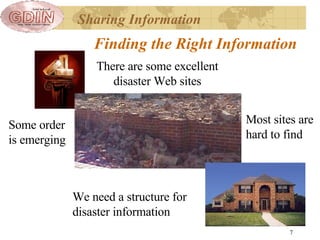
Finding the Right Information There are some excellent disaster Web sites Some order is emerging , Most sites are hard to find We need a structure for disaster information Sharing Information
Outline Sharing information Information market Market Infrastructure
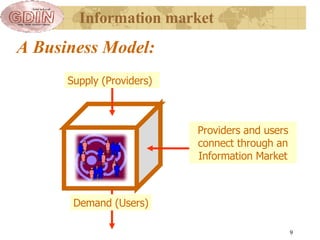
A Business Model: Information market Supply (Providers) Demand (Users) Providers and users connect through an Information Market
Attributes Price  – reciprocity, repute, altruism Trust  – visible, ubiquitous, top-down Signals  – position, education, networks Inefficiencies  – incomplete information, asymmetry, localness Pathologies  – monopolies, artificial scarcity, trade barriers  Adapted from Davenport (1998) Information market
Autonomous providers and users Diversity  - mandates, jurisdictions, roles Trust  - security, privacy, control Legal  - accountability, responsibility, liability Certification  - inclusion, authenticity, reliability Quality  - completeness, timeliness, accuracy Infrastructure  - standards, networks, systems Information market
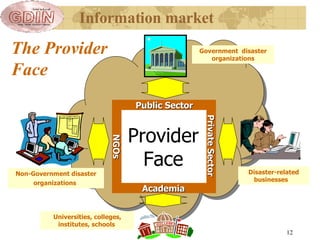
The Provider Face Information market Provider Face Academia NGOs Private Sector   Public Sector Government  disaster organizations Universities, colleges, institutes, schools   Disaster-related businesses  Non-Government disaster organizations
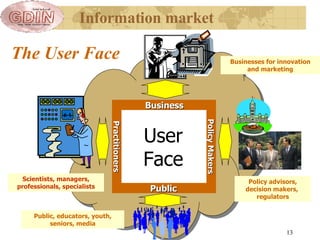
The User Face Information market Public, educators, youth, seniors, media Policy advisors, decision makers,  regulators User Face Public Practitioners Policy Makers Business Businesses for innovation and marketing Scientists, managers, professionals, specialists
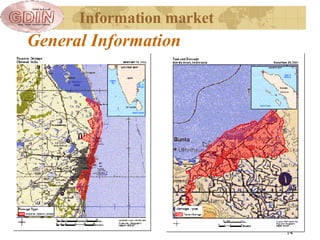
General Information Information market
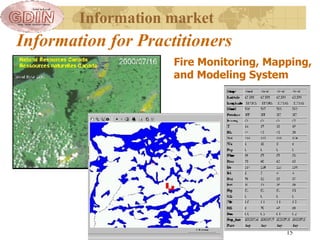
Information for Practitioners Fire Monitoring, Mapping, and Modeling System Information market
Information Facilitator   Enable information search and retrieval Support global database search and access  Create value-added information products and reports Support networking among communities of interest  Assist providers with communication and cataloging Help users with searching, reformatting, and interpretation Information market
Outline Sharing information Information market Market infrastructure
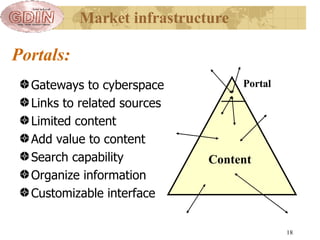
Portals:   Gateways to cyberspace Links to related sources Limited content Add value to content Search capability Organize information Customizable interface  Content Portal Market infrastructure
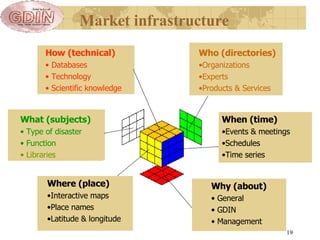
Market infrastructure How (technical) Databases Technology Scientific knowledge  What (subjects) Type of disaster Function Libraries   Where (place) Interactive maps Place names Latitude & longitude Who (directories) Organizations Experts Products  &  Services When (time) Events & meetings Schedules Time series Why (about) General   GDIN Management
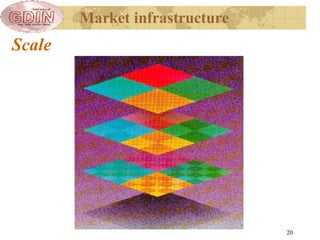
Scale Market infrastructure
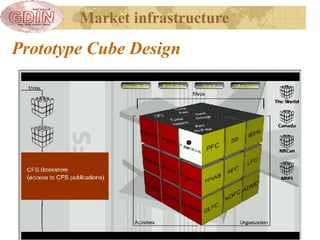
Prototype Cube Design Market infrastructure
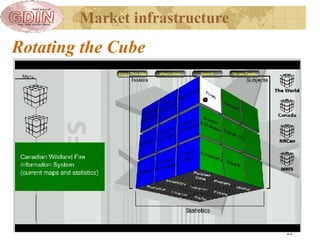
Rotating the Cube Market infrastructure
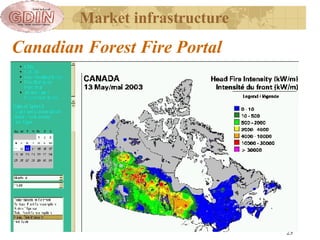
Canadian Forest Fire Portal Market infrastructure
The Way Ahead Establishment  agreements, plans, funding Design concepts, architecture, projects Prototype Build a key component Development Integrate components Implement Operationalize, maintain Summary Http://www.gdin.org

Global Disaster Information Network

  • 1.
    A Proposal GlobalDisaster Information Marketplace: Presented to: United Nations World Conference on Disaster Reduction January 18-22, 2005 Albert J. Simard
  • 2.
    Outline Sharing informationInformation market Market infrastructure
  • 3.
    Benefits Making disasterinformation more readily available when, where, and as needed. Lowering the cost of producing, providing, and using disaster information. Leveraging the efforts of existing disaster information and relief networks. Supporting more timely and better coordinated disaster response. Creating synergy to enable the production of new kinds of information. Sharing Information
  • 4.
    Barriers Informationis fragmented and hard to find Different languages, cultures, and mandates Lack of methods to integrate information Information is often not formatted to be useful when and where needed Sharing information
  • 5.
    Principles People Knowledgemust be volunteered; it cannot be conscripted People need time to provide and search for knowledge Sharing must be recognized, rewarded, and facilitated A champion is insufficient; a majority must participate Infrastructure Build a real /virtual “place” for exchanging knowledge IT greatly increases market efficiency Don’t force fluid knowledge into rigid structures Don’t focus on systems; also consider content Sharing information
  • 6.
    Mechanisms Talking (real,virtual) E-mail (individuals, list servers, distribution lists) Chat rooms, forums, discussion groups Communities of interest, informal networks Groupware (teams, working groups) Conferences, workshops, knowledge fairs Data bases, information bases, knowledge bases Digital libraries (repositories, search, retrieval) Sharing Information
  • 7.
    Finding the RightInformation There are some excellent disaster Web sites Some order is emerging , Most sites are hard to find We need a structure for disaster information Sharing Information
  • 8.
    Outline Sharing informationInformation market Market Infrastructure
  • 9.
    A Business Model:Information market Supply (Providers) Demand (Users) Providers and users connect through an Information Market
  • 10.
    Attributes Price – reciprocity, repute, altruism Trust – visible, ubiquitous, top-down Signals – position, education, networks Inefficiencies – incomplete information, asymmetry, localness Pathologies – monopolies, artificial scarcity, trade barriers Adapted from Davenport (1998) Information market
  • 11.
    Autonomous providers andusers Diversity - mandates, jurisdictions, roles Trust - security, privacy, control Legal - accountability, responsibility, liability Certification - inclusion, authenticity, reliability Quality - completeness, timeliness, accuracy Infrastructure - standards, networks, systems Information market
  • 12.
    The Provider FaceInformation market Provider Face Academia NGOs Private Sector Public Sector Government disaster organizations Universities, colleges, institutes, schools Disaster-related businesses Non-Government disaster organizations
  • 13.
    The User FaceInformation market Public, educators, youth, seniors, media Policy advisors, decision makers, regulators User Face Public Practitioners Policy Makers Business Businesses for innovation and marketing Scientists, managers, professionals, specialists
  • 14.
  • 15.
    Information for PractitionersFire Monitoring, Mapping, and Modeling System Information market
  • 16.
    Information Facilitator Enable information search and retrieval Support global database search and access Create value-added information products and reports Support networking among communities of interest Assist providers with communication and cataloging Help users with searching, reformatting, and interpretation Information market
  • 17.
    Outline Sharing informationInformation market Market infrastructure
  • 18.
    Portals: Gateways to cyberspace Links to related sources Limited content Add value to content Search capability Organize information Customizable interface Content Portal Market infrastructure
  • 19.
    Market infrastructure How(technical) Databases Technology Scientific knowledge What (subjects) Type of disaster Function Libraries Where (place) Interactive maps Place names Latitude & longitude Who (directories) Organizations Experts Products & Services When (time) Events & meetings Schedules Time series Why (about) General GDIN Management
  • 20.
  • 21.
    Prototype Cube DesignMarket infrastructure
  • 22.
    Rotating the CubeMarket infrastructure
  • 23.
    Canadian Forest FirePortal Market infrastructure
  • 24.
    The Way AheadEstablishment agreements, plans, funding Design concepts, architecture, projects Prototype Build a key component Development Integrate components Implement Operationalize, maintain Summary Http://www.gdin.org

Editor's Notes

  • #2 Today, I would like to talk about a virtual information marketplace that would serve the global emergency management community.