Introduction to  Knowledge Management
The World Has Changed Knowledge economy Democratization of knowledge Knowledge workers – 21 st  century set of literacies Perfect Storm
Its Social  Everything is going social Web 2.0 Enterprise 2.0 KM 2.0 Library 2.0 Management 2.0 Project Management 2.0 Education 2.0 Government 2.0 Politics 2.0 Learning 2.0 World 2.0 People 2.0
WE have ungated access to whats going on in the world. WE have a voice WE can influence things WE are participants WE wish to make a difference WE can no longer be misled or controlled WE can collaborate, innovate Social tools enable this…  Our mindset/willingness/awareness enables this…
Organizations exist To serve a mission To make money For legal reasons The only sustainable competitive advantage Is an organizations ability  to  learn  faster than the competition. - Peter Senge, Author of the Fifth Discipline
Organizations are people People have knowledge Groups have knowledge Companies have knowledge
 
Data Numbers, words, images (symbols) Information  Sets or patterns of data Knowledge Gain of understanding from sharing, analysis and experience
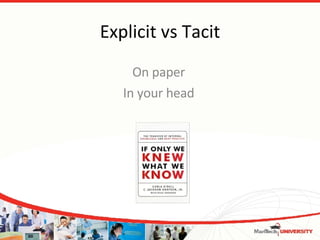
Explicit vs Tacit On paper In your head
Baking bread story
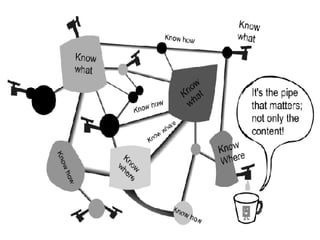
What is Knowledge Management? Many, many definitions… KISS: “Connecting Those Who Know With Those Who Need to Know”
What Value Does KM Provide? Knowledge Creation Knowledge Retention Knowledge Transfer Raise Awareness Helps you make better decisions - or the same decision faster Stimulates innovation and growth Makes it easier to find relevant knowledge, info and resources Helps you leverage existing expertise and experience Makes us more agile, sustainable and viable
 
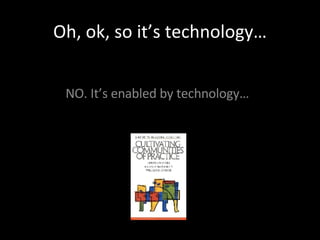
Oh, ok, so it’s technology… NO. It’s enabled by technology…
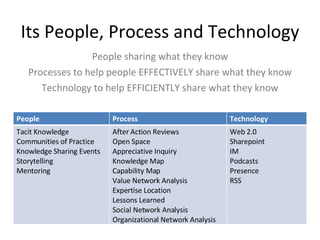
Its People, Process and Technology People sharing what they know Processes to help people EFFECTIVELY share what they know Technology to help EFFICIENTLY share what they know People Process Technology Tacit Knowledge Communities of Practice Knowledge Sharing Events Storytelling Mentoring After Action Reviews Open Space Appreciative Inquiry Knowledge Map Capability Map Value Network Analysis Expertise Location Lessons Learned Social Network Analysis Organizational Network Analysis Web 2.0 Sharepoint  IM Podcasts Presence RSS
So is it HR or IT? yup or training or learning  or marketing or comms or quality or strategy?
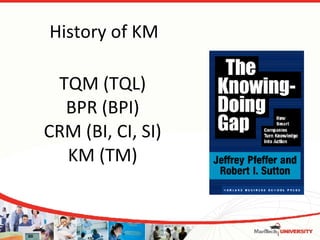
History of KM TQM (TQL) BPR (BPI) CRM (BI, CI, SI) KM (TM)
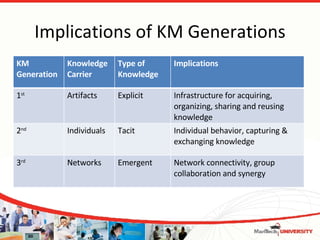
Implications of KM Generations KM Generation Knowledge Carrier Type of Knowledge Implications 1 st Artifacts Explicit Infrastructure for acquiring, organizing, sharing and reusing knowledge 2 nd Individuals Tacit Individual behavior, capturing & exchanging knowledge 3 rd   Networks Emergent Network connectivity, group collaboration and synergy
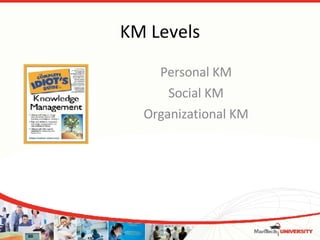
KM Levels Personal KM Social KM Organizational KM
Personal KM Personality type indicators  Know how to deal with others  Share your photos, videos, presence, thoughts, documents, friends, knowledge, wisdom, voice, etc.
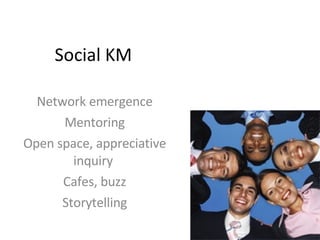
Social KM Network emergence Mentoring Open space, appreciative inquiry  Cafes, buzz Storytelling
Organizational KM Enterprise apps Communities of practice, expertise location, best practice transfer Knowledge market, talent market Learning organization - agility Personal mastery Building shared vision Team learning Mental models Systems thinking
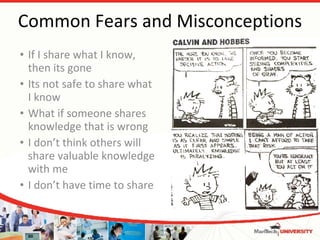
Common Fears and Misconceptions If I share what I know, then its gone Its not safe to share what I know What if someone shares knowledge that is wrong I don’t think others will share valuable knowledge with me I don’t have time to share
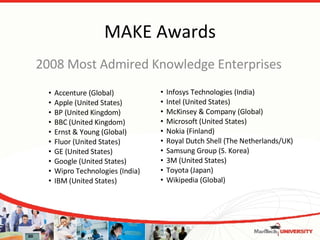
MAKE Awards 2008 Most Admired Knowledge Enterprises Accenture (Global)  Apple (United States)  BP (United Kingdom)  BBC (United Kingdom)  Ernst & Young (Global)  Fluor (United States)  GE (United States)  Google (United States)  Wipro Technologies (India) IBM (United States)  Infosys Technologies (India)  Intel (United States)  McKinsey & Company (Global)  Microsoft (United States)  Nokia (Finland)  Royal Dutch Shell (The Netherlands/UK)  Samsung Group (S. Korea)  3M (United States)  Toyota (Japan)  Wikipedia (Global)
What can I do tomorrow morning? Org Network Analysis Social Bookmarking Blogs Wikis Podcasts Communities of Practice Org Storytelling Mentoring Secondlife Knowledge Sharing Survey Knowledge Sharing Events KM Training After Action Review Incentivize Newsletters Internal/External Networking Facebook

Introduction To Knowledge Management

  • 1.
    Introduction to Knowledge Management
  • 2.
    The World HasChanged Knowledge economy Democratization of knowledge Knowledge workers – 21 st century set of literacies Perfect Storm
  • 3.
    Its Social Everything is going social Web 2.0 Enterprise 2.0 KM 2.0 Library 2.0 Management 2.0 Project Management 2.0 Education 2.0 Government 2.0 Politics 2.0 Learning 2.0 World 2.0 People 2.0
  • 4.
    WE have ungatedaccess to whats going on in the world. WE have a voice WE can influence things WE are participants WE wish to make a difference WE can no longer be misled or controlled WE can collaborate, innovate Social tools enable this… Our mindset/willingness/awareness enables this…
  • 5.
    Organizations exist Toserve a mission To make money For legal reasons The only sustainable competitive advantage Is an organizations ability to learn faster than the competition. - Peter Senge, Author of the Fifth Discipline
  • 6.
    Organizations are peoplePeople have knowledge Groups have knowledge Companies have knowledge
  • 7.
  • 8.
    Data Numbers, words,images (symbols) Information Sets or patterns of data Knowledge Gain of understanding from sharing, analysis and experience
  • 9.
    Explicit vs TacitOn paper In your head
  • 10.
  • 11.
    What is KnowledgeManagement? Many, many definitions… KISS: “Connecting Those Who Know With Those Who Need to Know”
  • 12.
    What Value DoesKM Provide? Knowledge Creation Knowledge Retention Knowledge Transfer Raise Awareness Helps you make better decisions - or the same decision faster Stimulates innovation and growth Makes it easier to find relevant knowledge, info and resources Helps you leverage existing expertise and experience Makes us more agile, sustainable and viable
  • 13.
  • 14.
    Oh, ok, soit’s technology… NO. It’s enabled by technology…
  • 15.
    Its People, Processand Technology People sharing what they know Processes to help people EFFECTIVELY share what they know Technology to help EFFICIENTLY share what they know People Process Technology Tacit Knowledge Communities of Practice Knowledge Sharing Events Storytelling Mentoring After Action Reviews Open Space Appreciative Inquiry Knowledge Map Capability Map Value Network Analysis Expertise Location Lessons Learned Social Network Analysis Organizational Network Analysis Web 2.0 Sharepoint IM Podcasts Presence RSS
  • 16.
    So is itHR or IT? yup or training or learning or marketing or comms or quality or strategy?
  • 17.
    History of KMTQM (TQL) BPR (BPI) CRM (BI, CI, SI) KM (TM)
  • 18.
    Implications of KMGenerations KM Generation Knowledge Carrier Type of Knowledge Implications 1 st Artifacts Explicit Infrastructure for acquiring, organizing, sharing and reusing knowledge 2 nd Individuals Tacit Individual behavior, capturing & exchanging knowledge 3 rd Networks Emergent Network connectivity, group collaboration and synergy
  • 19.
    KM Levels PersonalKM Social KM Organizational KM
  • 20.
    Personal KM Personalitytype indicators Know how to deal with others Share your photos, videos, presence, thoughts, documents, friends, knowledge, wisdom, voice, etc.
  • 21.
    Social KM Networkemergence Mentoring Open space, appreciative inquiry Cafes, buzz Storytelling
  • 22.
    Organizational KM Enterpriseapps Communities of practice, expertise location, best practice transfer Knowledge market, talent market Learning organization - agility Personal mastery Building shared vision Team learning Mental models Systems thinking
  • 23.
    Common Fears andMisconceptions If I share what I know, then its gone Its not safe to share what I know What if someone shares knowledge that is wrong I don’t think others will share valuable knowledge with me I don’t have time to share
  • 24.
    MAKE Awards 2008Most Admired Knowledge Enterprises Accenture (Global) Apple (United States) BP (United Kingdom) BBC (United Kingdom) Ernst & Young (Global) Fluor (United States) GE (United States) Google (United States) Wipro Technologies (India) IBM (United States) Infosys Technologies (India) Intel (United States) McKinsey & Company (Global) Microsoft (United States) Nokia (Finland) Royal Dutch Shell (The Netherlands/UK) Samsung Group (S. Korea) 3M (United States) Toyota (Japan) Wikipedia (Global)
  • 25.
    What can Ido tomorrow morning? Org Network Analysis Social Bookmarking Blogs Wikis Podcasts Communities of Practice Org Storytelling Mentoring Secondlife Knowledge Sharing Survey Knowledge Sharing Events KM Training After Action Review Incentivize Newsletters Internal/External Networking Facebook

Editor's Notes

  • #2 Walk disc How familiar are you with the concept, value and application of “knowledge management”? How do we run a meeting? How do we decide on action items? How do we learn? How do we define ethics? How do we foster democracy? How do we achieve our strategic goals? What is knowledge? How is it created? How do we share it? What benefit is there from sharing it? How does knowledge flow through your organization? Is it different than 5, 10, 20 years ago? How we started km at mantech Formal learning is only 20% Not managing our most valuable asset How many military or civilian folks are here? How many learning or training or hr folks are here? How many IT folks are here? What would u like to get out of this session?