Material Requirement Planning
( MRP)
Presented To : Presented by :
Md Enamul Haque Sujan Biswas ID: 622
Lecturer Antor Rasbongshi ID :623
Dept. of Textile Engg. Md. Nurul Azam Papon ID :621
World University of Bangladesh
Department of Textile Engineering
World University of Bangladesh
LIST OF CONTENT
 Definition
 Objectives of MRP
 Benefits of MRP
 Requirements for MRP
 MRP Terminology
 The scope of MRP
 The function of MRP
 When can do MRP
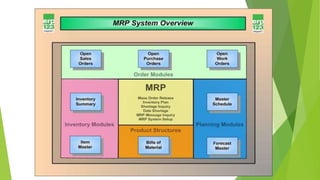
 MRP system
 MRP Inputs/Outputs
 Advantages of MRP
 Disadvantages of MRP
 Conclusion
MATERIAL REQUIRMENTS PLANNING (MRP)
DEFINITION :
Material Requirements Planning was introduced in 1970’s.
Material requirements planning (MRP) refers to production planning and inventory
control software systems that are used to manage the manufacturing process.
A materials requirement planning (MRP) information system is a sales forecast-
based system used to schedule raw material deliveries and quantities, given
assumptions of machine and labor units required to fulfill a sales forecast.
OBJECTIVES OF MRP
 To ensure that material and components are available for production, and final
products are ready for dispatch.
 To maintain minimum inventory but also ensure right quantity of material is
available at the right time to produce right quantity of final products.
 To ensure planning of all manufacturing processes , this scheduling of different job
work as to minimize or remove any kind of idle time for machine and worker.
BENEFITS OF MRP
Some specifically important benefits found by many industries are :
 Better response to customer orders as the result of improved adherence to
schedules,
 Faster response to market changes,
 Improved utilization of facilities and labor ,and
 Reduced inventory levels.
Better response to customer order and to the market wins orders and market
share. Better utilization of facilities and labor yield higher productivity and
return on investment. Less inventory allows capital and floor to be used for other
uses.
REQUIRMENTS FOR MRP
Effective use of MRP requires that the operations manager should know
the :
 Master production schedule (what is to be made and when)
 Specifications or bill of material (material and parts required to make the
product)
 Inventory availability (what is in stock )
 Purchase orders outstanding (what is in order),and
 Lead time (how long it takes to get various components).
MRP TERMINOLOGY
 MRP : A technique for determining the quality and timing of dependent
demand items
 Dependent Demand : The demand for an items depends on another item
. The demand dependency is the degree to which the demand for one item is
associated with demand for another items .
 Lot Size : The quantity of items required for and order.
 Time Phasing : Scheduling to produce or receive an appropriate amount of
material so that it will be available in the periods when required.
 Time Bucket : The time period used for planning process in MRP.
 Gross Requirements : The over all quantity of an items needed at the end
of the period to meet the planned output levels .
 Net Requirements : The net quality of an item that must be acquired to
meet the scheduled output for the period. It is calculated as, Gross
requirements minus scheduled receipts for the period minus amounts
available from the previous period.
 Requirements Explosion : The breaking down of exploding parent items
into component parts that can be individually planned and scheduled.
 Scheduled Receipts : The quantity of an item that will be received from
suppliers as a result of orders that have placed.
 Planned Order Receipts : The quality of an items that is planned to be
ordered so that will be received at the beginning of the period to meet net
requirements for the period . The order has not yet been placed.
 Planned Order Release : The quantity of an item that planned to be
ordered of it is a plan received on schedule after the lead time.
 Lead Time Offset : The supply time or number of time buckets between
releasing an order and receiving the materials.
THE SCOPE OF MRP
 Dependent demand – Demand for items that are sub-assemblies, parts or raw
materials to be used in the production of finished goods .
 Independent demand –Finished product.
THE FUNCTION OF MRP
 Inventory control
 Bill of material processing
 Elementary Scheduling
WHEN TO USE MRP
 Job shop production
 Complex product
 Assemble to Order Environment
 Discrete and Dependent demand items.
WHAT CAN MRP DO ?
 Reduce Inventory levels
 Reduce Component shortages
 Improve Shipping Performance
 Improve Customer Service
 Improve Productivity
 Simplified and Accurate Scheduling
 Reduce Purchasing cost
 Improve Production Scheduling
 Reduce Manufacturing Cost
 Reduce Lead Times
 Less Scrap and Rework
 Higher Production Quality
 Improve Communication
 Improve Plant Efficiency
 Reduce Freight Cost
 Reduction in Excess Inventory
 Reduce Overtime
MRP INPUTS
 Inventory status file
 Master Production Schedule
 Bill of Material File
INVENTORY STATUS FILE
 One –Hand quantities
 One –Order quantities
 Lot Size
 Safety Stock
 Lead Time
SAFTEY STOCKS IN INVENTORY FILE
 Need for safety stocks:
 Variations in demand due to end-item forecast errors and inventory errors
 Variations in supply – both lead-times and quantities
 Options to provide safety factors:
 Fixed quantity buffer stocks
 Safety lead-time
 Increase gross requirements
Overall View of the inputs to a standard MRP program and the
reports Generated by the program.
MASTER PRODUCTION SCHEDULE
 Schedule of Financial Products
 Represents Production, not Demand
 Combination of Customer Orders and
demand Forecasts
 What Needs to be Production.
BILL OF MATERIAL FILE
 This file provides the information regarding all the materials, parts and sub-
assemblies that so into the end product.
 The bill of materials can be viewed as having a series of levels , each of which
represent a stage in the manufacturing of the end product.
MRP OUTPUT
 Inventory Transaction Data
 Planned Order Schedule
 Exception Reports
ADVANTAGES OF MRP
 It helps in maintain minimum inventory levels
 With minimum inventory levels , material planning also reduces associated
costs.
 Material tracking becomes easy and ensures that economic order quantity is
achieved for all lot orders.
 Material planning smoothens capacity utilizations and allocates correct time
to products as per demand forecast.
DISADVANTAGES OF MRP
 Material planning is highly dependent on inputs it receives from systems or
department .It in out information is not correct than output for material planning
will also be incorrect.
 Material planning system requires proper training for end users, asto get
maximum out of the system.
 Material resource planning system requires substantial investment of time and
capital.
CONCLUSION
 We conclude that MRP is a computer- based production planning and
inventory control system .That schedules component items as needed which
will track inventory and helps you in many other aspects of business
 MRP is very much essential for manufacturing company.
ANY QUESTION
???
THANK YOU ALL

Mrp

  • 1.
    Material Requirement Planning (MRP) Presented To : Presented by : Md Enamul Haque Sujan Biswas ID: 622 Lecturer Antor Rasbongshi ID :623 Dept. of Textile Engg. Md. Nurul Azam Papon ID :621 World University of Bangladesh Department of Textile Engineering World University of Bangladesh
  • 2.
    LIST OF CONTENT Definition  Objectives of MRP  Benefits of MRP  Requirements for MRP  MRP Terminology  The scope of MRP  The function of MRP  When can do MRP  MRP system  MRP Inputs/Outputs  Advantages of MRP  Disadvantages of MRP  Conclusion
  • 3.
    MATERIAL REQUIRMENTS PLANNING(MRP) DEFINITION : Material Requirements Planning was introduced in 1970’s. Material requirements planning (MRP) refers to production planning and inventory control software systems that are used to manage the manufacturing process. A materials requirement planning (MRP) information system is a sales forecast- based system used to schedule raw material deliveries and quantities, given assumptions of machine and labor units required to fulfill a sales forecast.
  • 4.
    OBJECTIVES OF MRP To ensure that material and components are available for production, and final products are ready for dispatch.  To maintain minimum inventory but also ensure right quantity of material is available at the right time to produce right quantity of final products.  To ensure planning of all manufacturing processes , this scheduling of different job work as to minimize or remove any kind of idle time for machine and worker.
  • 5.
    BENEFITS OF MRP Somespecifically important benefits found by many industries are :  Better response to customer orders as the result of improved adherence to schedules,  Faster response to market changes,  Improved utilization of facilities and labor ,and  Reduced inventory levels. Better response to customer order and to the market wins orders and market share. Better utilization of facilities and labor yield higher productivity and return on investment. Less inventory allows capital and floor to be used for other uses.
  • 6.
    REQUIRMENTS FOR MRP Effectiveuse of MRP requires that the operations manager should know the :  Master production schedule (what is to be made and when)  Specifications or bill of material (material and parts required to make the product)  Inventory availability (what is in stock )  Purchase orders outstanding (what is in order),and  Lead time (how long it takes to get various components).
  • 7.
    MRP TERMINOLOGY  MRP: A technique for determining the quality and timing of dependent demand items  Dependent Demand : The demand for an items depends on another item . The demand dependency is the degree to which the demand for one item is associated with demand for another items .  Lot Size : The quantity of items required for and order.  Time Phasing : Scheduling to produce or receive an appropriate amount of material so that it will be available in the periods when required.  Time Bucket : The time period used for planning process in MRP.  Gross Requirements : The over all quantity of an items needed at the end of the period to meet the planned output levels .
  • 8.
     Net Requirements: The net quality of an item that must be acquired to meet the scheduled output for the period. It is calculated as, Gross requirements minus scheduled receipts for the period minus amounts available from the previous period.  Requirements Explosion : The breaking down of exploding parent items into component parts that can be individually planned and scheduled.  Scheduled Receipts : The quantity of an item that will be received from suppliers as a result of orders that have placed.  Planned Order Receipts : The quality of an items that is planned to be ordered so that will be received at the beginning of the period to meet net requirements for the period . The order has not yet been placed.  Planned Order Release : The quantity of an item that planned to be ordered of it is a plan received on schedule after the lead time.  Lead Time Offset : The supply time or number of time buckets between releasing an order and receiving the materials.
  • 9.
    THE SCOPE OFMRP  Dependent demand – Demand for items that are sub-assemblies, parts or raw materials to be used in the production of finished goods .  Independent demand –Finished product. THE FUNCTION OF MRP  Inventory control  Bill of material processing  Elementary Scheduling WHEN TO USE MRP  Job shop production  Complex product  Assemble to Order Environment  Discrete and Dependent demand items.
  • 10.
    WHAT CAN MRPDO ?  Reduce Inventory levels  Reduce Component shortages  Improve Shipping Performance  Improve Customer Service  Improve Productivity  Simplified and Accurate Scheduling  Reduce Purchasing cost  Improve Production Scheduling  Reduce Manufacturing Cost  Reduce Lead Times  Less Scrap and Rework  Higher Production Quality  Improve Communication  Improve Plant Efficiency  Reduce Freight Cost  Reduction in Excess Inventory  Reduce Overtime
  • 12.
    MRP INPUTS  Inventorystatus file  Master Production Schedule  Bill of Material File INVENTORY STATUS FILE  One –Hand quantities  One –Order quantities  Lot Size  Safety Stock  Lead Time
  • 13.
    SAFTEY STOCKS ININVENTORY FILE  Need for safety stocks:  Variations in demand due to end-item forecast errors and inventory errors  Variations in supply – both lead-times and quantities  Options to provide safety factors:  Fixed quantity buffer stocks  Safety lead-time  Increase gross requirements
  • 14.
    Overall View ofthe inputs to a standard MRP program and the reports Generated by the program.
  • 15.
    MASTER PRODUCTION SCHEDULE Schedule of Financial Products  Represents Production, not Demand  Combination of Customer Orders and demand Forecasts  What Needs to be Production.
  • 16.
    BILL OF MATERIALFILE  This file provides the information regarding all the materials, parts and sub- assemblies that so into the end product.  The bill of materials can be viewed as having a series of levels , each of which represent a stage in the manufacturing of the end product. MRP OUTPUT  Inventory Transaction Data  Planned Order Schedule  Exception Reports
  • 17.
    ADVANTAGES OF MRP It helps in maintain minimum inventory levels  With minimum inventory levels , material planning also reduces associated costs.  Material tracking becomes easy and ensures that economic order quantity is achieved for all lot orders.  Material planning smoothens capacity utilizations and allocates correct time to products as per demand forecast.
  • 18.
    DISADVANTAGES OF MRP Material planning is highly dependent on inputs it receives from systems or department .It in out information is not correct than output for material planning will also be incorrect.  Material planning system requires proper training for end users, asto get maximum out of the system.  Material resource planning system requires substantial investment of time and capital.
  • 19.
    CONCLUSION  We concludethat MRP is a computer- based production planning and inventory control system .That schedules component items as needed which will track inventory and helps you in many other aspects of business  MRP is very much essential for manufacturing company.
  • 20.
  • 21.