MARTA ALARCÓN TAMAYO
ELOY ALGORRI FERRERO
ISABEL CELAYA MARTÍNEZ
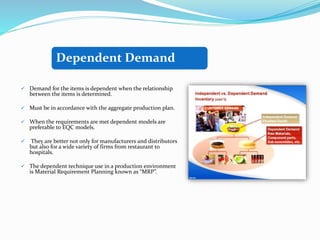
 Demand for the items is dependent when the relationship
between the items is determined.
 Must be in accordance with the aggregate production plan.
 When the requirements are met dependent models are
preferable to EQC models.
 They are better not only for manufacturers and distributors
but also for a wide variety of firms from restaurant to
hospitals.
 The dependent technique use in a production environment
is Material Requirement Planning known as “MRP”.
Dependent Demand
“A dependent demand technique that uses a bill- of
–material, inventory, expected receipts and master
production schedule to determine material
requirements”
 MBP provides such a clean structure for
dependent demand, it has evolved as the basis
for Enterprise Resource Planning(ERP).
 An MRP system is intended to simultaneously
meet three objectives:
 Ensure materials are available
for production and products are available
for delivery to customers.
 Maintain the lowest possible material and
product levels in store
 Plan manufacturing activities, delivery
schedules and purchasing activities.
MRP
Effective use of dependent theory
models requires that the operation
management know the following:
1) Master production
2) Specifications of bill
3) Inventory availability
4) Purchase orders outstanding
(also called expected receipts)
5) Lead Times
MRP
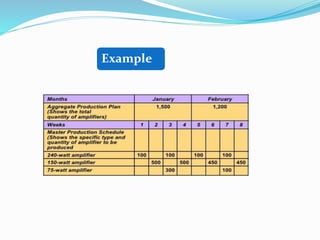
 Specifies what is to be made and when.
 It should be in accordance with the aggregate production plan
 Inputs from financial plans, customer demands, engineering
capabilities, labor availability, inventory fluctuations, supplier
performance and other considerations.
 Master Production schedule is focused on specific products.
Master Production Schedule
 Schedule must be followed for a reasonable
length of time
 MPS is a rolling schedule
 The MPS is quite often fixed or frozen in the
near term part of the plan
 It is a statement of what is to be produced, not
a forecast of demand.
Master Production Schedule
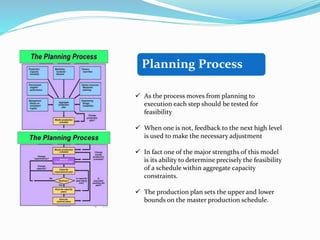
 As the process moves from planning to
execution each step should be tested for
feasibility
 When one is not, feedback to the next high level
is used to make the necessary adjustment
 In fact one of the major strengths of this model
is its ability to determine precisely the feasibility
of a schedule within aggregate capacity
constraints.
 The production plan sets the upper and lower
bounds on the master production schedule.
Planning Process
Example
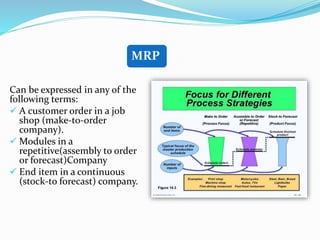
Can be expressed in any of the
following terms:
 A customer order in a job
shop (make-to-order
company).
 Modules in a
repetitive(assembly to order
or forecast)Company
 End item in a continuous
(stock-to forecast) company.
MRP
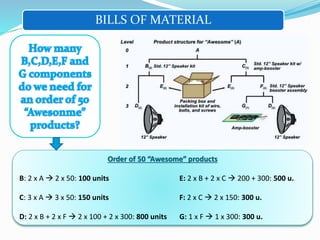
BILLS OF MATERIAL
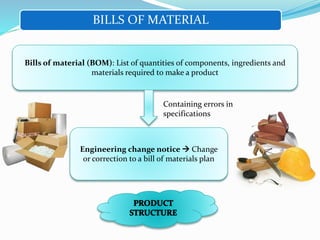
Bills of material (BOM): List of quantities of components, ingredients and
materials required to make a product
Engineering change notice  Change
or correction to a bill of materials plan
Containing errors in
specifications
BILLS OF MATERIAL
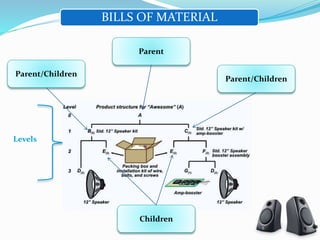
Parent
Parent/Children
Parent/Children
Levels
Children
BILLS OF MATERIAL
Order of 50 “Awesome” products
B: 2 x A  2 x 50: 100 units E: 2 x B + 2 x C  200 + 300: 500 u.
C: 3 x A  3 x 50: 150 units F: 2 x C  2 x 150: 300 u.
D: 2 x B + 2 x F  2 x 100 + 2 x 300: 800 units G: 1 x F  1 x 300: 300 u.
BILLS OF MATERIAL
As a tool for costing “Pick lists”
Modular bills
Planning bills and
Phantom bills
Low-level coding
•BOM organized in
modules
• Major components of
the final product or
product options
•Facilitates production
scheduling
•Pllaning bills: to
reduce the number of
components and for
using “kits”
•Phantom Bills:
temporally
components: never
inventoried; lead time
equals zero.
• Identical items at
different levels: they
are coded at the lowest
level.
• For facilitating
calculations
Accurate Records
Accurate inventory records are
absolutely required for MRP (or
any dependent demand system)
to operate correctly
Generally MRP systems require
99% accuracy
Outstanding purchase orders
must accurately reflect
quantities and scheduled
receipts
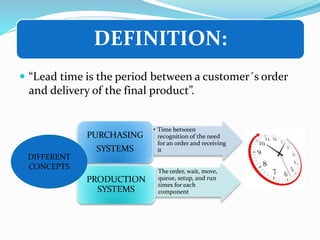
DEFINITION:
 “Lead time is the period between a customer´s order
and delivery of the final product”.
• Time between
recognition of the need
for an order and receiving
it
PURCHASING
SYSTEMS
• The order, wait, move,
queue, setup, and run
times for each
component
PRODUCTION
SYSTEMS
DIFFERENT
CONCEPTS
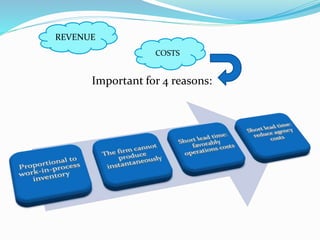
Important for 4 reasons:
REVENUE
COSTS
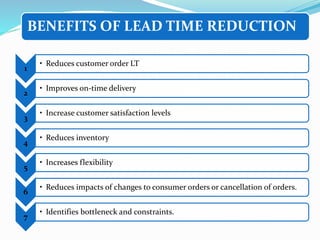
BENEFITS OF LEAD TIME REDUCTION
1
• Reduces customer order LT
2
• Improves on-time delivery
3
• Increase customer satisfaction levels
4
• Reduces inventory
5
• Increases flexibility
6
• Reduces impacts of changes to consumer orders or cancellation of orders.
7
• Identifies bottleneck and constraints.
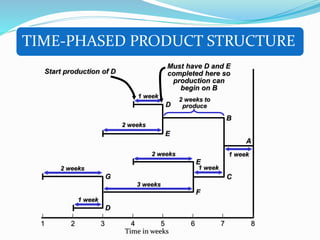
TIME-PHASED PRODUCT STRUCTURE
F
2 weeks
3 weeks
1 week
A
2 weeks
1 week
D
E
2 weeks
D
G
1 week
1 week
2 weeks to
produce
B
C
E
Start production of D
| | | | | | | |
1 2 3 4 5 6 7 8
Time in weeks
Must have D and E
completed here so
production can
begin on B
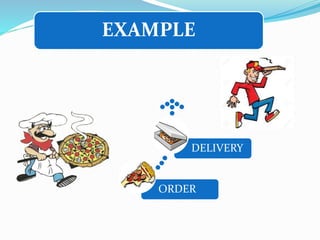
EXAMPLE
ORDER
DELIVERY
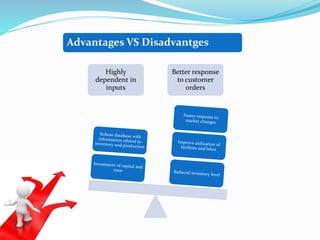
Highly
dependent in
inputs
Better response
to customer
orders
Advantages VS Disadvantges
MRP at wheeled Coach Ambulance
Largest manufacturer of ambulances in
the world
International competitor
12 major ambulance designs
18,000 different inventory items
6,000 manufactured parts
12,000 purchased parts
MRP at wheeled Coach Ambulance
Four Key Tasks
Material plan must meet both the
requirements of the master schedule and
the capabilities of the production facility
Plan must be executed as designed
Minimize inventory investment
Maintain excellent record integrity
TEST REVIEW
1. MRP is used for:
a) Independent demand items.
b) Dependent demand items.
c) Available-to-promise items.
d) Disaggregated items.
e) Pegged items.
2.Which of the following statements is false regarding MPS?
a) MPS is a rolling schedule
b) The MPS is quite often fixed or frozen in the near term part of the plan
c) Specifies what is to be made and when
d) Is focused on family products
TEST REVIEW
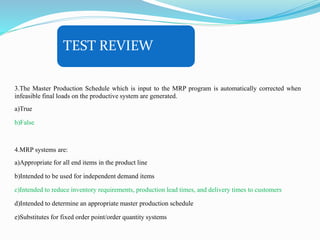
3.The Master Production Schedule which is input to the MRP program is automatically corrected when
infeasible final loads on the productive system are generated.
a)True
b)False
4.MRP systems are:
a)Appropriate for all end items in the product line
b)Intended to be used for independent demand items
c)Intended to reduce inventory requirements, production lead times, and delivery times to customers
d)Intended to determine an appropriate master production schedule
e)Substitutes for fixed order point/order quantity systems
TEST REVIEW
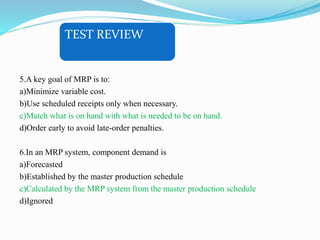
5.A key goal of MRP is to:
a)Minimize variable cost.
b)Use scheduled receipts only when necessary.
c)Match what is on hand with what is needed to be on hand.
d)Order early to avoid late-order penalties.
6.In an MRP system, component demand is
a)Forecasted
b)Established by the master production schedule
c)Calculated by the MRP system from the master production schedule
d)Ignored
TEST REVIEW
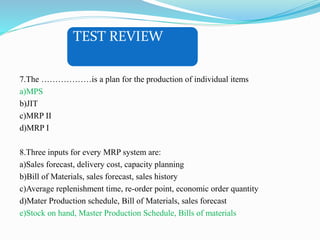
7.The ………………is a plan for the production of individual items
a)MPS
b)JIT
c)MRP II
d)MRP I
8.Three inputs for every MRP system are:
a)Sales forecast, delivery cost, capacity planning
b)Bill of Materials, sales forecast, sales history
c)Average replenishment time, re-order point, economic order quantity
d)Mater Production schedule, Bill of Materials, sales forecast
e)Stock on hand, Master Production Schedule, Bills of materials
TEST REVIEW
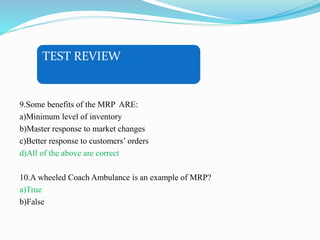
9.Some benefits of the MRP ARE:
a)Minimum level of inventory
b)Master response to market changes
c)Better response to customers’ orders
d)All of the above are correct
10.A wheeled Coach Ambulance is an example of MRP?
a)True
b)False

MRP Theory: Master Production Schedule, Bill of Material and Lead Times

  • 1.
    MARTA ALARCÓN TAMAYO ELOYALGORRI FERRERO ISABEL CELAYA MARTÍNEZ
  • 2.
     Demand forthe items is dependent when the relationship between the items is determined.  Must be in accordance with the aggregate production plan.  When the requirements are met dependent models are preferable to EQC models.  They are better not only for manufacturers and distributors but also for a wide variety of firms from restaurant to hospitals.  The dependent technique use in a production environment is Material Requirement Planning known as “MRP”. Dependent Demand
  • 3.
    “A dependent demandtechnique that uses a bill- of –material, inventory, expected receipts and master production schedule to determine material requirements”  MBP provides such a clean structure for dependent demand, it has evolved as the basis for Enterprise Resource Planning(ERP).  An MRP system is intended to simultaneously meet three objectives:  Ensure materials are available for production and products are available for delivery to customers.  Maintain the lowest possible material and product levels in store  Plan manufacturing activities, delivery schedules and purchasing activities. MRP
  • 4.
    Effective use ofdependent theory models requires that the operation management know the following: 1) Master production 2) Specifications of bill 3) Inventory availability 4) Purchase orders outstanding (also called expected receipts) 5) Lead Times MRP
  • 6.
     Specifies whatis to be made and when.  It should be in accordance with the aggregate production plan  Inputs from financial plans, customer demands, engineering capabilities, labor availability, inventory fluctuations, supplier performance and other considerations.  Master Production schedule is focused on specific products. Master Production Schedule
  • 7.
     Schedule mustbe followed for a reasonable length of time  MPS is a rolling schedule  The MPS is quite often fixed or frozen in the near term part of the plan  It is a statement of what is to be produced, not a forecast of demand. Master Production Schedule
  • 8.
     As theprocess moves from planning to execution each step should be tested for feasibility  When one is not, feedback to the next high level is used to make the necessary adjustment  In fact one of the major strengths of this model is its ability to determine precisely the feasibility of a schedule within aggregate capacity constraints.  The production plan sets the upper and lower bounds on the master production schedule. Planning Process
  • 9.
  • 10.
    Can be expressedin any of the following terms:  A customer order in a job shop (make-to-order company).  Modules in a repetitive(assembly to order or forecast)Company  End item in a continuous (stock-to forecast) company. MRP
  • 12.
    BILLS OF MATERIAL Billsof material (BOM): List of quantities of components, ingredients and materials required to make a product Engineering change notice  Change or correction to a bill of materials plan Containing errors in specifications
  • 13.
  • 14.
    BILLS OF MATERIAL Orderof 50 “Awesome” products B: 2 x A  2 x 50: 100 units E: 2 x B + 2 x C  200 + 300: 500 u. C: 3 x A  3 x 50: 150 units F: 2 x C  2 x 150: 300 u. D: 2 x B + 2 x F  2 x 100 + 2 x 300: 800 units G: 1 x F  1 x 300: 300 u.
  • 15.
    BILLS OF MATERIAL Asa tool for costing “Pick lists” Modular bills Planning bills and Phantom bills Low-level coding •BOM organized in modules • Major components of the final product or product options •Facilitates production scheduling •Pllaning bills: to reduce the number of components and for using “kits” •Phantom Bills: temporally components: never inventoried; lead time equals zero. • Identical items at different levels: they are coded at the lowest level. • For facilitating calculations
  • 17.
    Accurate Records Accurate inventoryrecords are absolutely required for MRP (or any dependent demand system) to operate correctly Generally MRP systems require 99% accuracy Outstanding purchase orders must accurately reflect quantities and scheduled receipts
  • 19.
    DEFINITION:  “Lead timeis the period between a customer´s order and delivery of the final product”. • Time between recognition of the need for an order and receiving it PURCHASING SYSTEMS • The order, wait, move, queue, setup, and run times for each component PRODUCTION SYSTEMS DIFFERENT CONCEPTS
  • 20.
    Important for 4reasons: REVENUE COSTS
  • 21.
    BENEFITS OF LEADTIME REDUCTION 1 • Reduces customer order LT 2 • Improves on-time delivery 3 • Increase customer satisfaction levels 4 • Reduces inventory 5 • Increases flexibility 6 • Reduces impacts of changes to consumer orders or cancellation of orders. 7 • Identifies bottleneck and constraints.
  • 22.
    TIME-PHASED PRODUCT STRUCTURE F 2weeks 3 weeks 1 week A 2 weeks 1 week D E 2 weeks D G 1 week 1 week 2 weeks to produce B C E Start production of D | | | | | | | | 1 2 3 4 5 6 7 8 Time in weeks Must have D and E completed here so production can begin on B
  • 23.
  • 24.
    Highly dependent in inputs Better response tocustomer orders Advantages VS Disadvantges
  • 25.
    MRP at wheeledCoach Ambulance Largest manufacturer of ambulances in the world International competitor 12 major ambulance designs 18,000 different inventory items 6,000 manufactured parts 12,000 purchased parts
  • 26.
    MRP at wheeledCoach Ambulance Four Key Tasks Material plan must meet both the requirements of the master schedule and the capabilities of the production facility Plan must be executed as designed Minimize inventory investment Maintain excellent record integrity
  • 27.
    TEST REVIEW 1. MRPis used for: a) Independent demand items. b) Dependent demand items. c) Available-to-promise items. d) Disaggregated items. e) Pegged items. 2.Which of the following statements is false regarding MPS? a) MPS is a rolling schedule b) The MPS is quite often fixed or frozen in the near term part of the plan c) Specifies what is to be made and when d) Is focused on family products
  • 28.
    TEST REVIEW 3.The MasterProduction Schedule which is input to the MRP program is automatically corrected when infeasible final loads on the productive system are generated. a)True b)False 4.MRP systems are: a)Appropriate for all end items in the product line b)Intended to be used for independent demand items c)Intended to reduce inventory requirements, production lead times, and delivery times to customers d)Intended to determine an appropriate master production schedule e)Substitutes for fixed order point/order quantity systems
  • 29.
    TEST REVIEW 5.A keygoal of MRP is to: a)Minimize variable cost. b)Use scheduled receipts only when necessary. c)Match what is on hand with what is needed to be on hand. d)Order early to avoid late-order penalties. 6.In an MRP system, component demand is a)Forecasted b)Established by the master production schedule c)Calculated by the MRP system from the master production schedule d)Ignored
  • 30.
    TEST REVIEW 7.The ………………isa plan for the production of individual items a)MPS b)JIT c)MRP II d)MRP I 8.Three inputs for every MRP system are: a)Sales forecast, delivery cost, capacity planning b)Bill of Materials, sales forecast, sales history c)Average replenishment time, re-order point, economic order quantity d)Mater Production schedule, Bill of Materials, sales forecast e)Stock on hand, Master Production Schedule, Bills of materials
  • 31.
    TEST REVIEW 9.Some benefitsof the MRP ARE: a)Minimum level of inventory b)Master response to market changes c)Better response to customers’ orders d)All of the above are correct 10.A wheeled Coach Ambulance is an example of MRP? a)True b)False