Material Requirement
Planning (MRP)
Contributors to MRP
• Joseph Orlicky
• George Plossl
• Oliver Wight
• American Production and Inventory
Control Society
What is MRP?
• Computerized Inventory Control
• Production Planning System
• Management Information System
• Manufacturing Control System
When to use MRP
• Job Shop Production
• Complex Products
• Assemble-to-Order Environments
• Discrete and Dependent Demand Items
What can MRP do?
• Reduce Inventory Levels
• Reduce Component
Shortages
• Improve Shipping
Performance
• Improve Customer
Service
• Improve Productivity
• Simplified and Accurate
Scheduling
• Reduce Purchasing Cost
• Improve Production
Schedules
• Reduce Manufacturing
Cost
• Reduce Lead Times
• Less Scrap and Rework
• Higher Production
Quality
What can MRP do?
• Improve
Communication
• Improve Plant
Efficiency
• Reduce Freight Cost
• Reduction in Excess
Inventory
• Reduce Overtime
• Improve Supply
Schedules
• Improve Calculation of
Material Requirements
• Improve Competitive
Position
Three Basic Steps of MRP
• Identifying Requirements
• Running MRP – Creating the
Suggestions
• Firming the Suggestions
Step 1: Identifying the
Requirements
• Quantity on Hand
• Quantity on Open Purchase Order
• Quantity in/or Planned for
Manufacturing
• Quantity Committed to Existing Orders
• Quantity Forecasted
Step 1: Important Information
MRP is…..
• Company Sensitive
• Location Sensitive
• Date Sensitive
Step 2: Running MRP –
Creating the Suggestions
• Critical Items
• Expedite Items
• Delay Items
Step 3: Firming the
Suggestions
• Manufacturing Orders
• Purchasing Orders
• Various Reports
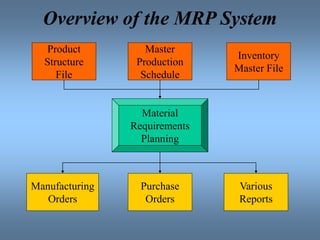
Overview of the MRP System
Product
Structure
File
Master
Production
Schedule
Inventory
Master File
Material
Requirements
Planning
Manufacturing
Orders
Purchase
Orders
Various
Reports
MRP Inputs
• Product Structure File
• Master Production Schedule
• Inventory Master File
Product Structure File
• Bill of Materials
Master Production Schedule
• Schedule of Finished Products
• Represents Production, not Demand
• Combination of Customer Orders and
Demand Forecasts
• What Needs to be Produced
Inventory Master File
• On-Hand Quantities
• On-Order Quantities
• Lot Sizes
• Safety Stock
• Lead Time
• Past-Usage Figures
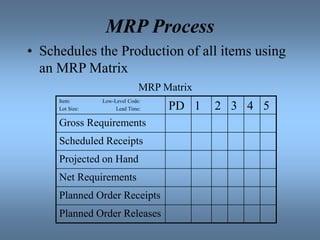
MRP Process
• Schedules the Production of all items using
an MRP Matrix
Item: Low-Level Code:
Lot Size: Lead Time: PD 1 2 3 4 5
Gross Requirements
Scheduled Receipts
Projected on Hand
Net Requirements
Planned Order Receipts
Planned Order Releases
MRP Matrix
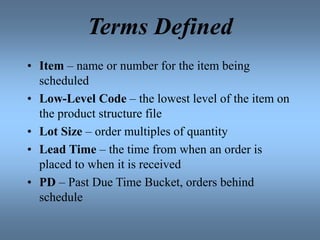
Terms Defined
• Item – name or number for the item being
scheduled
• Low-Level Code – the lowest level of the item on
the product structure file
• Lot Size – order multiples of quantity
• Lead Time – the time from when an order is
placed to when it is received
• PD – Past Due Time Bucket, orders behind
schedule
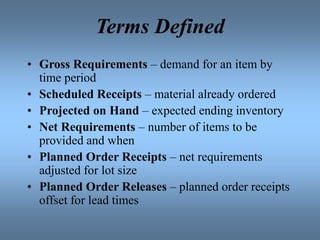
Terms Defined
• Gross Requirements – demand for an item by
time period
• Scheduled Receipts – material already ordered
• Projected on Hand – expected ending inventory
• Net Requirements – number of items to be
provided and when
• Planned Order Receipts – net requirements
adjusted for lot size
• Planned Order Releases – planned order receipts
offset for lead times
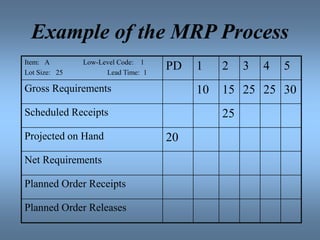
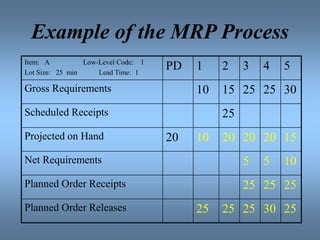
Example of the MRP Process
Item: A Low-Level Code: 1
Lot Size: 25 Lead Time: 1
PD 1 2 3 4 5
Gross Requirements 10 15 25 25 30
Scheduled Receipts 25
Projected on Hand 20
Net Requirements
Planned Order Receipts
Planned Order Releases
Example of the MRP Process
Item: A Low-Level Code: 1
Lot Size: 25 min Lead Time: 1
PD 1 2 3 4 5
Gross Requirements 10 15 25 25 30
Scheduled Receipts 25
Projected on Hand 20 10 20 20 20 15
Net Requirements 5 5 10
Planned Order Receipts 25 25 25
Planned Order Releases 25 25 25 30 25
MRP Outputs
• Manufacturing Orders
• Purchasing Orders
• Various Reports
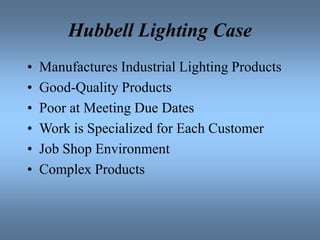
Hubbell Lighting Case
• Manufactures Industrial Lighting Products
• Good-Quality Products
• Poor at Meeting Due Dates
• Work is Specialized for Each Customer
• Job Shop Environment
• Complex Products
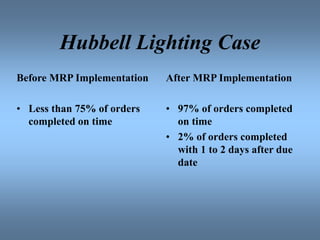
Hubbell Lighting Case
Before MRP Implementation
• Less than 75% of orders
completed on time
After MRP Implementation
• 97% of orders completed
on time
• 2% of orders completed
with 1 to 2 days after due
date
Summary of MRP
MRP is a…..
• Computerized Inventory Control
• Production Planning System
that…..
• Schedules Component Items as Needed
which will…..
• Track Inventory and…..
• Help you in many other aspects of business
References
Russell, Roberta S., and Bernard W. Taylor III. Operations Management. 3rd
Edition: Prentice Hall, 2000
Grubbstrom, Robert W. Material Requirements Planning and Manufacturing
Resource Planning. 03/12/2002.
http://www.itbp.com/opsmanagement/iebm/material_requirements.htm.
Vormittag Associates, Inc. System 2000 MRP. 03/12/2002.
http://www.vaihome.com/s2000mrp.htm.
Inventory Solutions. What is MRP?. 03/12/2002.
http://www.inventorysolutions.org/def_mrp.htm.

Material Requirement Planning Presentation.ppt

  • 1.
  • 2.
    Contributors to MRP •Joseph Orlicky • George Plossl • Oliver Wight • American Production and Inventory Control Society
  • 3.
    What is MRP? •Computerized Inventory Control • Production Planning System • Management Information System • Manufacturing Control System
  • 4.
    When to useMRP • Job Shop Production • Complex Products • Assemble-to-Order Environments • Discrete and Dependent Demand Items
  • 5.
    What can MRPdo? • Reduce Inventory Levels • Reduce Component Shortages • Improve Shipping Performance • Improve Customer Service • Improve Productivity • Simplified and Accurate Scheduling • Reduce Purchasing Cost • Improve Production Schedules • Reduce Manufacturing Cost • Reduce Lead Times • Less Scrap and Rework • Higher Production Quality
  • 6.
    What can MRPdo? • Improve Communication • Improve Plant Efficiency • Reduce Freight Cost • Reduction in Excess Inventory • Reduce Overtime • Improve Supply Schedules • Improve Calculation of Material Requirements • Improve Competitive Position
  • 7.
    Three Basic Stepsof MRP • Identifying Requirements • Running MRP – Creating the Suggestions • Firming the Suggestions
  • 8.
    Step 1: Identifyingthe Requirements • Quantity on Hand • Quantity on Open Purchase Order • Quantity in/or Planned for Manufacturing • Quantity Committed to Existing Orders • Quantity Forecasted
  • 9.
    Step 1: ImportantInformation MRP is….. • Company Sensitive • Location Sensitive • Date Sensitive
  • 10.
    Step 2: RunningMRP – Creating the Suggestions • Critical Items • Expedite Items • Delay Items
  • 11.
    Step 3: Firmingthe Suggestions • Manufacturing Orders • Purchasing Orders • Various Reports
  • 12.
    Overview of theMRP System Product Structure File Master Production Schedule Inventory Master File Material Requirements Planning Manufacturing Orders Purchase Orders Various Reports
  • 13.
    MRP Inputs • ProductStructure File • Master Production Schedule • Inventory Master File
  • 14.
    Product Structure File •Bill of Materials
  • 15.
    Master Production Schedule •Schedule of Finished Products • Represents Production, not Demand • Combination of Customer Orders and Demand Forecasts • What Needs to be Produced
  • 16.
    Inventory Master File •On-Hand Quantities • On-Order Quantities • Lot Sizes • Safety Stock • Lead Time • Past-Usage Figures
  • 17.
    MRP Process • Schedulesthe Production of all items using an MRP Matrix Item: Low-Level Code: Lot Size: Lead Time: PD 1 2 3 4 5 Gross Requirements Scheduled Receipts Projected on Hand Net Requirements Planned Order Receipts Planned Order Releases MRP Matrix
  • 18.
    Terms Defined • Item– name or number for the item being scheduled • Low-Level Code – the lowest level of the item on the product structure file • Lot Size – order multiples of quantity • Lead Time – the time from when an order is placed to when it is received • PD – Past Due Time Bucket, orders behind schedule
  • 19.
    Terms Defined • GrossRequirements – demand for an item by time period • Scheduled Receipts – material already ordered • Projected on Hand – expected ending inventory • Net Requirements – number of items to be provided and when • Planned Order Receipts – net requirements adjusted for lot size • Planned Order Releases – planned order receipts offset for lead times
  • 20.
    Example of theMRP Process Item: A Low-Level Code: 1 Lot Size: 25 Lead Time: 1 PD 1 2 3 4 5 Gross Requirements 10 15 25 25 30 Scheduled Receipts 25 Projected on Hand 20 Net Requirements Planned Order Receipts Planned Order Releases
  • 21.
    Example of theMRP Process Item: A Low-Level Code: 1 Lot Size: 25 min Lead Time: 1 PD 1 2 3 4 5 Gross Requirements 10 15 25 25 30 Scheduled Receipts 25 Projected on Hand 20 10 20 20 20 15 Net Requirements 5 5 10 Planned Order Receipts 25 25 25 Planned Order Releases 25 25 25 30 25
  • 22.
    MRP Outputs • ManufacturingOrders • Purchasing Orders • Various Reports
  • 23.
    Hubbell Lighting Case •Manufactures Industrial Lighting Products • Good-Quality Products • Poor at Meeting Due Dates • Work is Specialized for Each Customer • Job Shop Environment • Complex Products
  • 24.
    Hubbell Lighting Case BeforeMRP Implementation • Less than 75% of orders completed on time After MRP Implementation • 97% of orders completed on time • 2% of orders completed with 1 to 2 days after due date
  • 25.
    Summary of MRP MRPis a….. • Computerized Inventory Control • Production Planning System that….. • Schedules Component Items as Needed which will….. • Track Inventory and….. • Help you in many other aspects of business
  • 26.
    References Russell, Roberta S.,and Bernard W. Taylor III. Operations Management. 3rd Edition: Prentice Hall, 2000 Grubbstrom, Robert W. Material Requirements Planning and Manufacturing Resource Planning. 03/12/2002. http://www.itbp.com/opsmanagement/iebm/material_requirements.htm. Vormittag Associates, Inc. System 2000 MRP. 03/12/2002. http://www.vaihome.com/s2000mrp.htm. Inventory Solutions. What is MRP?. 03/12/2002. http://www.inventorysolutions.org/def_mrp.htm.