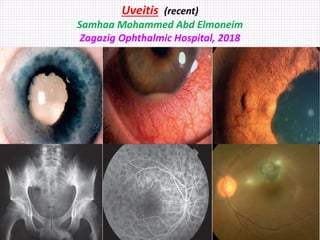
Uveitis (recent)
Samhaa Mohammed Abd Elmoneim
Zagazig Ophthalmic Hospital, 2018
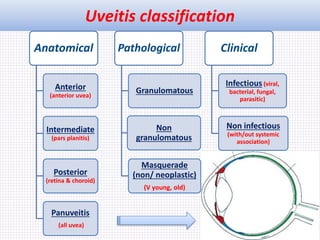
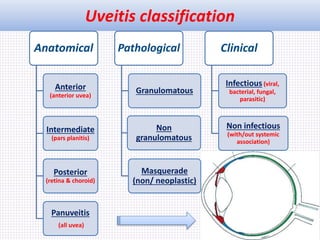
Uveitis classification
Anatomical
Anterior
(anterior uvea)
Intermediate
(pars planitis)
Posterior
(retina & choroid)
Panuveitis
(all uvea)
Pathological
Granulomatous
Non
granulomatous
Masquerade
(non/ neoplastic)
(V young, old)
Clinical
Infectious (viral,
bacterial, fungal,
parasitic)
Non infectious
(with/out systemic
association)
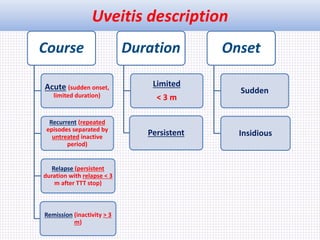
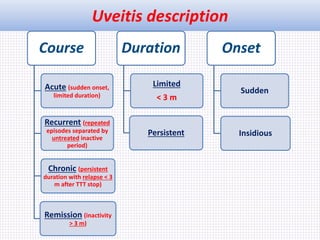
Uveitis description
Course
Acute (sudden onset,
limited duration)
Recurrent (repeated
episodes separated by
untreated inactive
period)
Relapse (persistent
duration with relapse < 3
m after TTT stop)
Remission (inactivity > 3
m)
Duration
Limited
< 3 m
Persistent
Onset
Sudden
Insidious
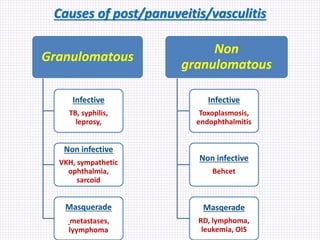
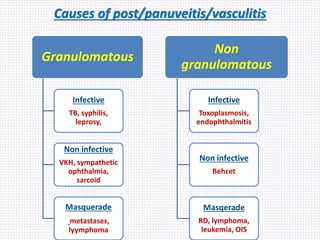
Causes of post/panuveitis/vasculitis
Granulomatous
Infective
TB, syphilis,
leprosy,
Non infective
VKH, sympathetic
ophthalmia,
sarcoid
Masquerade
metastases,
lyymphoma
Non
granulomatous
Infective
Toxoplasmosis,
endophthalmitis
Non infective
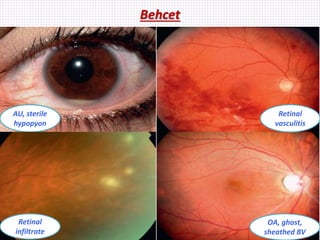
Behcet
Masqerade
RD, lymphoma,
leukemia, OIS
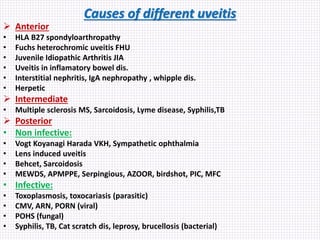
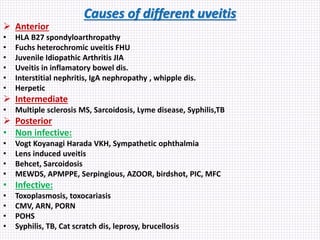
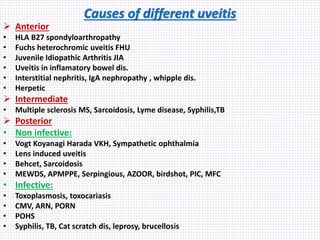
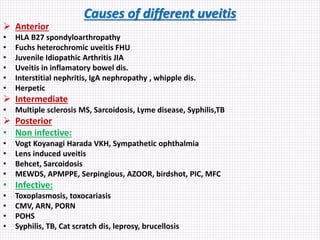
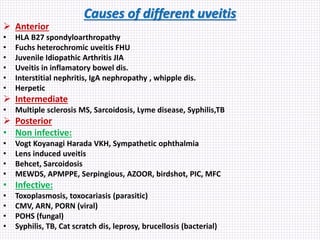
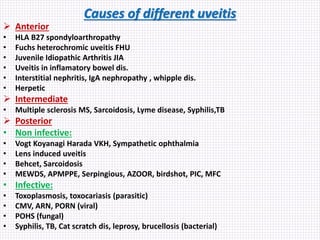
Causes of different uveitis
 Anterior
• HLA B27 spondyloarthropathy
• Fuchs heterochromic uveitis FHU
• Juvenile Idiopathic Arthritis JIA
• Uveitis in inflamatory bowel dis.
• Interstitial nephritis, IgA nephropathy , whipple dis.
• Herpetic
 Intermediate
• Multiple sclerosis MS, Sarcoidosis, Lyme disease, Syphilis,TB
 Posterior
• Non infective:
• Vogt Koyanagi Harada VKH, Sympathetic ophthalmia
• Lens induced uveitis
• Behcet, Sarcoidosis
• MEWDS, APMPPE, Serpingious, AZOOR, birdshot, PIC, MFC
• Infective:
• Toxoplasmosis, toxocariasis (parasitic)
• CMV, ARN, PORN (viral)
• POHS (fungal)
• Syphilis, TB, Cat scratch dis, leprosy, brucellosis (bacterial)
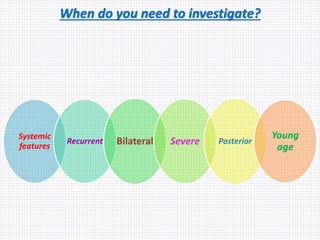
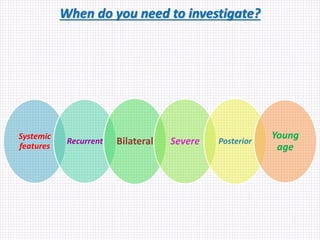
When do you need to investigate?
Systemic
features
Recurrent Bilateral Severe Posterior
Young
age
Causes of different uveitis
 Anterior
• HLA B27 spondyloarthropathy
• Fuchs heterochromic uveitis FHU
• Juvenile Idiopathic Arthritis JIA
• Uveitis in inflamatory bowel dis.
• Interstitial nephritis, IgA nephropathy , whipple dis.
• Herpetic
 Intermediate
• Multiple sclerosis MS, Sarcoidosis, Lyme disease, Syphilis,TB
 Posterior
• Non infective:
• Vogt Koyanagi Harada VKH, Sympathetic ophthalmia
• Lens induced uveitis
• Behcet, Sarcoidosis
• MEWDS, APMPPE, Serpingious, AZOOR, birdshot, PIC, MFC
• Infective:
• Toxoplasmosis, toxocariasis (parasitic)
• CMV, ARN, PORN (viral)
• POHS (fungal)
• Syphilis, TB, Cat scratch dis, leprosy, brucellosis (bacterial)
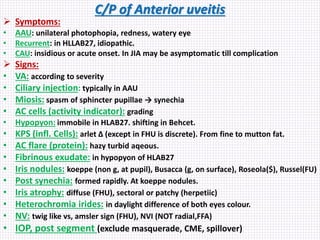
C/P of Anterior uveitis
 Symptoms:
• AAU: unilateral photophopia, redness, watery eye
• Recurrent: in HLLAB27, idiopathic.
• CAU: insidious or acute onset. In JIA may be asymptomatic till complication
 Signs:
• VA: according to severity
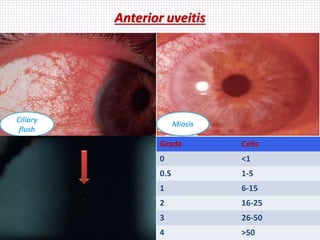
• Ciliary injection: typically in AAU
• Miosis: spasm of sphincter pupillae → synechia
• AC cells (activity indicator): grading
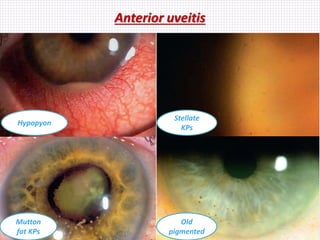
• Hypopyon: immobile in HLAB27. shifting in Behcet.
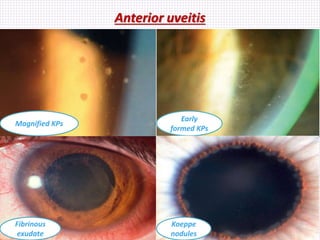
• KPS (infl. Cells): arlet Δ (except in FHU is discrete). From fine to mutton fat.
• AC flare (protein): hazy turbid aqeous.
• Fibrinous exudate: in hypopyon of HLAB27
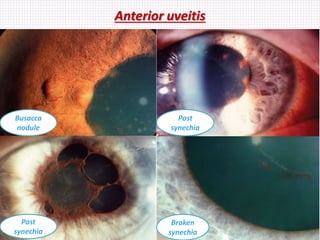
• Iris nodules: koeppe (non g, at pupil), Busacca (g, on surface), Roseola($), Russel(FU)
• Post synechia: formed rapidly. At koeppe nodules.
• Iris atrophy: diffuse (FHU), sectoral or patchy (herpetiic)
• Heterochromia irides: in daylight difference of both eyes colour.
• NV: twig like vs, amsler sign (FHU), NVI (NOT radial,FFA)
• IOP, post segment (exclude masquerade, CME, spillover)
Anterior uveitis
Ciliary
flush
Miosis
Grade Cells
0 <1
0.5 1-5
1 6-15
2 16-25
3 26-50
4 >50
Anterior uveitis
Hypopyon
Stellate
KPs
Mutton
fat KPs
Old
pigmented
Anterior uveitis
Magnified KPs
Early
formed KPs
Fibrinous
exudate
Koeppe
nodules
Anterior uveitis
Busacca
nodule
Post
synechia
Post
synechia
Broken
synechia
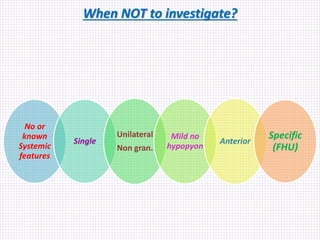
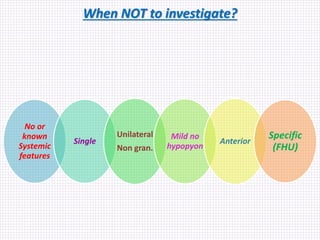
When NOT to investigate?
No or
known
Systemic
features
Single
Unilateral
Non gran.
Mild no
hypopyon
Anterior
Specific
(FHU)
When do you need to investigate?
Systemic
features
Recurrent Bilateral Severe Posterior
Young
age
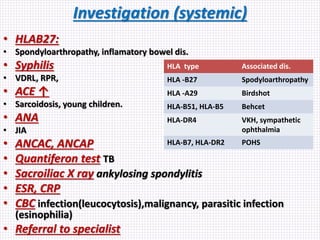
Investigation (systemic)
• HLAB27:
• Spondyloarthropathy, inflamatory bowel dis.
• Syphilis
• VDRL, RPR,
• ACE ↑
• Sarcoidosis, young children.
• ANA
• JIA
• ANCAC, ANCAP
• Quantiferon test TB
• Sacroiliac X ray ankylosing spondylitis
• ESR, CRP
• CBC infection(leucocytosis),malignancy, parasitic infection
(esinophilia)
• Referral to specialist
HLA type Associated dis.
HLA -B27 Spodyloarthropathy
HLA -A29 Birdshot
HLA-B51, HLA-B5 Behcet
HLA-DR4 VKH, sympathetic
ophthalmia
HLA-B7, HLA-DR2 POHS
Investigation (ocular)
• B scan:
• Small pupil, hazy media.
• OCT:
• Associated post uveitis (ERM, CME)
• FAF:
• Associated post uveitis (MEWDS)
• FA:
• Associated post uveitis (Macular ischemia, vasculitis, MEWDS)
• UBM:
• Hypotony (uveal effusion, cleft)
• Aqueous tap:
• PCR, viral culture
• Vitreous biopsy:
• Infectious endophthalmitis
• Conjunctival biopsy:
• Granuloma, sarcoidosis
Anterior uveitis
Treatment
• Topical steroid:
• Prednisolone, dexamethazone, difluprendate.
• Topical cycloplegic: (↓CM spasm, PS) at bedtime in mild & chronic)
• Cyclopentolate, mydriacyl, atropine, phenylphrine (acute stage dt
anticholinergic)
• Mydriacaine No 2:
• 0.12 adrenaline, 1mg atropine, 6mg procaine subconj.
• Subconjunctival steroid: (resistant)
• Betamethazone (4mg/0.1ml)
• Regional steroid injection:
• Orbital floor, subtenon
• Systemic steroid, antimetabolites:
• PCR, viral culture
Anterior uveitis
 Spondyloarthropathy:
• Ankylosing spondylitis: adult male, HLAB27 90% +ve,sacroiliac
joint. Uveitis in 25%
• Reactive arthritis (Reiters $): adult male, HLAB27 70%.
(urethritis→conjunctivitis→arthritis). Uveitis in 14%
• Psoriatic arthritis: uveitis in 7%
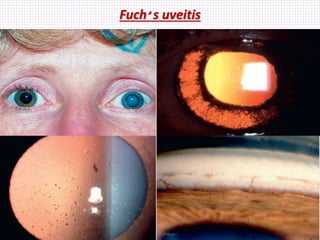
 Fuchs heterochromic uveitis/iridocyclitis:
• M=F, viral, toxoplasma!!
• Unilateral in 90%, incidental, diffuse iris atrophy.
• Heterochomia (hypochromic, hyperchromic in blue eyes)
• Mild AC activity (fine stellate diffuse kps), koeppe,busacca.
• Anterior vitritis, cataract, glaucoma.
• Amsler sign: radial angle bl vs.
• Synechia XX except after surgery.
Fuch̛s uveitis
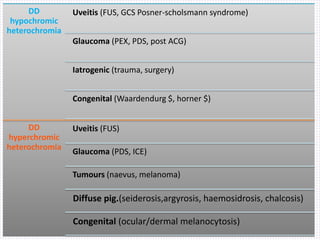
DD
hypochromic
heterochromia
Uveitis (FUS, GCS Posner-scholsmann syndrome)
Glaucoma (PEX, PDS, post ACG)
Iatrogenic (trauma, surgery)
Congenital (Waardendurg $, horner $)
DD
hyperchromic
heterochromia
Uveitis (FUS)
Glaucoma (PDS, ICE)
Tumours (naevus, melanoma)
Diffuse pig.(seiderosis,argyrosis, haemosidrosis, chalcosis)
Congenital (ocular/dermal melanocytosis)
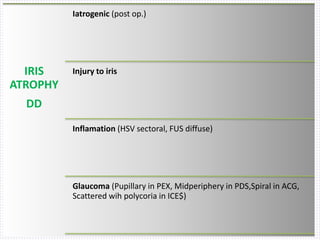
IRIS
ATROPHY
DD
Iatrogenic (post op.)
Injury to iris
Inflamation (HSV sectoral, FUS diffuse)
Glaucoma (Pupillary in PEX, Midperiphery in PDS,Spiral in ACG,
Scattered wih polycoria in ICE$)
Anterior uveitis
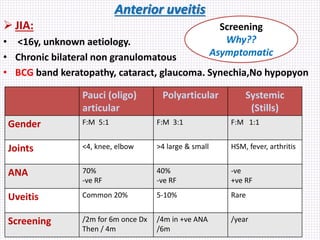
 JIA:
• <16y, unknown aetiology.
• Chronic bilateral non granulomatous
• BCG band keratopathy, cataract, glaucoma. Synechia,No hypopyon
Pauci (oligo)
articular
Polyarticular Systemic
(Stills)
Gender F:M 5:1 F:M 3:1 F:M 1:1
Joints <4, knee, elbow >4 large & small HSM, fever, arthritis
ANA 70%
-ve RF
40%
-ve RF
-ve
+ve RF
Uveitis Common 20% 5-10% Rare
Screening /2m for 6m once Dx
Then / 4m
/4m in +ve ANA
/6m
/year
Screening
Why??
Asymptomatic
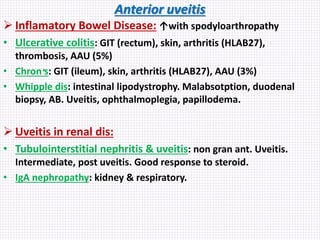
Anterior uveitis
 Inflamatory Bowel Disease: ↑with spodyloarthropathy
• Ulcerative colitis: GIT (rectum), skin, arthritis (HLAB27),
thrombosis, AAU (5%)
• Chron̛s: GIT (ileum), skin, arthritis (HLAB27), AAU (3%)
• Whipple dis: intestinal lipodystrophy. Malabsotption, duodenal
biopsy, AB. Uveitis, ophthalmoplegia, papillodema.
 Uveitis in renal dis:
• Tubulointerstitial nephritis & uveitis: non gran ant. Uveitis.
Intermediate, post uveitis. Good response to steroid.
• IgA nephropathy: kidney & respiratory.
Causes of different uveitis
 Anterior
• HLA B27 spondyloarthropathy
• Fuchs heterochromic uveitis FHU
• Juvenile Idiopathic Arthritis JIA
• Uveitis in inflamatory bowel dis.
• Interstitial nephritis, IgA nephropathy , whipple dis.
• Herpetic
 Intermediate
• Multiple sclerosis MS, Sarcoidosis, Lyme disease, Syphilis,TB
 Posterior
• Non infective:
• Vogt Koyanagi Harada VKH, Sympathetic ophthalmia
• Lens induced uveitis
• Behcet, Sarcoidosis
• MEWDS, APMPPE, Serpingious, AZOOR, birdshot, PIC, MFC
• Infective:
• Toxoplasmosis, toxocariasis
• CMV, ARN, PORN
• POHS
• Syphilis, TB, Cat scratch dis, leprosy, brucellosis
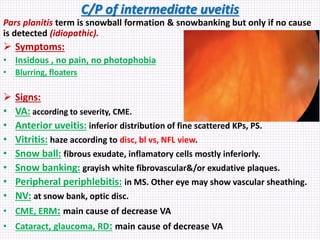
C/P of intermediate uveitis
Pars planitis term is snowball formation & snowbanking but only if no cause
is detected (idiopathic).
 Symptoms:
• Insidous , no pain, no photophobia
• Blurring, floaters
 Signs:
• VA: according to severity, CME.
• Anterior uveitis: inferior distribution of fine scattered KPs, PS.
• Vitritis: haze according to disc, bl vs, NFL view.
• Snow ball: fibrous exudate, inflamatory cells mostly inferiorly.
• Snow banking: grayish white fibrovascular&/or exudative plaques.
• Peripheral periphlebitis: in MS. Other eye may show vascular sheathing.
• NV: at snow bank, optic disc.
• CME, ERM: main cause of decrease VA
• Cataract, glaucoma, RD: main cause of decrease VA
When NOT to investigate?
No or
known
Systemic
features
Single
Unilateral
Non gran.
Mild no
hypopyon
Anterior
Specific
(FHU)
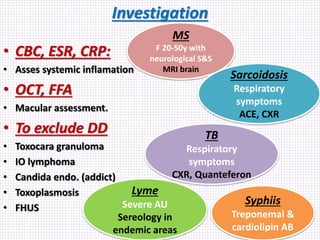
Investigation
• CBC, ESR, CRP:
• Asses systemic inflamation
• OCT, FFA
• Macular assessment.
• To exclude DD
• Toxocara granuloma
• IO lymphoma
• Candida endo. (addict)
• Toxoplasmosis
• FHUS
MS
F 20-50y with
neurological S&S
MRI brain
Sarcoidosis
Respiratory
symptoms
ACE, CXR
TB
Respiratory
symptoms
CXR, Quanteferon
Lyme
Severe AU
Sereology in
endemic areas
Syphiis
Treponemal &
cardiolipin AB
Intermediate uveitis
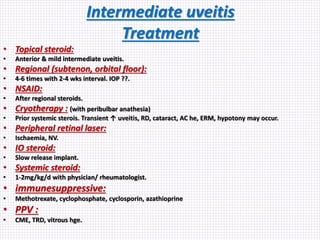
Treatment
• Topical steroid:
• Anterior & mild intermediate uveitis.
• Regional (subtenon, orbital floor):
• 4-6 times with 2-4 wks interval. IOP ??.
• NSAID:
• After regional steroids.
• Cryotherapy : (with peribulbar anathesia)
• Prior systemic sterois. Transient ↑ uveitis, RD, cataract, AC he, ERM, hypotony may occur.
• Peripheral retinal laser:
• Ischaemia, NV.
• IO steroid:
• Slow release implant.
• Systemic steroid:
• 1-2mg/kg/d with physician/ rheumatologist.
• immunesuppressive:
• Methotrexate, cyclophosphate, cyclosporin, azathioprine
• PPV :
• CME, TRD, vitrous hge.
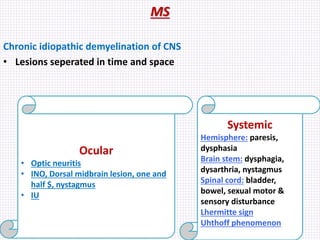
MS
Chronic idiopathic demyelination of CNS
• Lesions seperated in time and space
Ocular
• Optic neuritis
• INO, Dorsal midbrain lesion, one and
half $, nystagmus
• IU
Systemic
Hemisphere: paresis,
dysphasia
Brain stem: dysphagia,
dysarthria, nystagmus
Spinal cord: bladder,
bowel, sexual motor &
sensory disturbance
Lhermitte sign
Uhthoff phenomenon
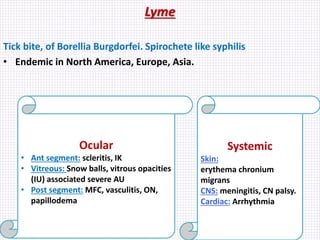
Lyme
Tick bite, of Borellia Burgdorfei. Spirochete like syphilis
• Endemic in North America, Europe, Asia.
Ocular
• Ant segment: scleritis, IK
• Vitreous: Snow balls, vitrous opacities
(IU) associated severe AU
• Post segment: MFC, vasculitis, ON,
papillodema
Systemic
Skin:
erythema chronium
migrans
CNS: meningitis, CN palsy.
Cardiac: Arrhythmia
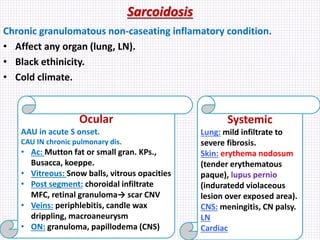
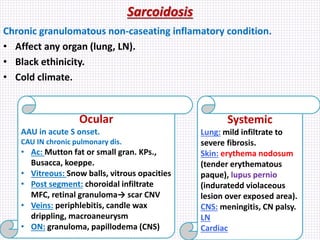
Sarcoidosis
Chronic granulomatous non-caseating inflamatory condition.
• Affect any organ (lung, LN).
• Black ethinicity.
• Cold climate.
Ocular
AAU in acute S onset.
CAU IN chronic pulmonary dis.
• Ac: Mutton fat or small gran. KPs.,
Busacca, koeppe.
• Vitreous: Snow balls, vitrous opacities
• Post segment: choroidal infiltrate
MFC, retinal granuloma→ scar CNV
• Veins: periphlebitis, candle wax
drippling, macroaneurysm
• ON: granuloma, papillodema (CNS)
Systemic
Lung: mild infiltrate to
severe fibrosis.
Skin: erythema nodosum
(tender erythematous
paque), lupus pernio
(induratedd violaceous
lesion over exposed area).
CNS: meningitis, CN palsy.
LN
Cardiac
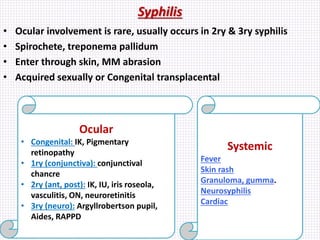
Syphilis
• Ocular involvement is rare, usually occurs in 2ry & 3ry syphilis
• Spirochete, treponema pallidum
• Enter through skin, MM abrasion
• Acquired sexually or Congenital transplacental
Ocular
• Congenital: IK, Pigmentary
retinopathy
• 1ry (conjunctiva): conjunctival
chancre
• 2ry (ant, post): IK, IU, iris roseola,
vasculitis, ON, neuroretinitis
• 3ry (neuro): Argyllrobertson pupil,
Aides, RAPPD
Systemic
Fever
Skin rash
Granuloma, gumma.
Neurosyphilis
Cardiac
TB
• Chronic granulomatous caseating inflamatory disease
• Lungs is the most targeted organ
Ocular
• Lacrimal gland: (dacryoadenitis)
• Phlyctenulosis
• IK
• Uveitis granulomatous:(AC Berlin
nodule, IU, post, panuveitis)
• Ealse disease
• Neuro: ON, INO, CN palsy
• Ethambutol: optic neuropathy
Systemic
Perihilar
lymphadenopathy
Causes of different uveitis
 Anterior
• HLA B27 spondyloarthropathy
• Fuchs heterochromic uveitis FHU
• Juvenile Idiopathic Arthritis JIA
• Uveitis in inflamatory bowel dis.
• Interstitial nephritis, IgA nephropathy , whipple dis.
• Herpetic
 Intermediate
• Multiple sclerosis MS, Sarcoidosis, Lyme disease, Syphilis,TB
 Posterior
• Non infective:
• Vogt Koyanagi Harada VKH, Sympathetic ophthalmia
• Lens induced uveitis
• Behcet, Sarcoidosis
• MEWDS, APMPPE, Serpingious, AZOOR, birdshot, PIC, MFC
• Infective:
• Toxoplasmosis, toxocariasis
• CMV, ARN, PORN
• POHS
• Syphilis, TB, Cat scratch dis, leprosy, brucellosis
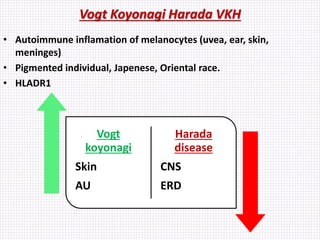
Vogt Koyonagi Harada VKH
• Autoimmune inflamation of melanocytes (uvea, ear, skin,
meninges)
• Pigmented individual, Japenese, Oriental race.
• HLADR1
Vogt
koyonagi
Skin
AU
Harada
disease
CNS
ERD
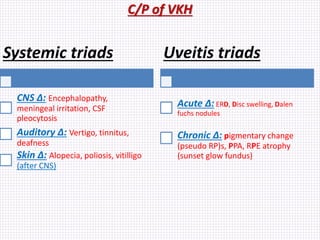
C/P of VKH
Systemic triads
CNS ∆: Encephalopathy,
meningeal irritation, CSF
pleocytosis
Auditory ∆: Vertigo, tinnitus,
deafness
Skin ∆: Alopecia, poliosis, vitilligo
(after CNS)
Uveitis triads
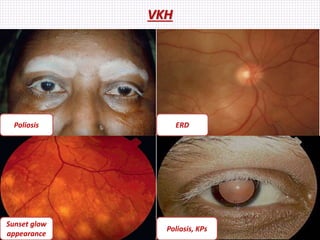
Acute ∆: ERD, Disc swelling, Dalen
fuchs nodules
Chronic ∆: pigmentary change
(pseudo RP)s, PPA, RPE atrophy
(sunset glow fundus)
VKH
Poliosis ERD
Poliosis, KPs
Sunset glow
appearance
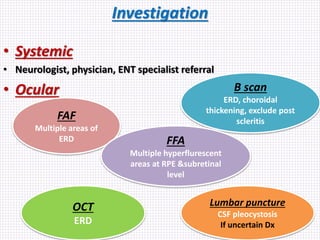
Investigation
• Systemic
• Neurologist, physician, ENT specialist referral
• Ocular
FAF
Multiple areas of
ERD
B scan
ERD, choroidal
thickening, exclude post
scleritis
FFA
Multiple hyperflurescent
areas at RPE &subretinal
level
OCT
ERD
Lumbar puncture
CSF pleocystosis
If uncertain Dx
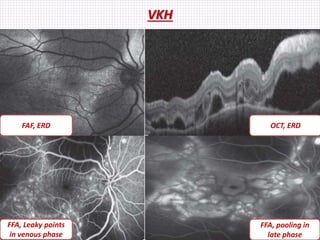
VKH
FAF, ERD OCT, ERD
FFA, pooling in
late phase
FFA, Leaky points
in venous phase
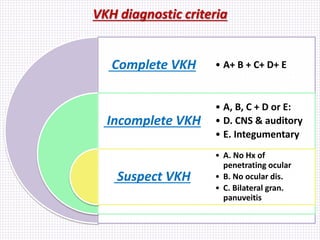
VKH diagnostic criteria
Complete VKH
Incomplete VKH
Suspect VKH
• A+ B + C+ D+ E
• A, B, C + D or E:
• D. CNS & auditory
• E. Integumentary
• A. No Hx of
penetrating ocular
• B. No ocular dis.
• C. Bilateral gran.
panuveitis
VKH
Treatment
• Topical steroid, cycloplegico:
• Anterior uveitis.
• Systemic steroid:
• Oral 1-2mg/kg/d with physician/ rheumatologist.
• May preceeded by IV methylprednisolone.
• Immunesuppressive:
• Methotrexate, cyclophosphamide, Azathioprine, cyclosporin
Sympathetic ophthalmia
• Hx of penetrating trauma, rarely surgery.
• Bilateral granulomatous panuveitis of both wxciting & sympathizing
eyes.
• Mutton fat KPs, Dalen fuchs nodules, MF choroidal infiltrates, ERD,
OD swelling.
• When inflamation subsides, sunset glow fundus appears dt scarring.
Investigation:
• OCT, FA, B scan: for follow up
TTT:
• Enucleation: early for severly injured eye. Evisceration provided
perfect removal of all uveal pigment.
• Systemic steroids, immunesuppressive.
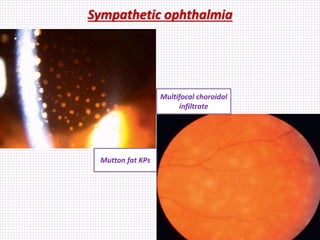
Sympathetic ophthalmia
Mutton fat KPs
Multifocal choroidal
infiltrate
Causes of different uveitis
 Anterior
• HLA B27 spondyloarthropathy
• Fuchs heterochromic uveitis FHU
• Juvenile Idiopathic Arthritis JIA
• Uveitis in inflamatory bowel dis.
• Interstitial nephritis, IgA nephropathy , whipple dis.
• Herpetic
 Intermediate
• Multiple sclerosis MS, Sarcoidosis, Lyme disease, Syphilis,TB
 Posterior
• Non infective:
• Vogt Koyanagi Harada VKH, Sympathetic ophthalmia
• Lens induced uveitis
• Behcet, Sarcoidosis
• MEWDS, APMPPE, Serpingious, AZOOR, birdshot, PIC, MFC
• Infective:
• Toxoplasmosis, toxocariasis
• CMV, ARN, PORN
• POHS
• Syphilis, TB, Cat scratch dis, leprosy, brucellosis
Lens induced uveitis (phacogenic,
phacoanaphylactic
• Lens outside capsule dt trauma, surgery.
• DD: bacterial endophthalmitis ??
• Corneal odema, gran. ant uveitis, IOP, lens fragment.
• Vitritis if lens in vitrous,, ERM, CME
Investigation:
• B scan: for follow up, UBM, OCT
TTT:
• Small retained fragment may be managed conservatively
• Removal of retained lens in AC, vitrous
• In case of blunt/ penetrating trauma, removal of damaged lens.
Causes of different uveitis
 Anterior
• HLA B27 spondyloarthropathy
• Fuchs heterochromic uveitis FHU
• Juvenile Idiopathic Arthritis JIA
• Uveitis in inflamatory bowel dis.
• Interstitial nephritis, IgA nephropathy , whipple dis.
• Herpetic
 Intermediate
• Multiple sclerosis MS, Sarcoidosis, Lyme disease, Syphilis,TB
 Posterior
• Non infective:
• Vogt Koyanagi Harada VKH, Sympathetic ophthalmia
• Lens induced uveitis
• Behcet, Sarcoidosis
• MEWDS, APMPPE, Serpingious, AZOOR, birdshot, PIC, MFC
• Infective:
• Toxoplasmosis, toxocariasis
• CMV, ARN, PORN
• POHS
• Syphilis, TB, Cat scratch dis, leprosy, brucellosis
Behcet disorder
Idiopathic multisystem disorder with characteristic C/P
• Obliterated vasculitis of a/v
• HLAB51
• 3rd decade
• Gender variable between ethinicity (middle, far east), more
aggressive in M > F
TTT:
• Steroid
• Immunesuppressive (cyclosporin2-5mg/kg/d), azathioprine,
influximab.
Behcet
Idiopathic multisystem disorder with characteristic C/P
• Obliterated vasculitis of a/v
• HLAB51
• 3rd decade, gender variable between ethinicity (middle, far east)
Diagnotic criteria
5 features
(oral ulcer + 2 of 4)
• Oral ulcers: painful, recurrent.
• Genital ulcer.
• Skin lesions: erypthema nodosum,
papular, pustular, nodular rash.
• +ve pathergy test.
• Eye lesion: bilateral non-gran.
Panuveitis.
Others
Vascular: aneurysm,
thromosis , vasculitis,
perphlebitis (v)
Arthritis
CNS: brainstem, IC
aneurysm.
GIT: inflamation
Behcet
AU, sterile
hypopyon
Retinal
infiltrate
Retinal
vasculitis
OA, ghost,
sheathed BV
Sarcoidosis
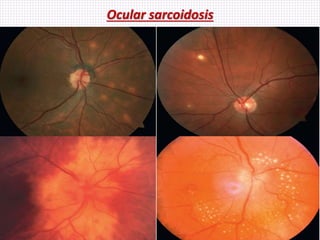
Chronic granulomatous non-caseating inflamatory condition.
• Affect any organ (lung, LN).
• Black ethinicity.
• Cold climate.
Ocular
AAU in acute S onset.
CAU IN chronic pulmonary dis.
• Ac: Mutton fat or small gran. KPs.,
Busacca, koeppe.
• Vitreous: Snow balls, vitrous opacities
• Post segment: choroidal infiltrate
MFC, retinal granuloma→ scar CNV
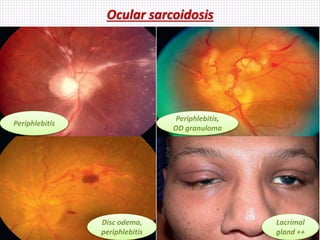
• Veins: periphlebitis, candle wax
drippling, macroaneurysm
• ON: granuloma, papillodema (CNS)
Systemic
Lung: mild infiltrate to
severe fibrosis.
Skin: erythema nodosum
(tender erythematous
paque), lupus pernio
(induratedd violaceous
lesion over exposed area).
CNS: meningitis, CN palsy.
LN
Cardiac
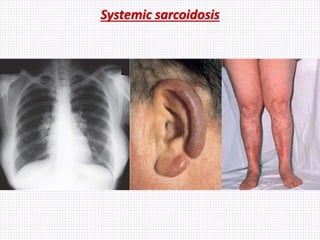
Systemic sarcoidosis
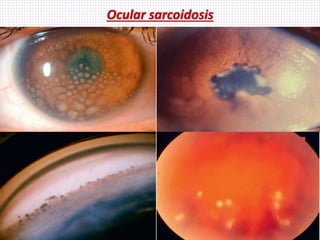
Ocular sarcoidosis
Ocular sarcoidosis
Ocular sarcoidosis
Periphlebitis
Disc odema,
periphlebitis
Periphlebitis,
OD granuloma
Lacrimal
gland ++
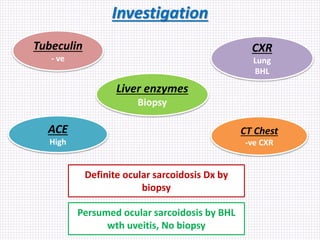
Investigation
Tubeculin
- ve
ACE
High
CXR
Lung
BHL
Liver enzymes
Biopsy
CT Chest
-ve CXR
Definite ocular sarcoidosis Dx by
biopsy
Persumed ocular sarcoidosis by BHL
wth uveitis, No biopsy
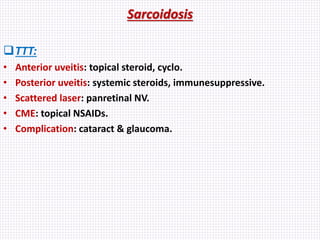
Sarcoidosis
TTT:
• Anterior uveitis: topical steroid, cyclo.
• Posterior uveitis: systemic steroids, immunesuppressive.
• Scattered laser: panretinal NV.
• CME: topical NSAIDs.
• Complication: cataract & glaucoma.
Causes of different uveitis
 Anterior
• HLA B27 spondyloarthropathy
• Fuchs heterochromic uveitis FHU
• Juvenile Idiopathic Arthritis JIA
• Uveitis in inflamatory bowel dis.
• Interstitial nephritis, IgA nephropathy , whipple dis.
• Herpetic
 Intermediate
• Multiple sclerosis MS, Sarcoidosis, Lyme disease, Syphilis,TB
 Posterior
• Non infective:
• Vogt Koyanagi Harada VKH, Sympathetic ophthalmia
• Lens induced uveitis
• Behcet, Sarcoidosis
• MEWDS, APMPPE, Serpingious, AZOOR, birdshot, PIC, MFC
• Infective:
• Toxoplasmosis, toxocariasis
• CMV, ARN, PORN
• POHS
• Syphilis, TB, Cat scratch dis, leprosy, brucellosis
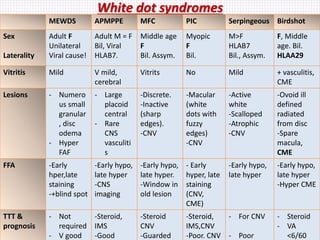
White dot syndromes
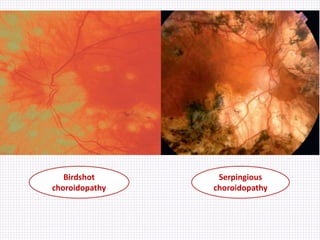
MEWDS APMPPE MFC PIC Serpingeous Birdshot
Sex
Laterality
Adult F
Unilateral
Viral cause!
Adult M = F
Bil, Viral
HLAB7.
Middle age
F
Bil. Assym.
Myopic
F
Bil.
M>F
HLAB7
Bil., Assym.
F, Middle
age. Bil.
HLAA29
Vitritis Mild V mild,
cerebral
Vitrits No Mild + vasculitis,
CME
Lesions - Numero
us small
granular
, disc
odema
- Hyper
FAF
- Large
placoid
central
- Rare
CNS
vasculiti
s
-Discrete.
-Inactive
(sharp
edges).
-CNV
-Macular
(white
dots with
fuzzy
edges)
-CNV
-Active
white
-Scalloped
-Atrophic
-CNV
-Ovoid ill
defined
radiated
from disc
-Spare
macula,
CME
FFA -Early
hper,late
staining
-+blind spot
-Early hypo,
late hyper
-CNS
imaging
-Early hypo,
late hyper.
-Window in
old lesion
- Early
hyper, late
staining
(CNV,
CME)
-Early hypo,
late hyper
-Early hypo,
late hyper
-Hyper CME
TTT &
prognosis
- Not
required
- V good
-Steroid,
IMS
-Good
-Steroid
CNV
-Guarded
-Steroid,
IMS,CNV
-Poor. CNV
- For CNV
- Poor
- Steroid
- VA
<6/60
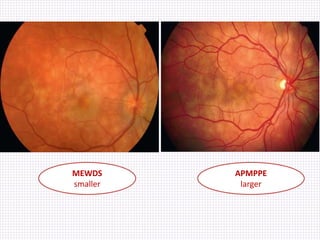
MEWDS
smaller
APMPPE
larger
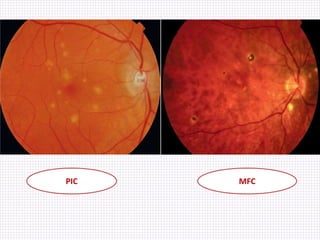
PIC MFC
Birdshot
choroidopathy
Serpingious
choroidopathy
Causes of different uveitis
 Anterior
• HLA B27 spondyloarthropathy
• Fuchs heterochromic uveitis FHU
• Juvenile Idiopathic Arthritis JIA
• Uveitis in inflamatory bowel dis.
• Interstitial nephritis, IgA nephropathy , whipple dis.
• Herpetic
 Intermediate
• Multiple sclerosis MS, Sarcoidosis, Lyme disease, Syphilis,TB
 Posterior
• Non infective:
• Vogt Koyanagi Harada VKH, Sympathetic ophthalmia
• Lens induced uveitis
• Behcet, Sarcoidosis
• MEWDS, APMPPE, Serpingious, AZOOR, birdshot, PIC, MFC
• Infective:
• Toxoplasmosis, toxocariasis (parasitic)
• CMV, ARN, PORN (viral)
• POHS (fungal)
• Syphilis, TB, Cat scratch dis, leprosy, brucellosis (bacterial)
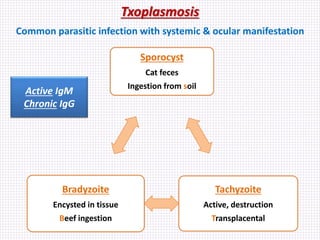
Txoplasmosis
Common parasitic infection with systemic & ocular manifestation
Sporocyst
Cat feces
Ingestion from soil
Tachyzoite
Active, destruction
Transplacental
Bradyzoite
Encysted in tissue
Beef ingestion
Active IgM
Chronic IgG
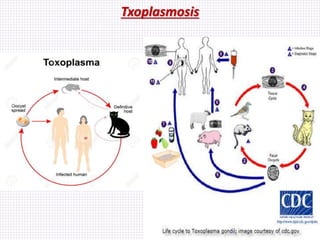
Txoplasmosis
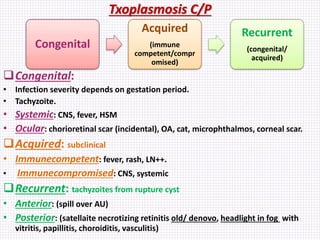
Txoplasmosis C/P
Congenital:
• Infection severity depends on gestation period.
• Tachyzoite.
• Systemic: CNS, fever, HSM
• Ocular: chorioretinal scar (incidental), OA, cat, microphthalmos, corneal scar.
Acquired: subclinical
• Immunecompetent: fever, rash, LN++.
• Immunecompromised: CNS, systemic
Recurrent: tachyzoites from rupture cyst
• Anterior: (spill over AU)
• Posterior: (satellaite necrotizing retinitis old/ denovo, headlight in fog with
vitritis, papillitis, choroiditis, vasculitis)
Congenital
Acquired
(immune
competent/compr
omised)
Recurrent
(congenital/
acquired)
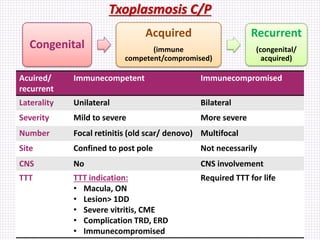
Txoplasmosis C/P
Congenital
Acquired
(immune
competent/compromised)
Recurrent
(congenital/
acquired)
Acuired/
recurrent
Immunecompetent Immunecompromised
Laterality Unilateral Bilateral
Severity Mild to severe More severe
Number Focal retinitis (old scar/ denovo) Multifocal
Site Confined to post pole Not necessarily
CNS No CNS involvement
TTT TTT indication:
• Macula, ON
• Lesion> 1DD
• Severe vitritis, CME
• Complication TRD, ERD
• Immunecompromised
Required TTT for life
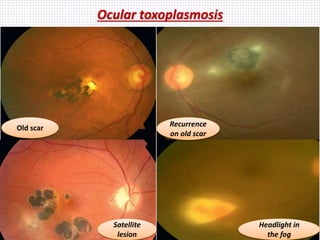
Ocular toxoplasmosis
Old scar Recurrence
on old scar
Satellite
lesion
Headlight in
the fog
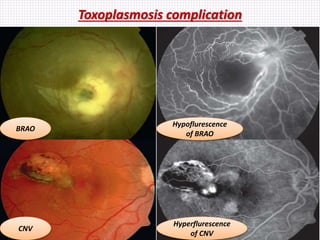
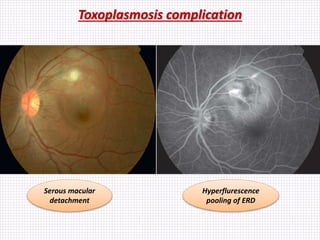
Toxoplasmosis complication
BRAO
Hypoflurescence
of BRAO
CNV
Hyperflurescence
of CNV
Toxoplasmosis complication
Serous macular
detachment
Hyperflurescence
pooling of ERD
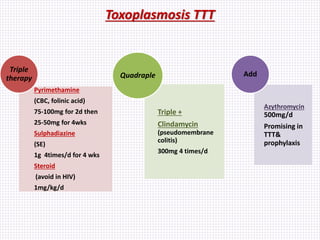
Toxoplasmosis TTT
Pyrimethamine
(CBC, folinic acid)
75-100mg for 2d then
25-50mg for 4wks
Sulphadiazine
(SE)
1g 4times/d for 4 wks
Steroid
(avoid in HIV)
1mg/kg/d
Triple
therapy
Triple +
Clindamycin
(pseudomembrane
colitis)
300mg 4 times/d
Quadraple
Azythromycin
500mg/d
Promising in
TTT&
prophylaxis
Add
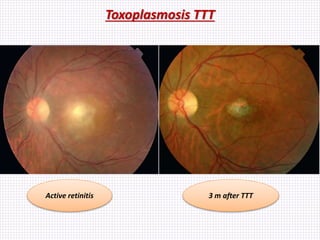
Toxoplasmosis TTT
Active retinitis 3 m after TTT
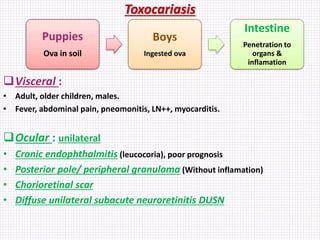
Toxocariasis
Visceral :
• Adult, older children, males.
• Fever, abdominal pain, pneomonitis, LN++, myocarditis.
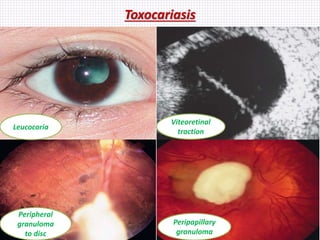
Ocular : unilateral
• Cronic endophthalmitis (leucocoria), poor prognosis
• Posterior pole/ peripheral granuloma (Without inflamation)
• Chorioretinal scar
• Diffuse unilateral subacute neuroretinitis DUSN
Puppies
Ova in soil
Boys
Ingested ova
Intestine
Penetration to
organs &
inflamation
Toxocariasis
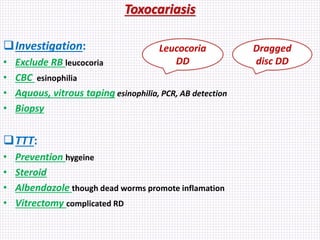
Investigation:
• Exclude RB leucocoria
• CBC esinophilia
• Aquous, vitrous taping esinophilia, PCR, AB detection
• Biopsy
TTT:
• Prevention hygeine
• Steroid
• Albendazole though dead worms promote inflamation
• Vitrectomy complicated RD
Dragged
disc DD
Leucocoria
DD
Toxocariasis
Leucocoria
Peripheral
granuloma
to disc
Viteoretinal
traction
Peripapillary
granuloma
Causes of different uveitis
 Anterior
• HLA B27 spondyloarthropathy
• Fuchs heterochromic uveitis FHU
• Juvenile Idiopathic Arthritis JIA
• Uveitis in inflamatory bowel dis.
• Interstitial nephritis, IgA nephropathy , whipple dis.
• Herpetic
 Intermediate
• Multiple sclerosis MS, Sarcoidosis, Lyme disease, Syphilis,TB
 Posterior
• Non infective:
• Vogt Koyanagi Harada VKH, Sympathetic ophthalmia
• Lens induced uveitis
• Behcet, Sarcoidosis
• MEWDS, APMPPE, Serpingious, AZOOR, birdshot, PIC, MFC
• Infective:
• Toxoplasmosis, toxocariasis (parasitic)
• CMV, ARN, PORN (viral)
• POHS (fungal)
• Syphilis, TB, Cat scratch dis, leprosy, brucellosis (bacterial)
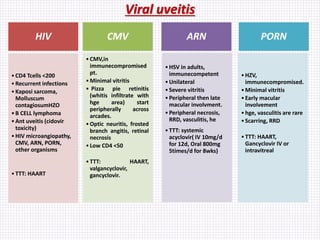
Viral uveitis
HIV
•CD4 Tcells <200
•Recurrent infections
•Kaposi sarcoma,
Molluscum
contagiosumHZO
•B CELL lymphoma
•Ant uveitis (cidovir
toxicity)
•HIV microangiopathy,
CMV, ARN, PORN,
other organisms
•TTT: HAART
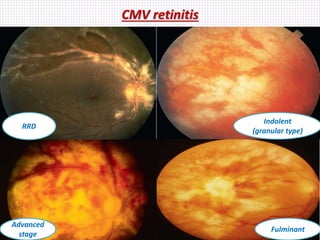
CMV
•CMV,in
immunecompromised
pt.
•Minimal vitritis
• Pizza pie retinitis
(whitis infiltrate with
hge area) start
peripherally across
arcades.
•Optic neuritis, frosted
branch angitis, retinal
necrosis
•Low CD4 <50
•TTT: HAART,
valgancyclovir,
gancyclovir.
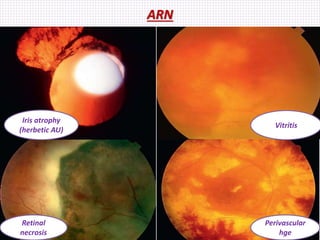
ARN
•HSV in adults,
immunecompetent
•Unilateral
•Severe vitritis
•Peripheral then late
macular involvment.
•Peripheral necrosis,
RRD, vasculitis, he
•TTT: systemic
acyclovir( IV 10mg/d
for 12d, Oral 800mg
5times/d for 8wks)
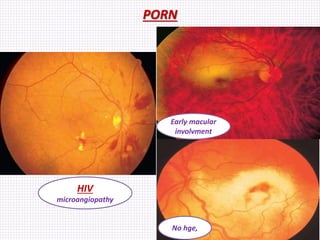
PORN
•HZV,
immunecompromised.
•Minimal vitritis
•Early macular
involvement
•hge, vasculitis are rare
•Scarring, RRD
•TTT: HAART,
Gancyclovir IV or
intravitreal
CMV retinitis
Indolent
(granular type)
Fulminant
Advanced
stage
RRD
ARN
Iris atrophy
(herbetic AU)
Vitritis
Retinal
necrosis
Perivascular
hge
PORN
Early macular
involvment
No hge,
HIV
microangiopathy
Causes of different uveitis
 Anterior
• HLA B27 spondyloarthropathy
• Fuchs heterochromic uveitis FHU
• Juvenile Idiopathic Arthritis JIA
• Uveitis in inflamatory bowel dis.
• Interstitial nephritis, IgA nephropathy , whipple dis.
• Herpetic
 Intermediate
• Multiple sclerosis MS, Sarcoidosis, Lyme disease, Syphilis,TB
 Posterior
• Non infective:
• Vogt Koyanagi Harada VKH, Sympathetic ophthalmia
• Lens induced uveitis
• Behcet, Sarcoidosis
• MEWDS, APMPPE, Serpingious, AZOOR, birdshot, PIC, MFC
• Infective:
• Toxoplasmosis, toxocariasis (parasitic)
• CMV, ARN, PORN (viral)
• POHS (fungal)
• Syphilis, TB, Cat scratch dis, leprosy, brucellosis (bacterial)
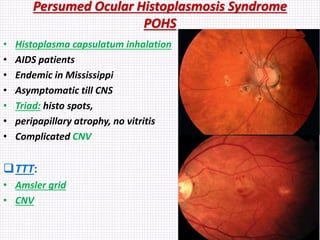
Persumed Ocular Histoplasmosis Syndrome
POHS
• Histoplasma capsulatum inhalation
• AIDS patients
• Endemic in Mississippi
• Asymptomatic till CNS
• Triad: histo spots,
• peripapillary atrophy, no vitritis
• Complicated CNV
TTT:
• Amsler grid
• CNV
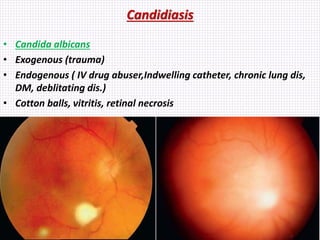
Candidiasis
• Candida albicans
• Exogenous (trauma)
• Endogenous ( IV drug abuser,Indwelling catheter, chronic lung dis,
DM, deblitating dis.)
• Cotton balls, vitritis, retinal necrosis
Causes of different uveitis
 Anterior
• HLA B27 spondyloarthropathy
• Fuchs heterochromic uveitis FHU
• Juvenile Idiopathic Arthritis JIA
• Uveitis in inflamatory bowel dis.
• Interstitial nephritis, IgA nephropathy , whipple dis.
• Herpetic
 Intermediate
• Multiple sclerosis MS, Sarcoidosis, Lyme disease, Syphilis,TB
 Posterior
• Non infective:
• Vogt Koyanagi Harada VKH, Sympathetic ophthalmia
• Lens induced uveitis
• Behcet, Sarcoidosis
• MEWDS, APMPPE, Serpingious, AZOOR, birdshot, PIC, MFC
• Infective:
• Toxoplasmosis, toxocariasis (parasitic)
• CMV, ARN, PORN (viral)
• POHS (fungal)
• Syphilis, TB, Cat scratch dis, leprosy, brucellosis (bacterial)
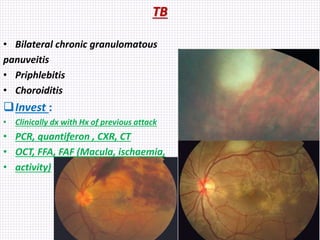
TB
• Bilateral chronic granulomatous
panuveitis
• Priphlebitis
• Choroiditis
Invest :
• Clinically dx with Hx of previous attack
• PCR, quantiferon , CXR, CT
• OCT, FFA, FAF (Macula, ischaemia,
• activity)
Acquired syphilis
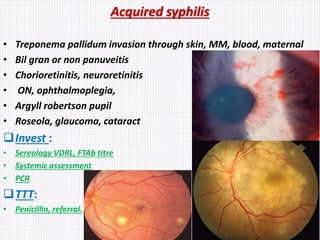
• Treponema pallidum invasion through skin, MM, blood, maternal
• Bil gran or non panuveitis
• Chorioretinitis, neuroretinitis
• ON, ophthalmoplegia,
• Argyll robertson pupil
• Roseola, glaucoma, cataract
Invest :
• Sereology VDRL, FTAb titre
• Systemic assessment
• PCR
TTT:
• Penicillin, referral.
Lyme
• Borrelia burgedorfie, tick bite
• North America, Europe
• Stage 1: fever, rash
• Stage 2: systemic (CNS, heart)
• Stage 3: complication (arthritis, encephalopathy, polyneuropathy)
• Ocular: intermediate uveitis, scleritis, keratitis, facial palsy, ON
TTT:
• Protection
• Early: doxycline, erythromycine
• Established: ceftriaxone, penicillin
Cat scratch dis.
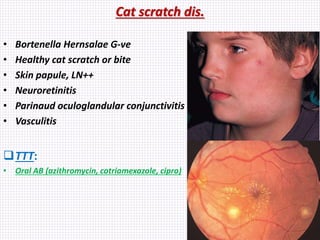
• Bortenella Hernsalae G-ve
• Healthy cat scratch or bite
• Skin papule, LN++
• Neuroretinitis
• Parinaud oculoglandular conjunctivitis
• Vasculitis
TTT:
• Oral AB (azithromycin, cotriamexazole, cipro)
Causes of different uveitis
 Anterior
• HLA B27 spondyloarthropathy
• Fuchs heterochromic uveitis FHU
• Juvenile Idiopathic Arthritis JIA
• Uveitis in inflamatory bowel dis.
• Interstitial nephritis, IgA nephropathy , whipple dis.
• Herpetic
 Intermediate
• Multiple sclerosis MS, Sarcoidosis, Lyme disease, Syphilis,TB
 Posterior
• Non infective:
• Vogt Koyanagi Harada VKH, Sympathetic ophthalmia
• Lens induced uveitis
• Behcet, Sarcoidosis
• MEWDS, APMPPE, Serpingious, AZOOR, birdshot, PIC, MFC
• Infective:
• Toxoplasmosis, toxocariasis (parasitic)
• HIV, CMV, ARN, PORN (viral)
• POHS (fungal)
• Syphilis, TB, Cat scratch dis, leprosy, brucellosis (bacterial)
Uveitis classification
Anatomical
Anterior
(anterior uvea)
Intermediate
(pars planitis)
Posterior
(retina & choroid)
Panuveitis
(all uvea)
Pathological
Granulomatous
Non
granulomatous
Masquerade
(non/ neoplastic)
Clinical
Infectious (viral,
bacterial, fungal,
parasitic)
Non infectious
(with/out systemic
association)
Uveitis description
Course
Acute (sudden onset,
limited duration)
Recurrent (repeated
episodes separated by
untreated inactive
period)
Chronic (persistent
duration with relapse < 3
m after TTT stop)
Remission (inactivity
> 3 m)
Duration
Limited
< 3 m
Persistent
Onset
Sudden
Insidious
Causes of post/panuveitis/vasculitis
Granulomatous
Infective
TB, syphilis,
leprosy,
Non infective
VKH, sympathetic
ophthalmia,
sarcoid
Masquerade
metastases,
lyymphoma
Non
granulomatous
Infective
Toxoplasmosis,
endophthalmitis
Non infective
Behcet
Masqerade
RD, lymphoma,
leukemia, OIS

Uveitis (recent)

  • 1.
    Uveitis (recent) Samhaa MohammedAbd Elmoneim Zagazig Ophthalmic Hospital, 2018
  • 2.
    Uveitis classification Anatomical Anterior (anterior uvea) Intermediate (parsplanitis) Posterior (retina & choroid) Panuveitis (all uvea) Pathological Granulomatous Non granulomatous Masquerade (non/ neoplastic) (V young, old) Clinical Infectious (viral, bacterial, fungal, parasitic) Non infectious (with/out systemic association)
  • 3.
    Uveitis description Course Acute (suddenonset, limited duration) Recurrent (repeated episodes separated by untreated inactive period) Relapse (persistent duration with relapse < 3 m after TTT stop) Remission (inactivity > 3 m) Duration Limited < 3 m Persistent Onset Sudden Insidious
  • 4.
    Causes of post/panuveitis/vasculitis Granulomatous Infective TB,syphilis, leprosy, Non infective VKH, sympathetic ophthalmia, sarcoid Masquerade metastases, lyymphoma Non granulomatous Infective Toxoplasmosis, endophthalmitis Non infective Behcet Masqerade RD, lymphoma, leukemia, OIS
  • 5.
    Causes of differentuveitis  Anterior • HLA B27 spondyloarthropathy • Fuchs heterochromic uveitis FHU • Juvenile Idiopathic Arthritis JIA • Uveitis in inflamatory bowel dis. • Interstitial nephritis, IgA nephropathy , whipple dis. • Herpetic  Intermediate • Multiple sclerosis MS, Sarcoidosis, Lyme disease, Syphilis,TB  Posterior • Non infective: • Vogt Koyanagi Harada VKH, Sympathetic ophthalmia • Lens induced uveitis • Behcet, Sarcoidosis • MEWDS, APMPPE, Serpingious, AZOOR, birdshot, PIC, MFC • Infective: • Toxoplasmosis, toxocariasis (parasitic) • CMV, ARN, PORN (viral) • POHS (fungal) • Syphilis, TB, Cat scratch dis, leprosy, brucellosis (bacterial)
  • 6.
    When do youneed to investigate? Systemic features Recurrent Bilateral Severe Posterior Young age
  • 7.
    Causes of differentuveitis  Anterior • HLA B27 spondyloarthropathy • Fuchs heterochromic uveitis FHU • Juvenile Idiopathic Arthritis JIA • Uveitis in inflamatory bowel dis. • Interstitial nephritis, IgA nephropathy , whipple dis. • Herpetic  Intermediate • Multiple sclerosis MS, Sarcoidosis, Lyme disease, Syphilis,TB  Posterior • Non infective: • Vogt Koyanagi Harada VKH, Sympathetic ophthalmia • Lens induced uveitis • Behcet, Sarcoidosis • MEWDS, APMPPE, Serpingious, AZOOR, birdshot, PIC, MFC • Infective: • Toxoplasmosis, toxocariasis (parasitic) • CMV, ARN, PORN (viral) • POHS (fungal) • Syphilis, TB, Cat scratch dis, leprosy, brucellosis (bacterial)
  • 8.
    C/P of Anterioruveitis  Symptoms: • AAU: unilateral photophopia, redness, watery eye • Recurrent: in HLLAB27, idiopathic. • CAU: insidious or acute onset. In JIA may be asymptomatic till complication  Signs: • VA: according to severity • Ciliary injection: typically in AAU • Miosis: spasm of sphincter pupillae → synechia • AC cells (activity indicator): grading • Hypopyon: immobile in HLAB27. shifting in Behcet. • KPS (infl. Cells): arlet Δ (except in FHU is discrete). From fine to mutton fat. • AC flare (protein): hazy turbid aqeous. • Fibrinous exudate: in hypopyon of HLAB27 • Iris nodules: koeppe (non g, at pupil), Busacca (g, on surface), Roseola($), Russel(FU) • Post synechia: formed rapidly. At koeppe nodules. • Iris atrophy: diffuse (FHU), sectoral or patchy (herpetiic) • Heterochromia irides: in daylight difference of both eyes colour. • NV: twig like vs, amsler sign (FHU), NVI (NOT radial,FFA) • IOP, post segment (exclude masquerade, CME, spillover)
  • 9.
    Anterior uveitis Ciliary flush Miosis Grade Cells 0<1 0.5 1-5 1 6-15 2 16-25 3 26-50 4 >50
  • 10.
  • 11.
    Anterior uveitis Magnified KPs Early formedKPs Fibrinous exudate Koeppe nodules
  • 12.
  • 13.
    When NOT toinvestigate? No or known Systemic features Single Unilateral Non gran. Mild no hypopyon Anterior Specific (FHU)
  • 14.
    When do youneed to investigate? Systemic features Recurrent Bilateral Severe Posterior Young age
  • 15.
    Investigation (systemic) • HLAB27: •Spondyloarthropathy, inflamatory bowel dis. • Syphilis • VDRL, RPR, • ACE ↑ • Sarcoidosis, young children. • ANA • JIA • ANCAC, ANCAP • Quantiferon test TB • Sacroiliac X ray ankylosing spondylitis • ESR, CRP • CBC infection(leucocytosis),malignancy, parasitic infection (esinophilia) • Referral to specialist HLA type Associated dis. HLA -B27 Spodyloarthropathy HLA -A29 Birdshot HLA-B51, HLA-B5 Behcet HLA-DR4 VKH, sympathetic ophthalmia HLA-B7, HLA-DR2 POHS
  • 16.
    Investigation (ocular) • Bscan: • Small pupil, hazy media. • OCT: • Associated post uveitis (ERM, CME) • FAF: • Associated post uveitis (MEWDS) • FA: • Associated post uveitis (Macular ischemia, vasculitis, MEWDS) • UBM: • Hypotony (uveal effusion, cleft) • Aqueous tap: • PCR, viral culture • Vitreous biopsy: • Infectious endophthalmitis • Conjunctival biopsy: • Granuloma, sarcoidosis
  • 17.
    Anterior uveitis Treatment • Topicalsteroid: • Prednisolone, dexamethazone, difluprendate. • Topical cycloplegic: (↓CM spasm, PS) at bedtime in mild & chronic) • Cyclopentolate, mydriacyl, atropine, phenylphrine (acute stage dt anticholinergic) • Mydriacaine No 2: • 0.12 adrenaline, 1mg atropine, 6mg procaine subconj. • Subconjunctival steroid: (resistant) • Betamethazone (4mg/0.1ml) • Regional steroid injection: • Orbital floor, subtenon • Systemic steroid, antimetabolites: • PCR, viral culture
  • 18.
    Anterior uveitis  Spondyloarthropathy: •Ankylosing spondylitis: adult male, HLAB27 90% +ve,sacroiliac joint. Uveitis in 25% • Reactive arthritis (Reiters $): adult male, HLAB27 70%. (urethritis→conjunctivitis→arthritis). Uveitis in 14% • Psoriatic arthritis: uveitis in 7%  Fuchs heterochromic uveitis/iridocyclitis: • M=F, viral, toxoplasma!! • Unilateral in 90%, incidental, diffuse iris atrophy. • Heterochomia (hypochromic, hyperchromic in blue eyes) • Mild AC activity (fine stellate diffuse kps), koeppe,busacca. • Anterior vitritis, cataract, glaucoma. • Amsler sign: radial angle bl vs. • Synechia XX except after surgery.
  • 19.
  • 20.
    DD hypochromic heterochromia Uveitis (FUS, GCSPosner-scholsmann syndrome) Glaucoma (PEX, PDS, post ACG) Iatrogenic (trauma, surgery) Congenital (Waardendurg $, horner $) DD hyperchromic heterochromia Uveitis (FUS) Glaucoma (PDS, ICE) Tumours (naevus, melanoma) Diffuse pig.(seiderosis,argyrosis, haemosidrosis, chalcosis) Congenital (ocular/dermal melanocytosis)
  • 21.
    IRIS ATROPHY DD Iatrogenic (post op.) Injuryto iris Inflamation (HSV sectoral, FUS diffuse) Glaucoma (Pupillary in PEX, Midperiphery in PDS,Spiral in ACG, Scattered wih polycoria in ICE$)
  • 22.
    Anterior uveitis  JIA: •<16y, unknown aetiology. • Chronic bilateral non granulomatous • BCG band keratopathy, cataract, glaucoma. Synechia,No hypopyon Pauci (oligo) articular Polyarticular Systemic (Stills) Gender F:M 5:1 F:M 3:1 F:M 1:1 Joints <4, knee, elbow >4 large & small HSM, fever, arthritis ANA 70% -ve RF 40% -ve RF -ve +ve RF Uveitis Common 20% 5-10% Rare Screening /2m for 6m once Dx Then / 4m /4m in +ve ANA /6m /year Screening Why?? Asymptomatic
  • 23.
    Anterior uveitis  InflamatoryBowel Disease: ↑with spodyloarthropathy • Ulcerative colitis: GIT (rectum), skin, arthritis (HLAB27), thrombosis, AAU (5%) • Chron̛s: GIT (ileum), skin, arthritis (HLAB27), AAU (3%) • Whipple dis: intestinal lipodystrophy. Malabsotption, duodenal biopsy, AB. Uveitis, ophthalmoplegia, papillodema.  Uveitis in renal dis: • Tubulointerstitial nephritis & uveitis: non gran ant. Uveitis. Intermediate, post uveitis. Good response to steroid. • IgA nephropathy: kidney & respiratory.
  • 24.
    Causes of differentuveitis  Anterior • HLA B27 spondyloarthropathy • Fuchs heterochromic uveitis FHU • Juvenile Idiopathic Arthritis JIA • Uveitis in inflamatory bowel dis. • Interstitial nephritis, IgA nephropathy , whipple dis. • Herpetic  Intermediate • Multiple sclerosis MS, Sarcoidosis, Lyme disease, Syphilis,TB  Posterior • Non infective: • Vogt Koyanagi Harada VKH, Sympathetic ophthalmia • Lens induced uveitis • Behcet, Sarcoidosis • MEWDS, APMPPE, Serpingious, AZOOR, birdshot, PIC, MFC • Infective: • Toxoplasmosis, toxocariasis • CMV, ARN, PORN • POHS • Syphilis, TB, Cat scratch dis, leprosy, brucellosis
  • 25.
    C/P of intermediateuveitis Pars planitis term is snowball formation & snowbanking but only if no cause is detected (idiopathic).  Symptoms: • Insidous , no pain, no photophobia • Blurring, floaters  Signs: • VA: according to severity, CME. • Anterior uveitis: inferior distribution of fine scattered KPs, PS. • Vitritis: haze according to disc, bl vs, NFL view. • Snow ball: fibrous exudate, inflamatory cells mostly inferiorly. • Snow banking: grayish white fibrovascular&/or exudative plaques. • Peripheral periphlebitis: in MS. Other eye may show vascular sheathing. • NV: at snow bank, optic disc. • CME, ERM: main cause of decrease VA • Cataract, glaucoma, RD: main cause of decrease VA
  • 26.
    When NOT toinvestigate? No or known Systemic features Single Unilateral Non gran. Mild no hypopyon Anterior Specific (FHU)
  • 27.
    Investigation • CBC, ESR,CRP: • Asses systemic inflamation • OCT, FFA • Macular assessment. • To exclude DD • Toxocara granuloma • IO lymphoma • Candida endo. (addict) • Toxoplasmosis • FHUS MS F 20-50y with neurological S&S MRI brain Sarcoidosis Respiratory symptoms ACE, CXR TB Respiratory symptoms CXR, Quanteferon Lyme Severe AU Sereology in endemic areas Syphiis Treponemal & cardiolipin AB
  • 28.
    Intermediate uveitis Treatment • Topicalsteroid: • Anterior & mild intermediate uveitis. • Regional (subtenon, orbital floor): • 4-6 times with 2-4 wks interval. IOP ??. • NSAID: • After regional steroids. • Cryotherapy : (with peribulbar anathesia) • Prior systemic sterois. Transient ↑ uveitis, RD, cataract, AC he, ERM, hypotony may occur. • Peripheral retinal laser: • Ischaemia, NV. • IO steroid: • Slow release implant. • Systemic steroid: • 1-2mg/kg/d with physician/ rheumatologist. • immunesuppressive: • Methotrexate, cyclophosphate, cyclosporin, azathioprine • PPV : • CME, TRD, vitrous hge.
  • 29.
    MS Chronic idiopathic demyelinationof CNS • Lesions seperated in time and space Ocular • Optic neuritis • INO, Dorsal midbrain lesion, one and half $, nystagmus • IU Systemic Hemisphere: paresis, dysphasia Brain stem: dysphagia, dysarthria, nystagmus Spinal cord: bladder, bowel, sexual motor & sensory disturbance Lhermitte sign Uhthoff phenomenon
  • 30.
    Lyme Tick bite, ofBorellia Burgdorfei. Spirochete like syphilis • Endemic in North America, Europe, Asia. Ocular • Ant segment: scleritis, IK • Vitreous: Snow balls, vitrous opacities (IU) associated severe AU • Post segment: MFC, vasculitis, ON, papillodema Systemic Skin: erythema chronium migrans CNS: meningitis, CN palsy. Cardiac: Arrhythmia
  • 31.
    Sarcoidosis Chronic granulomatous non-caseatinginflamatory condition. • Affect any organ (lung, LN). • Black ethinicity. • Cold climate. Ocular AAU in acute S onset. CAU IN chronic pulmonary dis. • Ac: Mutton fat or small gran. KPs., Busacca, koeppe. • Vitreous: Snow balls, vitrous opacities • Post segment: choroidal infiltrate MFC, retinal granuloma→ scar CNV • Veins: periphlebitis, candle wax drippling, macroaneurysm • ON: granuloma, papillodema (CNS) Systemic Lung: mild infiltrate to severe fibrosis. Skin: erythema nodosum (tender erythematous paque), lupus pernio (induratedd violaceous lesion over exposed area). CNS: meningitis, CN palsy. LN Cardiac
  • 32.
    Syphilis • Ocular involvementis rare, usually occurs in 2ry & 3ry syphilis • Spirochete, treponema pallidum • Enter through skin, MM abrasion • Acquired sexually or Congenital transplacental Ocular • Congenital: IK, Pigmentary retinopathy • 1ry (conjunctiva): conjunctival chancre • 2ry (ant, post): IK, IU, iris roseola, vasculitis, ON, neuroretinitis • 3ry (neuro): Argyllrobertson pupil, Aides, RAPPD Systemic Fever Skin rash Granuloma, gumma. Neurosyphilis Cardiac
  • 33.
    TB • Chronic granulomatouscaseating inflamatory disease • Lungs is the most targeted organ Ocular • Lacrimal gland: (dacryoadenitis) • Phlyctenulosis • IK • Uveitis granulomatous:(AC Berlin nodule, IU, post, panuveitis) • Ealse disease • Neuro: ON, INO, CN palsy • Ethambutol: optic neuropathy Systemic Perihilar lymphadenopathy
  • 34.
    Causes of differentuveitis  Anterior • HLA B27 spondyloarthropathy • Fuchs heterochromic uveitis FHU • Juvenile Idiopathic Arthritis JIA • Uveitis in inflamatory bowel dis. • Interstitial nephritis, IgA nephropathy , whipple dis. • Herpetic  Intermediate • Multiple sclerosis MS, Sarcoidosis, Lyme disease, Syphilis,TB  Posterior • Non infective: • Vogt Koyanagi Harada VKH, Sympathetic ophthalmia • Lens induced uveitis • Behcet, Sarcoidosis • MEWDS, APMPPE, Serpingious, AZOOR, birdshot, PIC, MFC • Infective: • Toxoplasmosis, toxocariasis • CMV, ARN, PORN • POHS • Syphilis, TB, Cat scratch dis, leprosy, brucellosis
  • 35.
    Vogt Koyonagi HaradaVKH • Autoimmune inflamation of melanocytes (uvea, ear, skin, meninges) • Pigmented individual, Japenese, Oriental race. • HLADR1 Vogt koyonagi Skin AU Harada disease CNS ERD
  • 36.
    C/P of VKH Systemictriads CNS ∆: Encephalopathy, meningeal irritation, CSF pleocytosis Auditory ∆: Vertigo, tinnitus, deafness Skin ∆: Alopecia, poliosis, vitilligo (after CNS) Uveitis triads Acute ∆: ERD, Disc swelling, Dalen fuchs nodules Chronic ∆: pigmentary change (pseudo RP)s, PPA, RPE atrophy (sunset glow fundus)
  • 37.
  • 38.
    Investigation • Systemic • Neurologist,physician, ENT specialist referral • Ocular FAF Multiple areas of ERD B scan ERD, choroidal thickening, exclude post scleritis FFA Multiple hyperflurescent areas at RPE &subretinal level OCT ERD Lumbar puncture CSF pleocystosis If uncertain Dx
  • 39.
    VKH FAF, ERD OCT,ERD FFA, pooling in late phase FFA, Leaky points in venous phase
  • 40.
    VKH diagnostic criteria CompleteVKH Incomplete VKH Suspect VKH • A+ B + C+ D+ E • A, B, C + D or E: • D. CNS & auditory • E. Integumentary • A. No Hx of penetrating ocular • B. No ocular dis. • C. Bilateral gran. panuveitis
  • 41.
    VKH Treatment • Topical steroid,cycloplegico: • Anterior uveitis. • Systemic steroid: • Oral 1-2mg/kg/d with physician/ rheumatologist. • May preceeded by IV methylprednisolone. • Immunesuppressive: • Methotrexate, cyclophosphamide, Azathioprine, cyclosporin
  • 42.
    Sympathetic ophthalmia • Hxof penetrating trauma, rarely surgery. • Bilateral granulomatous panuveitis of both wxciting & sympathizing eyes. • Mutton fat KPs, Dalen fuchs nodules, MF choroidal infiltrates, ERD, OD swelling. • When inflamation subsides, sunset glow fundus appears dt scarring. Investigation: • OCT, FA, B scan: for follow up TTT: • Enucleation: early for severly injured eye. Evisceration provided perfect removal of all uveal pigment. • Systemic steroids, immunesuppressive.
  • 43.
    Sympathetic ophthalmia Mutton fatKPs Multifocal choroidal infiltrate
  • 44.
    Causes of differentuveitis  Anterior • HLA B27 spondyloarthropathy • Fuchs heterochromic uveitis FHU • Juvenile Idiopathic Arthritis JIA • Uveitis in inflamatory bowel dis. • Interstitial nephritis, IgA nephropathy , whipple dis. • Herpetic  Intermediate • Multiple sclerosis MS, Sarcoidosis, Lyme disease, Syphilis,TB  Posterior • Non infective: • Vogt Koyanagi Harada VKH, Sympathetic ophthalmia • Lens induced uveitis • Behcet, Sarcoidosis • MEWDS, APMPPE, Serpingious, AZOOR, birdshot, PIC, MFC • Infective: • Toxoplasmosis, toxocariasis • CMV, ARN, PORN • POHS • Syphilis, TB, Cat scratch dis, leprosy, brucellosis
  • 45.
    Lens induced uveitis(phacogenic, phacoanaphylactic • Lens outside capsule dt trauma, surgery. • DD: bacterial endophthalmitis ?? • Corneal odema, gran. ant uveitis, IOP, lens fragment. • Vitritis if lens in vitrous,, ERM, CME Investigation: • B scan: for follow up, UBM, OCT TTT: • Small retained fragment may be managed conservatively • Removal of retained lens in AC, vitrous • In case of blunt/ penetrating trauma, removal of damaged lens.
  • 46.
    Causes of differentuveitis  Anterior • HLA B27 spondyloarthropathy • Fuchs heterochromic uveitis FHU • Juvenile Idiopathic Arthritis JIA • Uveitis in inflamatory bowel dis. • Interstitial nephritis, IgA nephropathy , whipple dis. • Herpetic  Intermediate • Multiple sclerosis MS, Sarcoidosis, Lyme disease, Syphilis,TB  Posterior • Non infective: • Vogt Koyanagi Harada VKH, Sympathetic ophthalmia • Lens induced uveitis • Behcet, Sarcoidosis • MEWDS, APMPPE, Serpingious, AZOOR, birdshot, PIC, MFC • Infective: • Toxoplasmosis, toxocariasis • CMV, ARN, PORN • POHS • Syphilis, TB, Cat scratch dis, leprosy, brucellosis
  • 47.
    Behcet disorder Idiopathic multisystemdisorder with characteristic C/P • Obliterated vasculitis of a/v • HLAB51 • 3rd decade • Gender variable between ethinicity (middle, far east), more aggressive in M > F TTT: • Steroid • Immunesuppressive (cyclosporin2-5mg/kg/d), azathioprine, influximab.
  • 48.
    Behcet Idiopathic multisystem disorderwith characteristic C/P • Obliterated vasculitis of a/v • HLAB51 • 3rd decade, gender variable between ethinicity (middle, far east) Diagnotic criteria 5 features (oral ulcer + 2 of 4) • Oral ulcers: painful, recurrent. • Genital ulcer. • Skin lesions: erypthema nodosum, papular, pustular, nodular rash. • +ve pathergy test. • Eye lesion: bilateral non-gran. Panuveitis. Others Vascular: aneurysm, thromosis , vasculitis, perphlebitis (v) Arthritis CNS: brainstem, IC aneurysm. GIT: inflamation
  • 49.
  • 50.
    Sarcoidosis Chronic granulomatous non-caseatinginflamatory condition. • Affect any organ (lung, LN). • Black ethinicity. • Cold climate. Ocular AAU in acute S onset. CAU IN chronic pulmonary dis. • Ac: Mutton fat or small gran. KPs., Busacca, koeppe. • Vitreous: Snow balls, vitrous opacities • Post segment: choroidal infiltrate MFC, retinal granuloma→ scar CNV • Veins: periphlebitis, candle wax drippling, macroaneurysm • ON: granuloma, papillodema (CNS) Systemic Lung: mild infiltrate to severe fibrosis. Skin: erythema nodosum (tender erythematous paque), lupus pernio (induratedd violaceous lesion over exposed area). CNS: meningitis, CN palsy. LN Cardiac
  • 51.
  • 52.
  • 53.
  • 54.
  • 55.
    Investigation Tubeculin - ve ACE High CXR Lung BHL Liver enzymes Biopsy CTChest -ve CXR Definite ocular sarcoidosis Dx by biopsy Persumed ocular sarcoidosis by BHL wth uveitis, No biopsy
  • 56.
    Sarcoidosis TTT: • Anterior uveitis:topical steroid, cyclo. • Posterior uveitis: systemic steroids, immunesuppressive. • Scattered laser: panretinal NV. • CME: topical NSAIDs. • Complication: cataract & glaucoma.
  • 57.
    Causes of differentuveitis  Anterior • HLA B27 spondyloarthropathy • Fuchs heterochromic uveitis FHU • Juvenile Idiopathic Arthritis JIA • Uveitis in inflamatory bowel dis. • Interstitial nephritis, IgA nephropathy , whipple dis. • Herpetic  Intermediate • Multiple sclerosis MS, Sarcoidosis, Lyme disease, Syphilis,TB  Posterior • Non infective: • Vogt Koyanagi Harada VKH, Sympathetic ophthalmia • Lens induced uveitis • Behcet, Sarcoidosis • MEWDS, APMPPE, Serpingious, AZOOR, birdshot, PIC, MFC • Infective: • Toxoplasmosis, toxocariasis • CMV, ARN, PORN • POHS • Syphilis, TB, Cat scratch dis, leprosy, brucellosis
  • 58.
    White dot syndromes MEWDSAPMPPE MFC PIC Serpingeous Birdshot Sex Laterality Adult F Unilateral Viral cause! Adult M = F Bil, Viral HLAB7. Middle age F Bil. Assym. Myopic F Bil. M>F HLAB7 Bil., Assym. F, Middle age. Bil. HLAA29 Vitritis Mild V mild, cerebral Vitrits No Mild + vasculitis, CME Lesions - Numero us small granular , disc odema - Hyper FAF - Large placoid central - Rare CNS vasculiti s -Discrete. -Inactive (sharp edges). -CNV -Macular (white dots with fuzzy edges) -CNV -Active white -Scalloped -Atrophic -CNV -Ovoid ill defined radiated from disc -Spare macula, CME FFA -Early hper,late staining -+blind spot -Early hypo, late hyper -CNS imaging -Early hypo, late hyper. -Window in old lesion - Early hyper, late staining (CNV, CME) -Early hypo, late hyper -Early hypo, late hyper -Hyper CME TTT & prognosis - Not required - V good -Steroid, IMS -Good -Steroid CNV -Guarded -Steroid, IMS,CNV -Poor. CNV - For CNV - Poor - Steroid - VA <6/60
  • 59.
  • 60.
  • 61.
  • 62.
    Causes of differentuveitis  Anterior • HLA B27 spondyloarthropathy • Fuchs heterochromic uveitis FHU • Juvenile Idiopathic Arthritis JIA • Uveitis in inflamatory bowel dis. • Interstitial nephritis, IgA nephropathy , whipple dis. • Herpetic  Intermediate • Multiple sclerosis MS, Sarcoidosis, Lyme disease, Syphilis,TB  Posterior • Non infective: • Vogt Koyanagi Harada VKH, Sympathetic ophthalmia • Lens induced uveitis • Behcet, Sarcoidosis • MEWDS, APMPPE, Serpingious, AZOOR, birdshot, PIC, MFC • Infective: • Toxoplasmosis, toxocariasis (parasitic) • CMV, ARN, PORN (viral) • POHS (fungal) • Syphilis, TB, Cat scratch dis, leprosy, brucellosis (bacterial)
  • 63.
    Txoplasmosis Common parasitic infectionwith systemic & ocular manifestation Sporocyst Cat feces Ingestion from soil Tachyzoite Active, destruction Transplacental Bradyzoite Encysted in tissue Beef ingestion Active IgM Chronic IgG
  • 64.
  • 65.
    Txoplasmosis C/P Congenital: • Infectionseverity depends on gestation period. • Tachyzoite. • Systemic: CNS, fever, HSM • Ocular: chorioretinal scar (incidental), OA, cat, microphthalmos, corneal scar. Acquired: subclinical • Immunecompetent: fever, rash, LN++. • Immunecompromised: CNS, systemic Recurrent: tachyzoites from rupture cyst • Anterior: (spill over AU) • Posterior: (satellaite necrotizing retinitis old/ denovo, headlight in fog with vitritis, papillitis, choroiditis, vasculitis) Congenital Acquired (immune competent/compr omised) Recurrent (congenital/ acquired)
  • 66.
    Txoplasmosis C/P Congenital Acquired (immune competent/compromised) Recurrent (congenital/ acquired) Acuired/ recurrent Immunecompetent Immunecompromised LateralityUnilateral Bilateral Severity Mild to severe More severe Number Focal retinitis (old scar/ denovo) Multifocal Site Confined to post pole Not necessarily CNS No CNS involvement TTT TTT indication: • Macula, ON • Lesion> 1DD • Severe vitritis, CME • Complication TRD, ERD • Immunecompromised Required TTT for life
  • 67.
    Ocular toxoplasmosis Old scarRecurrence on old scar Satellite lesion Headlight in the fog
  • 68.
  • 69.
  • 70.
    Toxoplasmosis TTT Pyrimethamine (CBC, folinicacid) 75-100mg for 2d then 25-50mg for 4wks Sulphadiazine (SE) 1g 4times/d for 4 wks Steroid (avoid in HIV) 1mg/kg/d Triple therapy Triple + Clindamycin (pseudomembrane colitis) 300mg 4 times/d Quadraple Azythromycin 500mg/d Promising in TTT& prophylaxis Add
  • 71.
  • 72.
    Toxocariasis Visceral : • Adult,older children, males. • Fever, abdominal pain, pneomonitis, LN++, myocarditis. Ocular : unilateral • Cronic endophthalmitis (leucocoria), poor prognosis • Posterior pole/ peripheral granuloma (Without inflamation) • Chorioretinal scar • Diffuse unilateral subacute neuroretinitis DUSN Puppies Ova in soil Boys Ingested ova Intestine Penetration to organs & inflamation
  • 73.
    Toxocariasis Investigation: • Exclude RBleucocoria • CBC esinophilia • Aquous, vitrous taping esinophilia, PCR, AB detection • Biopsy TTT: • Prevention hygeine • Steroid • Albendazole though dead worms promote inflamation • Vitrectomy complicated RD Dragged disc DD Leucocoria DD
  • 74.
  • 75.
    Causes of differentuveitis  Anterior • HLA B27 spondyloarthropathy • Fuchs heterochromic uveitis FHU • Juvenile Idiopathic Arthritis JIA • Uveitis in inflamatory bowel dis. • Interstitial nephritis, IgA nephropathy , whipple dis. • Herpetic  Intermediate • Multiple sclerosis MS, Sarcoidosis, Lyme disease, Syphilis,TB  Posterior • Non infective: • Vogt Koyanagi Harada VKH, Sympathetic ophthalmia • Lens induced uveitis • Behcet, Sarcoidosis • MEWDS, APMPPE, Serpingious, AZOOR, birdshot, PIC, MFC • Infective: • Toxoplasmosis, toxocariasis (parasitic) • CMV, ARN, PORN (viral) • POHS (fungal) • Syphilis, TB, Cat scratch dis, leprosy, brucellosis (bacterial)
  • 76.
    Viral uveitis HIV •CD4 Tcells<200 •Recurrent infections •Kaposi sarcoma, Molluscum contagiosumHZO •B CELL lymphoma •Ant uveitis (cidovir toxicity) •HIV microangiopathy, CMV, ARN, PORN, other organisms •TTT: HAART CMV •CMV,in immunecompromised pt. •Minimal vitritis • Pizza pie retinitis (whitis infiltrate with hge area) start peripherally across arcades. •Optic neuritis, frosted branch angitis, retinal necrosis •Low CD4 <50 •TTT: HAART, valgancyclovir, gancyclovir. ARN •HSV in adults, immunecompetent •Unilateral •Severe vitritis •Peripheral then late macular involvment. •Peripheral necrosis, RRD, vasculitis, he •TTT: systemic acyclovir( IV 10mg/d for 12d, Oral 800mg 5times/d for 8wks) PORN •HZV, immunecompromised. •Minimal vitritis •Early macular involvement •hge, vasculitis are rare •Scarring, RRD •TTT: HAART, Gancyclovir IV or intravitreal
  • 77.
  • 78.
  • 79.
  • 80.
    Causes of differentuveitis  Anterior • HLA B27 spondyloarthropathy • Fuchs heterochromic uveitis FHU • Juvenile Idiopathic Arthritis JIA • Uveitis in inflamatory bowel dis. • Interstitial nephritis, IgA nephropathy , whipple dis. • Herpetic  Intermediate • Multiple sclerosis MS, Sarcoidosis, Lyme disease, Syphilis,TB  Posterior • Non infective: • Vogt Koyanagi Harada VKH, Sympathetic ophthalmia • Lens induced uveitis • Behcet, Sarcoidosis • MEWDS, APMPPE, Serpingious, AZOOR, birdshot, PIC, MFC • Infective: • Toxoplasmosis, toxocariasis (parasitic) • CMV, ARN, PORN (viral) • POHS (fungal) • Syphilis, TB, Cat scratch dis, leprosy, brucellosis (bacterial)
  • 81.
    Persumed Ocular HistoplasmosisSyndrome POHS • Histoplasma capsulatum inhalation • AIDS patients • Endemic in Mississippi • Asymptomatic till CNS • Triad: histo spots, • peripapillary atrophy, no vitritis • Complicated CNV TTT: • Amsler grid • CNV
  • 82.
    Candidiasis • Candida albicans •Exogenous (trauma) • Endogenous ( IV drug abuser,Indwelling catheter, chronic lung dis, DM, deblitating dis.) • Cotton balls, vitritis, retinal necrosis
  • 83.
    Causes of differentuveitis  Anterior • HLA B27 spondyloarthropathy • Fuchs heterochromic uveitis FHU • Juvenile Idiopathic Arthritis JIA • Uveitis in inflamatory bowel dis. • Interstitial nephritis, IgA nephropathy , whipple dis. • Herpetic  Intermediate • Multiple sclerosis MS, Sarcoidosis, Lyme disease, Syphilis,TB  Posterior • Non infective: • Vogt Koyanagi Harada VKH, Sympathetic ophthalmia • Lens induced uveitis • Behcet, Sarcoidosis • MEWDS, APMPPE, Serpingious, AZOOR, birdshot, PIC, MFC • Infective: • Toxoplasmosis, toxocariasis (parasitic) • CMV, ARN, PORN (viral) • POHS (fungal) • Syphilis, TB, Cat scratch dis, leprosy, brucellosis (bacterial)
  • 84.
    TB • Bilateral chronicgranulomatous panuveitis • Priphlebitis • Choroiditis Invest : • Clinically dx with Hx of previous attack • PCR, quantiferon , CXR, CT • OCT, FFA, FAF (Macula, ischaemia, • activity)
  • 85.
    Acquired syphilis • Treponemapallidum invasion through skin, MM, blood, maternal • Bil gran or non panuveitis • Chorioretinitis, neuroretinitis • ON, ophthalmoplegia, • Argyll robertson pupil • Roseola, glaucoma, cataract Invest : • Sereology VDRL, FTAb titre • Systemic assessment • PCR TTT: • Penicillin, referral.
  • 86.
    Lyme • Borrelia burgedorfie,tick bite • North America, Europe • Stage 1: fever, rash • Stage 2: systemic (CNS, heart) • Stage 3: complication (arthritis, encephalopathy, polyneuropathy) • Ocular: intermediate uveitis, scleritis, keratitis, facial palsy, ON TTT: • Protection • Early: doxycline, erythromycine • Established: ceftriaxone, penicillin
  • 87.
    Cat scratch dis. •Bortenella Hernsalae G-ve • Healthy cat scratch or bite • Skin papule, LN++ • Neuroretinitis • Parinaud oculoglandular conjunctivitis • Vasculitis TTT: • Oral AB (azithromycin, cotriamexazole, cipro)
  • 88.
    Causes of differentuveitis  Anterior • HLA B27 spondyloarthropathy • Fuchs heterochromic uveitis FHU • Juvenile Idiopathic Arthritis JIA • Uveitis in inflamatory bowel dis. • Interstitial nephritis, IgA nephropathy , whipple dis. • Herpetic  Intermediate • Multiple sclerosis MS, Sarcoidosis, Lyme disease, Syphilis,TB  Posterior • Non infective: • Vogt Koyanagi Harada VKH, Sympathetic ophthalmia • Lens induced uveitis • Behcet, Sarcoidosis • MEWDS, APMPPE, Serpingious, AZOOR, birdshot, PIC, MFC • Infective: • Toxoplasmosis, toxocariasis (parasitic) • HIV, CMV, ARN, PORN (viral) • POHS (fungal) • Syphilis, TB, Cat scratch dis, leprosy, brucellosis (bacterial)
  • 89.
    Uveitis classification Anatomical Anterior (anterior uvea) Intermediate (parsplanitis) Posterior (retina & choroid) Panuveitis (all uvea) Pathological Granulomatous Non granulomatous Masquerade (non/ neoplastic) Clinical Infectious (viral, bacterial, fungal, parasitic) Non infectious (with/out systemic association)
  • 90.
    Uveitis description Course Acute (suddenonset, limited duration) Recurrent (repeated episodes separated by untreated inactive period) Chronic (persistent duration with relapse < 3 m after TTT stop) Remission (inactivity > 3 m) Duration Limited < 3 m Persistent Onset Sudden Insidious
  • 91.
    Causes of post/panuveitis/vasculitis Granulomatous Infective TB,syphilis, leprosy, Non infective VKH, sympathetic ophthalmia, sarcoid Masquerade metastases, lyymphoma Non granulomatous Infective Toxoplasmosis, endophthalmitis Non infective Behcet Masqerade RD, lymphoma, leukemia, OIS