Strabismus
(squint) Dr. SidraJabeen
MBBS, FCPS Ophthalmology,
FCPS Pediatric ophthalmology
Assistant Professor, HFH,RMU
2
3.
Contents:
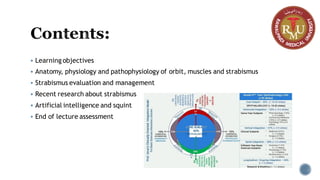
▪ Learning objectives
▪Anatomy, physiology and pathophysiology of orbit, muscles and strabismus
▪ Strabismus evaluation and management
▪ Recent research about strabismus
▪ Artificial intelligence and squint
▪ End of lecture assessment
4.
Learning objective:
▪ Atthe end of lecture students will be able to:
✓ define strabismus
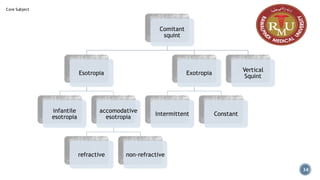
✓ classify different types of strabismus
✓ outline examination and investigation of strabismus
✓ enlist various treatment options including surgical procedure
Strabismus
• The misalignmentof the visual
axes of two eyes is called
squint or strabismus
Definition
6
Core Subject
7.
Binocular single vision
▪Definition
▪ Ability to use both eyes simultaneously with bifoveal fixation to form single image
Core Subject
7
8.
Binocular single vision
▪Grades
▪ Grade 1- Simultaneous perception
▪ Grade 2- Fusion
▪ Unified single perception of an object in two dimensions(height and width)
▪ Grade3- Stereopsis
▪ Unified single perception of an object in three dimensions(height, width and depth)
Core Subject
8
9.
Binocular single vision
Anamoliesof BSV
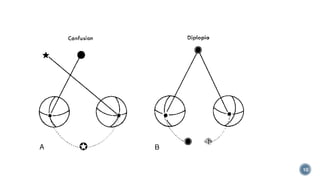
When BSV breaks down ,following things occur:
1-Confusion
▪ Appreciation of two dissimilar images, one on top of other
▪ Caused by stimulation of corresponding retinal elements (usually fovea) by different
object
2-Pathologic diplopia
▪ Appreciation of a single object as two images
▪ Caused by stimulation of non-corresponding retinal elements by same object
Core Subject
9
Binocular single vision
▪Sensory adaptations to strabismus
▪ Suppression
▪ Abnormal retinal correspondence
▪ Motor adaptations to strabismus
▪ Abnormal head posture
Core Subject
11
12.
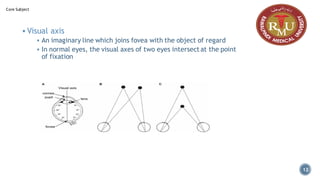
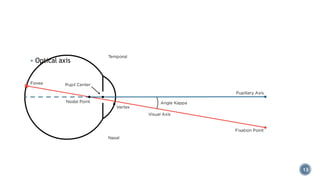
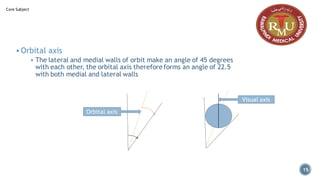
▪ Visual axis
▪An imaginary line which joins fovea with the object of regard
▪ In normal eyes, the visual axes of two eyes intersect at the point
of fixation
Core Subject
12
▪ Orbital axis
▪The lateral and medial walls of orbit make an angle of 45 degrees
with each other, the orbital axis therefore forms an angle of 22.5
with both medial and lateral walls
Orbital axis
Visual axis
Core Subject
15
16.
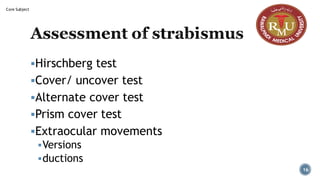
Assessment of strabismus
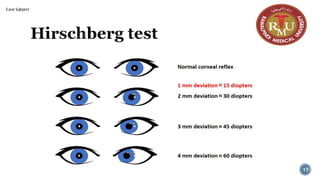
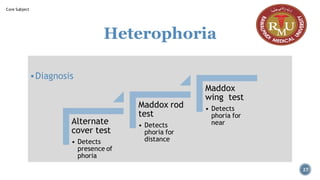
▪Hirschbergtest
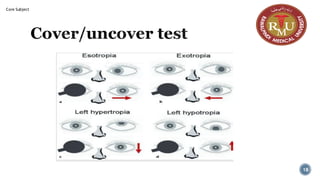
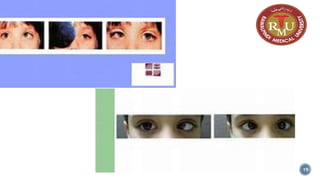
▪Cover/ uncover test
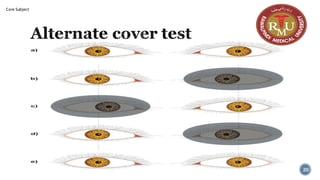
▪Alternate cover test
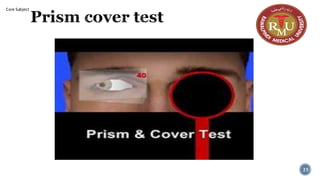
▪Prism cover test
▪Extraocular movements
▪Versions
▪ductions
16
Core Subject
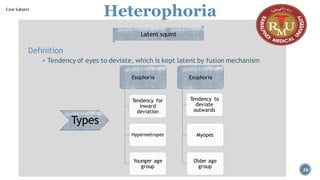
Heterophoria
Definition
▪ Tendency ofeyes to deviate, which is kept latent by fusion mechanism
Latent squint
Esophoria
Tendency for
inward
deviation
Hypermetropes
Younger age
group
Exophoria
Tendency to
deviate
outwards
Myopes
Older age
group
Types
26
Core Subject
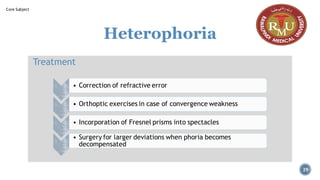
Heterophoria
Treatment
• Correction ofrefractive error
• Orthoptic exercises in case of convergence weakness
• Incorporation of Fresnel prisms into spectacles
• Surgery for larger deviations when phoria becomes
decompensated
29
Core Subject
Horizontal Integration
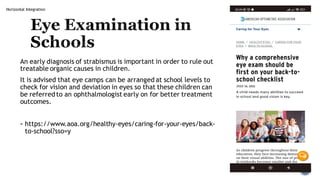
Eye Examinationin
Schools
An early diagnosis of strabismus is important in order to rule out
treatable organic causes in children.
It is advised that eye camps can be arranged at school levels to
check for vision and deviation in eyes so that these children can
be referredto an ophthalmologist early on for better treatment
outcomes.
▪ https://www.aoa.org/healthy-eyes/caring-for-your-eyes/back-
to-school?sso=y
49.
Recent research:
▪ Accordingto journal of AAPOS weekend atropine topical drops can improved visual
acuity in amblyopic squinted eye in age group of 3-12 years
▪ It can be a good alternative to patching and avoid compliance of patching.
Core Subject
50.
Artificial intelligence and
Squint:
▪A cross sectional study done at Zhongshan Ophthalmic Center of Sun Yat-sen
UniversityAn AI platform consisting of three deep learning (DL) systems was used for
strabismus diagnosis, angle evaluation, and operation plannings based on corneal
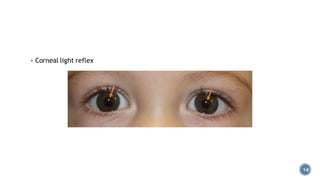
light-reflection photo.
▪ It was 99% accurate for diagnosis and 95% accurate for evaluation of degree of
squint.
▪ Hence AI is becoming a useful tool for screening of early squint cases.
Core Subject
51.
EOLA( END OFLECTURE
ASSESSMENT)
▪ A 2 YEARS OLD CHILD WAS BROUGHT TO OPD BY HIS MOTHER WITH COMPLAINT OF
INWARD DEVIATION OF HIS RIGHT SINCE 3 MONTHS OF HIS LIFE.ON EXAMINATION
ANGLE OF DEVIATION WAS EQUAL IN EACH GAZE OF EYE.HIRSCHBERG WAS AT
PUPILLARY MARGIN. DEFINE TYPE AND DEGREE OF SQUINT.
Core Subject
52.
References:
▪ Kanski clinicalophthalmology, strabismus, 728-771
▪ Basic ophthalmology by Renu Jogi
▪ Mao K, Yang Y, Guo C, Zhu Y, Chen C, Chen J, Liu L, Chen L, Mo Z, Lin B, Zhang X, Li
S, Lin X, Lin H. An artificial intelligence platform for the diagnosis and surgical
planning of strabismus using corneal light-reflection photos. Ann Transl Med. 2021
Mar;9(5):374. doi: 10.21037/atm-20-5442. PMID: 33842595; PMCID: PMC8033395.
Core Subject








![CASE_PRESENTATION_ON_subdural_hematoma(SDH)[1 FINAL PPT]-1.pptx](https://cdn.slidesharecdn.com/ss_thumbnails/casepresentationonsubduralhematomasdh1finalppt-1-260129172522-d405d375-thumbnail.jpg?width=640&height=640&fit=bounds)


