Motivation at Work Motivation COOP Prepared by: Jo B. Bitonio Presenter-Discussant
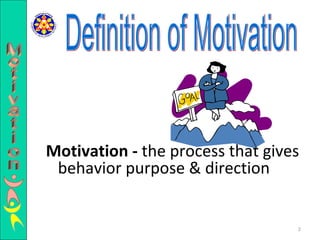
Motivation -  the process that gives behavior purpose & direction Definition of Motivation Motivation
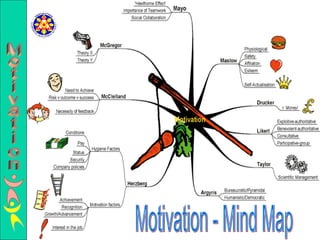
Motivation - Mind Map Motivation
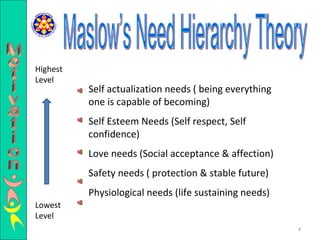
Self actualization needs ( being everything one is capable of becoming) Self Esteem Needs (Self respect, Self confidence) Love needs (Social acceptance & affection) Safety needs ( protection & stable future) Physiological needs (life sustaining needs) Lowest Level Highest Level Maslow’s Need Hierarchy Theory Motivation
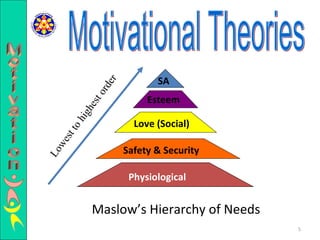
SA Esteem Love (Social) Safety & Security Physiological Maslow’s Hierarchy of Needs Lowest   to highest order Motivational Theories Motivation
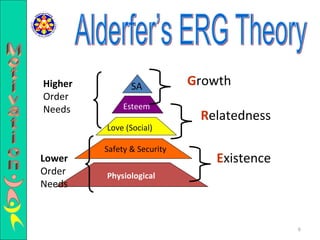
SA Esteem Love (Social) Safety & Security Physiological Higher  Order Needs Lower  Order Needs G rowth R elatedness E xistence Alderfer’s ERG Theory Motivation
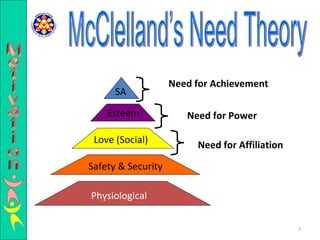
SA Esteem Love (Social) Safety & Security Physiological Need for Achievement Need for Power Need for Affiliation McClelland’s Need Theory Motivation
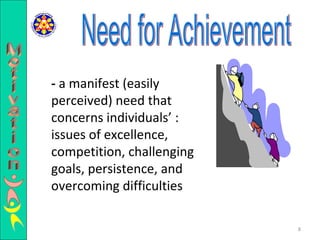
-  a manifest (easily perceived) need that concerns individuals’ :  issues of excellence, competition, challenging goals, persistence, and overcoming difficulties Need for Achievement Motivation
-   a manifest (easily perceived) need that concerns an individual’s need to make an impact on others, influence others, change people or events, and make a difference in life Need for Power Motivation
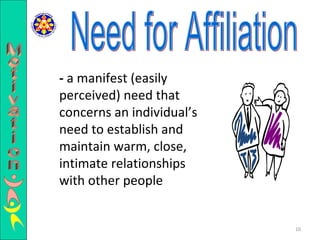
-  a manifest (easily perceived) need that concerns an individual’s need to establish and maintain warm, close, intimate relationships with other people Need for Affiliation Motivation
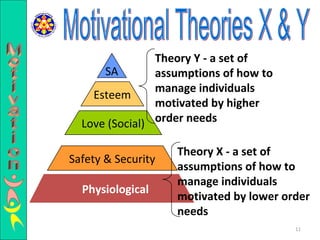
Motivational Theories X & Y Motivation Physiological Safety & Security Love (Social) Esteem SA Theory Y - a set of assumptions of how to manage individuals motivated by higher order needs Theory X - a set of assumptions of how to manage individuals motivated by lower order needs
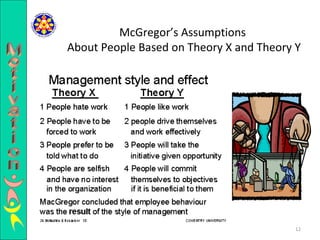
McGregor’s Assumptions  About People Based on Theory X and Theory Y Motivation
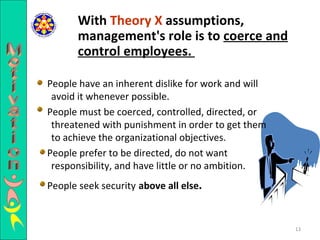
People have an inherent dislike for work and will avoid it whenever possible.  People must be coerced, controlled, directed, or threatened with punishment in order to get them to achieve the organizational objectives.  People prefer to be directed, do not want responsibility, and have little or no ambition.  People seek security   above all else .   With  Theory X  assumptions, management's role is to  coerce and control employees.   Motivation
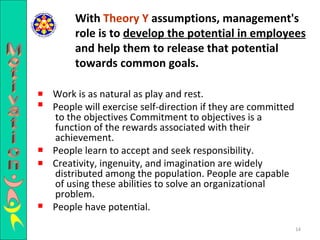
Work is as natural as play and rest.  People will exercise self-direction if they are committed to the objectives Commitment to objectives is a function of the rewards associated with their achievement.  People learn to accept and seek responsibility.  Creativity, ingenuity, and imagination are widely distributed among the population. People are capable of using these abilities to solve an organizational problem.  People have potential.  With  Theory Y  assumptions, management's role is to  develop the potential in employees  and help them to release that potential towards common goals. Motivation
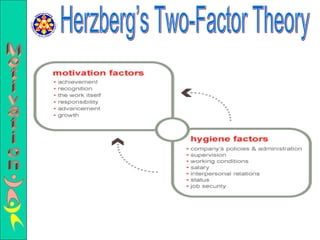
Herzberg’s Two-Factor Theory Motivation
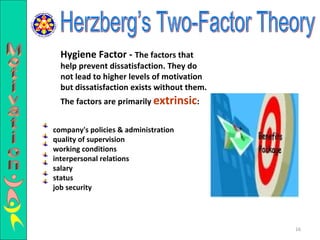
Hygiene Factor -   The factors that help prevent dissatisfaction. They do not lead to higher levels of motivation but dissatisfaction exists without them. The factors are primarily  extrinsic : company's policies & administration  quality of supervision  working conditions  interpersonal relations  salary  status  job security Herzberg’s Two-Factor Theory Motivation
Motivation factors: The five factors that lead to job satisfaction and higher levels of motivation. These factors are neutral if they are not activated. They are primarily  intrinsic  factors: achievement; recognition; the work itself; responsibility; advancement  Motivation
Forbes  magazine list of the "100 Best Companies to Work for in America,"  highlights organizations that have achieved high rates of employee satisfaction and motivation.  Revenues, net income and job growth for these companies were substantially higher than they were for companies with average levels of employee   satisfaction . Motivation
How can you, as an employer, achieve similar results Motivation
It is essential that you understand the relationship of employee motivation to your company's performance, that you  identify strategies  to motivate your employees to increase their discretionary effort, and that you have a plan to  effectively implement   those strategies, which ultimately will contribute to your company's success. Motivation
1. Understand employee needs Devise employee management programs and practices that aim to satisfy emerging or unmet needs such as offering flexible work schedules or benefit plans to employees. Actively seek employee input regarding issues that are important to them.  Effective Motivational Practice Motivation
Establish hiring and promotion decisions that are based on merit- and job-related information.  Find out employee perceptions of salary, working conditions, supervisor relationships, company policies and other dissatisfying extrinsic factors through informal conversations, interviews or attitude surveys.  Respond quickly and accordingly to correct potential problems  2 .  Offer fair compensation Motivation
Consider using a combination of rewards in your company's reward system.  Start by examining and addressing sources of dissatisfaction, such as salary, workplace relationships and job security.  Next, improve motivating factors, such as employee recognition, career growth and increased responsibility levels.  3.  Build an effective employee rewards program Motivation
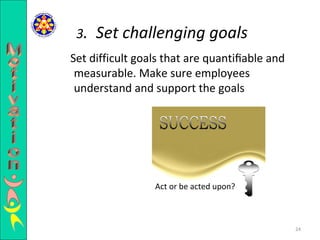
Set difficult goals that are quantifiable and measurable. Make sure employees understand and support the goals  3 .  Set challenging goals Act or be acted upon? Motivation
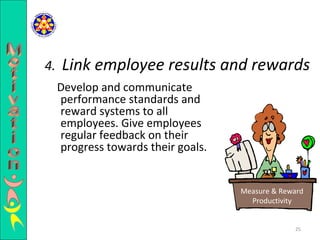
Develop and communicate performance standards and reward systems to all employees. Give employees regular feedback on their progress towards their goals.  4.  Link employee results and rewards Measure & Reward Productivity Motivation
Motivate yourself to succeed by taking ownership of your work. Find out which goals motivated you and make them your focus. If you are unsatisfied with your work, you will not be productive. For some of you this is crucial; either find your purpose or find another job.  5. Take Ownership  Motivation
Motivation
End of presentation Motivation

Motivation

  • 1.
    Motivation at WorkMotivation COOP Prepared by: Jo B. Bitonio Presenter-Discussant
  • 2.
    Motivation - the process that gives behavior purpose & direction Definition of Motivation Motivation
  • 3.
    Motivation - MindMap Motivation
  • 4.
    Self actualization needs( being everything one is capable of becoming) Self Esteem Needs (Self respect, Self confidence) Love needs (Social acceptance & affection) Safety needs ( protection & stable future) Physiological needs (life sustaining needs) Lowest Level Highest Level Maslow’s Need Hierarchy Theory Motivation
  • 5.
    SA Esteem Love(Social) Safety & Security Physiological Maslow’s Hierarchy of Needs Lowest to highest order Motivational Theories Motivation
  • 6.
    SA Esteem Love(Social) Safety & Security Physiological Higher Order Needs Lower Order Needs G rowth R elatedness E xistence Alderfer’s ERG Theory Motivation
  • 7.
    SA Esteem Love(Social) Safety & Security Physiological Need for Achievement Need for Power Need for Affiliation McClelland’s Need Theory Motivation
  • 8.
    - amanifest (easily perceived) need that concerns individuals’ : issues of excellence, competition, challenging goals, persistence, and overcoming difficulties Need for Achievement Motivation
  • 9.
    - a manifest (easily perceived) need that concerns an individual’s need to make an impact on others, influence others, change people or events, and make a difference in life Need for Power Motivation
  • 10.
    - amanifest (easily perceived) need that concerns an individual’s need to establish and maintain warm, close, intimate relationships with other people Need for Affiliation Motivation
  • 11.
    Motivational Theories X& Y Motivation Physiological Safety & Security Love (Social) Esteem SA Theory Y - a set of assumptions of how to manage individuals motivated by higher order needs Theory X - a set of assumptions of how to manage individuals motivated by lower order needs
  • 12.
    McGregor’s Assumptions About People Based on Theory X and Theory Y Motivation
  • 13.
    People have aninherent dislike for work and will avoid it whenever possible. People must be coerced, controlled, directed, or threatened with punishment in order to get them to achieve the organizational objectives. People prefer to be directed, do not want responsibility, and have little or no ambition. People seek security above all else . With Theory X assumptions, management's role is to coerce and control employees. Motivation
  • 14.
    Work is asnatural as play and rest. People will exercise self-direction if they are committed to the objectives Commitment to objectives is a function of the rewards associated with their achievement. People learn to accept and seek responsibility. Creativity, ingenuity, and imagination are widely distributed among the population. People are capable of using these abilities to solve an organizational problem. People have potential. With Theory Y assumptions, management's role is to develop the potential in employees and help them to release that potential towards common goals. Motivation
  • 15.
  • 16.
    Hygiene Factor - The factors that help prevent dissatisfaction. They do not lead to higher levels of motivation but dissatisfaction exists without them. The factors are primarily extrinsic : company's policies & administration quality of supervision working conditions interpersonal relations salary status job security Herzberg’s Two-Factor Theory Motivation
  • 17.
    Motivation factors: Thefive factors that lead to job satisfaction and higher levels of motivation. These factors are neutral if they are not activated. They are primarily intrinsic factors: achievement; recognition; the work itself; responsibility; advancement Motivation
  • 18.
    Forbes magazinelist of the "100 Best Companies to Work for in America," highlights organizations that have achieved high rates of employee satisfaction and motivation. Revenues, net income and job growth for these companies were substantially higher than they were for companies with average levels of employee satisfaction . Motivation
  • 19.
    How can you,as an employer, achieve similar results Motivation
  • 20.
    It is essentialthat you understand the relationship of employee motivation to your company's performance, that you identify strategies to motivate your employees to increase their discretionary effort, and that you have a plan to effectively implement those strategies, which ultimately will contribute to your company's success. Motivation
  • 21.
    1. Understand employeeneeds Devise employee management programs and practices that aim to satisfy emerging or unmet needs such as offering flexible work schedules or benefit plans to employees. Actively seek employee input regarding issues that are important to them. Effective Motivational Practice Motivation
  • 22.
    Establish hiring andpromotion decisions that are based on merit- and job-related information. Find out employee perceptions of salary, working conditions, supervisor relationships, company policies and other dissatisfying extrinsic factors through informal conversations, interviews or attitude surveys. Respond quickly and accordingly to correct potential problems 2 . Offer fair compensation Motivation
  • 23.
    Consider using acombination of rewards in your company's reward system. Start by examining and addressing sources of dissatisfaction, such as salary, workplace relationships and job security. Next, improve motivating factors, such as employee recognition, career growth and increased responsibility levels. 3. Build an effective employee rewards program Motivation
  • 24.
    Set difficult goalsthat are quantifiable and measurable. Make sure employees understand and support the goals 3 . Set challenging goals Act or be acted upon? Motivation
  • 25.
    Develop and communicateperformance standards and reward systems to all employees. Give employees regular feedback on their progress towards their goals. 4. Link employee results and rewards Measure & Reward Productivity Motivation
  • 26.
    Motivate yourself tosucceed by taking ownership of your work. Find out which goals motivated you and make them your focus. If you are unsatisfied with your work, you will not be productive. For some of you this is crucial; either find your purpose or find another job. 5. Take Ownership Motivation
  • 27.
  • 28.