EMPLOYEE
MOTIVATION
What is Motivation?
Types of Motivation
• Intrinsic Motivation – Intrinsic motivation is a
type of motivation in which an individual is being
motivated by internal desires.
• Extrinsic motivation - Extrinsic motivation on
the other hand is a type of motivation in which
an individual is being motivated by external
desires.
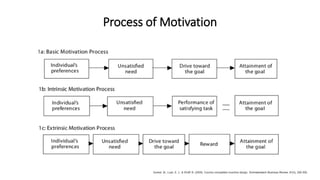
Process of Motivation
Gunkel, M., Lusk, E. J., & Wolff, B. (2009). Country-compatible incentive design. Schmalenbach Business Review, 61(3), 290-309.
Role of Motivation in
Organizational Behavior
Employees need to be motivated to actualize their
potential and there are several ways of enabling them
and empowering them to do so
A. Reward systems
B. Benefits like extended vacations and perquisites like
company provided accommodation and funding for
kids schooling, provision of medical insurance coverage
for the employees and their families
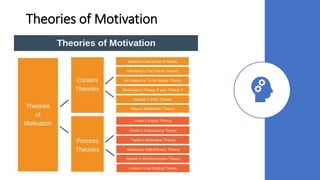
Theories of Motivation
• Content theories
 Maslow’s Need Hierarchy
 Herzberg’s Two Factor Theory
 Theory X and Y
• Process Theories
 Goal Setting Theory
 Equity Theory
 Expectancy Theory
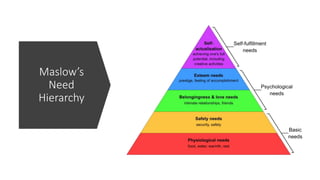
Maslow’s
Need
Hierarchy
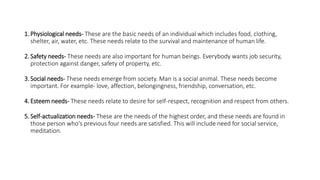
1. Physiological needs- These are the basic needs of an individual which includes food, clothing,
shelter, air, water, etc. These needs relate to the survival and maintenance of human life.
2. Safety needs- These needs are also important for human beings. Everybody wants job security,
protection against danger, safety of property, etc.
3. Social needs- These needs emerge from society. Man is a social animal. These needs become
important. For example- love, affection, belongingness, friendship, conversation, etc.
4. Esteem needs- These needs relate to desire for self-respect, recognition and respect from others.
5. Self-actualization needs- These are the needs of the highest order, and these needs are found in
those person who's previous four needs are satisfied. This will include need for social service,
meditation.
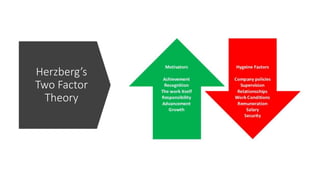
Herzberg’s
Two Factor
Theory
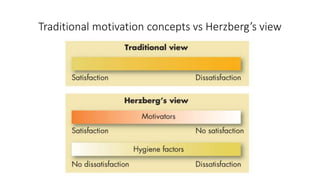
Traditional motivation concepts vs Herzberg’s view
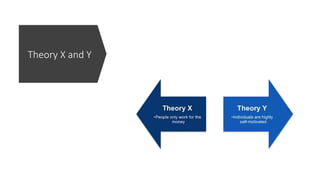
Theory X and Y
• Douglas McGregor proposed two distinct views of human beings: one
basically negative, labeled Theory X, and the other basically positive,
labeled Theory Y.
• Under Theory X, managers believe employees inherently dislike work
and must therefore be directed or even coerced into performing it.
Under Theory Y, in contrast, managers assume employees can view
work as being as natural as rest or play, and therefore the average
person can learn to accept, and even seek, responsibility.
Goal Setting Theory
• Goals indicate and give direction to an employee about what needs to
be done and how much efforts are required to be put in.
• This theory states that goal setting is essentially linked to task
performance. It states that specific and challenging goals along with
appropriate feedback contribute to higher and better task
performance.
Important features of goal-setting theory
• The willingness to work towards attainment of goal is main source of job
motivation. Clear, particular and difficult goals are greater motivating factors than
easy, general and vague goals.
• Specific and clear goals lead to greater output and better performance.
Unambiguous, measurable and clear goals accompanied by a deadline for
completion avoids misunderstanding.
• Goals should be realistic and challenging. This gives an individual a feeling of
pride and triumph when he attains them and sets him up for attainment of next
goal.
Equity Theory of Motivation
• The core of the equity theory is the principle of balance or equity.
• an individual’s motivation level is correlated to his perception of equity,
fairness and justice practiced by the management.
• Higher is individual’s perception of fairness, greater is the motivation level
and vice versa.
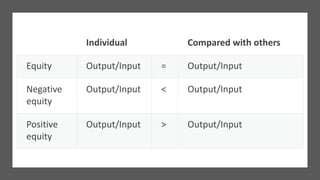
• While evaluating fairness, employee compares the job input (in terms of
contribution) to outcome (in terms of compensation) and also compares the
same with that of another peer of equal category.
Individual Compared with others
Equity Output/Input = Output/Input
Negative
equity
Output/Input < Output/Input
Positive
equity
Output/Input > Output/Input
Expectancy Theory of Motivation
• The Expectancy theory states that employee’s motivation is an
outcome of how much an individual wants a reward (Valence), the
assessment that the likelihood that the effort will lead to expected
performance (Expectancy) and the belief that the performance will
lead to reward (Instrumentality).
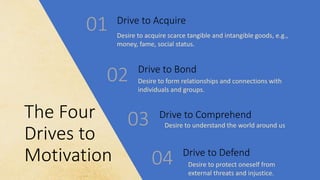
The Four
Drives to
Motivation
Drive to Acquire
Drive to Bond
02
01
Drive to Comprehend
03
Drive to Defend
04
Desire to acquire scarce tangible and intangible goods, e.g.,
money, fame, social status.
Desire to form relationships and connections with
individuals and groups.
Desire to understand the world around us
Desire to protect oneself from
external threats and injustice.
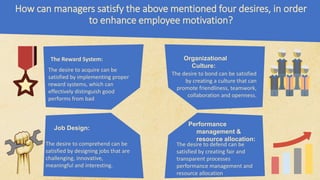
How can managers satisfy the above mentioned four desires, in order
to enhance employee motivation?
The Reward System:
The desire to acquire can be
satisfied by implementing proper
reward systems, which can
effectively distinguish good
performs from bad
The Reward System:
The Reward System:
The desire to bond can be satisfied
by creating a culture that can
promote friendliness, teamwork,
collaboration and openness.
The desire to defend can be
satisfied by creating fair and
transparent processes
performance management and
resource allocation
The desire to comprehend can be
satisfied by designing jobs that are
challenging, innovative,
meaningful and interesting.
Organizational
Culture:
Performance
management &
resource allocation:
Job Design:
Job Design:
Reasons why good employees
leave their organization
“I don’t care enough to do
this”
Va l u e
M i s m a t c h 01
02
TRAP
1
“I don’t think I am able to do
this”
L a c k o f
S e l f -
e f f i c a c y
TRAP
2
I don’t know what
went wrong with this”
A t t r i b u t i o n
E r r o r s
TRAP
4
“I am too upset to
do this”
D i s r u p t i v e
E m o t i o n s
TRAP
3
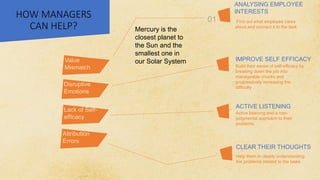
Find out what employee cares
about and connect it to the task
Mercury is the
closest planet to
the Sun and the
smallest one in
our Solar System
HOW MANAGERS
CAN HELP?
ANALYSING EMPLOYEE
INTERESTS
01
Build their sense of self-efficacy by
breaking down the job into
manageable chunks and
progressively increasing the
difficulty
IMPROVE SELF EFFICACY
Help them in clearly understanding
the problems related to the tasks
CLEAR THEIR THOUGHTS
Value
Mismatch
Disruptive
Emotions
Lack of Self-
efficacy
Attribution
Errors
Active listening and a non-
judgmental approach to their
problems
ACTIVE LISTENING
Strategies
for
motivating
your
most
creative
employees
Assign them to the right roles and build a team around
them
Reward innovation
Tolerate their dark side, up to a point
Apply the right amount of pressure
Promote cognitive
diversity
Challenge them
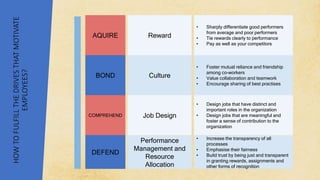
AQUIRE
BOND
COMPREHEND
DEFEND
Reward
Culture
Job Design
Performance
Management and
Resource
Allocation
• Sharply differentiate good performers
from average and poor performers
• Tie rewards clearly to performance
• Pay as well as your competitors
• Foster mutual reliance and friendship
among co-workers
• Value collaboration and teamwork
• Encourage sharing of best practises
• Design jobs that have distinct and
important roles in the organization
• Design jobs that are meaningful and
foster a sense of contribution to the
organization
• Increase the transparency of all
processes
• Emphasise their fairness
• Build trust by being just and transparent
in granting rewards, assignments and
other forms of recognition
HOW
TO
FULFILL
THE
DRIVES
THAT
MOTIVATE
EMPLOYEES?
Thank You!!!

02 Motivation.pptx

  • 1.
  • 2.
  • 3.
    Types of Motivation •Intrinsic Motivation – Intrinsic motivation is a type of motivation in which an individual is being motivated by internal desires. • Extrinsic motivation - Extrinsic motivation on the other hand is a type of motivation in which an individual is being motivated by external desires.
  • 4.
    Process of Motivation Gunkel,M., Lusk, E. J., & Wolff, B. (2009). Country-compatible incentive design. Schmalenbach Business Review, 61(3), 290-309.
  • 5.
    Role of Motivationin Organizational Behavior Employees need to be motivated to actualize their potential and there are several ways of enabling them and empowering them to do so A. Reward systems B. Benefits like extended vacations and perquisites like company provided accommodation and funding for kids schooling, provision of medical insurance coverage for the employees and their families
  • 6.
  • 7.
    Theories of Motivation •Content theories  Maslow’s Need Hierarchy  Herzberg’s Two Factor Theory  Theory X and Y • Process Theories  Goal Setting Theory  Equity Theory  Expectancy Theory
  • 8.
  • 9.
    1. Physiological needs-These are the basic needs of an individual which includes food, clothing, shelter, air, water, etc. These needs relate to the survival and maintenance of human life. 2. Safety needs- These needs are also important for human beings. Everybody wants job security, protection against danger, safety of property, etc. 3. Social needs- These needs emerge from society. Man is a social animal. These needs become important. For example- love, affection, belongingness, friendship, conversation, etc. 4. Esteem needs- These needs relate to desire for self-respect, recognition and respect from others. 5. Self-actualization needs- These are the needs of the highest order, and these needs are found in those person who's previous four needs are satisfied. This will include need for social service, meditation.
  • 10.
  • 11.
    Traditional motivation conceptsvs Herzberg’s view
  • 12.
  • 13.
    • Douglas McGregorproposed two distinct views of human beings: one basically negative, labeled Theory X, and the other basically positive, labeled Theory Y. • Under Theory X, managers believe employees inherently dislike work and must therefore be directed or even coerced into performing it. Under Theory Y, in contrast, managers assume employees can view work as being as natural as rest or play, and therefore the average person can learn to accept, and even seek, responsibility.
  • 14.
    Goal Setting Theory •Goals indicate and give direction to an employee about what needs to be done and how much efforts are required to be put in. • This theory states that goal setting is essentially linked to task performance. It states that specific and challenging goals along with appropriate feedback contribute to higher and better task performance.
  • 15.
    Important features ofgoal-setting theory • The willingness to work towards attainment of goal is main source of job motivation. Clear, particular and difficult goals are greater motivating factors than easy, general and vague goals. • Specific and clear goals lead to greater output and better performance. Unambiguous, measurable and clear goals accompanied by a deadline for completion avoids misunderstanding. • Goals should be realistic and challenging. This gives an individual a feeling of pride and triumph when he attains them and sets him up for attainment of next goal.
  • 16.
    Equity Theory ofMotivation • The core of the equity theory is the principle of balance or equity. • an individual’s motivation level is correlated to his perception of equity, fairness and justice practiced by the management. • Higher is individual’s perception of fairness, greater is the motivation level and vice versa. • While evaluating fairness, employee compares the job input (in terms of contribution) to outcome (in terms of compensation) and also compares the same with that of another peer of equal category.
  • 17.
    Individual Compared withothers Equity Output/Input = Output/Input Negative equity Output/Input < Output/Input Positive equity Output/Input > Output/Input
  • 18.
    Expectancy Theory ofMotivation • The Expectancy theory states that employee’s motivation is an outcome of how much an individual wants a reward (Valence), the assessment that the likelihood that the effort will lead to expected performance (Expectancy) and the belief that the performance will lead to reward (Instrumentality).
  • 19.
    The Four Drives to Motivation Driveto Acquire Drive to Bond 02 01 Drive to Comprehend 03 Drive to Defend 04 Desire to acquire scarce tangible and intangible goods, e.g., money, fame, social status. Desire to form relationships and connections with individuals and groups. Desire to understand the world around us Desire to protect oneself from external threats and injustice.
  • 20.
    How can managerssatisfy the above mentioned four desires, in order to enhance employee motivation? The Reward System: The desire to acquire can be satisfied by implementing proper reward systems, which can effectively distinguish good performs from bad The Reward System: The Reward System: The desire to bond can be satisfied by creating a culture that can promote friendliness, teamwork, collaboration and openness. The desire to defend can be satisfied by creating fair and transparent processes performance management and resource allocation The desire to comprehend can be satisfied by designing jobs that are challenging, innovative, meaningful and interesting. Organizational Culture: Performance management & resource allocation: Job Design: Job Design:
  • 21.
    Reasons why goodemployees leave their organization “I don’t care enough to do this” Va l u e M i s m a t c h 01 02 TRAP 1 “I don’t think I am able to do this” L a c k o f S e l f - e f f i c a c y TRAP 2 I don’t know what went wrong with this” A t t r i b u t i o n E r r o r s TRAP 4 “I am too upset to do this” D i s r u p t i v e E m o t i o n s TRAP 3
  • 22.
    Find out whatemployee cares about and connect it to the task Mercury is the closest planet to the Sun and the smallest one in our Solar System HOW MANAGERS CAN HELP? ANALYSING EMPLOYEE INTERESTS 01 Build their sense of self-efficacy by breaking down the job into manageable chunks and progressively increasing the difficulty IMPROVE SELF EFFICACY Help them in clearly understanding the problems related to the tasks CLEAR THEIR THOUGHTS Value Mismatch Disruptive Emotions Lack of Self- efficacy Attribution Errors Active listening and a non- judgmental approach to their problems ACTIVE LISTENING
  • 23.
    Strategies for motivating your most creative employees Assign them tothe right roles and build a team around them Reward innovation Tolerate their dark side, up to a point Apply the right amount of pressure Promote cognitive diversity Challenge them
  • 24.
    AQUIRE BOND COMPREHEND DEFEND Reward Culture Job Design Performance Management and Resource Allocation •Sharply differentiate good performers from average and poor performers • Tie rewards clearly to performance • Pay as well as your competitors • Foster mutual reliance and friendship among co-workers • Value collaboration and teamwork • Encourage sharing of best practises • Design jobs that have distinct and important roles in the organization • Design jobs that are meaningful and foster a sense of contribution to the organization • Increase the transparency of all processes • Emphasise their fairness • Build trust by being just and transparent in granting rewards, assignments and other forms of recognition HOW TO FULFILL THE DRIVES THAT MOTIVATE EMPLOYEES?
  • 25.