• Motivation refers to the stimulation,
inspiration, and induction of employees to
perform at their best capacity.
• It is a psychological process that cannot be
forced upon individuals; rather, it arises
from within them as a willingness to work.
• Various definitions highlight this concept:
• Joe Kelly: “Motivation is a process whereby needs
instigate behavior directed toward goals that can
satisfy those needs.”
• W. G. Scot: “Motivation means stimulating people
to action to accomplish desired goals.”
• Michael J. Jucius: “Motivation is the act of
stimulating someone (or oneself) to take a
desired course of action, pushing the right
buttons to achieve desired results.”
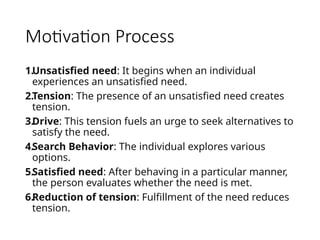
Motivation Process
1.Unsatisfied need: It begins when an individual
experiences an unsatisfied need.
2.Tension: The presence of an unsatisfied need creates
tension.
3.Drive: This tension fuels an urge to seek alternatives to
satisfy the need.
4.Search Behavior: The individual explores various
options.
5.Satisfied need: After behaving in a particular manner,
the person evaluates whether the need is met.
6.Reduction of tension: Fulfillment of the need reduces
tension.
Types of Motivation:
• Achievement Motivation: Driven by the desire to
pursue and attain goals. Accomplishment is valued
for its own sake, not just for accompanying
rewards.
• Affiliation Motivation: Focused on social
connections. Individuals perform better when
complimented for favorable attitudes and
cooperation.
• Competence Motivation: A drive to excel and
perform high-quality work. Competence-motivated
people seek mastery and creative problem-solving.
Types of Motivation.
• Intrinsic motivation: Intrinsic motivation refers to
motivation that originates within the person and
willingly. It is a self-motivation. It is and personal
gratification and feeling rather than just achieving
a goal.
• Extrinsic motivation: Extrinsic motivation comes
from the external environment, such as rewards,
money, incentives, popularity, competition, and
punishment, to achieve something.
• Affiliation motivation: Affiliation motivation is a
drive that relates to people on a social basis. There
is an intense desire of an individual to associate
with different people in social matters. The
individuals must have favorable attitudes toward
others, and they need to cooperate with them.
• 4. Fear motivation: The person gets motivated by
known or unknown fear and acts contrary to his or
her original intention. It is good to accomplish the
work quickly but for a short time, not always.
• Incentive motivation: Incentive motivation arises
due to incentives and rewards for doing a task. In
some instances, the employees put an extra effort
to get a prize. It is a form of extrinsic motivation.
• Attitude motivation: It signifies the way the
employees perceive their future and react
accordingly. It must reveal self-confidence among
employees. Employees, if having a positive attitude
toward the work, will be motivated to work.
• Power motivation: Power motivation is a powerful
drive to influence people. It helps in bringing
desired changes in the organization.
Factors influencing motivation
• Leadership Style:
• Supervisors, managers, and
leaders significantly impact employee
motivation.
Organizational Culture:
1.Culture shapes employee behavior and attitudes.
2.A positive culture fosters motivation.
3.Factors include values, norms, and
communication within the organization.
Paths to Advancement:
1.Opportunities for career growth motivate employees.
2.Clear promotion paths encourage effort and
commitment.
Professional Development:
3.Training, skill enhancement, and
learning opportunities.
4.Employees feel motivated when they can develop
professionally.
• Recognition and Rewards:
• Acknowledgment for good work boosts
motivation.
• Bonuses, awards, and praise play a role
Work Environment:
1.A pleasant, supportive environment enhances
motivation.
2.Factors include physical conditions, safety, and
comfort.
Flexibility:
1.Work-life balance, remote work options, and
flexible hours.
2.Employees value autonomy and adaptability.
Belonging and Social Connections:
3.Team spirit and a sense of belonging.
4.Social interactions positively impact motivation.
Meaningful Work:
1.Employees are motivated when their work has purpose and
impact.
2.Aligning tasks with personal values drives motivation.
• Physiological Factors:
• Health, well-being, and energy levels influence
motivation.
• Adequate rest, nutrition, and exercise matter
Theories of Motivation
Abraham Maslow Hierarchy of Needs
Theory
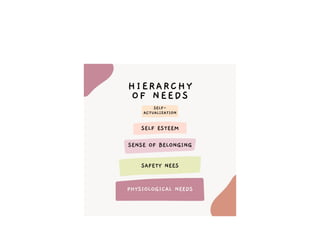
• Abraham Maslow proposed this theory,
emphasizing that motivation arises from
fulfilling a hierarchy of needs.
• The pyramid of needs includes:
• Physiological needs: Basic survival requirements
like air, sleep, food, water, clothing, sex, and
shelter.
• Safety needs: Protection from threats, health,
secure employment, and property.
• Social (belongingness and love) needs: The
desire for association, affiliation, and friendship.
• Self-esteem needs: The need for respect and
recognition.
• Self-actualization needs: The pursuit of personal
development, learning, and fulfilling work.
• People cannot ascend to the next level
unless lower-level needs are met.
Hertzberg’s Two-Factor
Theory:
• Frederick Herzberg proposed this theory,
distinguishing between hygiene
factors (external conditions)
and motivators (internal factors).
• Hygiene factors (e.g., salary, job security,
work environment) prevent dissatisfaction
but do not directly motivate.
• Motivators (e.g., achievement, recognition,
growth) lead to satisfaction and increased
productivity.
McClelland’s Needs Theory:
1.David McClelland identified three fundamental
needs:
1.Need for achievement: Desire for success,
challenging tasks, and personal accomplishment.
2.Need for affiliation: Focus on social connections and
relationships.
3.Need for power: Drive to influence and control others.
2.Individuals exhibit varying combinations of these
needs.
Vroom’s Expectancy
Theory:
1.Victor Vroom proposed that motivation depends
on three factors:
1.Expectancy: Belief that effort leads to performance.
2.Instrumentality: Belief that performance results in
rewards.
3.Valence: Value placed on the rewards.
2.Motivation increases when all three factors align
positively.
McGregor’s Theory X and Theory Y:
1.Douglas McGregor introduced contrasting assumptions
about employee behavior:
1.Theory X: Assumes employees dislike work, lack
ambition, and need strict supervision.
2.Theory Y: Assumes employees are self-motivated,
seek responsibility, and enjoy work.
2.Managers’ beliefs influence how they lead and motivate
their teams.
Goal-Setting Theory:
1.Goal-setting theory posits that specific types of
goals motivate individuals.
2.(especially SMART goals: Specific, Measurable,
Achievable, Relevant, and Time-bound)
3.Leaders can enhance motivation by employing
effective goal-setting practices and involving
individuals in the goal-setting process.
Reinforcement Theory:
• According to reinforcement theory, individual behavior is influenced
by the consequences resulting from that behavior.
• Developed by psychologist B.F. Skinner, this theory posits the following:
• 1. Rewarded behaviors are likely to be repeated.
• When individuals receive positive reinforcement for a specific behavior,
they are motivated to continue that behavior.
• 2. Punished behaviors are likely to cease.
• When negative consequences follow a behavior, individuals tend to avoid
repeating it.
3. Extinction:
1. Extinction aims to end learned behavior over time.
2. Managers may use positive reinforcement (such as overtime pay
during busy periods) to encourage extra effort. Once the desired
behavior is established, the reinforcement is gradually removed.
Equity Theory:
1.Equity theory focuses on how employees are
motivated (or demotivated) in the workforce.
2.It highlights the impact of fairness:
1.Distributive justice: Fairness in rewards distribution.
2.Procedural fairness: Fairness in decision-making
processes.
3.Interactional fairness: Fairness in interpersonal
treatment.
Expectancy Theory:
• Expectancy theory proposes that
employees are motivated when they believe:
• Their efforts will lead to the desired level of
performance (expectancy).
• Performance will result in desired outcomes
(instrumentality).
• The outcomes are personally desirable (valence).
Role of Nurse Managers to
Motivating staff
• Nurse managers play an essential part in motivating
their staff.
• .Focus on needs and wants of individual staff
• Recognize each team as a unique individual and use
accordingly appropriate strategy to each group
• Act as a role model, active listener, supporter, and
encourager for demotivated team
• Recognize differences among staff and treat them
well
• Give them respect and dignity-a feeling of
belonging
• Set realistic goals and make work interesting
• Throw a challenge
• Have effective communication
• Practice nonfinancial rewards for right action
• Provide positive reinforcement
• Create a climate for the independent and
motivating working environment
• Make them responsible and give them a feeling of
belonging and ownership
• Create a competitive and healthy environment
• Use problem-solving approach
• Motivate staff through individual
guidance and counseling

motivation nursing administration pptx,

  • 2.
    • Motivation refersto the stimulation, inspiration, and induction of employees to perform at their best capacity. • It is a psychological process that cannot be forced upon individuals; rather, it arises from within them as a willingness to work.
  • 3.
    • Various definitionshighlight this concept: • Joe Kelly: “Motivation is a process whereby needs instigate behavior directed toward goals that can satisfy those needs.” • W. G. Scot: “Motivation means stimulating people to action to accomplish desired goals.” • Michael J. Jucius: “Motivation is the act of stimulating someone (or oneself) to take a desired course of action, pushing the right buttons to achieve desired results.”
  • 4.
    Motivation Process 1.Unsatisfied need:It begins when an individual experiences an unsatisfied need. 2.Tension: The presence of an unsatisfied need creates tension. 3.Drive: This tension fuels an urge to seek alternatives to satisfy the need. 4.Search Behavior: The individual explores various options. 5.Satisfied need: After behaving in a particular manner, the person evaluates whether the need is met. 6.Reduction of tension: Fulfillment of the need reduces tension.
  • 6.
    Types of Motivation: •Achievement Motivation: Driven by the desire to pursue and attain goals. Accomplishment is valued for its own sake, not just for accompanying rewards. • Affiliation Motivation: Focused on social connections. Individuals perform better when complimented for favorable attitudes and cooperation. • Competence Motivation: A drive to excel and perform high-quality work. Competence-motivated people seek mastery and creative problem-solving.
  • 7.
    Types of Motivation. •Intrinsic motivation: Intrinsic motivation refers to motivation that originates within the person and willingly. It is a self-motivation. It is and personal gratification and feeling rather than just achieving a goal. • Extrinsic motivation: Extrinsic motivation comes from the external environment, such as rewards, money, incentives, popularity, competition, and punishment, to achieve something.
  • 8.
    • Affiliation motivation:Affiliation motivation is a drive that relates to people on a social basis. There is an intense desire of an individual to associate with different people in social matters. The individuals must have favorable attitudes toward others, and they need to cooperate with them.
  • 9.
    • 4. Fearmotivation: The person gets motivated by known or unknown fear and acts contrary to his or her original intention. It is good to accomplish the work quickly but for a short time, not always. • Incentive motivation: Incentive motivation arises due to incentives and rewards for doing a task. In some instances, the employees put an extra effort to get a prize. It is a form of extrinsic motivation.
  • 10.
    • Attitude motivation:It signifies the way the employees perceive their future and react accordingly. It must reveal self-confidence among employees. Employees, if having a positive attitude toward the work, will be motivated to work. • Power motivation: Power motivation is a powerful drive to influence people. It helps in bringing desired changes in the organization.
  • 12.
    Factors influencing motivation •Leadership Style: • Supervisors, managers, and leaders significantly impact employee motivation. Organizational Culture: 1.Culture shapes employee behavior and attitudes. 2.A positive culture fosters motivation. 3.Factors include values, norms, and communication within the organization.
  • 13.
    Paths to Advancement: 1.Opportunitiesfor career growth motivate employees. 2.Clear promotion paths encourage effort and commitment. Professional Development: 3.Training, skill enhancement, and learning opportunities. 4.Employees feel motivated when they can develop professionally.
  • 14.
    • Recognition andRewards: • Acknowledgment for good work boosts motivation. • Bonuses, awards, and praise play a role Work Environment: 1.A pleasant, supportive environment enhances motivation. 2.Factors include physical conditions, safety, and comfort.
  • 15.
    Flexibility: 1.Work-life balance, remotework options, and flexible hours. 2.Employees value autonomy and adaptability. Belonging and Social Connections: 3.Team spirit and a sense of belonging. 4.Social interactions positively impact motivation.
  • 16.
    Meaningful Work: 1.Employees aremotivated when their work has purpose and impact. 2.Aligning tasks with personal values drives motivation. • Physiological Factors: • Health, well-being, and energy levels influence motivation. • Adequate rest, nutrition, and exercise matter
  • 17.
    Theories of Motivation AbrahamMaslow Hierarchy of Needs Theory • Abraham Maslow proposed this theory, emphasizing that motivation arises from fulfilling a hierarchy of needs. • The pyramid of needs includes: • Physiological needs: Basic survival requirements like air, sleep, food, water, clothing, sex, and shelter. • Safety needs: Protection from threats, health, secure employment, and property.
  • 18.
    • Social (belongingnessand love) needs: The desire for association, affiliation, and friendship. • Self-esteem needs: The need for respect and recognition. • Self-actualization needs: The pursuit of personal development, learning, and fulfilling work. • People cannot ascend to the next level unless lower-level needs are met.
  • 20.
    Hertzberg’s Two-Factor Theory: • FrederickHerzberg proposed this theory, distinguishing between hygiene factors (external conditions) and motivators (internal factors). • Hygiene factors (e.g., salary, job security, work environment) prevent dissatisfaction but do not directly motivate. • Motivators (e.g., achievement, recognition, growth) lead to satisfaction and increased productivity.
  • 21.
    McClelland’s Needs Theory: 1.DavidMcClelland identified three fundamental needs: 1.Need for achievement: Desire for success, challenging tasks, and personal accomplishment. 2.Need for affiliation: Focus on social connections and relationships. 3.Need for power: Drive to influence and control others. 2.Individuals exhibit varying combinations of these needs.
  • 22.
    Vroom’s Expectancy Theory: 1.Victor Vroomproposed that motivation depends on three factors: 1.Expectancy: Belief that effort leads to performance. 2.Instrumentality: Belief that performance results in rewards. 3.Valence: Value placed on the rewards. 2.Motivation increases when all three factors align positively.
  • 23.
    McGregor’s Theory Xand Theory Y: 1.Douglas McGregor introduced contrasting assumptions about employee behavior: 1.Theory X: Assumes employees dislike work, lack ambition, and need strict supervision. 2.Theory Y: Assumes employees are self-motivated, seek responsibility, and enjoy work. 2.Managers’ beliefs influence how they lead and motivate their teams.
  • 25.
    Goal-Setting Theory: 1.Goal-setting theoryposits that specific types of goals motivate individuals. 2.(especially SMART goals: Specific, Measurable, Achievable, Relevant, and Time-bound) 3.Leaders can enhance motivation by employing effective goal-setting practices and involving individuals in the goal-setting process.
  • 26.
    Reinforcement Theory: • Accordingto reinforcement theory, individual behavior is influenced by the consequences resulting from that behavior. • Developed by psychologist B.F. Skinner, this theory posits the following: • 1. Rewarded behaviors are likely to be repeated. • When individuals receive positive reinforcement for a specific behavior, they are motivated to continue that behavior. • 2. Punished behaviors are likely to cease. • When negative consequences follow a behavior, individuals tend to avoid repeating it. 3. Extinction: 1. Extinction aims to end learned behavior over time. 2. Managers may use positive reinforcement (such as overtime pay during busy periods) to encourage extra effort. Once the desired behavior is established, the reinforcement is gradually removed.
  • 27.
    Equity Theory: 1.Equity theoryfocuses on how employees are motivated (or demotivated) in the workforce. 2.It highlights the impact of fairness: 1.Distributive justice: Fairness in rewards distribution. 2.Procedural fairness: Fairness in decision-making processes. 3.Interactional fairness: Fairness in interpersonal treatment.
  • 28.
    Expectancy Theory: • Expectancytheory proposes that employees are motivated when they believe: • Their efforts will lead to the desired level of performance (expectancy). • Performance will result in desired outcomes (instrumentality). • The outcomes are personally desirable (valence).
  • 30.
    Role of NurseManagers to Motivating staff • Nurse managers play an essential part in motivating their staff. • .Focus on needs and wants of individual staff • Recognize each team as a unique individual and use accordingly appropriate strategy to each group • Act as a role model, active listener, supporter, and encourager for demotivated team • Recognize differences among staff and treat them well
  • 31.
    • Give themrespect and dignity-a feeling of belonging • Set realistic goals and make work interesting • Throw a challenge • Have effective communication • Practice nonfinancial rewards for right action
  • 32.
    • Provide positivereinforcement • Create a climate for the independent and motivating working environment • Make them responsible and give them a feeling of belonging and ownership • Create a competitive and healthy environment • Use problem-solving approach • Motivate staff through individual guidance and counseling