Presented by: Wenchie V. Artacho
MPA 209
PLAN FOR
IMPLEMENTATION
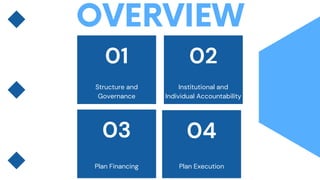
OVERVIEW
Structure and
Governance
01
Institutional and
Individual Accountability
02
Plan Execution
04
Plan Financing
03
Governance structure refers to the framework of
project management, especially regarding rules,
procedures, roles and the division of responsibilities
within the whole decision-making process. It keeps the
project in check, allowing it to run flawlessly and in
accordance with the plan.
STRUCTURE AND
GOVERNANCE
Logic
Adequacy
Transparency
Repeatability
Efficiency
The governance structure of any project should be based on a few main
principles, so that it is fully applicable throughout the entire process,
regardless of the phase of the project:
1.
2.
3.
4.
5.
STRUCTURE AND
GOVERNANCE
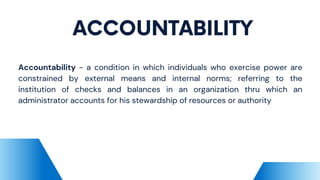
ACCOUNTABILITY
Accountability - a condition in which individuals who exercise power are
constrained by external means and internal norms; referring to the
institution of checks and balances in an organization thru which an
administrator accounts for his stewardship of resources or authority
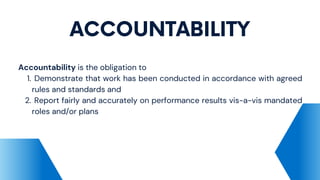
ACCOUNTABILITY
Demonstrate that work has been conducted in accordance with agreed
rules and standards and
Report fairly and accurately on performance results vis-a-vis mandated
roles and/or plans
Accountability is the obligation to
1.
2.
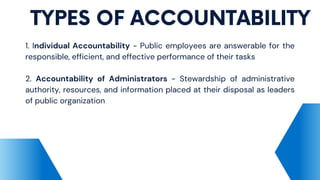
TYPES OF ACCOUNTABILITY
1. Individual Accountability - Public employees are answerable for the
responsible, efficient, and effective performance of their tasks
2. Accountability of Administrators - Stewardship of administrative
authority, resources, and information placed at their disposal as leaders
of public organization
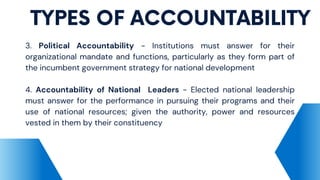
TYPES OF ACCOUNTABILITY
3. Political Accountability - Institutions must answer for their
organizational mandate and functions, particularly as they form part of
the incumbent government strategy for national development
4. Accountability of National Leaders - Elected national leadership
must answer for the performance in pursuing their programs and their
use of national resources; given the authority, power and resources
vested in them by their constituency
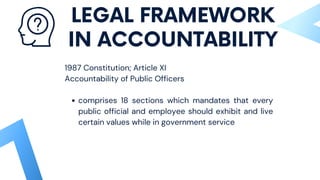
comprises 18 sections which mandates that every
public official and employee should exhibit and live
certain values while in government service
1987 Constitution; Article XI
Accountability of Public Officers
LEGAL FRAMEWORK
IN ACCOUNTABILITY
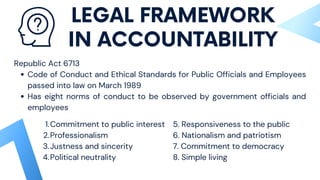
Code of Conduct and Ethical Standards for Public Officials and Employees
passed into law on March 1989
Has eight norms of conduct to be observed by government officials and
employees
Republic Act 6713
LEGAL FRAMEWORK
IN ACCOUNTABILITY
Commitment to public interest
Professionalism
Justness and sincerity
Political neutrality
1.
2.
3.
4.
5. Responsiveness to the public
6. Nationalism and patriotism
7. Commitment to democracy
8. Simple living
INSTITUTIONAL
ACCOUNTABILITY
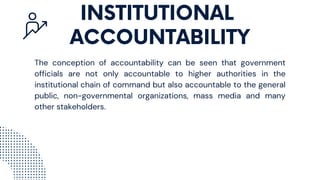
The conception of accountability can be seen that government
officials are not only accountable to higher authorities in the
institutional chain of command but also accountable to the general
public, non-governmental organizations, mass media and many
other stakeholders.
INSTITUTIONAL
ACCOUNTABILITY
01
02
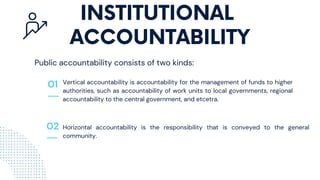
Vertical accountability is accountability for the management of funds to higher
authorities, such as accountability of work units to local governments, regional
accountability to the central government, and etcetra.
Horizontal accountability is the responsibility that is conveyed to the general
community.
Public accountability consists of two kinds:
A comprehensive evaluation of an individual’s (or organization’s)
current and future financial state to predict and manage future cash
flows, expenditures, and asset values.
FINANCIAL PLANNING
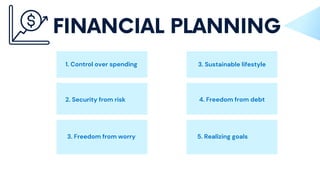
1. Control over spending
FINANCIAL PLANNING
2. Security from risk
3. Freedom from worry
3. Sustainable lifestyle
4. Freedom from debt
5. Realizing goals
FINANCIAL PLANNING
The Department of Finance (DOF) is
responsible for the management of the
government's financial resources. Its
duties include policy formulation,
revenue generation, resource
mobilization, debt management, and
financial market development.
Execution plan is the governing document that establishes the
means to execute, monitor, and control projects.
The plan serves as the main communication vehicle to ensure that
everyone is aware and knowledgeable of project objectives and how
they will be accomplished.
The plan is a living document and should be updated to describe
current and future processes and procedures, such as integrating
safety into the design process.
Donna
Stroupe
PLAN EXECUTION
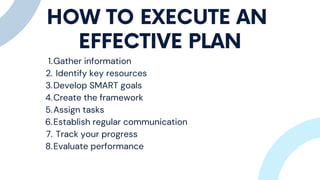
HOW TO EXECUTE AN
EFFECTIVE PLAN
Gather information
Identify key resources
Develop SMART goals
Create the framework
Assign tasks
Establish regular communication
Track your progress
Evaluate performance
1.
2.
3.
4.
5.
6.
7.
8.

MPA 209 : PLAN FOR IMPLEMENTATION.pdf

  • 1.
    Presented by: WenchieV. Artacho MPA 209 PLAN FOR IMPLEMENTATION
  • 2.
    OVERVIEW Structure and Governance 01 Institutional and IndividualAccountability 02 Plan Execution 04 Plan Financing 03
  • 3.
    Governance structure refersto the framework of project management, especially regarding rules, procedures, roles and the division of responsibilities within the whole decision-making process. It keeps the project in check, allowing it to run flawlessly and in accordance with the plan. STRUCTURE AND GOVERNANCE
  • 4.
    Logic Adequacy Transparency Repeatability Efficiency The governance structureof any project should be based on a few main principles, so that it is fully applicable throughout the entire process, regardless of the phase of the project: 1. 2. 3. 4. 5. STRUCTURE AND GOVERNANCE
  • 5.
    ACCOUNTABILITY Accountability - acondition in which individuals who exercise power are constrained by external means and internal norms; referring to the institution of checks and balances in an organization thru which an administrator accounts for his stewardship of resources or authority
  • 6.
    ACCOUNTABILITY Demonstrate that workhas been conducted in accordance with agreed rules and standards and Report fairly and accurately on performance results vis-a-vis mandated roles and/or plans Accountability is the obligation to 1. 2.
  • 7.
    TYPES OF ACCOUNTABILITY 1.Individual Accountability - Public employees are answerable for the responsible, efficient, and effective performance of their tasks 2. Accountability of Administrators - Stewardship of administrative authority, resources, and information placed at their disposal as leaders of public organization
  • 8.
    TYPES OF ACCOUNTABILITY 3.Political Accountability - Institutions must answer for their organizational mandate and functions, particularly as they form part of the incumbent government strategy for national development 4. Accountability of National Leaders - Elected national leadership must answer for the performance in pursuing their programs and their use of national resources; given the authority, power and resources vested in them by their constituency
  • 9.
    comprises 18 sectionswhich mandates that every public official and employee should exhibit and live certain values while in government service 1987 Constitution; Article XI Accountability of Public Officers LEGAL FRAMEWORK IN ACCOUNTABILITY
  • 10.
    Code of Conductand Ethical Standards for Public Officials and Employees passed into law on March 1989 Has eight norms of conduct to be observed by government officials and employees Republic Act 6713 LEGAL FRAMEWORK IN ACCOUNTABILITY Commitment to public interest Professionalism Justness and sincerity Political neutrality 1. 2. 3. 4. 5. Responsiveness to the public 6. Nationalism and patriotism 7. Commitment to democracy 8. Simple living
  • 11.
    INSTITUTIONAL ACCOUNTABILITY The conception ofaccountability can be seen that government officials are not only accountable to higher authorities in the institutional chain of command but also accountable to the general public, non-governmental organizations, mass media and many other stakeholders.
  • 12.
    INSTITUTIONAL ACCOUNTABILITY 01 02 Vertical accountability isaccountability for the management of funds to higher authorities, such as accountability of work units to local governments, regional accountability to the central government, and etcetra. Horizontal accountability is the responsibility that is conveyed to the general community. Public accountability consists of two kinds:
  • 13.
    A comprehensive evaluationof an individual’s (or organization’s) current and future financial state to predict and manage future cash flows, expenditures, and asset values. FINANCIAL PLANNING
  • 14.
    1. Control overspending FINANCIAL PLANNING 2. Security from risk 3. Freedom from worry 3. Sustainable lifestyle 4. Freedom from debt 5. Realizing goals
  • 15.
    FINANCIAL PLANNING The Departmentof Finance (DOF) is responsible for the management of the government's financial resources. Its duties include policy formulation, revenue generation, resource mobilization, debt management, and financial market development.
  • 16.
    Execution plan isthe governing document that establishes the means to execute, monitor, and control projects. The plan serves as the main communication vehicle to ensure that everyone is aware and knowledgeable of project objectives and how they will be accomplished. The plan is a living document and should be updated to describe current and future processes and procedures, such as integrating safety into the design process. Donna Stroupe PLAN EXECUTION
  • 17.
    HOW TO EXECUTEAN EFFECTIVE PLAN Gather information Identify key resources Develop SMART goals Create the framework Assign tasks Establish regular communication Track your progress Evaluate performance 1. 2. 3. 4. 5. 6. 7. 8.