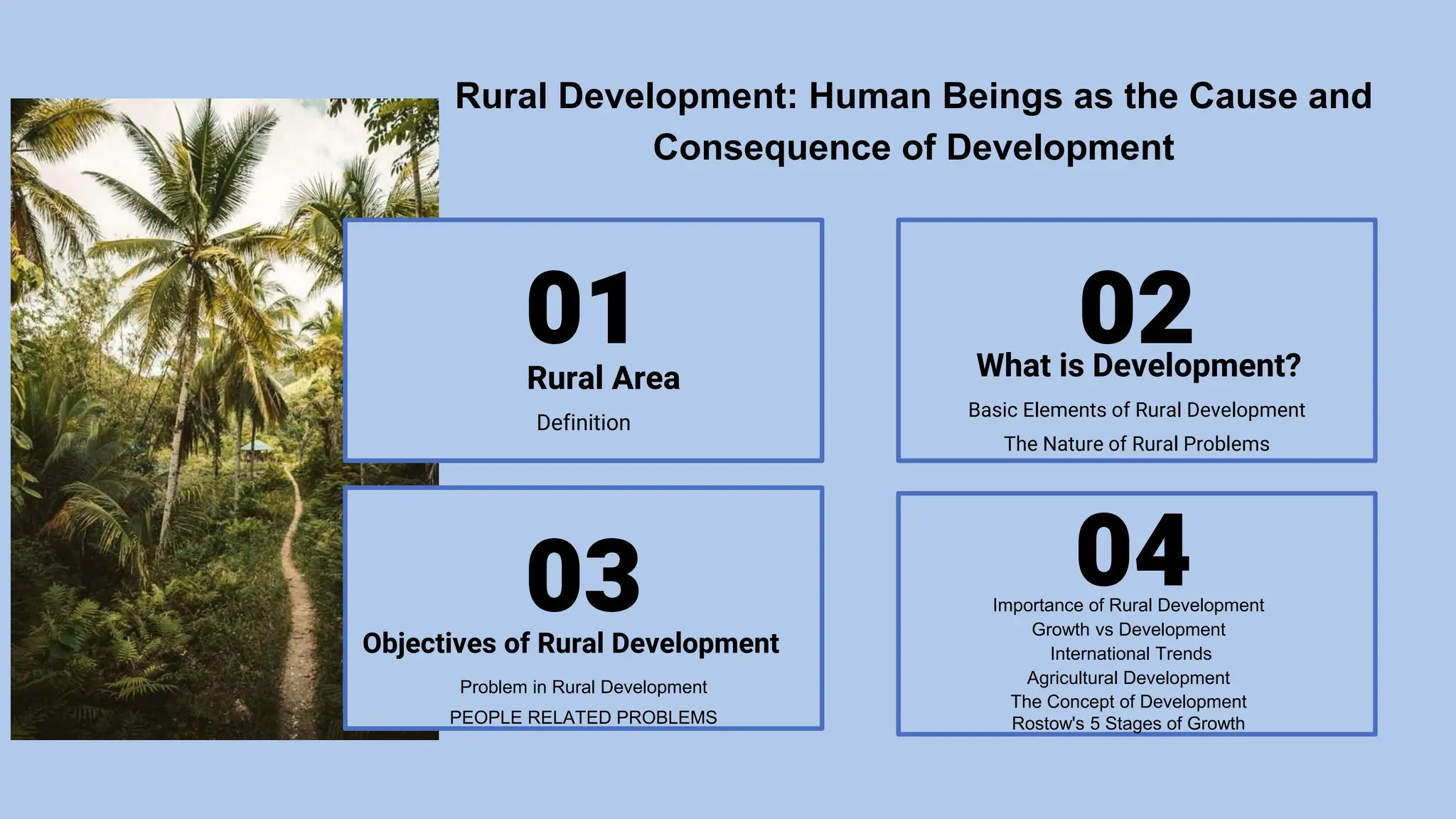
Rural Development: Human Beings as the Cause and
Consequence of Development
01
03
02
04
Definition
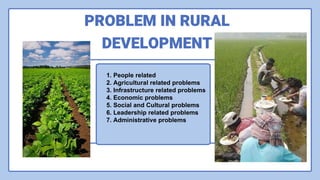
Problem in Rural Development
PEOPLE RELATED PROBLEMS
Basic Elements of Rural Development
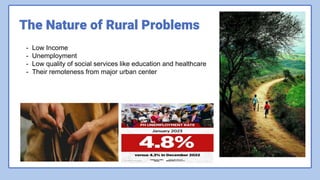
The Nature of Rural Problems
Rural Area
Objectives of Rural Development
What is Development?
Importance of Rural Development
Growth vs Development
International Trends
Agricultural Development
The Concept of Development
Rostow's 5 Stages of Growth
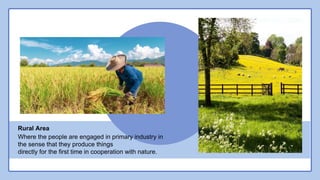
Rural Area
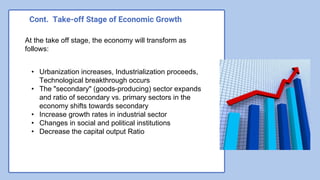
Where the people are engaged in primary industry in
the sense that they produce things
directly for the first time in cooperation with nature.
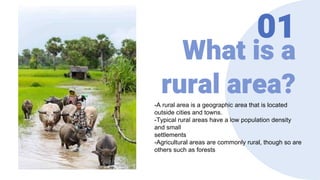
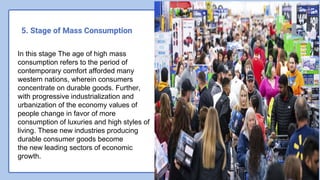
What is a
rural area?
01
-A rural area is a geographic area that is located
outside cities and towns.
-Typical rural areas have a low population density
and small
settlements
-Agricultural areas are commonly rural, though so are
others such as forests
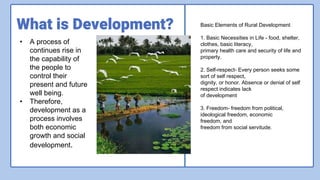
What is Development?
• A process of
continues rise in
the capability of
the people to
control their
present and future
well being.
• Therefore,
development as a
process involves
both economic
growth and social
development.
Basic Elements of Rural Development
1. Basic Necessities in Life - food, shelter,
clothes, basic literacy,
primary health care and security of life and
property.
2. Self-respect- Every person seeks some
sort of self respect,
dignity, or honor. Absence or denial of self
respect indicates lack
of development
3. Freedom- freedom from political,
ideological freedom, economic
freedom, and
freedom from social servitude.
The Nature of Rural Problems
- Low Income
- Unemployment
- Low quality of social services like education and healthcare
- Their remoteness from major urban center
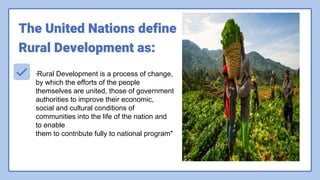
"Rural Development is a process of change,
by which the efforts of the people
themselves are united, those of government
authorities to improve their economic,
social and cultural conditions of
communities into the life of the nation and
to enable
them to contribute fully to national program"
The United Nations define
Rural Development as:
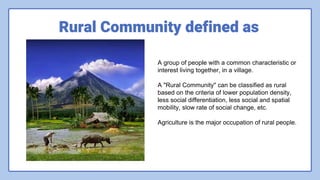
Rural Community defined as
A group of people with a common characteristic or
interest living together, in a village.
A "Rural Community" can be classified as rural
based on the criteria of lower population density,
less social differentiation, less social and spatial
mobility, slow rate of social change, etc.
Agriculture is the major occupation of rural people.
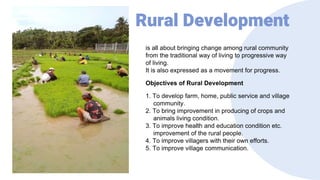
Rural Development
is all about bringing change among rural community
from the traditional way of living to progressive way
of living.
It is also expressed as a movement for progress.
Objectives of Rural Development
1. To develop farm, home, public service and village
community.
2. To bring improvement in producing of crops and
animals living condition.
3. To improve health and education condition etc.
improvement of the rural people.
4. To improve villagers with their own efforts.
5. To improve village communication.
1. People related
2. Agricultural related problems
3. Infrastructure related problems
4. Economic problems
5. Social and Cultural problems
6. Leadership related problems
7. Administrative problems
PROBLEM IN RURAL
DEVELOPMENT
PEOPLE RELATED
PROBLEMS
1. Traditional way of thinking
2. Poor understanding
3. Low level of education to understand
developmental efforts and new technology.
4. Deprived psychology and scientific
orientation.
5. Lack of confidence
6. Poor awareness
7. Low level of education
8. Existence of unfelt needs
9. Personal ego
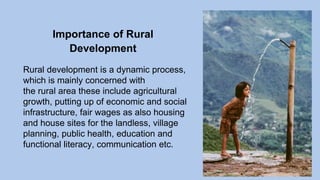
Importance of Rural
Development
Rural development is a dynamic process,
which is mainly concerned with
the rural area these include agricultural
growth, putting up of economic and social
infrastructure, fair wages as also housing
and house sites for the landless, village
planning, public health, education and
functional literacy, communication etc.
Growth vs.
Development
04
Economic growth is an essential component of development, it must encompass more than the
material and financial sides of people's lives. It is a multidimensional process involving the
reorganization and reorientation of both economic and social systems; improvements in the level of
distribution of incomes and output; involves radical changes in institutional, social and administrative
structures; and although development is usually defined in a national context, its widespread
realization may necessitate fundamental modifications of the international economic, social and
political systems as well
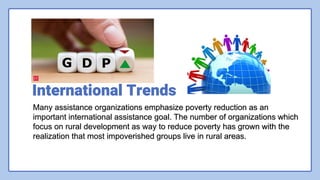
International Trends
Many assistance organizations emphasize poverty reduction as an
important international assistance goal. The number of organizations which
focus on rural development as way to reduce poverty has grown with the
realization that most impoverished groups live in rural areas.
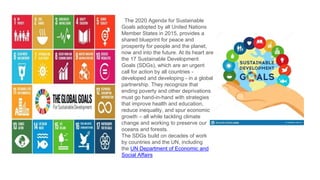
The 2020 Agenda for Sustainable
Goals adopted by all United Nations
Member States in 2015, provides a
shared blueprint for peace and
prosperity for people and the planet,
now and into the future. At its heart are
the 17 Sustainable Development
Goals (SDGs), which are an urgent
call for action by all countries -
developed and developing - in a global
partnership. They recognize that
ending poverty and other deprivations
must go hand-in-hand with strategies
that improve health and education,
reduce inequality, and spur economic
growth – all while tackling climate
change and working to preserve our
oceans and forests.
The SDGs build on decades of work
by countries and the UN, including
the UN Department of Economic and
Social Affairs
Eradicating extreme poverty
• Poverty has many dimensions, but its causes include unemployment, social exclusion, and high vulnerability of
certain populations to disasters, diseases and other phenomena which prevent them from being productive.
• A pivotal goal of the 2030 Agenda for Sustainable Development. Extreme poverty, defined as surviving on less
than $2.15 per person per day at 2017 purchasing power parity, has witnessed remarkable declines over
recent decades.
• If current patterns persist, an estimated 7% of the global population – around 575 million people – could still
find themselves trapped in extreme poverty by 2030, with a significant concentration in sub-Saharan Africa.
• A shocking revelation is the resurgence of hunger levels to those last observed in 2005. Equally concerning is
the persistent increase in food prices across a larger number of countries compared to the period from 2015 to
2019. This dual challenge of poverty and food security poses a critical global concern.
Goal 1: End poverty in all its forms everywhere - United Nations Sustainable Development
.
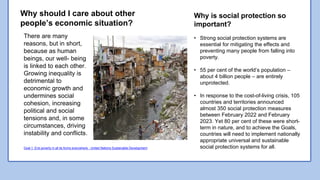
There are many
reasons, but in short,
because as human
beings, our well- being
is linked to each other.
Growing inequality is
detrimental to
economic growth and
undermines social
cohesion, increasing
political and social
tensions and, in some
circumstances, driving
instability and conflicts.
Why is social protection so
important?
• Strong social protection systems are
essential for mitigating the effects and
preventing many people from falling into
poverty.
• 55 per cent of the world’s population –
about 4 billion people – are entirely
unprotected.
• In response to the cost-of-living crisis, 105
countries and territories announced
almost 350 social protection measures
between February 2022 and February
2023. Yet 80 per cent of these were short-
term in nature, and to achieve the Goals,
countries will need to implement nationally
appropriate universal and sustainable
social protection systems for all.
Why should I care about other
people’s economic situation?
Goal 1: End poverty in all its forms everywhere - United Nations Sustainable Development
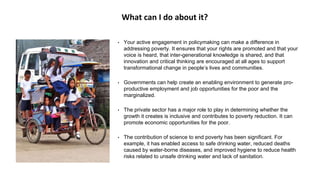
What can I do about it?
• Your active engagement in policymaking can make a difference in
addressing poverty. It ensures that your rights are promoted and that your
voice is heard, that inter-generational knowledge is shared, and that
innovation and critical thinking are encouraged at all ages to support
transformational change in people’s lives and communities.
• Governments can help create an enabling environment to generate pro-
productive employment and job opportunities for the poor and the
marginalized.
• The private sector has a major role to play in determining whether the
growth it creates is inclusive and contributes to poverty reduction. It can
promote economic opportunities for the poor.
• The contribution of science to end poverty has been significant. For
example, it has enabled access to safe drinking water, reduced deaths
caused by water-borne diseases, and improved hygiene to reduce health
risks related to unsafe drinking water and lack of sanitation.
Japan’s Assistance in Rural Development
In the past, Japanese assistance focused not on rural development
but
on agricultural development and the improvement of agricultural productivity.
Therefore, approaches centering on technical transfers such as construction
of
irrigation facilities and introduction of farming techniques were utilized.
However, the agricultural approach alone was insufficient. As a result,
multisectoral activities increased. This included non-agricultural income
generation, capacity building for farmers, health and hygiene, infrastructure,
education,
environment, and capacity building. International trends in comprehensive
efforts also contributed to this change.
In Japan, the ODA Charter of 1992 states that poverty in developing
countries should not be overlooked for humanitarian reasons. Also, in its
Medium-term Policy on ODA in 1999, the Japanese government
demonstrated
its intention by implementing ODA under the Charter, keeping the objectives
of the new 1996 DAC strategy in mind. This policy emphasizes the
importance
of economic growth and the fair distribution of its benefits and assistance for
the poor. In addition, the Japanese government emphasizes the importance of
basic education, health care, support for women in developing countries, safe
water supply, and the improvement of regional differences through assistance
to poor rural areas.
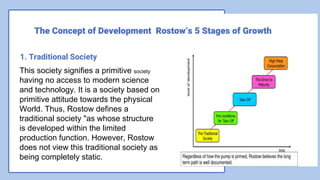
1. Traditional Society
This society signifies a primitive society
having no access to modern science
and technology. It is a society based on
primitive attitude towards the physical
World. Thus, Rostow defines a
traditional society "as whose structure
is developed within the limited
production function. However, Rostow
does not view this traditional society as
being completely static.
The Concept of Development Rostow’s 5 Stages of Growth
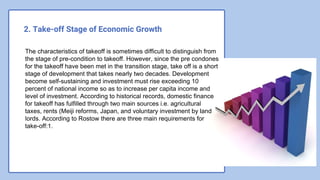
2. Take-off Stage of Economic Growth
The characteristics of takeoff is sometimes difficult to distinguish from
the stage of pre-condition to takeoff. However, since the pre condones
for the takeoff have been met in the transition stage, take off is a short
stage of development that takes nearly two decades. Development
become self-sustaining and investment must rise exceeding 10
percent of national income so as to increase per capita income and
level of investment. According to historical records, domestic finance
for takeoff has fulfilled through two main sources i.e. agricultural
taxes, rents (Meiji reforms, Japan, and voluntary investment by land
lords. According to Rostow there are three main requirements for
take-off:1.
Cont. Take-off Stage of Economic Growth
At the take off stage, the economy will transform as
follows:
• Urbanization increases, Industrialization proceeds,
Technological breakthrough occurs
• The "secondary" (goods-producing) sector expands
and ratio of secondary vs. primary sectors in the
economy shifts towards secondary
• Increase growth rates in industrial sector
• Changes in social and political institutions
• Decrease the capital output Ratio
3. Pre-Conditions or the Preparatory Stage
These conditions mainly comprise fundamental changes in the
social, political and economic fields; for example:
(a) A change in society's attitudes towards science, risk-taking
and profit-earning
(b) The adaptability of the labor force;
(c) Political sovereignty;
(d) Development of a centralized tax system and financial
institutions and
(e) The construction of certain economic and social
infrastructure like railways, ports, power generation and
educational institutions,
4. Drive to Maturity
Rostow defines it as the period when a society has effectively
applied the range of modern technology to the bulk of its
resources.
" Now regularly growing economy drives to extend modern
technology over the whole front of its economic activity. Some 10-
20% of the national income is steadily invested, permitting output
regularly to outstrip the increase in population. The make-up of the
economy changes unceasingly as technique improves, new
industries accelerate, and older industries level off. The economy
finds its place in the international economy: goods formerly
imported are produced at home; new import requirements develop,
and new export commodities to match them. The leading sectors
will in an economy be determined by the nature of resource
endowments and not only by technology
5. Stage of Mass Consumption
In this stage The age of high mass
consumption refers to the period of
contemporary comfort afforded many
western nations, wherein consumers
concentrate on durable goods. Further,
with progressive industrialization and
urbanization of the economy values of
people change in favor of more
consumption of luxuries and high styles of
living. These new industries producing
durable consumer goods become
the new leading sectors of economic
growth.
RESOURCE
PAGE
• https://www.slideshare.net/manishkumarsi
nha2/rural-development-ppt
• https://www.slideshare.net/jobitonio/rural-
development-109551216
• https://www.uky.edu/AS/Courses/GEO260/P
owerpoint/Concept_of_Development.ppt
• https://www.jica.go.jp/jica-ri/IFIC_and_JBICI-
Studies/english/publications/reports/study/top
ical/spd/pdf/chapter4.pdf
• https://launion.gov.ph/la-union-bukas-
portal/strategic-roadmap-2021/
.
THANK
YOU

Human Beings: Consequence development

  • 1.
    Rural Development: HumanBeings as the Cause and Consequence of Development 01 03 02 04 Definition Problem in Rural Development PEOPLE RELATED PROBLEMS Basic Elements of Rural Development The Nature of Rural Problems Rural Area Objectives of Rural Development What is Development? Importance of Rural Development Growth vs Development International Trends Agricultural Development The Concept of Development Rostow's 5 Stages of Growth
  • 2.
    Rural Area Where thepeople are engaged in primary industry in the sense that they produce things directly for the first time in cooperation with nature.
  • 3.
    What is a ruralarea? 01 -A rural area is a geographic area that is located outside cities and towns. -Typical rural areas have a low population density and small settlements -Agricultural areas are commonly rural, though so are others such as forests
  • 4.
    What is Development? •A process of continues rise in the capability of the people to control their present and future well being. • Therefore, development as a process involves both economic growth and social development. Basic Elements of Rural Development 1. Basic Necessities in Life - food, shelter, clothes, basic literacy, primary health care and security of life and property. 2. Self-respect- Every person seeks some sort of self respect, dignity, or honor. Absence or denial of self respect indicates lack of development 3. Freedom- freedom from political, ideological freedom, economic freedom, and freedom from social servitude.
  • 5.
    The Nature ofRural Problems - Low Income - Unemployment - Low quality of social services like education and healthcare - Their remoteness from major urban center
  • 6.
    "Rural Development isa process of change, by which the efforts of the people themselves are united, those of government authorities to improve their economic, social and cultural conditions of communities into the life of the nation and to enable them to contribute fully to national program" The United Nations define Rural Development as:
  • 7.
    Rural Community definedas A group of people with a common characteristic or interest living together, in a village. A "Rural Community" can be classified as rural based on the criteria of lower population density, less social differentiation, less social and spatial mobility, slow rate of social change, etc. Agriculture is the major occupation of rural people.
  • 8.
    Rural Development is allabout bringing change among rural community from the traditional way of living to progressive way of living. It is also expressed as a movement for progress. Objectives of Rural Development 1. To develop farm, home, public service and village community. 2. To bring improvement in producing of crops and animals living condition. 3. To improve health and education condition etc. improvement of the rural people. 4. To improve villagers with their own efforts. 5. To improve village communication.
  • 9.
    1. People related 2.Agricultural related problems 3. Infrastructure related problems 4. Economic problems 5. Social and Cultural problems 6. Leadership related problems 7. Administrative problems PROBLEM IN RURAL DEVELOPMENT
  • 10.
    PEOPLE RELATED PROBLEMS 1. Traditionalway of thinking 2. Poor understanding 3. Low level of education to understand developmental efforts and new technology. 4. Deprived psychology and scientific orientation. 5. Lack of confidence 6. Poor awareness 7. Low level of education 8. Existence of unfelt needs 9. Personal ego
  • 11.
    Importance of Rural Development Ruraldevelopment is a dynamic process, which is mainly concerned with the rural area these include agricultural growth, putting up of economic and social infrastructure, fair wages as also housing and house sites for the landless, village planning, public health, education and functional literacy, communication etc.
  • 12.
    Growth vs. Development 04 Economic growthis an essential component of development, it must encompass more than the material and financial sides of people's lives. It is a multidimensional process involving the reorganization and reorientation of both economic and social systems; improvements in the level of distribution of incomes and output; involves radical changes in institutional, social and administrative structures; and although development is usually defined in a national context, its widespread realization may necessitate fundamental modifications of the international economic, social and political systems as well
  • 13.
    International Trends Many assistanceorganizations emphasize poverty reduction as an important international assistance goal. The number of organizations which focus on rural development as way to reduce poverty has grown with the realization that most impoverished groups live in rural areas.
  • 14.
    The 2020 Agendafor Sustainable Goals adopted by all United Nations Member States in 2015, provides a shared blueprint for peace and prosperity for people and the planet, now and into the future. At its heart are the 17 Sustainable Development Goals (SDGs), which are an urgent call for action by all countries - developed and developing - in a global partnership. They recognize that ending poverty and other deprivations must go hand-in-hand with strategies that improve health and education, reduce inequality, and spur economic growth – all while tackling climate change and working to preserve our oceans and forests. The SDGs build on decades of work by countries and the UN, including the UN Department of Economic and Social Affairs
  • 15.
    Eradicating extreme poverty •Poverty has many dimensions, but its causes include unemployment, social exclusion, and high vulnerability of certain populations to disasters, diseases and other phenomena which prevent them from being productive. • A pivotal goal of the 2030 Agenda for Sustainable Development. Extreme poverty, defined as surviving on less than $2.15 per person per day at 2017 purchasing power parity, has witnessed remarkable declines over recent decades. • If current patterns persist, an estimated 7% of the global population – around 575 million people – could still find themselves trapped in extreme poverty by 2030, with a significant concentration in sub-Saharan Africa. • A shocking revelation is the resurgence of hunger levels to those last observed in 2005. Equally concerning is the persistent increase in food prices across a larger number of countries compared to the period from 2015 to 2019. This dual challenge of poverty and food security poses a critical global concern. Goal 1: End poverty in all its forms everywhere - United Nations Sustainable Development
  • 16.
    . There are many reasons,but in short, because as human beings, our well- being is linked to each other. Growing inequality is detrimental to economic growth and undermines social cohesion, increasing political and social tensions and, in some circumstances, driving instability and conflicts. Why is social protection so important? • Strong social protection systems are essential for mitigating the effects and preventing many people from falling into poverty. • 55 per cent of the world’s population – about 4 billion people – are entirely unprotected. • In response to the cost-of-living crisis, 105 countries and territories announced almost 350 social protection measures between February 2022 and February 2023. Yet 80 per cent of these were short- term in nature, and to achieve the Goals, countries will need to implement nationally appropriate universal and sustainable social protection systems for all. Why should I care about other people’s economic situation? Goal 1: End poverty in all its forms everywhere - United Nations Sustainable Development
  • 17.
    What can Ido about it? • Your active engagement in policymaking can make a difference in addressing poverty. It ensures that your rights are promoted and that your voice is heard, that inter-generational knowledge is shared, and that innovation and critical thinking are encouraged at all ages to support transformational change in people’s lives and communities. • Governments can help create an enabling environment to generate pro- productive employment and job opportunities for the poor and the marginalized. • The private sector has a major role to play in determining whether the growth it creates is inclusive and contributes to poverty reduction. It can promote economic opportunities for the poor. • The contribution of science to end poverty has been significant. For example, it has enabled access to safe drinking water, reduced deaths caused by water-borne diseases, and improved hygiene to reduce health risks related to unsafe drinking water and lack of sanitation.
  • 18.
    Japan’s Assistance inRural Development In the past, Japanese assistance focused not on rural development but on agricultural development and the improvement of agricultural productivity. Therefore, approaches centering on technical transfers such as construction of irrigation facilities and introduction of farming techniques were utilized. However, the agricultural approach alone was insufficient. As a result, multisectoral activities increased. This included non-agricultural income generation, capacity building for farmers, health and hygiene, infrastructure, education, environment, and capacity building. International trends in comprehensive efforts also contributed to this change. In Japan, the ODA Charter of 1992 states that poverty in developing countries should not be overlooked for humanitarian reasons. Also, in its Medium-term Policy on ODA in 1999, the Japanese government demonstrated its intention by implementing ODA under the Charter, keeping the objectives of the new 1996 DAC strategy in mind. This policy emphasizes the importance of economic growth and the fair distribution of its benefits and assistance for the poor. In addition, the Japanese government emphasizes the importance of basic education, health care, support for women in developing countries, safe water supply, and the improvement of regional differences through assistance to poor rural areas.
  • 19.
    1. Traditional Society Thissociety signifies a primitive society having no access to modern science and technology. It is a society based on primitive attitude towards the physical World. Thus, Rostow defines a traditional society "as whose structure is developed within the limited production function. However, Rostow does not view this traditional society as being completely static. The Concept of Development Rostow’s 5 Stages of Growth
  • 20.
    2. Take-off Stageof Economic Growth The characteristics of takeoff is sometimes difficult to distinguish from the stage of pre-condition to takeoff. However, since the pre condones for the takeoff have been met in the transition stage, take off is a short stage of development that takes nearly two decades. Development become self-sustaining and investment must rise exceeding 10 percent of national income so as to increase per capita income and level of investment. According to historical records, domestic finance for takeoff has fulfilled through two main sources i.e. agricultural taxes, rents (Meiji reforms, Japan, and voluntary investment by land lords. According to Rostow there are three main requirements for take-off:1.
  • 21.
    Cont. Take-off Stageof Economic Growth At the take off stage, the economy will transform as follows: • Urbanization increases, Industrialization proceeds, Technological breakthrough occurs • The "secondary" (goods-producing) sector expands and ratio of secondary vs. primary sectors in the economy shifts towards secondary • Increase growth rates in industrial sector • Changes in social and political institutions • Decrease the capital output Ratio
  • 22.
    3. Pre-Conditions orthe Preparatory Stage These conditions mainly comprise fundamental changes in the social, political and economic fields; for example: (a) A change in society's attitudes towards science, risk-taking and profit-earning (b) The adaptability of the labor force; (c) Political sovereignty; (d) Development of a centralized tax system and financial institutions and (e) The construction of certain economic and social infrastructure like railways, ports, power generation and educational institutions,
  • 23.
    4. Drive toMaturity Rostow defines it as the period when a society has effectively applied the range of modern technology to the bulk of its resources. " Now regularly growing economy drives to extend modern technology over the whole front of its economic activity. Some 10- 20% of the national income is steadily invested, permitting output regularly to outstrip the increase in population. The make-up of the economy changes unceasingly as technique improves, new industries accelerate, and older industries level off. The economy finds its place in the international economy: goods formerly imported are produced at home; new import requirements develop, and new export commodities to match them. The leading sectors will in an economy be determined by the nature of resource endowments and not only by technology
  • 24.
    5. Stage ofMass Consumption In this stage The age of high mass consumption refers to the period of contemporary comfort afforded many western nations, wherein consumers concentrate on durable goods. Further, with progressive industrialization and urbanization of the economy values of people change in favor of more consumption of luxuries and high styles of living. These new industries producing durable consumer goods become the new leading sectors of economic growth.
  • 30.
    RESOURCE PAGE • https://www.slideshare.net/manishkumarsi nha2/rural-development-ppt • https://www.slideshare.net/jobitonio/rural- development-109551216 •https://www.uky.edu/AS/Courses/GEO260/P owerpoint/Concept_of_Development.ppt • https://www.jica.go.jp/jica-ri/IFIC_and_JBICI- Studies/english/publications/reports/study/top ical/spd/pdf/chapter4.pdf • https://launion.gov.ph/la-union-bukas- portal/strategic-roadmap-2021/
  • 31.