What is Leadership?
The ability to influence a group toward the achievement of
goals and inspires them through motivation and direction.
Leaders have –
Vision & direction
Are capable of aligning employees towards a common
purpose.
Traits of Leaders
• Intelligence
• Physical Features
• Inner Motivation
• Maturity
• Vision & Foresight
• Acceptance of Responsibility
• Open-Minded and adaptability
• Self-confidence
• Human Relations Attitude
• Fairness and Objectivity
Importance/Need of leadership
•Facilitate Change
•Building and increase employees morale
•Provide Guidance
•Determination of Goal
•Promote team spirit
•Aid to Authority
Leaders are needed
everywhere.
Good leaders promote unity,
harmony, strength, prosperity
and happiness.
NEED FOR LEADERSHIP
NEED FOR LEADERSHIP
• Without leaders, things drift along.
• They go where they want to go,
following the path of least resistance.
However, when this is not desirable—
or acceptable—you hire, elect,
appoint or become a leader.
• The leader’s job is to overcome
resistance and make things flow in a
direction.
PROCESS OF LEADERSHIP
TO BE : TO DO : TO SEE : TO TELL
TO TELL
TO SEE
TO DO
TO BE
FUNCTIONS
ACHIEVING
THE TASK
DEVELOPING
THE
INDIVIDUAL
BUILDING AND
MAINTAINING
THE TEAM
ACHIEVING
THE TASKDEVELOPING
THE
INDIVIDUALBUILDING AND
MAINTAINING
THE TEAM
Defining the task
Planning
BriefingControlling
Evaluating
Motivating
Organizing
Providing an example
FUNCTIONS OF
LEADERSHIP
Defining the task
Planning
BriefingControlling
Evaluating
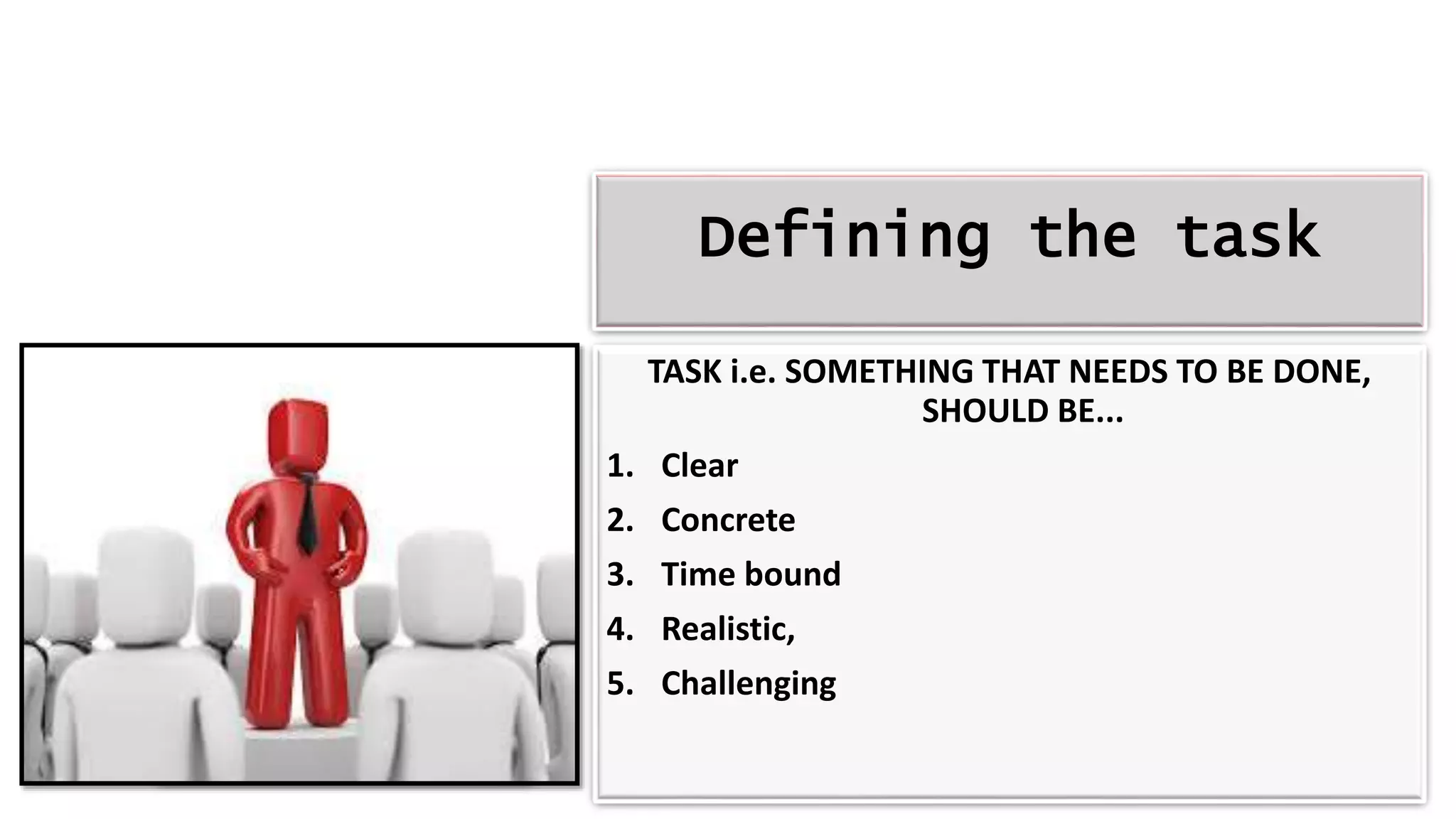
TASK i.e. SOMETHING THAT NEEDS TO BE DONE,
SHOULD BE...
1. Clear
2. Concrete
3. Time bound
4. Realistic,
5. Challenging
Defining the task
Motivating
Organizing
Planning
It means building a mental
bridge from where you are now
to where you want to be .
How would you like to make a plan?
• Leader presents problems , get suggestions
and makes plan
Defining the task
Briefing
Motivating
OrganizingEstablishing a clear
vision of the
organization’s
future
Defining the task
Planning
BriefingControlling
Control can be defined as a methodical
process through which managers monitor
employees and their activities to ensure
that they are in alignment with the company's
objectives.
Proper use of Power:
Leader must be careful while exercising
his power or authority in relation to his
subordinates.
Leader must analyze the situation before
exercising his power.
Planning
Briefing
Motivating
Organizing
Evaluating
Controlling
Evaluating
Motivating
Motivation word comes from Latin verb
“to move”
Leaders are doing it by “Rewards” and
“Threats” approach,
A leader must understand ‘needs’ of his
men, to motivate them.
Planning
FUNCTIONS OF
LEADERSHIP
Organizing
• This is the function of arranging or forming into a
coherent whole.
• It encompasses the structuring or re-structuring so
that people work as a team with each performing
its part.
Planning
Briefing
Motivating
Organizing
Providing an example
Example is a prime
means to communicate
a message through
body language or non-
verbal communication.
Leading by example
includes sharing
fully in dangers and
hardships.
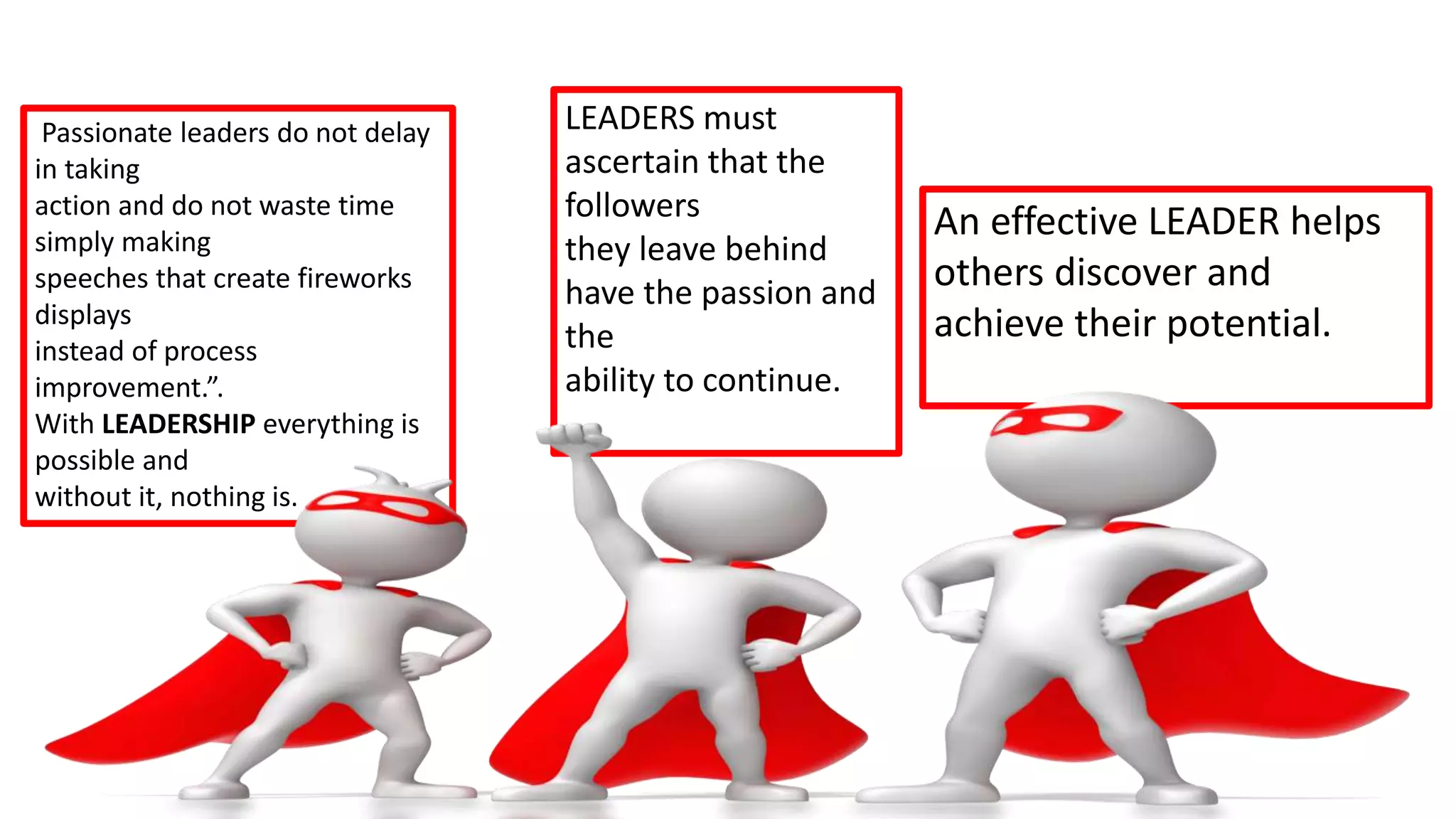
An effective LEADER helps
others discover and
achieve their potential.
LEADERS must
ascertain that the
followers
they leave behind
have the passion and
the
ability to continue.
Passionate leaders do not delay
in taking
action and do not waste time
simply making
speeches that create fireworks
displays
instead of process
improvement.”.
With LEADERSHIP everything is
possible and
without it, nothing is.
MANAGEMENT, A USEFUL TOOL FOR A LEADER
“ ONE CAN BE A GOOD MANAGER WITHOUT
BEING A GOOD LEADER,
BUT ONE CAN NOT BE A GOOD
LEADER WITHOUT BEING
A GOOD MANAGER”
LEADERSHIP & MANAGEMENT
What Is a Production Manager in the Fashion Industry?
• Churning out fashion collections twice a year is no easy job for even the most seasoned fashion
designer, and without a loyal support staff, it may be close to impossible.
• Chief among employees attached to a fashion house is the fashion production manager, a pivotal job
that calls for a person with a passion for detail and an organized mind.
• Production managers are the sun around which a designer’s logistical efforts revolve, so if you enjoy
multi-tasking and responsibility, this could be the career of your dreams.
ROLES AND RESPONSIBILITIES OF A FASHION MANAGER
• The fashion product manager makes the ideas and concepts of design
concrete, transforming creativity into a valid commercial proposal.
• From the initial idea through to final production, he or she supervises
the proceedings of the entire project and is responsible for the
organization and activating protocols in guarantees, aimed at
certifying the quality of the products.
• The professional also selects the methodologies for the realization of
company reporting in different negotiating phases, while managing
prototypes, analyses and processes.
• The product manager looks to the future.
Leadership Styles
• Autocratic
(Authoritarian)
• Bureaucratic
• Democratic
• Coercive
• Laissez-Faire
Autocratic(Authoritarian)
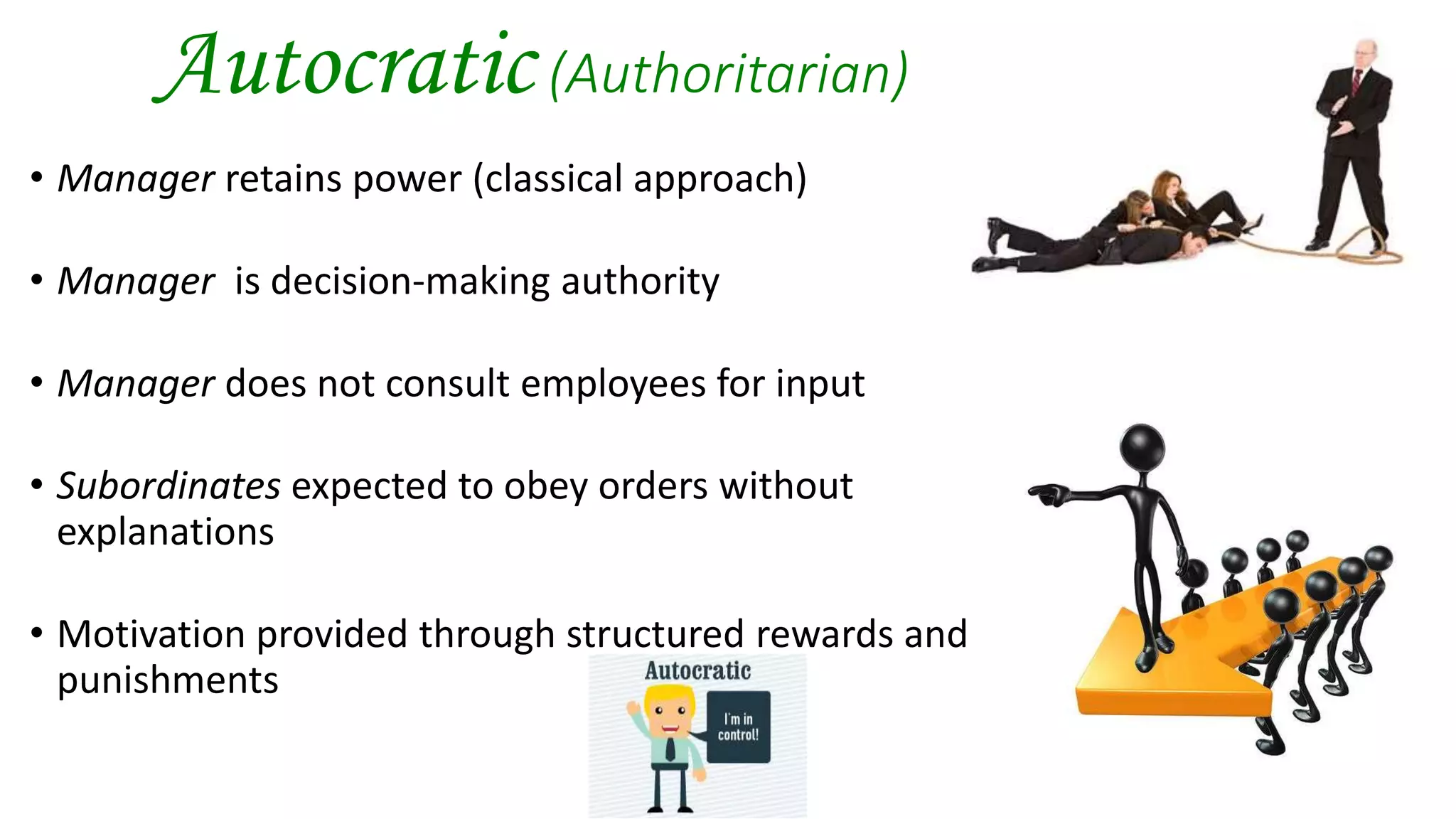
• Manager retains power (classical approach)
• Manager is decision-making authority
• Manager does not consult employees for input
• Subordinates expected to obey orders without
explanations
• Motivation provided through structured rewards and
punishments
Bureaucratic
• Manager manages “by the book¨
• Everything must be done according to procedure or policy
• If it isn’t covered by the book, the manager refers to the next
level above him or her
• Police officer more than leader
Democratic
• Often referred to as participative
style
• Keeps employees informed
• Shares decision making and
problem solving responsibilities
• Gathers information from staff
members before making decisions
DemocraticContinued
• Help employees evaluate their own performance
• Allows employees to establish goals
• Encourages employees to grow on the job and be promoted
• Recognizes and encourages achievement
• Can produce high quality and high quantity work for long periods
of time
Coercive
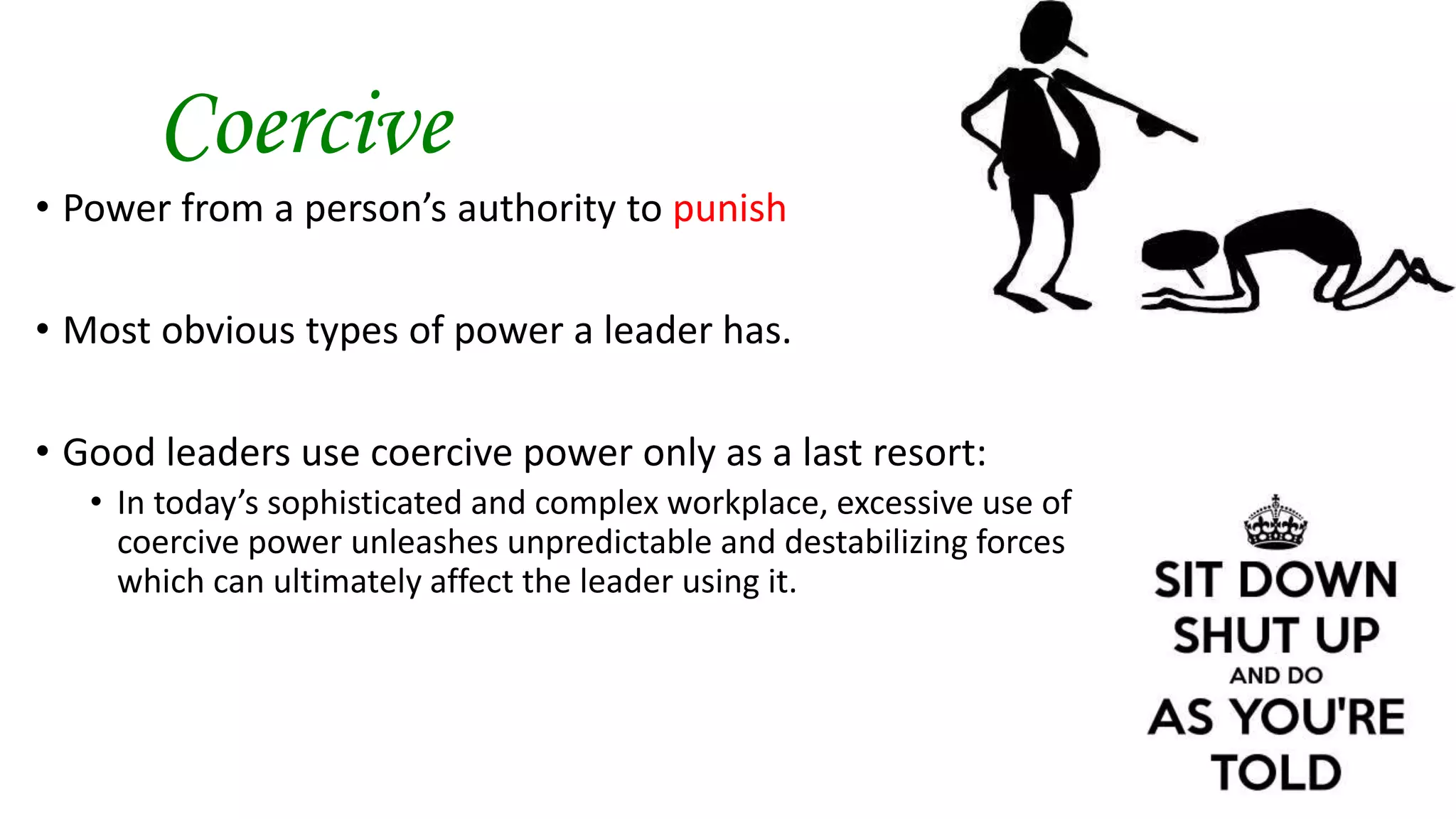
• Power from a person’s authority to punish
• Most obvious types of power a leader has.
• Good leaders use coercive power only as a last resort:
• In today’s sophisticated and complex workplace, excessive use of
coercive power unleashes unpredictable and destabilizing forces
which can ultimately affect the leader using it.
Laissez-Faire
• Also known as the “hands-off¨ style
• Little or no direction
• Gives followers as much freedom as possible
• All authority or power is given to the followers
• Followers must determine goals, make decisions, and resolve
problems on their own.
• Listening ( and questioning) skills
• Dealing with conflict
• Dealing with difficult people
• Appreciating other people
• Forming effective teams
• Establishing trust through consistency
• Sensitivity to other cultures
• Communicating positive & negative feedbacks
• Capacity to handle criticism
Put Your People First
• If you don’t take the time to support your
staff & ensure their needs are being met,
all of your work will be useless.
Be a Credible Manager
• Effective managers understand that
no good ever comes out of
authority without accountability.
You are an includer
• Keep your employees within the loop.
Inform them of all decisions that will
affect & be affected by their work. Don’t
treat them as a mindless machines that
are used only to get the job done.
Don’t show discrimination
• Being a good manager you should
never discriminate among your team
members.
Be calm & dignified
• Don’t be rude with others
• You can be firm but not harsh
• Don’t use hurting words in your
statement
Be a mentor
• Rather than shouting on others
who are not as good as you on that
job try to make them learn. Your
team members will pay high
regards to you.
Avoid last minute tasks
• No one likes to start a task at the
end of the day, especially when
you have other plans for the
evening.
• Do not throw work at your
employees just as they are about
to call it a day.
Leadership
Leadership

Leadership

  • 2.
    What is Leadership? Theability to influence a group toward the achievement of goals and inspires them through motivation and direction. Leaders have – Vision & direction Are capable of aligning employees towards a common purpose.
  • 3.
    Traits of Leaders •Intelligence • Physical Features • Inner Motivation • Maturity • Vision & Foresight • Acceptance of Responsibility • Open-Minded and adaptability • Self-confidence • Human Relations Attitude • Fairness and Objectivity
  • 4.
    Importance/Need of leadership •FacilitateChange •Building and increase employees morale •Provide Guidance •Determination of Goal •Promote team spirit •Aid to Authority
  • 5.
    Leaders are needed everywhere. Goodleaders promote unity, harmony, strength, prosperity and happiness. NEED FOR LEADERSHIP
  • 6.
    NEED FOR LEADERSHIP •Without leaders, things drift along. • They go where they want to go, following the path of least resistance. However, when this is not desirable— or acceptable—you hire, elect, appoint or become a leader. • The leader’s job is to overcome resistance and make things flow in a direction.
  • 8.
    PROCESS OF LEADERSHIP TOBE : TO DO : TO SEE : TO TELL TO TELL TO SEE TO DO TO BE
  • 9.
  • 10.
  • 11.
  • 12.
  • 13.
  • 14.
  • 15.
    Defining the task Planning BriefingControlling Evaluating TASKi.e. SOMETHING THAT NEEDS TO BE DONE, SHOULD BE... 1. Clear 2. Concrete 3. Time bound 4. Realistic, 5. Challenging
  • 16.
    Defining the task Motivating Organizing Planning Itmeans building a mental bridge from where you are now to where you want to be . How would you like to make a plan? • Leader presents problems , get suggestions and makes plan
  • 17.
    Defining the task Briefing Motivating OrganizingEstablishinga clear vision of the organization’s future
  • 18.
    Defining the task Planning BriefingControlling Controlcan be defined as a methodical process through which managers monitor employees and their activities to ensure that they are in alignment with the company's objectives. Proper use of Power: Leader must be careful while exercising his power or authority in relation to his subordinates. Leader must analyze the situation before exercising his power.
  • 19.
  • 20.
    Controlling Evaluating Motivating Motivation word comesfrom Latin verb “to move” Leaders are doing it by “Rewards” and “Threats” approach, A leader must understand ‘needs’ of his men, to motivate them.
  • 21.
    Planning FUNCTIONS OF LEADERSHIP Organizing • Thisis the function of arranging or forming into a coherent whole. • It encompasses the structuring or re-structuring so that people work as a team with each performing its part.
  • 22.
    Planning Briefing Motivating Organizing Providing an example Exampleis a prime means to communicate a message through body language or non- verbal communication. Leading by example includes sharing fully in dangers and hardships.
  • 23.
    An effective LEADERhelps others discover and achieve their potential. LEADERS must ascertain that the followers they leave behind have the passion and the ability to continue. Passionate leaders do not delay in taking action and do not waste time simply making speeches that create fireworks displays instead of process improvement.”. With LEADERSHIP everything is possible and without it, nothing is.
  • 25.
    MANAGEMENT, A USEFULTOOL FOR A LEADER “ ONE CAN BE A GOOD MANAGER WITHOUT BEING A GOOD LEADER, BUT ONE CAN NOT BE A GOOD LEADER WITHOUT BEING A GOOD MANAGER” LEADERSHIP & MANAGEMENT
  • 26.
    What Is aProduction Manager in the Fashion Industry? • Churning out fashion collections twice a year is no easy job for even the most seasoned fashion designer, and without a loyal support staff, it may be close to impossible. • Chief among employees attached to a fashion house is the fashion production manager, a pivotal job that calls for a person with a passion for detail and an organized mind. • Production managers are the sun around which a designer’s logistical efforts revolve, so if you enjoy multi-tasking and responsibility, this could be the career of your dreams.
  • 27.
    ROLES AND RESPONSIBILITIESOF A FASHION MANAGER • The fashion product manager makes the ideas and concepts of design concrete, transforming creativity into a valid commercial proposal. • From the initial idea through to final production, he or she supervises the proceedings of the entire project and is responsible for the organization and activating protocols in guarantees, aimed at certifying the quality of the products. • The professional also selects the methodologies for the realization of company reporting in different negotiating phases, while managing prototypes, analyses and processes. • The product manager looks to the future.
  • 28.
    Leadership Styles • Autocratic (Authoritarian) •Bureaucratic • Democratic • Coercive • Laissez-Faire
  • 29.
    Autocratic(Authoritarian) • Manager retainspower (classical approach) • Manager is decision-making authority • Manager does not consult employees for input • Subordinates expected to obey orders without explanations • Motivation provided through structured rewards and punishments
  • 30.
    Bureaucratic • Manager manages“by the book¨ • Everything must be done according to procedure or policy • If it isn’t covered by the book, the manager refers to the next level above him or her • Police officer more than leader
  • 31.
    Democratic • Often referredto as participative style • Keeps employees informed • Shares decision making and problem solving responsibilities • Gathers information from staff members before making decisions
  • 32.
    DemocraticContinued • Help employeesevaluate their own performance • Allows employees to establish goals • Encourages employees to grow on the job and be promoted • Recognizes and encourages achievement • Can produce high quality and high quantity work for long periods of time
  • 33.
    Coercive • Power froma person’s authority to punish • Most obvious types of power a leader has. • Good leaders use coercive power only as a last resort: • In today’s sophisticated and complex workplace, excessive use of coercive power unleashes unpredictable and destabilizing forces which can ultimately affect the leader using it.
  • 34.
    Laissez-Faire • Also knownas the “hands-off¨ style • Little or no direction • Gives followers as much freedom as possible • All authority or power is given to the followers • Followers must determine goals, make decisions, and resolve problems on their own.
  • 36.
    • Listening (and questioning) skills • Dealing with conflict • Dealing with difficult people • Appreciating other people • Forming effective teams • Establishing trust through consistency • Sensitivity to other cultures • Communicating positive & negative feedbacks • Capacity to handle criticism
  • 37.
    Put Your PeopleFirst • If you don’t take the time to support your staff & ensure their needs are being met, all of your work will be useless.
  • 38.
    Be a CredibleManager • Effective managers understand that no good ever comes out of authority without accountability.
  • 39.
    You are anincluder • Keep your employees within the loop. Inform them of all decisions that will affect & be affected by their work. Don’t treat them as a mindless machines that are used only to get the job done.
  • 40.
    Don’t show discrimination •Being a good manager you should never discriminate among your team members.
  • 41.
    Be calm &dignified • Don’t be rude with others • You can be firm but not harsh • Don’t use hurting words in your statement
  • 42.
    Be a mentor •Rather than shouting on others who are not as good as you on that job try to make them learn. Your team members will pay high regards to you.
  • 43.
    Avoid last minutetasks • No one likes to start a task at the end of the day, especially when you have other plans for the evening. • Do not throw work at your employees just as they are about to call it a day.