MOTIVATION
WORK MOTIVATIONis the set of internal and external forces that cause an employee to choose a course of action and engage in certain behaviorsThree Elements of Work MotivationDirection and Focus of the BehaviorLevel of effort providedPersistence of the behavior
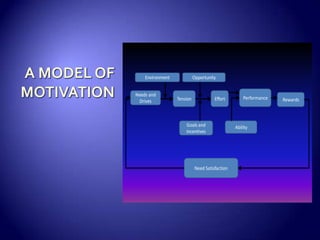
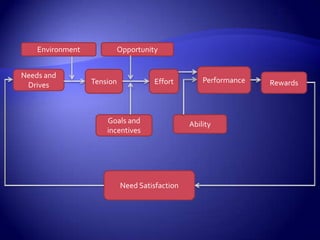
A MODEL OF MOTIVATION
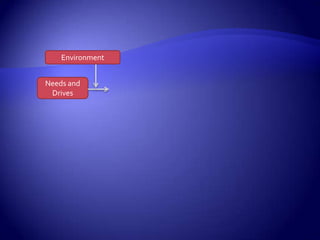
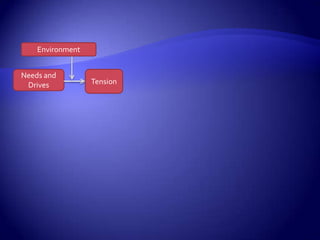
EnvironmentNeeds and Drives
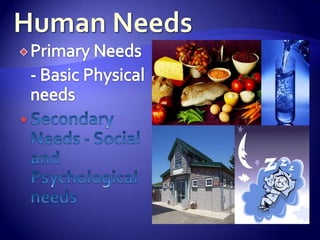
Human NeedsPrimary Needs 	- Basic Physical needsSecondary Needs - Social and Psychological needs
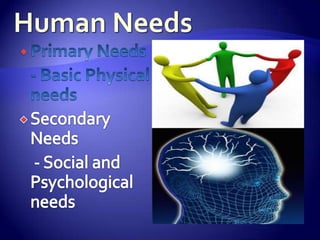
Human NeedsPrimary Needs 	- Basic Physical needsSecondary Needs	 - Social and Psychological needs
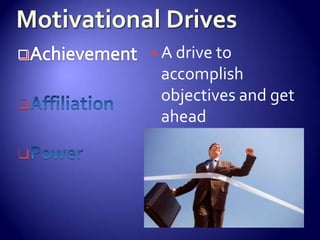
Motivational DrivesAchievement
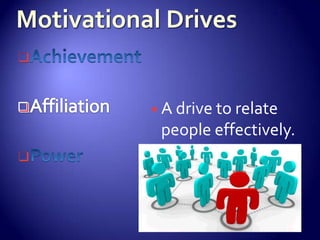
Affiliation
PowerMotivational DrivesA drive to accomplish objectives and get aheadAchievement
Affiliation
PowerMotivational DrivesA drive to relate people effectively.Achievement
Affiliation
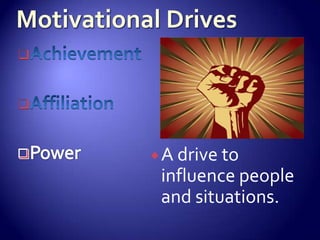
PowerMotivational DrivesA drive to influence people and situations.Achievement
Affiliation
PowerMotivational DrivesInstitutional powerPersonalized PowerAchievement
Affiliation
PowerEnvironmentNeeds and DrivesTension
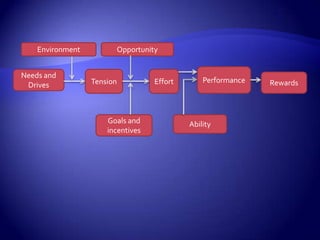
OpportunityEnvironmentPerformanceNeeds and DrivesTensionEffortRewardsAbilityGoals and incentives
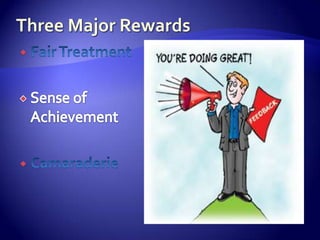
Three Major RewardsFair TreatmentSense of AchievementCamaraderie
OpportunityEnvironmentPerformanceNeeds and DrivesTensionEffortRewardsAbilityGoals and incentivesNeed Satisfaction
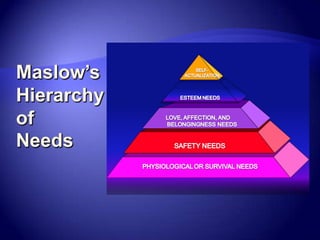
Maslow’sHierarchyofNeeds
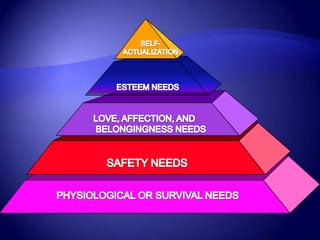
SELF-ACTUALIZATIONESTEEM NEEDSLOVE, AFFECTION, AND BELONGINGNESS NEEDSSAFETY NEEDSPHYSIOLOGICAL OR SURVIVAL NEEDS
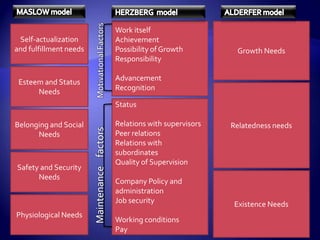
MASLOW modelHERZBERG  modelALDERFER modelWork itselfAchievementPossibility of GrowthResponsibility AdvancementRecognitionGrowth NeedsSelf-actualization and fulfillment needsMotivational FactorsEsteem and Status NeedsRelatedness needsStatusRelations with supervisorsPeer relationsRelations with subordinatesQuality of SupervisionCompany Policy and administrationJob securityWorking conditionsPayBelonging and Social NeedsSafety and Security NeedsMaintenance    factorsExistence NeedsPhysiological Needs
Herzberg’s Two-Factor Modelon the basis of research with engineers and accountants, Frederick Herzberg in the 1950’s  developed the Two Factor Model for MotivationHerzberg’s Two-Factor ModelMaintenance & Motivational FactorsMaintenance or Hygiene FactorsTheir presence generally brings employees only to a neutral state. The factors are not strongly motivating.
Herzberg’s Two-Factor ModelMaintenance & Motivational FactorsMotivational FactorsOther job conditions operate primarily to build this motivation, but their absence rarely is strongly dissatisfying.
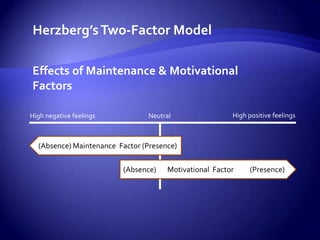
Herzberg’s Two-Factor ModelEffects of Maintenance & Motivational FactorsHigh positive feelingsHigh negative feelingsNeutral(Absence) Maintenance  Factor (Presence)(Absence)       Motivational  Factor          (Presence)
Herzberg’s Two-Factor ModelJob Contents and ContextJob ContentThese are the motivational factors such as achievement and responsibility are related, for the most par, directly to the job itself. The employees’ performance and the personal recognition and growth that the employee experiences.
Herzberg’s Two-Factor ModelJob Contents and ContextJob Context	-Maintenance factors are mainly related	-Employees are more related to the environment 	  surrounding the job.
Herzberg’s Two-Factor ModelIntrinsic and Extrinsic MotivatorsIntrinsic MotivatorsThese are internal rewards that a person feels when performing a job.
Herzberg’s Two-Factor ModelIntrinsic and Extrinsic MotivatorsExtrinsic MotivatorsThese are external rewards that occur apart from the nature of work providing no direct satisfaction at the time the work is performed.
Herzberg’s Two-Factor ModelInterpreting the Two-Factor ModelHerzberg’s model provides a useful distinction between maintenance factor which are necessary but not sufficient and motivational factor which have the potential for improving employee effort.
Alderfer’s E-R-G ModelExistence NeedCombine physiological and security factors pay, physical working conditions, job security, and firing benefits can also address these needs.
Alderfer’s E-R-G ModelRelatedness NeedsThese involve being understood and accepted by people above, below and around the employee at work and away from it.
Alderfer’s E-R-G ModelGrowth NeedsThese involve the desire for both self-esteem and self actualization.
Comparison of the Maslow, Herzberg, and Alderfer’s ModelThe similarities among the three models of human needs are quite apparent. But there are also important contrasts:Maslow and Alderferfocuses on the internal needs of the employees. “Whereas” Herzberg also identifies and differentiates the conditions (job content or job context) that could be provided for need satisfaction.
BEHAVIOR MODIFICATION by: Jacel
Organizational Behavior Modification or OB Mod-> Is the application in organizations of the principles of behavior modification.
Law of Effect-> state that a person tends to repeat behavior that is accompanied by favorable consequences (reinforcement) and tends not to repeat behavior that is accompanied by unfavorable consequences.
	“we learn best under pleasant surroundings”						-learning theory-“internal needs lead to behavior”						-content theory-“external consequences tend to determine  behavior”						-OB Mod-
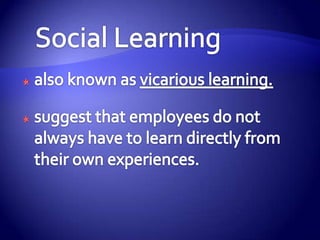
Social Learningalso known as vicarious learning.suggest that employees do not always have to learn directly from their own experiences.
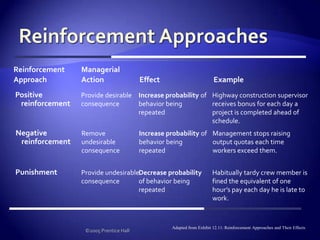
©2005 Prentice HallReinforcement ApproachesReinforcement	Managerial Approach 	Action 	Effect 	ExamplePositive reinforcementProvide desirable consequenceIncrease probability of behavior being repeatedHighway construction supervisor receives bonus for each day a project is completed ahead of schedule.Negative reinforcementRemove undesirable consequenceIncrease probability of behavior being repeatedManagement stops raising output quotas each time workers exceed them.PunishmentProvide undesirable consequenceDecrease probability of behavior being repeatedHabitually tardy crew member is fined the equivalent of one hour’s pay each day he is late to work.Adapted from Exhibit 12.11: Reinforcement Approaches and Their Effects
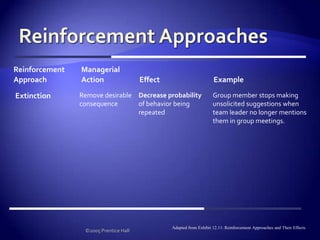
©2005 Prentice HallReinforcement ApproachesReinforcement	Managerial Approach 	Action 	Effect 	ExampleExtinctionRemove desirable consequenceDecrease probability of behavior being repeatedGroup member stops making unsolicited suggestions when team leader no longer mentions them in group meetings.Adapted from Exhibit 12.11: Reinforcement Approaches and Their Effects
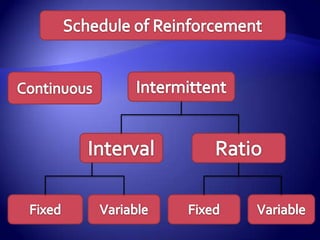
Schedule of ReinforcementIntermittentContinuousRatioIntervalVariableFixedVariableFixed
Major Benefit of Behavior modificationMakes managers become more conscious motivators.Encourages manager to analyze employee behavior, explore why it occurs and how often.Identify specific consequences that will help change it when those consequences are applied systematically.
Goal setting Prepared by: Jay Daileg
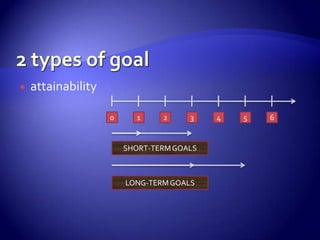
GoalTargets and objectives for future performanceProvides a sense of direction and purpose
2 types of goalattainability0635241SHORT-TERM GOALSLONG-TERM GOALS
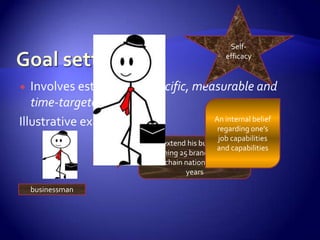
Goal settingInvolves establishing specific, measurable and time-targeted objectivesIllustrative example:Self-efficacyAn internal belief regarding one’s job capabilities and capabilitiesTo extend his business by opening 25 branches of his food chain nationwide for 10 yearswantsbusinessman
Elements of a goal settingGoal setting
Elements of a goal settingGoal acceptanceSpecificityChallengePerformance monitoring and feedback
Aspects for goal settingThe S.M.A.R.T. F.O.R. M.E. goal setting process
S-M-A-R-T-F-O-R-M-E-specificmeasurableattainablerealistictimedfocusedoptimisticreadymeaningfulexciting
End of goal settingGoal setting
Expectancy theoryJulyanneErese
Expectancy theoryDeveloped by 	Victor H. VroomEstates, a worker expects  to receive(reward pay) for efforts produced. The rewards, wages, or incentives are usually agreed upon by employer and employee.
3 factors of motivation on expectancy theory
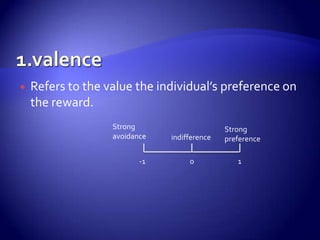
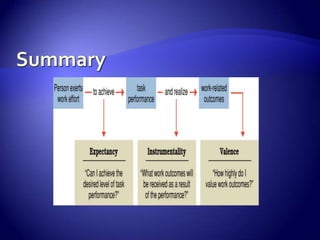
1.valenceRefers to the value the individual’s preference on the reward.StrongavoidanceStrongpreferenceindifference-110
2.ExpectancyIs the strength of belief one’s work related effort will result on the completion of the task.Range expectancy:Low probabilityLow probability01
3 bases Past experienceSelf-confidence perceived difficulty
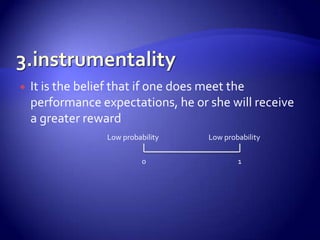
3.instrumentalityIt is the belief that if one does meet the performance expectations, he or she will receive a greater rewardLow probabilityLow probability01
Summary
Advantages of expectancy theoryExpectancy is a valuable tool  for helping managers think about the mental processes through which motivation occurs.Values human dignityEncourages manager to design the motivational climate that will stimulate appropriate employee behaviour.
End of expectancy theory
THE EQUITY MODEL by: julyanne
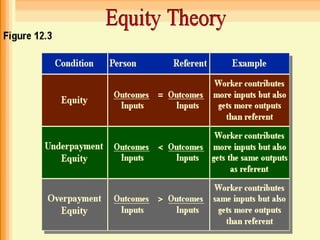
THE EQUITY MODEL -> developed on the belief that fair treatment or perception thereof, motivates people to keep such fairness maintained within the relationships of their  colleagues and the organization.
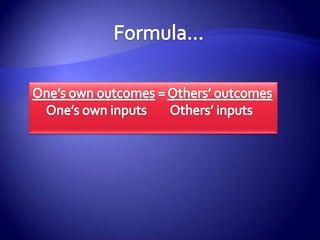
Formula…One’s own outcomes = Others’ outcomes     One’s own inputs	    Others’ inputs

Motivation chapter v