!ATTITUDEISEVERY THING
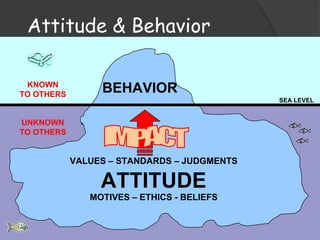
The Iceberg  How much do you see of an iceberg???
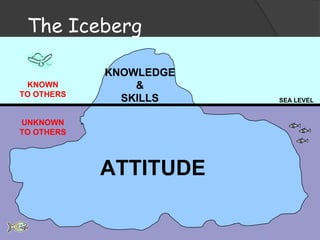
The IcebergONLY 10% OF ANY ICEBERG IS VISIBLE. THE REMAINING 90% IS BELOW SEA LEVEL.
The IcebergThe Iceberg phenomena is also applicable on human beings …
The IcebergKNOWLEDGE&SKILLSKNOWN TO OTHERSSEA LEVELUNKNOWN TO OTHERSATTITUDE
ConceptAn attitude is a hypothetical construct that represents an individual's degree of like or dislike for an item. Attitudes are generally positive or negative views of a person, place, thing, or event this is often referred to as the attitude object.
Four Possible Reactions to Attitude Objects
Positive attitude:	The predisposition that results in desirable outcomes for individuals and organizations.Negative attitude:	The tendency of a person that result in an undesirable outcome for individuals and organizations.
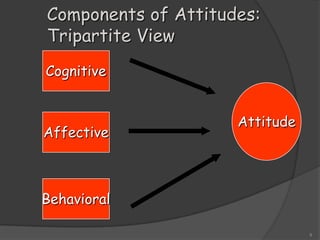
9Components of Attitudes: Tripartite ViewCognitiveAttitudeAffectiveBehavioral
Components of AttitudesCOGNITIVEOpinion or beliefs about attitude object (pos & neg)AFFECTIVEemotions and feelings the object triggers (pos & neg)BEHAVIORALreaction toward the object (pos & neg actions)10
Attitude Object:  EMPLOYEECOGNITIONSMy pay is low.My supervisor is unfair.AFFECTSI am angry over how little I’m paid.I dislike my supervisor.BEHAVIORSI am going to look for another job that pays better.I am looking for another job.11
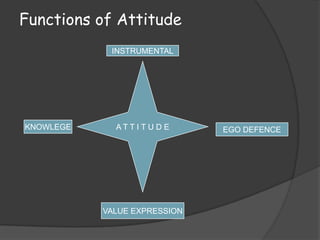
Functions of AttitudeINSTRUMENTALA T T I T U D EKNOWLEGEEGO DEFENCEVALUE EXPRESSION
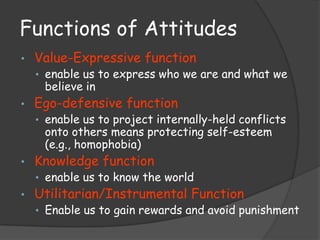
Functions of AttitudesValue-Expressive function
enable us to express who we are and what we believe in
Ego-defensive function
enable us to project internally-held conflicts onto others means protecting self-esteem (e.g., homophobia)
Knowledge function
enable us to know the world
Utilitarian/Instrumental Function
Enable us to gain rewards and avoid punishmentTheories of attitude changeCognitive Dissonance TheorySelf Perception Theory
Attitudes, Behavior & ConsistencyPeople try maintain consistency between their different attitudes.
People try maintain consistency between attitudes and behavior.
Altering their attitudes or behavior, developing a rationalization for their discrepancy.15
Cognitive Dissonance TheoryIf there is an inconsistency between two attitudes or between attitudes and behavior
People seek to make them consistent
Achieve a stable state with minimum of dissonance16
Cognitive Dissonance TheoryDesire to reduce dissonance depends on  importance of elements creating the dissonance
degree of influence over the elements
rewards involved in the dissonance17
Self-PerceptionTheoryAttitudes do not cause behavior, behavior causes attitudes
Attitudes are formed after the fact to make sense out of behavior that already occurred18
Do Attitudes cause Behavior?Answer: Not very well! Attitudes have a stronger affect on behavior if they are important
specific

Attitude