Motivation
Motivation
Introduction
Definition
Importance
Theories
Motivation - Introduction
“ Neil Lebovits, President of Ajilon, a staffing firm based in
New Jersey, had some serious employee’s problems.
Turnover was high, and morale was low. The severity of the
situation hit home when he hosted a after work party and only
5 out of 50 employees bothered to show up. Lebovits wanted
to improve employees spirit but like many other managers he
didn’t have the resources to give big many raises.”
What would you do ?
Motivation - Introduction
1. He started in-house training programs on various topics in
which employees had expressed interests.
2. He initiated monthly conferences with every employee to
discuss management decision point by point.
3. He set up an email address, employees could use to
propose ideas, and he responded to every one.
4. He gave employees three “YDOs” or “Your Days Off” a
year with no questions asked.
After implemented these changes, staff’s morale skyrocketed.
Motivation - Introduction
1. Motivation refers to the process by which a person’s effort
are energized, directed and sustained toward attaining a
goal.
2. Motivation can be defined as incitement or
inducement to fulfil an action.
3. Motivation is the process that initiates, guides, and
maintains goal-oriented behaviors.
Motivation - Introduction
Motivation causes you to act in a way that gets you
closer to your goals. Motivation includes
the biological, emotional, social, and cognitive forces
that activate human behavior.
Motivation - Introduction
1. Motivation refers to the process by which a
person’s effort are energized, directed and
sustained toward attaining a goal.
The energy is the measure of intensity or drive.
A motivated person put forth effort and works
hard. However quality of the effort must be
considered. High level of effort do not
necessarily lead to favourable job performance
unless the effort is channelled in right direction.
Motivation - Introduction
Effort that is directed toward, and consistent
with, organizational goals is a kind of effort we
want from employee.
Finally motivation includes a persistence
dimension. We pant employees to persist in
putting forth effort to achieve those goals.
Motivation - Introduction
The concept of motivation can be further
classified into three important sub-concepts:
1. Motivators,
2. The motive
3. The actual act of motivation.
Motivation - Introduction
Motive
A motive initiates an action or certain behavior for the
fulfillment of a specific goal, and this directly
corresponds to the desire of an individual.
Motivators
These are the tools used for motivating employees, such
as promotions and pay bonuses.
Act of motivation is the actual process of completing a task
and this usually depends on the motives and motivators.
Motivation - Importance
1. Increases productivity
Motivators like promotions create a drive for
employees to work to the best of their
capabilities. As such, motivation in an
organization will lead to an increase in the
productivity of an employee, who will contribute
more compared to a disheartened employee.
Motivation - Importance
2. Ensures organizational efficiency
Motivators can also help in changing the work
culture of an organization. With better rewards to
look forward to, employees will be more dedicated to
their work and more motivated to reach their targets.
This can increase overall work efficiency and the
attitude of an entire organization.
Motivation - Importance
3. Promotes loyalty among the employees:
Motivating your employees to do their best and
rewarding their hard work can also be beneficial in
igniting a sense of loyalty towards the company. A
well-motivated workforce is loyal and has higher
levels of morale, being more committed to the
organization and its goals. Ensuring your staff are
motivated can also reduce employee turnover and
therefore the company costs of hiring new people.
Motivation - Importance
4. Facilitates direction
Direction is an important aspect of any
business. It involves the creation and
implementation of specific plans and strategies,
contributing to the organization's main goals. A
motivated workforce will be enthusiastic about
helping to develop and innovate the company.
They will also be more likely to suggest strategies
or direction that can help the company expand
Motivation - Importance
5. Ensures a proactive workforce: For any
business to be successful, it requires its employees
to adapt to dynamic changes in the work
environment. You cannot take a financially prudential
decision that could harm employee interests without
them being completely committed to the company’s
goals and visions. As such, motivation among
employees reduces the resistance to difficult
organizational decisions.
Motivation - Types
The two main types of motivation are frequently
described as being either extrinsic or intrinsic.
Extrinsic motivation arises from outside of the
individual and often involves external rewards such
as trophies, money, social recognition, or praise.
Intrinsic motivation is internal and arises from
within the individual, such as doing a complicated
crossword puzzle purely for the gratification of
solving a problem.
Motivation - Theories
Motivation Theories
1. Maslow’s hierarchy of need theory
2. McGregor’s Theory X & Theory Y
3. Herzberg’s Two-factor theory
4. McClelland’s three Needs Theory
Motivation - Theories
1. Maslow’s Hierarchy of Needs Theory
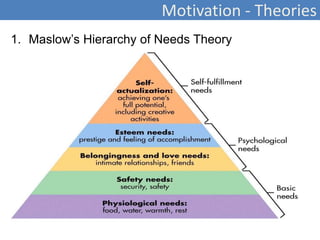
The best known theory of motivation is probably
Abraham Maslow’s hierarchy of needs theory.
A psychologist who proposed that within every
person is a hierarchy of five needs. It was widely
recognized during 1960 and 1970
Motivation - Theories
1. Maslow’s Hierarchy of Needs Theory
Motivation - Theories
1. Maslow’s Hierarchy of Needs Theory
1. Physiological Needs : A person’s needs for
food, water, shelter and other physical
requirements.
2. Safety Needs : A person’s need for security
and protection from physical and emotional
harm as well as assurance that physical needs
will continue to be met.
Motivation - Theories
1. Maslow’s Hierarchy of Needs Theory
3. Social Needs : A person’s needs for affection,
belongingness, acceptance and friendship.
4. Esteem Needs : A person’s need for internal
esteem factors such as self respect, autonomy
and achievement and external esteem factors
such as status, recognition and attention.
5. Self-actualization Needs : Needs for growth,
achieving one’s potential and self fulfillment
Motivation - Theories
2. McGregor’s Theory X and Theory Y
Douglas McGregor proposed two assumptions
about the human nature Theory X and Theory Y.
Theory X is a negative view of people which
assumes that workers have little ambition, dislike
work, want to avoid responsibilities and needs to
be closely controlled to work effectivelly.
Motivation - Theories
2. McGregor’s Theory X and Theory Y
Theory Y is a positive view which assumes that
employees enjoy work, seek out and accept
responsibility and exercise self-direction.
He believed that Theory Y assumptions should
guide management practice and proposed their
participation in decision making, responsible and
challenging jobs would maximize employee
motivation.
Motivation - Theories
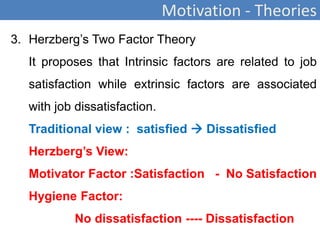
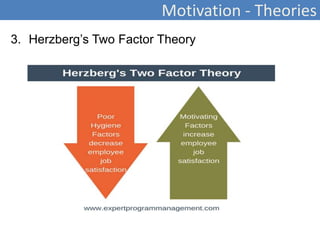
3. Herzberg’s Two Factor Theory
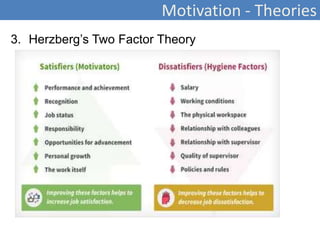
It proposes that Intrinsic factors are related to job
satisfaction while extrinsic factors are associated
with job dissatisfaction.
Traditional view : satisfied  Dissatisfied
Herzberg’s View:
Motivator Factor :Satisfaction - No Satisfaction
Hygiene Factor:
No dissatisfaction ---- Dissatisfaction
Motivation - Theories
3. Herzberg’s Two Factor Theory
Motivation - Theories
3. Herzberg’s Two Factor Theory
Motivation - Theories
3. McClelland’s Three Needs Theory
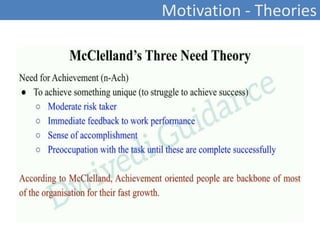
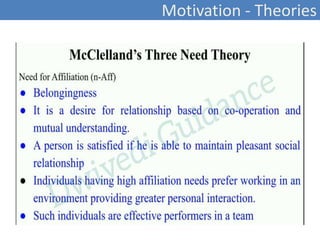
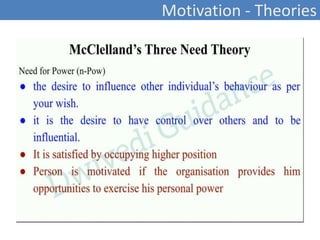
David McClelland and his associates proposed
the three needs theory, which says that there are
three acquired needs that are major motivation in
the work.
n-Ach : Need for achievment
n-Pow : Need for Power
n-Aff : Need for Affiliation
Motivation - Theories

Unit3Motivation.pptx

  • 1.
  • 2.
  • 3.
    Motivation - Introduction “Neil Lebovits, President of Ajilon, a staffing firm based in New Jersey, had some serious employee’s problems. Turnover was high, and morale was low. The severity of the situation hit home when he hosted a after work party and only 5 out of 50 employees bothered to show up. Lebovits wanted to improve employees spirit but like many other managers he didn’t have the resources to give big many raises.” What would you do ?
  • 4.
    Motivation - Introduction 1.He started in-house training programs on various topics in which employees had expressed interests. 2. He initiated monthly conferences with every employee to discuss management decision point by point. 3. He set up an email address, employees could use to propose ideas, and he responded to every one. 4. He gave employees three “YDOs” or “Your Days Off” a year with no questions asked. After implemented these changes, staff’s morale skyrocketed.
  • 5.
    Motivation - Introduction 1.Motivation refers to the process by which a person’s effort are energized, directed and sustained toward attaining a goal. 2. Motivation can be defined as incitement or inducement to fulfil an action. 3. Motivation is the process that initiates, guides, and maintains goal-oriented behaviors.
  • 6.
    Motivation - Introduction Motivationcauses you to act in a way that gets you closer to your goals. Motivation includes the biological, emotional, social, and cognitive forces that activate human behavior.
  • 7.
    Motivation - Introduction 1.Motivation refers to the process by which a person’s effort are energized, directed and sustained toward attaining a goal. The energy is the measure of intensity or drive. A motivated person put forth effort and works hard. However quality of the effort must be considered. High level of effort do not necessarily lead to favourable job performance unless the effort is channelled in right direction.
  • 8.
    Motivation - Introduction Effortthat is directed toward, and consistent with, organizational goals is a kind of effort we want from employee. Finally motivation includes a persistence dimension. We pant employees to persist in putting forth effort to achieve those goals.
  • 9.
    Motivation - Introduction Theconcept of motivation can be further classified into three important sub-concepts: 1. Motivators, 2. The motive 3. The actual act of motivation.
  • 10.
    Motivation - Introduction Motive Amotive initiates an action or certain behavior for the fulfillment of a specific goal, and this directly corresponds to the desire of an individual. Motivators These are the tools used for motivating employees, such as promotions and pay bonuses. Act of motivation is the actual process of completing a task and this usually depends on the motives and motivators.
  • 11.
    Motivation - Importance 1.Increases productivity Motivators like promotions create a drive for employees to work to the best of their capabilities. As such, motivation in an organization will lead to an increase in the productivity of an employee, who will contribute more compared to a disheartened employee.
  • 12.
    Motivation - Importance 2.Ensures organizational efficiency Motivators can also help in changing the work culture of an organization. With better rewards to look forward to, employees will be more dedicated to their work and more motivated to reach their targets. This can increase overall work efficiency and the attitude of an entire organization.
  • 13.
    Motivation - Importance 3.Promotes loyalty among the employees: Motivating your employees to do their best and rewarding their hard work can also be beneficial in igniting a sense of loyalty towards the company. A well-motivated workforce is loyal and has higher levels of morale, being more committed to the organization and its goals. Ensuring your staff are motivated can also reduce employee turnover and therefore the company costs of hiring new people.
  • 14.
    Motivation - Importance 4.Facilitates direction Direction is an important aspect of any business. It involves the creation and implementation of specific plans and strategies, contributing to the organization's main goals. A motivated workforce will be enthusiastic about helping to develop and innovate the company. They will also be more likely to suggest strategies or direction that can help the company expand
  • 15.
    Motivation - Importance 5.Ensures a proactive workforce: For any business to be successful, it requires its employees to adapt to dynamic changes in the work environment. You cannot take a financially prudential decision that could harm employee interests without them being completely committed to the company’s goals and visions. As such, motivation among employees reduces the resistance to difficult organizational decisions.
  • 16.
    Motivation - Types Thetwo main types of motivation are frequently described as being either extrinsic or intrinsic. Extrinsic motivation arises from outside of the individual and often involves external rewards such as trophies, money, social recognition, or praise. Intrinsic motivation is internal and arises from within the individual, such as doing a complicated crossword puzzle purely for the gratification of solving a problem.
  • 17.
    Motivation - Theories MotivationTheories 1. Maslow’s hierarchy of need theory 2. McGregor’s Theory X & Theory Y 3. Herzberg’s Two-factor theory 4. McClelland’s three Needs Theory
  • 18.
    Motivation - Theories 1.Maslow’s Hierarchy of Needs Theory The best known theory of motivation is probably Abraham Maslow’s hierarchy of needs theory. A psychologist who proposed that within every person is a hierarchy of five needs. It was widely recognized during 1960 and 1970
  • 19.
    Motivation - Theories 1.Maslow’s Hierarchy of Needs Theory
  • 20.
    Motivation - Theories 1.Maslow’s Hierarchy of Needs Theory 1. Physiological Needs : A person’s needs for food, water, shelter and other physical requirements. 2. Safety Needs : A person’s need for security and protection from physical and emotional harm as well as assurance that physical needs will continue to be met.
  • 21.
    Motivation - Theories 1.Maslow’s Hierarchy of Needs Theory 3. Social Needs : A person’s needs for affection, belongingness, acceptance and friendship. 4. Esteem Needs : A person’s need for internal esteem factors such as self respect, autonomy and achievement and external esteem factors such as status, recognition and attention. 5. Self-actualization Needs : Needs for growth, achieving one’s potential and self fulfillment
  • 22.
    Motivation - Theories 2.McGregor’s Theory X and Theory Y Douglas McGregor proposed two assumptions about the human nature Theory X and Theory Y. Theory X is a negative view of people which assumes that workers have little ambition, dislike work, want to avoid responsibilities and needs to be closely controlled to work effectivelly.
  • 23.
    Motivation - Theories 2.McGregor’s Theory X and Theory Y Theory Y is a positive view which assumes that employees enjoy work, seek out and accept responsibility and exercise self-direction. He believed that Theory Y assumptions should guide management practice and proposed their participation in decision making, responsible and challenging jobs would maximize employee motivation.
  • 24.
    Motivation - Theories 3.Herzberg’s Two Factor Theory It proposes that Intrinsic factors are related to job satisfaction while extrinsic factors are associated with job dissatisfaction. Traditional view : satisfied  Dissatisfied Herzberg’s View: Motivator Factor :Satisfaction - No Satisfaction Hygiene Factor: No dissatisfaction ---- Dissatisfaction
  • 25.
    Motivation - Theories 3.Herzberg’s Two Factor Theory
  • 26.
    Motivation - Theories 3.Herzberg’s Two Factor Theory
  • 27.
    Motivation - Theories 3.McClelland’s Three Needs Theory David McClelland and his associates proposed the three needs theory, which says that there are three acquired needs that are major motivation in the work. n-Ach : Need for achievment n-Pow : Need for Power n-Aff : Need for Affiliation
  • 28.
  • 29.
  • 30.