MOSFET
MOSFETs
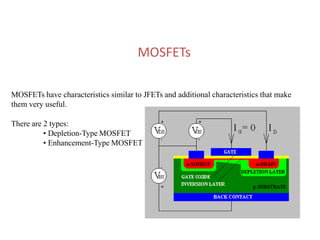
MOSFETs have characteristics similar to JFETs and additional characteristics that make
them very useful.
There are 2 types:
• Depletion-Type MOSFET
• Enhancement-Type MOSFET
Depletion-Type MOSFET Construction
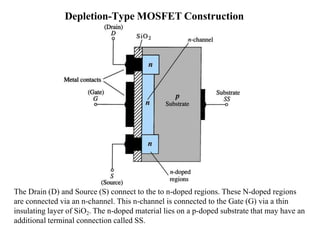
The Drain (D) and Source (S) connect to the to n-doped regions. These N-doped regions
are connected via an n-channel. This n-channel is connected to the Gate (G) via a thin
insulating layer of SiO2. The n-doped material lies on a p-doped substrate that may have an
additional terminal connection called SS.
Basic Operation
Basic Operation
ADepletion MOSFET can operate in two modes: Depletion or Enhancement mode.
•In this figure VGS has been set at a negative voltage such as 1 V. The negative potential at the gate will tend to
pressure electrons toward the p-type substrate (like charges repel) and attract holes from the p-type substrate
(opposite charges attract).
•Depending on the magnitude of the negative bias established by VGS, a level of recombination between electrons
and holes will occur that will reduce the number of free electrons in the n-channel available for conduction. The more
negative the bias, the higher the rate of recombination.
•The resulting level of drain current is therefore reduced with increasing negative bias for VGS for VGS =1 V, 2 V, and so
on, to the pinch-off level of 6 V. The resulting levels of drain current and the plotting of the transfer curve proceeds
exactly as described for the JFET.
Depletion-type MOSFET in Depletion Mode
VP
Depletion mode
The characteristics are similar to the JFET.
When VGS = 0V, ID = IDSS
When VGS < 0V, ID < IDSS
The formula used to plot the Transfer Curve still applies:
ID  IDSS(1
VGS
)2
Enhancement Mode
For positive values of VGS, the positive gate will draw additional electrons (free carriers)
from the p-type substrate due to the reverse leakage current and establish new carriers
through the collisions resulting between accelerating particles.
As the gate-to-source voltage continues to increase in the positive direction, the drain
current will increase at a rapid rate
The application of a positive gate-to-source voltage has “enhanced” the level of free
carriers in the channel compared to that encountered with VGS =0 V. For this reason the
region of positive gate voltages on the drain or transfer characteristics is often referred
to as the enhancement region,
The region between cutoff and the saturation level of IDSS referred to as the depletion
region.
Depletion-type MOSFET in Enhancement Mode
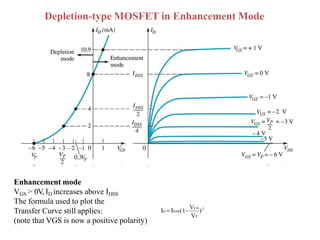
Enhancement mode
VGS > 0V, ID increases above IDSS
The formula used to plot the
Transfer Curve still applies:
(note that VGS is now a positive polarity)
VP
ID  IDSS(1
VGS
)2
Slide 26
p-Channel Depletion-Type MOSFET
The p-channel Depletion-type MOSFET is similar to the n-channel except that the voltage
polarities and current directions are reversed.
Symbols
Enhancement-Type MOSFET Construction
The Drain (D) and Source (S) connect to the to n-doped regions. These n-doped regions
are connected via an n-channel. The Gate (G) connects to the p-doped substrate via a thin
insulating layer of SiO2. There is no channel. The n-doped material lies on a p-doped
substrate that may have an additional terminal connection called SS.
Basic Operation and Characteristics
If VGS is set at 0 V and a voltage applied between the drain and source of the device, the
absence of an n-channel (with its generous number of free carriers) will result in a current
of effectively zero amperes—quite different from the depletion- type MOSFET and JFET
where ID = IDSS.
It is not sufficient to have a large accumulation of carriers (electrons) at the drain and
source (due to the n-doped regions) if a path fails to exist between the two.
If both VDS and VGS is set at some positive voltage greater than 0 V, then the positive
potential at the gate will pressure the holes (since like charges repel) in the p-substrate
along the edge of the SiO2 layer to leave the area and enter deeper regions of the p-
substrate.
However, the electrons in the p-substrate (the minority carriers of the material) will be
attracted to the positive gate and accumulate in the region near the surface of the SiO2
layer. The SiO2 layer and its insulating qualities will prevent the negative carriers from
being absorbed at the gate terminal.
Continued…
As VGS increases in magnitude, the concentration of electrons near the SiO2 surface increases until eventually the
induced n-type region can support a measurable flow between drain and source. The level of VGS that results in the
significant increase in drain current is called the threshold voltage and is given the symbol VT.
Since the channel is nonexistent with VGS=0 V and “enhanced” by the application of a positive gate-to-source
voltage, this type of MOSFET is called an enhancement-type MOSFET.
Continued…
•As VGS is increased beyond the threshold level, the density of free carriers in the
induced channel will increase, resulting in an increased level of drain current.
•However, if we hold VGS constant and increase the level of VDS, the drain current will
eventually reach a saturation level The levelling off of ID is due to a pinching-off
process depicted by the narrower channel at the drain end of the induced channel
•By applying KVL we get -
If VGS is held fixed at some value such as 8 V and VDS is increased from 2 to 5V, the
voltage will drop from -6 to -3 V. This reduction in gate-to-drain voltage will in turn
reduce the attractive forces for free carriers (electrons) in this region of the induced
channel, causing a reduction in the effective channel width.
Eventually, the channel will be reduced to the point of pinch-off and a saturation
condition will be established.
Continued…
The Enhancement-type MOSFET only operates in the enhancement mode.
Slide 30
Basic Operation
VGS is always positive
As VGS increases, ID increases
But if VGS is kept constant and VDS is increased, then ID saturates (IDSS)
The saturation level, VDSsat is reached.
VDsat VGS VT
Slide 31
Transfer Curve
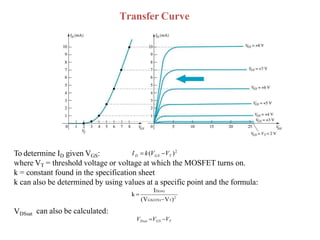
To determine ID given VGS:
where VT = threshold voltage or voltage at which the MOSFET turns on.
k = constant found in the specification sheet
k can also be determined by using values at a specific point and the formula:
VDSsat can also be calculated:
D GS T
V )2
I  k(V
(VGS(ON)VT)2
ID(on)
k 
VDsat VGS VT
The p-channel Enhancement-type MOSFET is similar to the n-channel except that the
voltage polarities and current directions are reversed.
Slide 32
p-Channel Enhancement-Type MOSFETs
Symbols
MOSFET Handling
MOSFETs are very static sensitive. Because of the very thin SiO2 layer between the
external terminals and the layers of the device, any small electrical discharge can stablish
an unwanted conduction.
Protection:
• Always transport in a static sensitive bag
• Always wear a static strap when handling MOSFETS
• Apply voltage limiting devices between the Gate and Source, such as back-to-
back Zeners to limit any transient voltage.
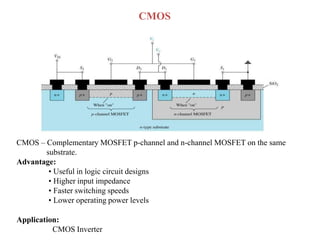
CMOS – Complementary MOSFET p-channel and n-channel MOSFET on the same
substrate.
Advantage:
• Useful in logic circuit designs
• Higher input impedance
• Faster switching speeds
• Lower operating power levels
Application:
CMOS Inverter
CMOS
CMOS Inverter
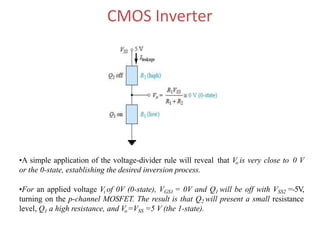
•An inverter is a logic element that “inverts” the applied signal. That is, if the logic levels of operation
are 0V (0-state) and 5V (1-state), an input level of 0V will result in an output level of 5V, and vice
versa.
•Here, both gates are connected to the applied signal and both drain to the output Vo. The source of the p-
channel MOSFET (Q2) is connected directly to the applied voltage VSS, while the source of the n-
channel MOSFET (Q1) is connected to ground.
•Here, the application of 5V at the input should result in approximately 0 V at the output. With 5V at
Vi (with respect to ground), VGS1 = Vi and Q1 is “on,” resulting in a relatively low resistance between
drain and source
•Since Viand VSS are at 5 V, VGS2 = 0 V, which is less than the required VT for the device, resulting in an
“off” state. The resulting resistance level between drain and source is quite high for Q2
CMOS Inverter
•A simple application of the voltage-divider rule will reveal that Vo is very close to 0 V
or the 0-state, establishing the desired inversion process.
•For an applied voltage Vi of 0V (0-state), VGS1 = 0V and Q1 will be off with VSS2 =-5V,
turning on the p-channel MOSFET. The result is that Q2 will present a small resistance
level, Q1 a high resistance, and Vo=VSS =5 V (the 1-state).
Summary Table

mosfet ppt.pptx

  • 1.
  • 2.
    MOSFETs MOSFETs have characteristicssimilar to JFETs and additional characteristics that make them very useful. There are 2 types: • Depletion-Type MOSFET • Enhancement-Type MOSFET
  • 3.
    Depletion-Type MOSFET Construction TheDrain (D) and Source (S) connect to the to n-doped regions. These N-doped regions are connected via an n-channel. This n-channel is connected to the Gate (G) via a thin insulating layer of SiO2. The n-doped material lies on a p-doped substrate that may have an additional terminal connection called SS.
  • 4.
  • 5.
    Basic Operation ADepletion MOSFETcan operate in two modes: Depletion or Enhancement mode.
  • 6.
    •In this figureVGS has been set at a negative voltage such as 1 V. The negative potential at the gate will tend to pressure electrons toward the p-type substrate (like charges repel) and attract holes from the p-type substrate (opposite charges attract). •Depending on the magnitude of the negative bias established by VGS, a level of recombination between electrons and holes will occur that will reduce the number of free electrons in the n-channel available for conduction. The more negative the bias, the higher the rate of recombination. •The resulting level of drain current is therefore reduced with increasing negative bias for VGS for VGS =1 V, 2 V, and so on, to the pinch-off level of 6 V. The resulting levels of drain current and the plotting of the transfer curve proceeds exactly as described for the JFET.
  • 7.
    Depletion-type MOSFET inDepletion Mode VP Depletion mode The characteristics are similar to the JFET. When VGS = 0V, ID = IDSS When VGS < 0V, ID < IDSS The formula used to plot the Transfer Curve still applies: ID  IDSS(1 VGS )2
  • 8.
    Enhancement Mode For positivevalues of VGS, the positive gate will draw additional electrons (free carriers) from the p-type substrate due to the reverse leakage current and establish new carriers through the collisions resulting between accelerating particles. As the gate-to-source voltage continues to increase in the positive direction, the drain current will increase at a rapid rate The application of a positive gate-to-source voltage has “enhanced” the level of free carriers in the channel compared to that encountered with VGS =0 V. For this reason the region of positive gate voltages on the drain or transfer characteristics is often referred to as the enhancement region, The region between cutoff and the saturation level of IDSS referred to as the depletion region.
  • 9.
    Depletion-type MOSFET inEnhancement Mode Enhancement mode VGS > 0V, ID increases above IDSS The formula used to plot the Transfer Curve still applies: (note that VGS is now a positive polarity) VP ID  IDSS(1 VGS )2
  • 10.
    Slide 26 p-Channel Depletion-TypeMOSFET The p-channel Depletion-type MOSFET is similar to the n-channel except that the voltage polarities and current directions are reversed.
  • 11.
  • 12.
    Enhancement-Type MOSFET Construction TheDrain (D) and Source (S) connect to the to n-doped regions. These n-doped regions are connected via an n-channel. The Gate (G) connects to the p-doped substrate via a thin insulating layer of SiO2. There is no channel. The n-doped material lies on a p-doped substrate that may have an additional terminal connection called SS.
  • 13.
    Basic Operation andCharacteristics If VGS is set at 0 V and a voltage applied between the drain and source of the device, the absence of an n-channel (with its generous number of free carriers) will result in a current of effectively zero amperes—quite different from the depletion- type MOSFET and JFET where ID = IDSS. It is not sufficient to have a large accumulation of carriers (electrons) at the drain and source (due to the n-doped regions) if a path fails to exist between the two. If both VDS and VGS is set at some positive voltage greater than 0 V, then the positive potential at the gate will pressure the holes (since like charges repel) in the p-substrate along the edge of the SiO2 layer to leave the area and enter deeper regions of the p- substrate. However, the electrons in the p-substrate (the minority carriers of the material) will be attracted to the positive gate and accumulate in the region near the surface of the SiO2 layer. The SiO2 layer and its insulating qualities will prevent the negative carriers from being absorbed at the gate terminal.
  • 14.
    Continued… As VGS increasesin magnitude, the concentration of electrons near the SiO2 surface increases until eventually the induced n-type region can support a measurable flow between drain and source. The level of VGS that results in the significant increase in drain current is called the threshold voltage and is given the symbol VT. Since the channel is nonexistent with VGS=0 V and “enhanced” by the application of a positive gate-to-source voltage, this type of MOSFET is called an enhancement-type MOSFET.
  • 15.
    Continued… •As VGS isincreased beyond the threshold level, the density of free carriers in the induced channel will increase, resulting in an increased level of drain current. •However, if we hold VGS constant and increase the level of VDS, the drain current will eventually reach a saturation level The levelling off of ID is due to a pinching-off process depicted by the narrower channel at the drain end of the induced channel •By applying KVL we get - If VGS is held fixed at some value such as 8 V and VDS is increased from 2 to 5V, the voltage will drop from -6 to -3 V. This reduction in gate-to-drain voltage will in turn reduce the attractive forces for free carriers (electrons) in this region of the induced channel, causing a reduction in the effective channel width. Eventually, the channel will be reduced to the point of pinch-off and a saturation condition will be established.
  • 16.
  • 17.
    The Enhancement-type MOSFETonly operates in the enhancement mode. Slide 30 Basic Operation VGS is always positive As VGS increases, ID increases But if VGS is kept constant and VDS is increased, then ID saturates (IDSS) The saturation level, VDSsat is reached. VDsat VGS VT
  • 18.
    Slide 31 Transfer Curve Todetermine ID given VGS: where VT = threshold voltage or voltage at which the MOSFET turns on. k = constant found in the specification sheet k can also be determined by using values at a specific point and the formula: VDSsat can also be calculated: D GS T V )2 I  k(V (VGS(ON)VT)2 ID(on) k  VDsat VGS VT
  • 19.
    The p-channel Enhancement-typeMOSFET is similar to the n-channel except that the voltage polarities and current directions are reversed. Slide 32 p-Channel Enhancement-Type MOSFETs
  • 20.
  • 21.
    MOSFET Handling MOSFETs arevery static sensitive. Because of the very thin SiO2 layer between the external terminals and the layers of the device, any small electrical discharge can stablish an unwanted conduction. Protection: • Always transport in a static sensitive bag • Always wear a static strap when handling MOSFETS • Apply voltage limiting devices between the Gate and Source, such as back-to- back Zeners to limit any transient voltage.
  • 22.
    CMOS – ComplementaryMOSFET p-channel and n-channel MOSFET on the same substrate. Advantage: • Useful in logic circuit designs • Higher input impedance • Faster switching speeds • Lower operating power levels Application: CMOS Inverter CMOS
  • 23.
    CMOS Inverter •An inverteris a logic element that “inverts” the applied signal. That is, if the logic levels of operation are 0V (0-state) and 5V (1-state), an input level of 0V will result in an output level of 5V, and vice versa. •Here, both gates are connected to the applied signal and both drain to the output Vo. The source of the p- channel MOSFET (Q2) is connected directly to the applied voltage VSS, while the source of the n- channel MOSFET (Q1) is connected to ground. •Here, the application of 5V at the input should result in approximately 0 V at the output. With 5V at Vi (with respect to ground), VGS1 = Vi and Q1 is “on,” resulting in a relatively low resistance between drain and source •Since Viand VSS are at 5 V, VGS2 = 0 V, which is less than the required VT for the device, resulting in an “off” state. The resulting resistance level between drain and source is quite high for Q2
  • 24.
    CMOS Inverter •A simpleapplication of the voltage-divider rule will reveal that Vo is very close to 0 V or the 0-state, establishing the desired inversion process. •For an applied voltage Vi of 0V (0-state), VGS1 = 0V and Q1 will be off with VSS2 =-5V, turning on the p-channel MOSFET. The result is that Q2 will present a small resistance level, Q1 a high resistance, and Vo=VSS =5 V (the 1-state).
  • 25.