An Efficient Edge Preserving Algorithm To
Remove Impulse Noise For IOT Applications
PRESENTED BY:
M.Sindhu
M.Maddulety Yadav
B.Ankith Raj
S.Jagadeeswar Reddy
Under the Esteemed Guidance of:
DR VASUDEVA BEVARA
(ASST PROFFESOR )
CONTENTS
• ABSTRACT
• INTRODUCTION
• LITERATURE SURVEY
• EXISTING METHODS
• OBJECTIVE
• PROPOSED SYSTEM
• FUTURE SCOPE
• CONCLUSION
ABSTRACT
• An efficient denoising scheme and its VLSI
architecture for the removal of random valued
impulse noise
• A decision tree based impulse noise detector to
detect the noise pixels
• Edge preserving filters to reconstruct the intensity
values of noisy pixels
INTRODUCTION
NOISE IN IMAGE
• It is a random variation in the image signal.
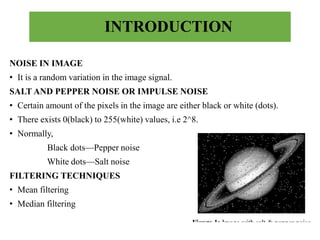
SALT AND PEPPER NOISE OR IMPULSE NOISE
• Certain amount of the pixels in the image are either black or white (dots).
• There exists 0(black) to 255(white) values, i.e 2^8.
• Normally,
Black dots—Pepper noise
White dots—Salt noise
FILTERING TECHNIQUES
• Mean filtering
• Median filtering
 Data Quality and Reliability
 Accurate Decision Making
 Efficient Resource Utilization
 Reduced False Alarms
 Long-Term Data Analysis
 Data Fusion and Integration
Impulse noise removal algorithms are important in
Internet of Things (IoT) applications for several reasons:
OBJECTIVE
• To effectively reduce impulse noise and to get
a better reconstructed image as output, so that
its suitable for many real-time IOT applications.
• Decision tree-based methods aim to identify
and correct pixel values that have been
corrupted by impulse noise , while preserving
the overall structure of image.
LITERATURE SURVEY
• Many researchers have worked on impulse noise removal
techniques, like- median filter, ACWN, LCNR, RORD, DRID
etc….
• Median filter removes the impulse noise keeping edges of the
images unaffected.
• ACWM filter works on switching method. A difference
between output of centre weighted median filter and the current
pixel is calculated. With this calculation a more general
operator that depends upon impulse detection is estimated.
• LCNR is implemented with two steps, noise detector and
filtering. It detects random valued noisy pixels and applies
median filter only for noisy pixels.
• RORD improves the impulse noise detection accuracy by using
a reference image. Then we introduce a simple weighted mean
filter to suppress the impulse noise while preserving image
details.
EXISITING METHODS
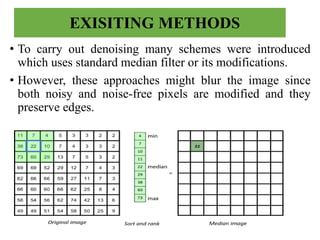
• To carry out denoising many schemes were introduced
which uses standard median filter or its modifications.
• However, these approaches might blur the image since
both noisy and noise-free pixels are modified and they
preserve edges.
PROPOSED SYSTEM
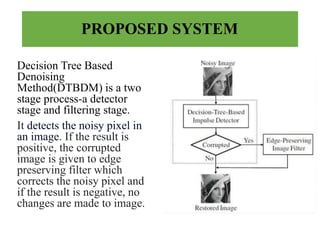
Decision Tree Based
Denoising
Method(DTBDM) is a two
stage process-a detector
stage and filtering stage.
It detects the noisy pixel in
an image. If the result is
positive, the corrupted
image is given to edge
preserving filter which
corrects the noisy pixel and
if the result is negative, no
changes are made to image.
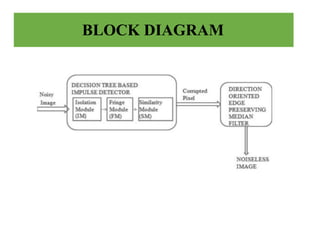
BLOCK DIAGRAM
DECISION TREE BASED IMPULSE
DETECTOR
ISOLATION MODULE
• If the distribution of pixel values are slightly different in a region then it may be
noisy pixel. By observing the smoothness of the region we can determine
whether the pixel value is isolated from its neighboring pixel values.
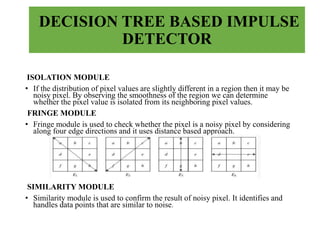
FRINGE MODULE
• Fringe module is used to check whether the pixel is a noisy pixel by considering
along four edge directions and it uses distance based approach.
SIMILARITY MODULE
• Similarity module is used to confirm the result of noisy pixel. It identifies and
handles data points that are similar to noise.
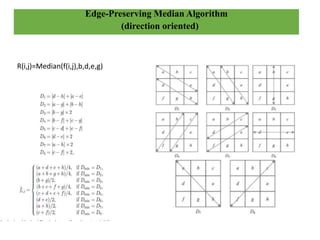
Edge-Preserving Median Algorithm
(direction oriented)
R(i,j)=Median(f(i,j),b,d,e,g)
FUTURE SCOPE
DTBDM technique can be further used in future for video
processing in televisions, mobiles, computers, gaming with
high graphics etc.
CONCLUSION
An efficient denoising scheme Decision Tree Based DeNoising Method
(DBTM) is used to avoid the damage on noise free pixels and also for the
removal of high density impulse noise
denoising.pptx

denoising.pptx

  • 1.
    An Efficient EdgePreserving Algorithm To Remove Impulse Noise For IOT Applications PRESENTED BY: M.Sindhu M.Maddulety Yadav B.Ankith Raj S.Jagadeeswar Reddy Under the Esteemed Guidance of: DR VASUDEVA BEVARA (ASST PROFFESOR )
  • 2.
    CONTENTS • ABSTRACT • INTRODUCTION •LITERATURE SURVEY • EXISTING METHODS • OBJECTIVE • PROPOSED SYSTEM • FUTURE SCOPE • CONCLUSION
  • 3.
    ABSTRACT • An efficientdenoising scheme and its VLSI architecture for the removal of random valued impulse noise • A decision tree based impulse noise detector to detect the noise pixels • Edge preserving filters to reconstruct the intensity values of noisy pixels
  • 4.
    INTRODUCTION NOISE IN IMAGE •It is a random variation in the image signal. SALT AND PEPPER NOISE OR IMPULSE NOISE • Certain amount of the pixels in the image are either black or white (dots). • There exists 0(black) to 255(white) values, i.e 2^8. • Normally, Black dots—Pepper noise White dots—Salt noise FILTERING TECHNIQUES • Mean filtering • Median filtering
  • 5.
     Data Qualityand Reliability  Accurate Decision Making  Efficient Resource Utilization  Reduced False Alarms  Long-Term Data Analysis  Data Fusion and Integration Impulse noise removal algorithms are important in Internet of Things (IoT) applications for several reasons:
  • 6.
    OBJECTIVE • To effectivelyreduce impulse noise and to get a better reconstructed image as output, so that its suitable for many real-time IOT applications. • Decision tree-based methods aim to identify and correct pixel values that have been corrupted by impulse noise , while preserving the overall structure of image.
  • 7.
    LITERATURE SURVEY • Manyresearchers have worked on impulse noise removal techniques, like- median filter, ACWN, LCNR, RORD, DRID etc…. • Median filter removes the impulse noise keeping edges of the images unaffected. • ACWM filter works on switching method. A difference between output of centre weighted median filter and the current pixel is calculated. With this calculation a more general operator that depends upon impulse detection is estimated. • LCNR is implemented with two steps, noise detector and filtering. It detects random valued noisy pixels and applies median filter only for noisy pixels. • RORD improves the impulse noise detection accuracy by using a reference image. Then we introduce a simple weighted mean filter to suppress the impulse noise while preserving image details.
  • 8.
    EXISITING METHODS • Tocarry out denoising many schemes were introduced which uses standard median filter or its modifications. • However, these approaches might blur the image since both noisy and noise-free pixels are modified and they preserve edges.
  • 9.
    PROPOSED SYSTEM Decision TreeBased Denoising Method(DTBDM) is a two stage process-a detector stage and filtering stage. It detects the noisy pixel in an image. If the result is positive, the corrupted image is given to edge preserving filter which corrects the noisy pixel and if the result is negative, no changes are made to image.
  • 10.
  • 11.
    DECISION TREE BASEDIMPULSE DETECTOR ISOLATION MODULE • If the distribution of pixel values are slightly different in a region then it may be noisy pixel. By observing the smoothness of the region we can determine whether the pixel value is isolated from its neighboring pixel values. FRINGE MODULE • Fringe module is used to check whether the pixel is a noisy pixel by considering along four edge directions and it uses distance based approach. SIMILARITY MODULE • Similarity module is used to confirm the result of noisy pixel. It identifies and handles data points that are similar to noise.
  • 12.
    Edge-Preserving Median Algorithm (directionoriented) R(i,j)=Median(f(i,j),b,d,e,g)
  • 13.
    FUTURE SCOPE DTBDM techniquecan be further used in future for video processing in televisions, mobiles, computers, gaming with high graphics etc.
  • 14.
    CONCLUSION An efficient denoisingscheme Decision Tree Based DeNoising Method (DBTM) is used to avoid the damage on noise free pixels and also for the removal of high density impulse noise