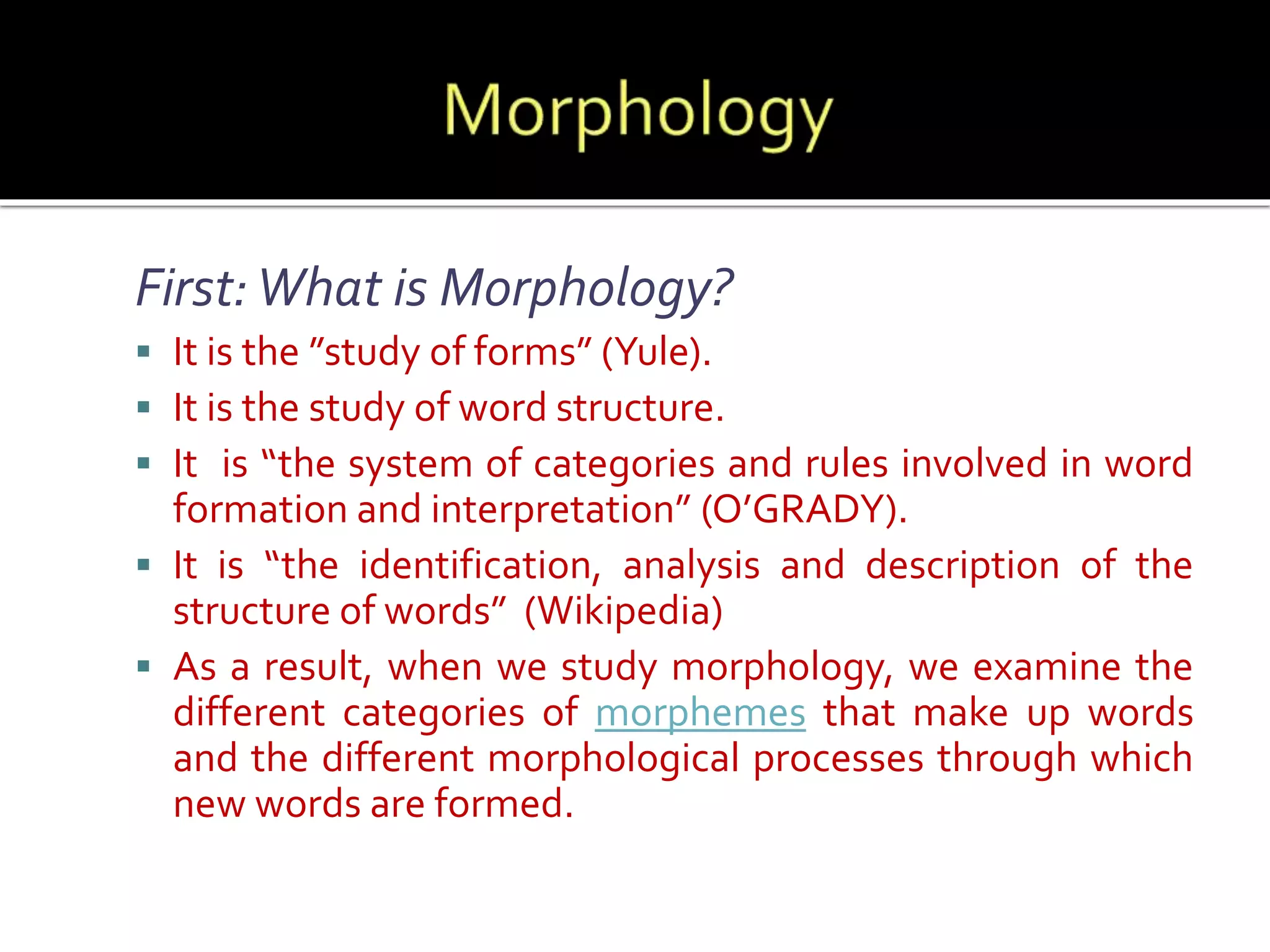
First: What is Morphology? 
 It is the ”study of forms” (Yule). 
 It is the study of word structure. 
 It is “the system of categories and rules involved in word 
formation and interpretation” (O’GRADY). 
 It is “the identification, analysis and description of the 
structure of words” (Wikipedia) 
 As a result, when we study morphology, we examine the 
different categories of morphemes that make up words 
and the different morphological processes through which 
new words are formed.
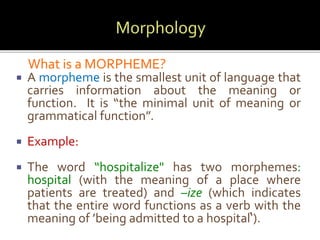
What is a MORPHEME? 
 A morpheme is the smallest unit of language that 
carries information about the meaning or 
function. It is “the minimal unit of meaning or 
grammatical function”. 
 Example: 
 The word “hospitalize" has two morphemes: 
hospital (with the meaning of a place where 
patients are treated) and –ize (which indicates 
that the entire word functions as a verb with the 
meaning of ’being admitted to a hospital‘).
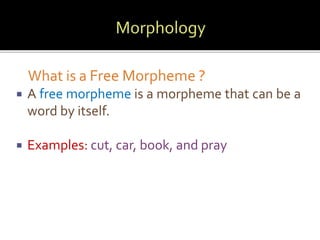
What is a Free Morpheme ? 
 A free morpheme is a morpheme that can be a 
word by itself. 
 Examples: cut, car, book, and pray
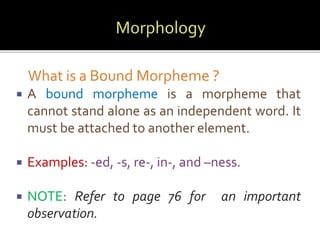
What is a Bound Morpheme ? 
 A bound morpheme is a morpheme that 
cannot stand alone as an independent word. It 
must be attached to another element. 
 Examples: -ed, -s, re-, in-, and –ness. 
 NOTE: Refer to page 76 for an important 
observation.
What is a Lexical Morpheme ? 
 Words that have meaning by themselves—boy, 
food, door—are called lexical morphemes.
What is a Functional Morpheme ? 
 words that function to specify the relationship 
between one lexical morpheme and another— 
words like at, in, on, -ed, -s—are called 
functional morphemes. 
NOTE: Sometimes functional morphemes are 
referred to as grammatical morphemes.
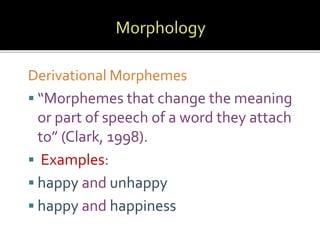
Derivational Morphemes 
 “Morphemes that change the meaning 
or part of speech of a word they attach 
to” (Clark, 1998). 
 Examples: 
 happy and unhappy 
 happy and happiness
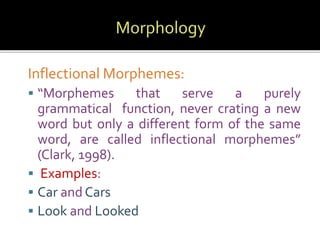
Inflectional Morphemes: 
 “Morphemes that serve a purely 
grammatical function, never crating a new 
word but only a different form of the same 
word, are called inflectional morphemes” 
(Clark, 1998). 
 Examples: 
 Car and Cars 
 Look and Looked
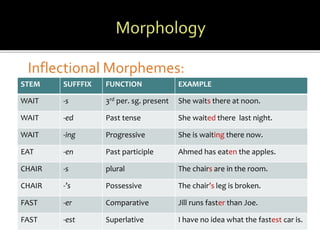
Inflectional Morphemes: 
STEM SUFFFIX FUNCTION EXAMPLE 
WAIT -s 3rd per. sg. present She waits there at noon. 
WAIT -ed Past tense She waited there last night. 
WAIT -ing Progressive She is waiting there now. 
EAT -en Past participle Ahmed has eaten the apples. 
CHAIR -s plural The chairs are in the room. 
CHAIR -’s Possessive The chair’s leg is broken. 
FAST -er Comparative Jill runs faster than Joe. 
FAST -est Superlative I have no idea what the fastest car is.
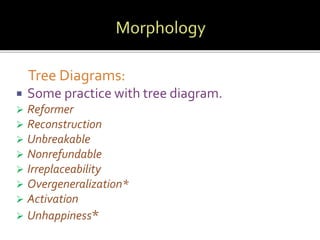
Tree Diagrams: 
 Some practice with tree diagram. 
 Reformer 
 Reconstruction 
 Unbreakable 
 Nonrefundable 
 Irreplaceability 
 Overgeneralization* 
 Activation 
 Unhappiness*
If you are asking about my web site, then here 
it is 
http://faculty.ksu.edu.sa/aabanomey/default.aspx

Morphology

  • 1.
    First: What isMorphology?  It is the ”study of forms” (Yule).  It is the study of word structure.  It is “the system of categories and rules involved in word formation and interpretation” (O’GRADY).  It is “the identification, analysis and description of the structure of words” (Wikipedia)  As a result, when we study morphology, we examine the different categories of morphemes that make up words and the different morphological processes through which new words are formed.
  • 2.
    What is aMORPHEME?  A morpheme is the smallest unit of language that carries information about the meaning or function. It is “the minimal unit of meaning or grammatical function”.  Example:  The word “hospitalize" has two morphemes: hospital (with the meaning of a place where patients are treated) and –ize (which indicates that the entire word functions as a verb with the meaning of ’being admitted to a hospital‘).
  • 3.
    What is aFree Morpheme ?  A free morpheme is a morpheme that can be a word by itself.  Examples: cut, car, book, and pray
  • 4.
    What is aBound Morpheme ?  A bound morpheme is a morpheme that cannot stand alone as an independent word. It must be attached to another element.  Examples: -ed, -s, re-, in-, and –ness.  NOTE: Refer to page 76 for an important observation.
  • 5.
    What is aLexical Morpheme ?  Words that have meaning by themselves—boy, food, door—are called lexical morphemes.
  • 6.
    What is aFunctional Morpheme ?  words that function to specify the relationship between one lexical morpheme and another— words like at, in, on, -ed, -s—are called functional morphemes. NOTE: Sometimes functional morphemes are referred to as grammatical morphemes.
  • 7.
    Derivational Morphemes “Morphemes that change the meaning or part of speech of a word they attach to” (Clark, 1998).  Examples:  happy and unhappy  happy and happiness
  • 8.
    Inflectional Morphemes: “Morphemes that serve a purely grammatical function, never crating a new word but only a different form of the same word, are called inflectional morphemes” (Clark, 1998).  Examples:  Car and Cars  Look and Looked
  • 9.
    Inflectional Morphemes: STEMSUFFFIX FUNCTION EXAMPLE WAIT -s 3rd per. sg. present She waits there at noon. WAIT -ed Past tense She waited there last night. WAIT -ing Progressive She is waiting there now. EAT -en Past participle Ahmed has eaten the apples. CHAIR -s plural The chairs are in the room. CHAIR -’s Possessive The chair’s leg is broken. FAST -er Comparative Jill runs faster than Joe. FAST -est Superlative I have no idea what the fastest car is.
  • 10.
    Tree Diagrams: Some practice with tree diagram.  Reformer  Reconstruction  Unbreakable  Nonrefundable  Irreplaceability  Overgeneralization*  Activation  Unhappiness*
  • 11.
    If you areasking about my web site, then here it is http://faculty.ksu.edu.sa/aabanomey/default.aspx

Editor's Notes

  • #2 A word is ........ Morphemes
  • #3 A word is ........ Morphemes
  • #4 A word is ........ Morphemes
  • #5 A word is ........ Morphemes
  • #6 A word is ........ Morphemes
  • #7 A word is ........ Morphemes
  • #8 A word is ........ Morphemes
  • #9 A word is ........ Morphemes
  • #10 A word is ........ Morphemes
  • #11 A word is ........ Morphemes