

In the name of Allah, the most Beneficent, the most Merciful.
Syntactic Relations
Presented to: Miss Madeeha Khan
Presented by: Asif Ali Raza
asifalirazzza@yahoo.com
+92-300-4626234
Points to be discussed
 What are Syntactic Relations?
 What is Tree Diagram?
 Basic Terms regarding Tree Diagram
 Constituent Command or C-Command
 C-Command condition on binding
What are Syntactic Relations?
 In linguistics, syntactic relations (= grammatical
functions, grammatical roles, syntactic functions,
grammatical relations) refer to functional
relationships between constituents in a clause or
phrase.
 Relation between the constituents of various
types of phrases or sentences is called Syntactic
Relations.
What is Tree Diagram?
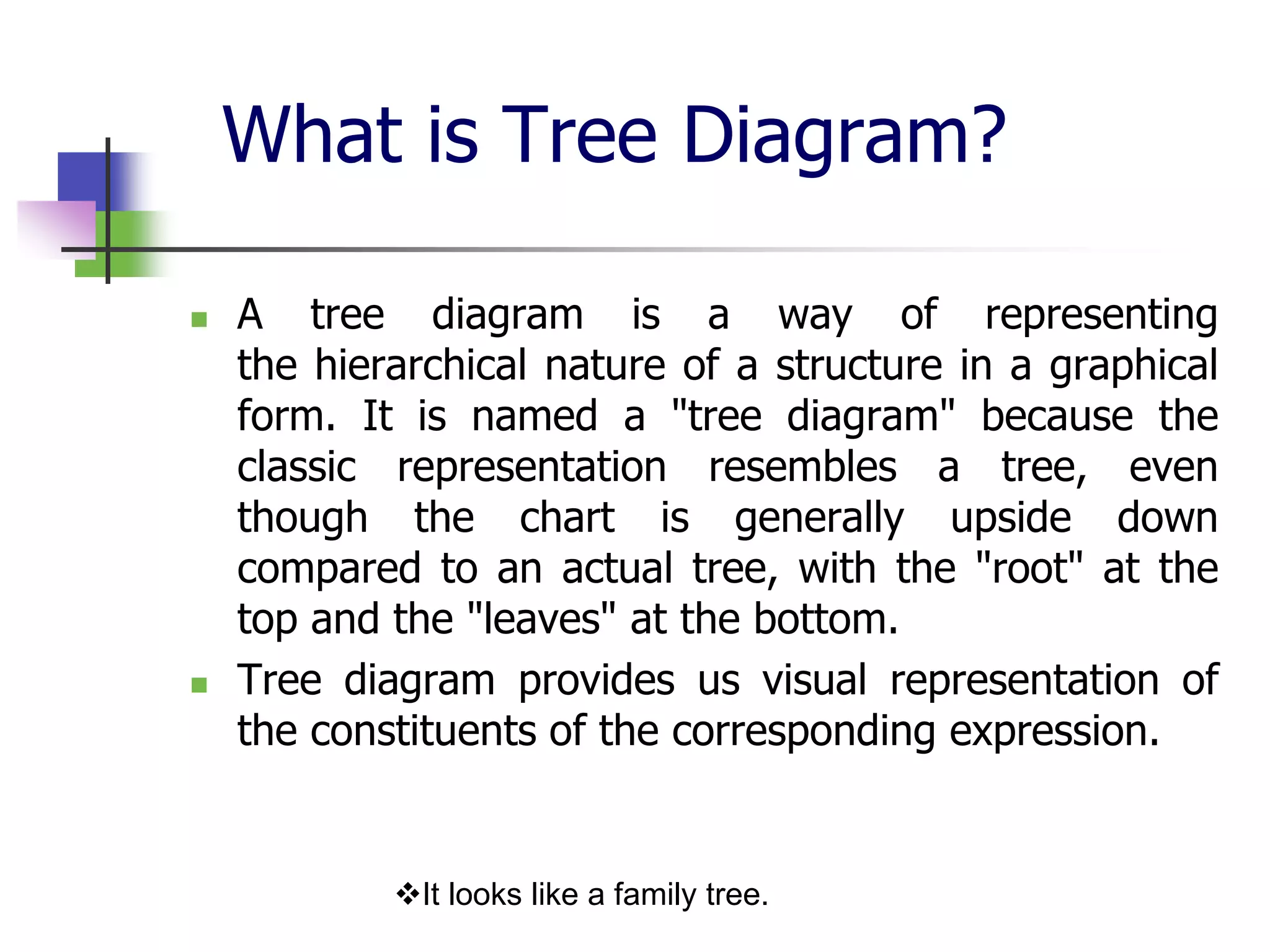
 A tree diagram is a way of representing
the hierarchical nature of a structure in a graphical
form. It is named a "tree diagram" because the
classic representation resembles a tree, even
though the chart is generally upside down
compared to an actual tree, with the "root" at the
top and the "leaves" at the bottom.
 Tree diagram provides us visual representation of
the constituents of the corresponding expression.
It looks like a family tree.
What is Tree Diagram?
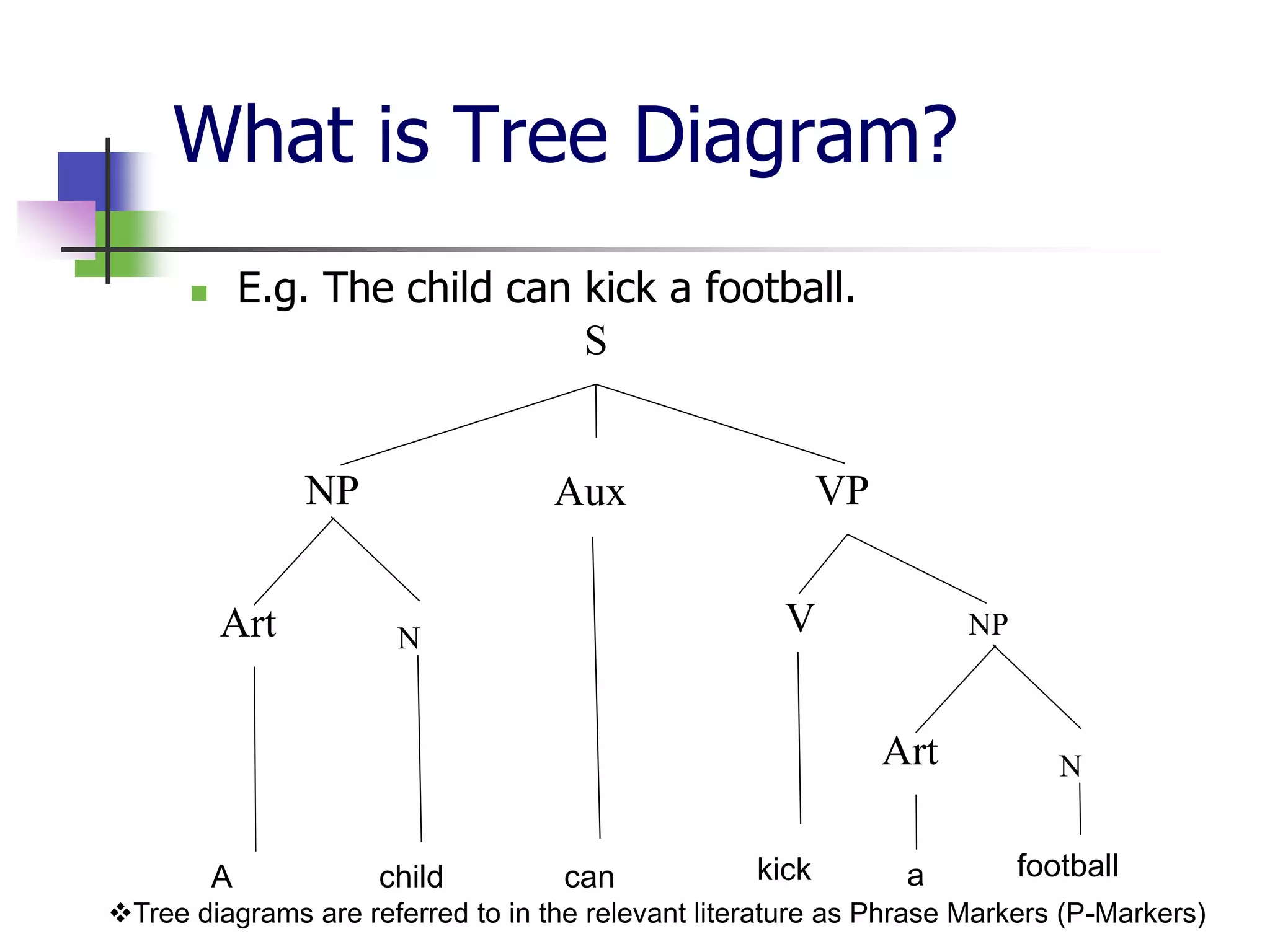
 E.g. The child can kick a football.
Tree diagrams are referred to in the relevant literature as Phrase Markers (P-Markers)
A child can kick footballa
S
NP Aux VP
N
V NPArt
NArt
What is Tree Diagram?
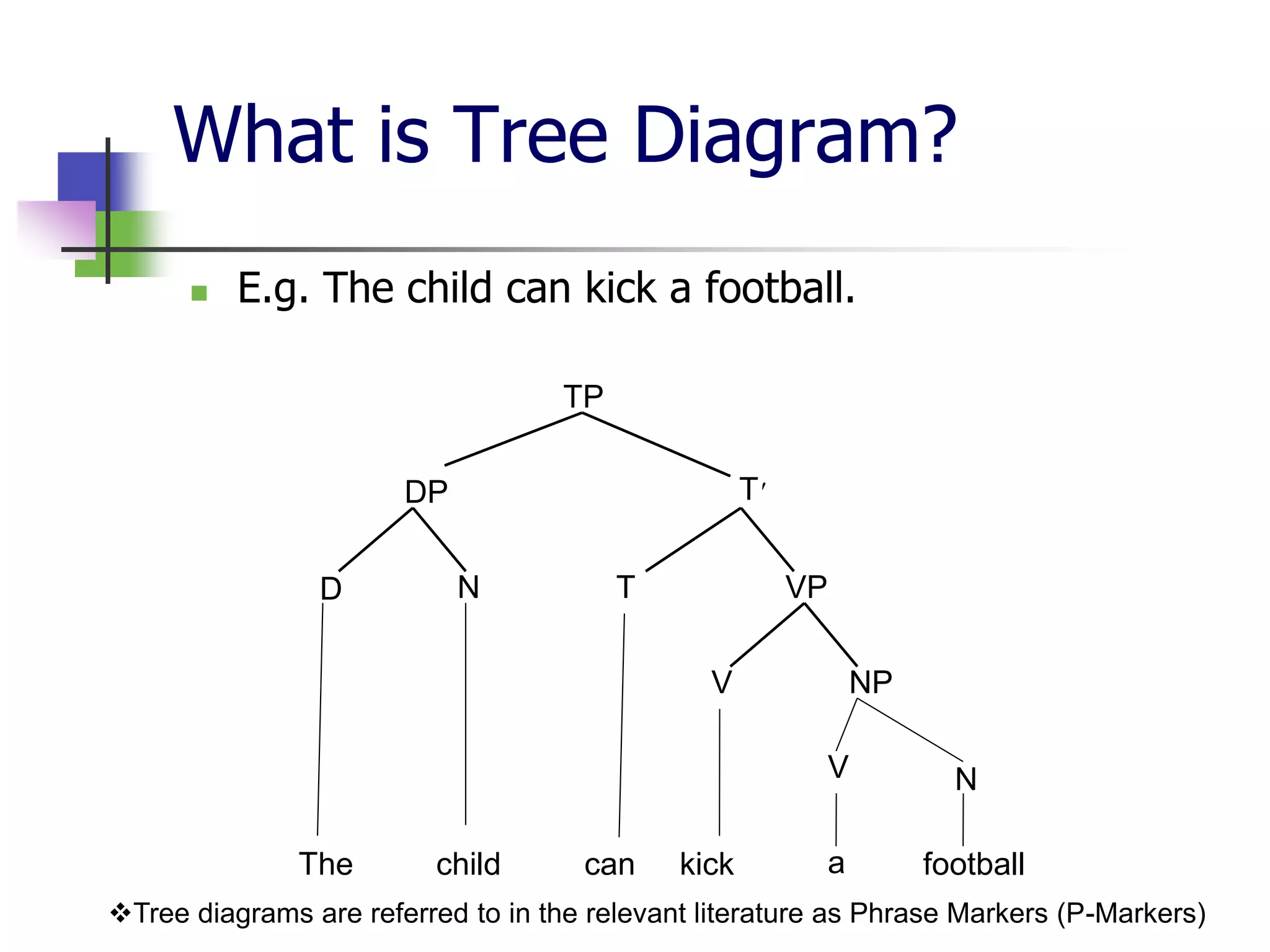
 E.g. The child can kick a football.
TP
DP T'
D N T VP
V NP
The child can kick football
Tree diagrams are referred to in the relevant literature as Phrase Markers (P-Markers)
NV
a
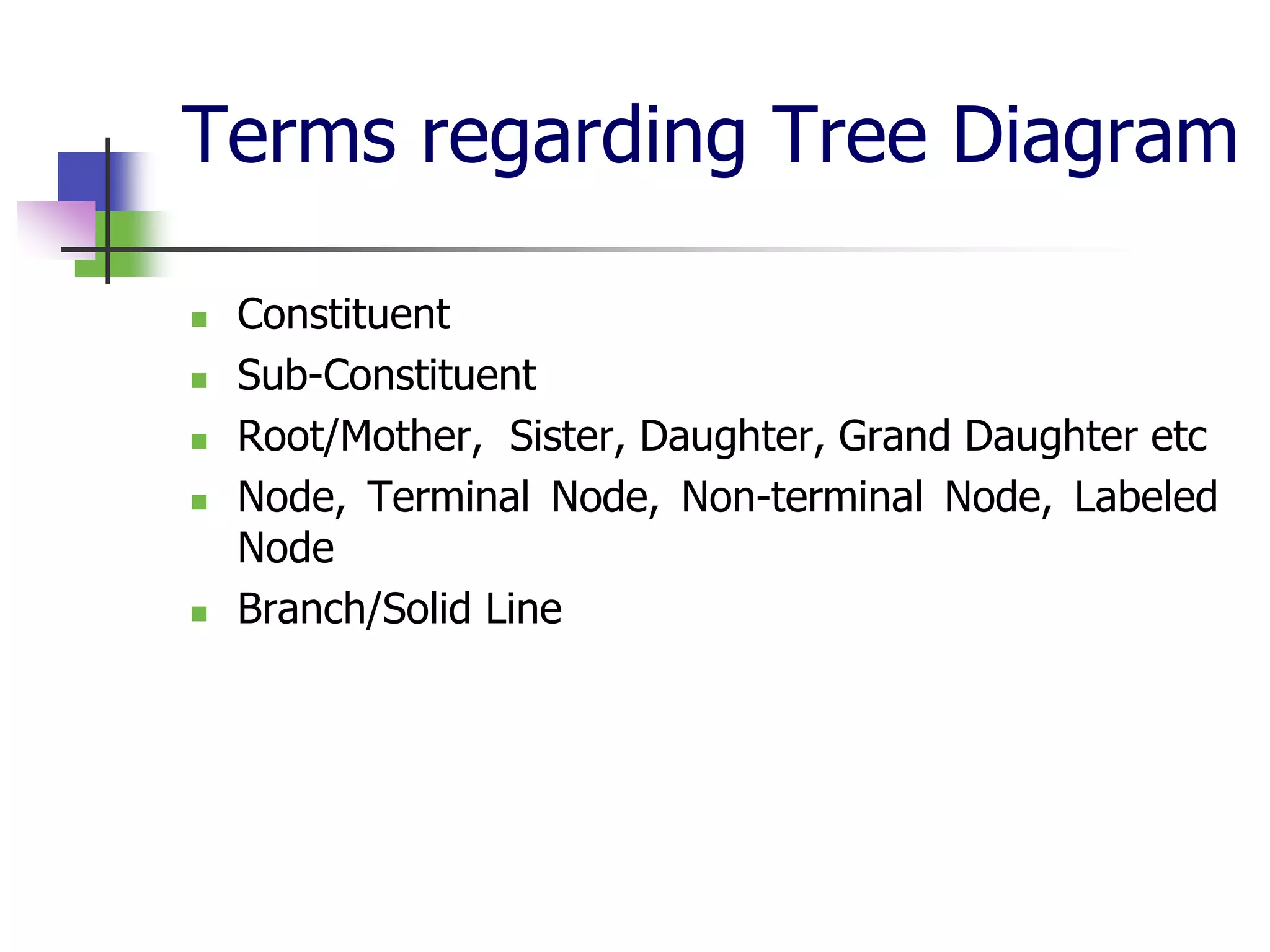
Terms regarding Tree Diagram
 Constituent
 Sub-Constituent
 Root/Mother, Sister, Daughter, Grand Daughter etc
 Node, Terminal Node, Non-terminal Node, Labeled
Node
 Branch/Solid Line
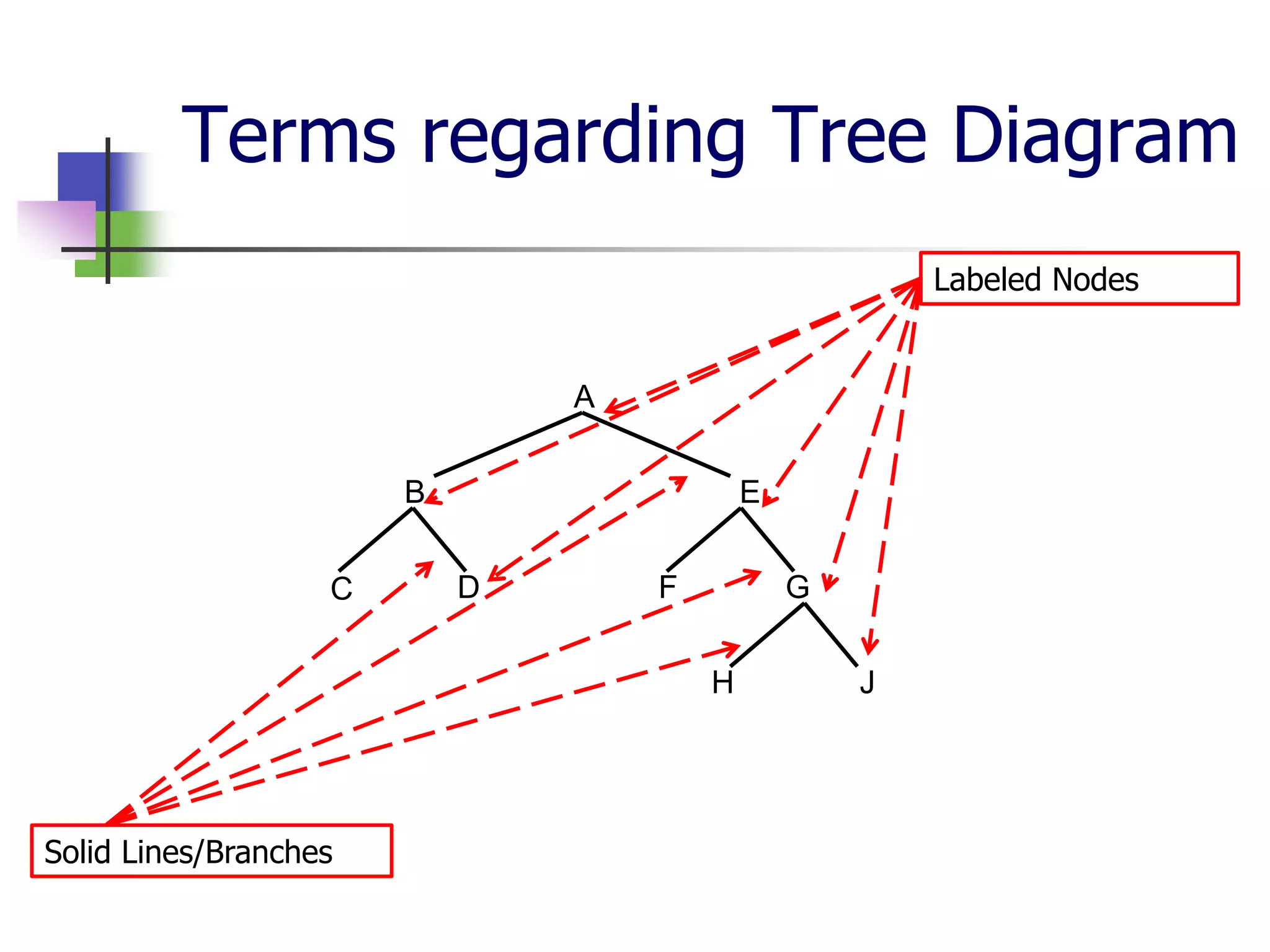
Terms regarding Tree Diagram
A
B E
C D F G
H J
Labeled Nodes
Solid Lines/Branches
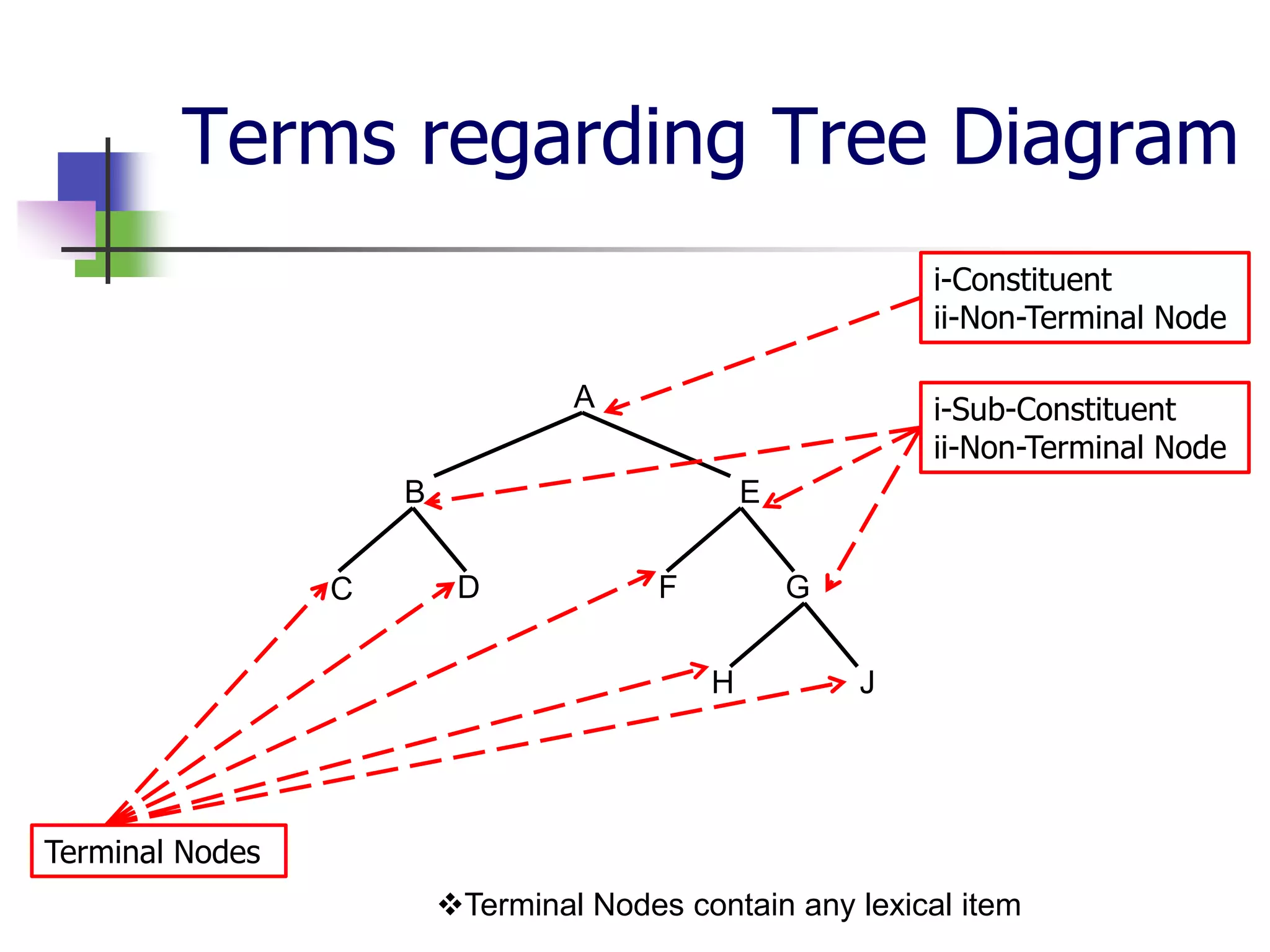
Terms regarding Tree Diagram
A
B E
C D F G
H J
i-Constituent
ii-Non-Terminal Node
i-Sub-Constituent
ii-Non-Terminal Node
Terminal Nodes
Terminal Nodes contain any lexical item
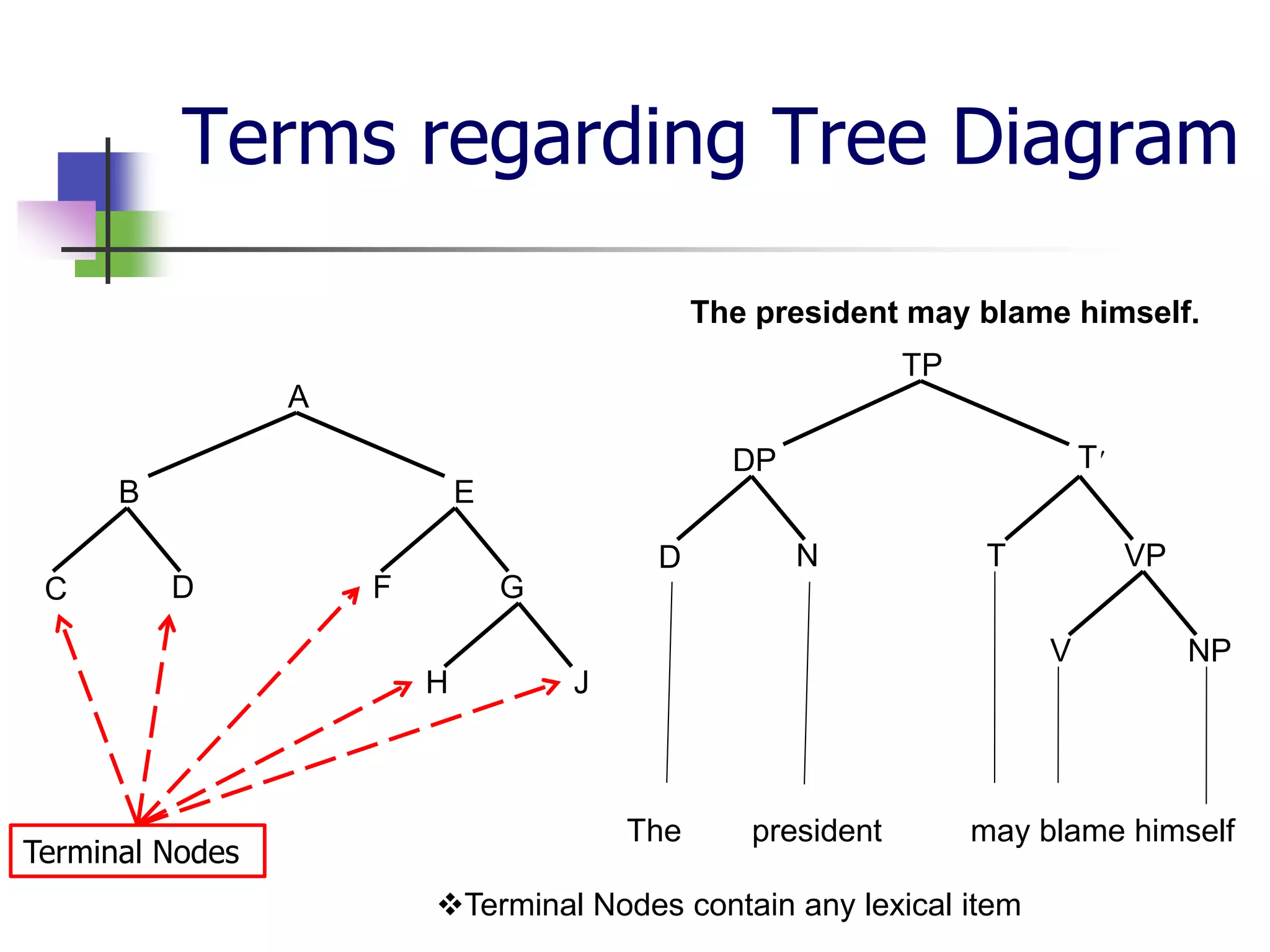
Terms regarding Tree Diagram
A
B E
C D F G
H J
Terminal Nodes
Terminal Nodes contain any lexical item
The president may blame himself.
TP
DP T'
D N T VP
V
The president may blame himself
NP
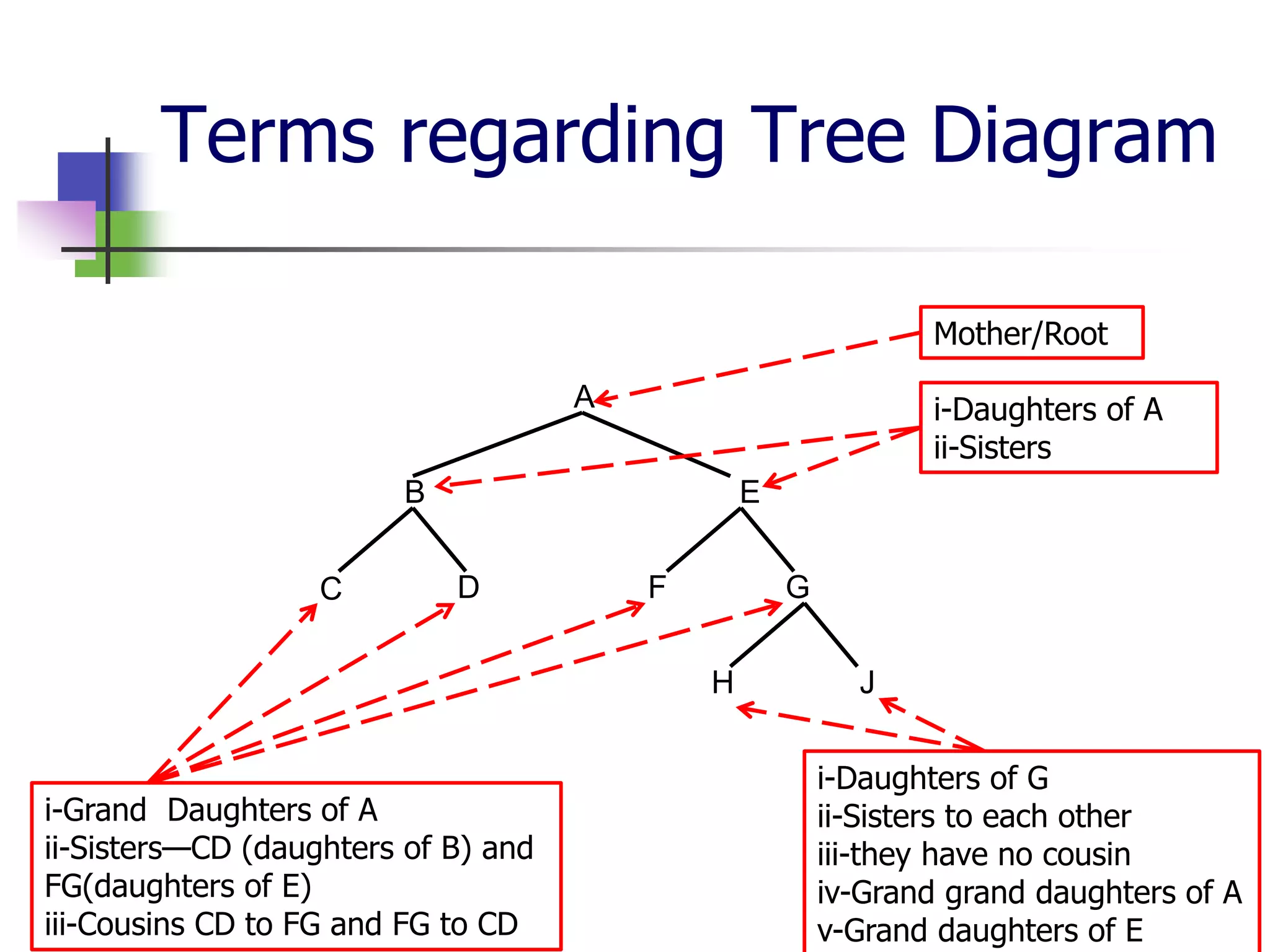
Terms regarding Tree Diagram
A
B E
C D F G
H J
Mother/Root
i-Daughters of A
ii-Sisters
i-Grand Daughters of A
ii-Sisters—CD (daughters of B) and
FG(daughters of E)
iii-Cousins CD to FG and FG to CD
i-Daughters of G
ii-Sisters to each other
iii-they have no cousin
iv-Grand grand daughters of A
v-Grand daughters of E
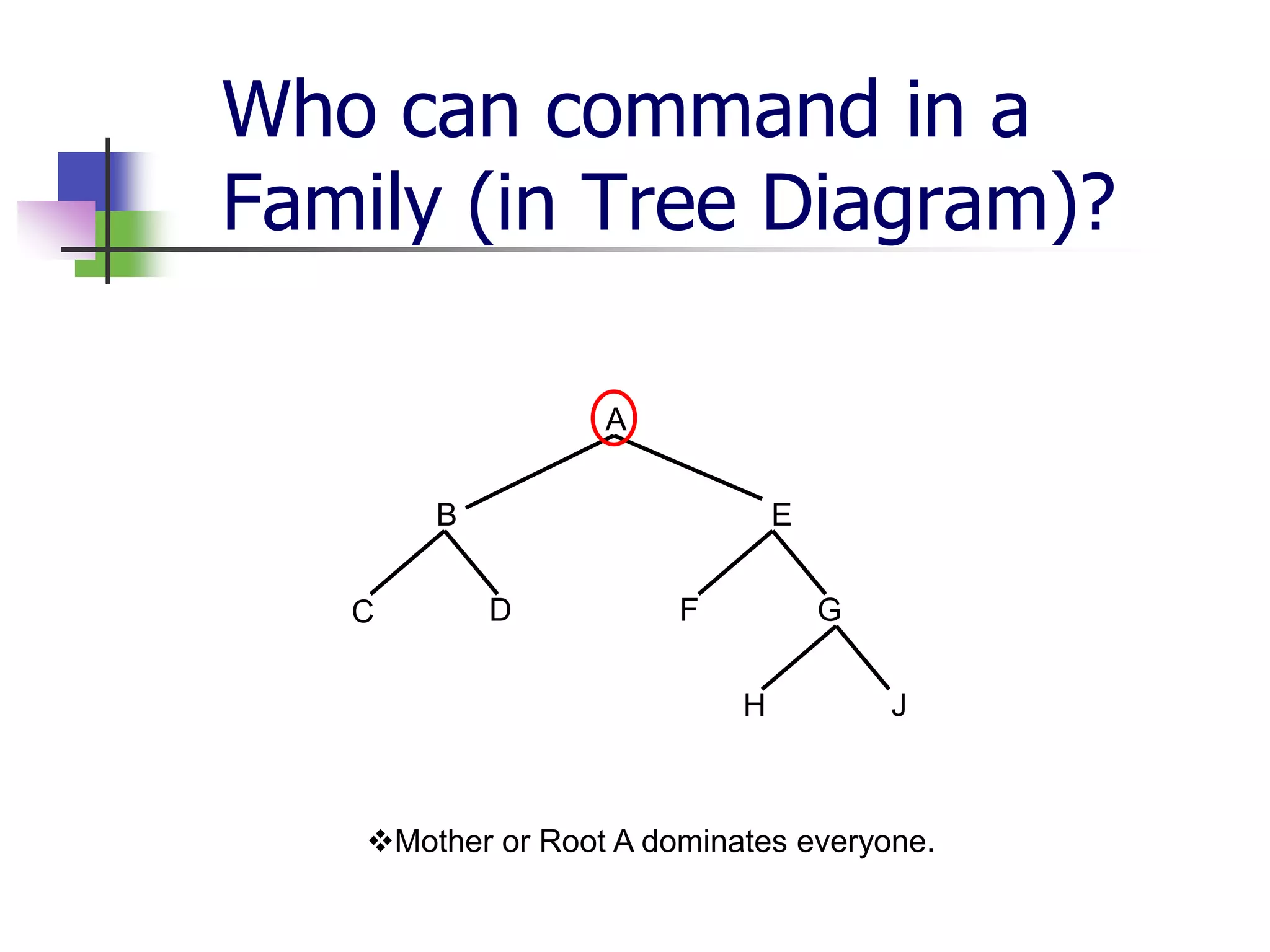
Who can command in a
Family (in Tree Diagram)?
A
B E
C D F G
H J
Mother or Root A dominates everyone.
Who can command in a Family
(in Tree Diagram)?
A
B E
C D F G
H J
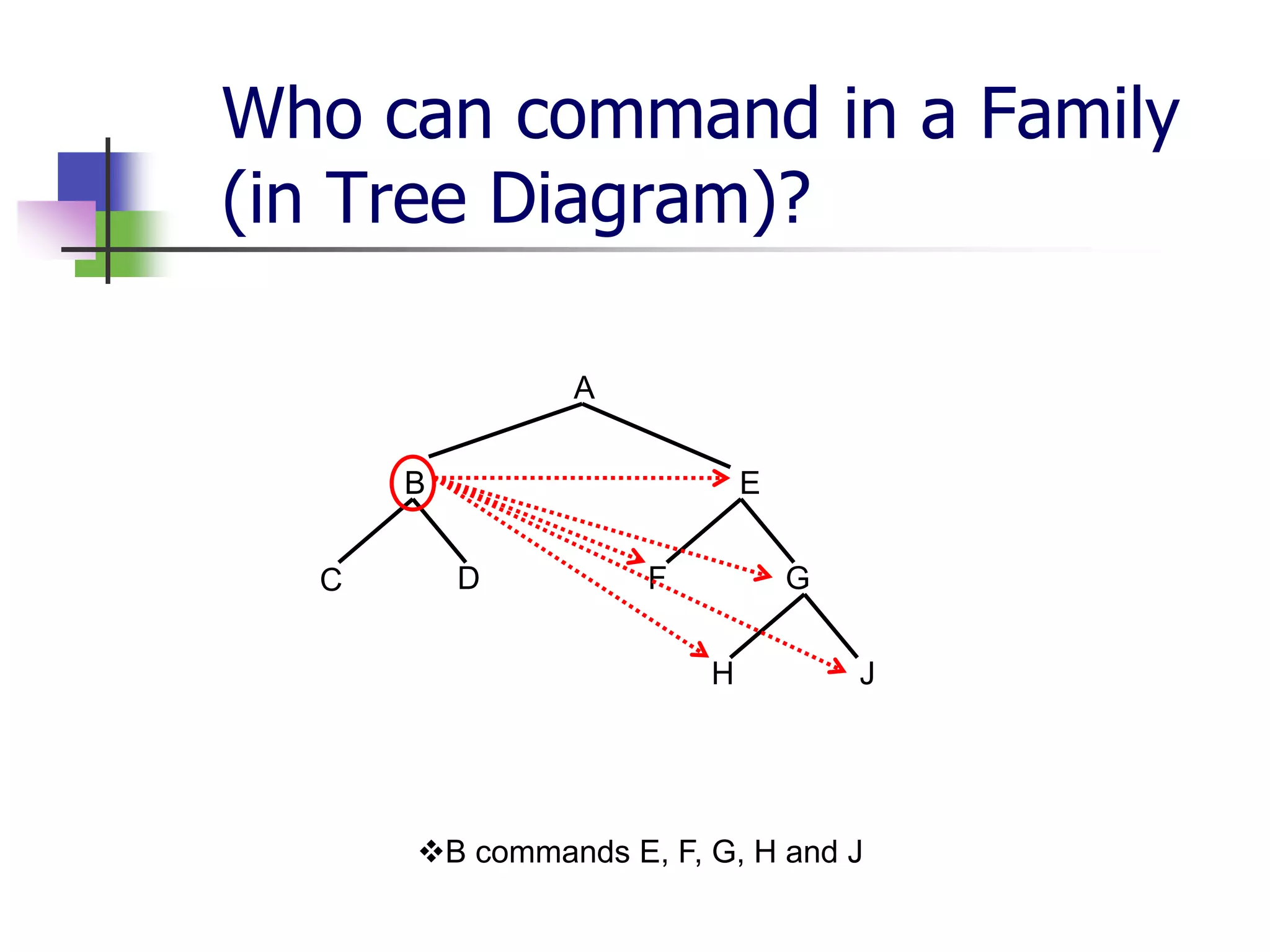
B commands E, F, G, H and J
Who can command in a Family
(in Tree Diagram)?
A
B E
C D F G
H J
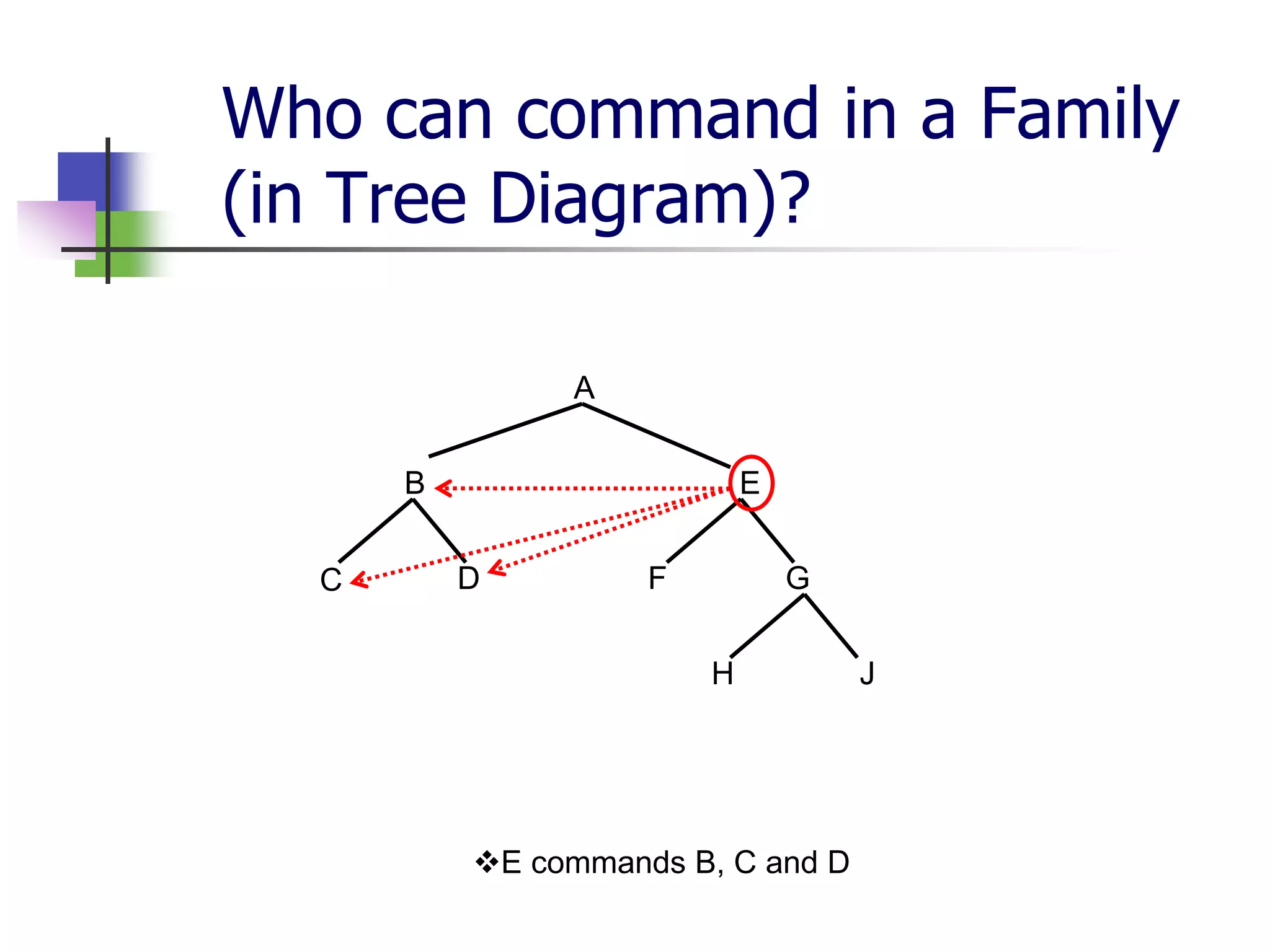
E commands B, C and D
Who can command in a Family
(in Tree Diagram)?
A
B E
C D F G
H J
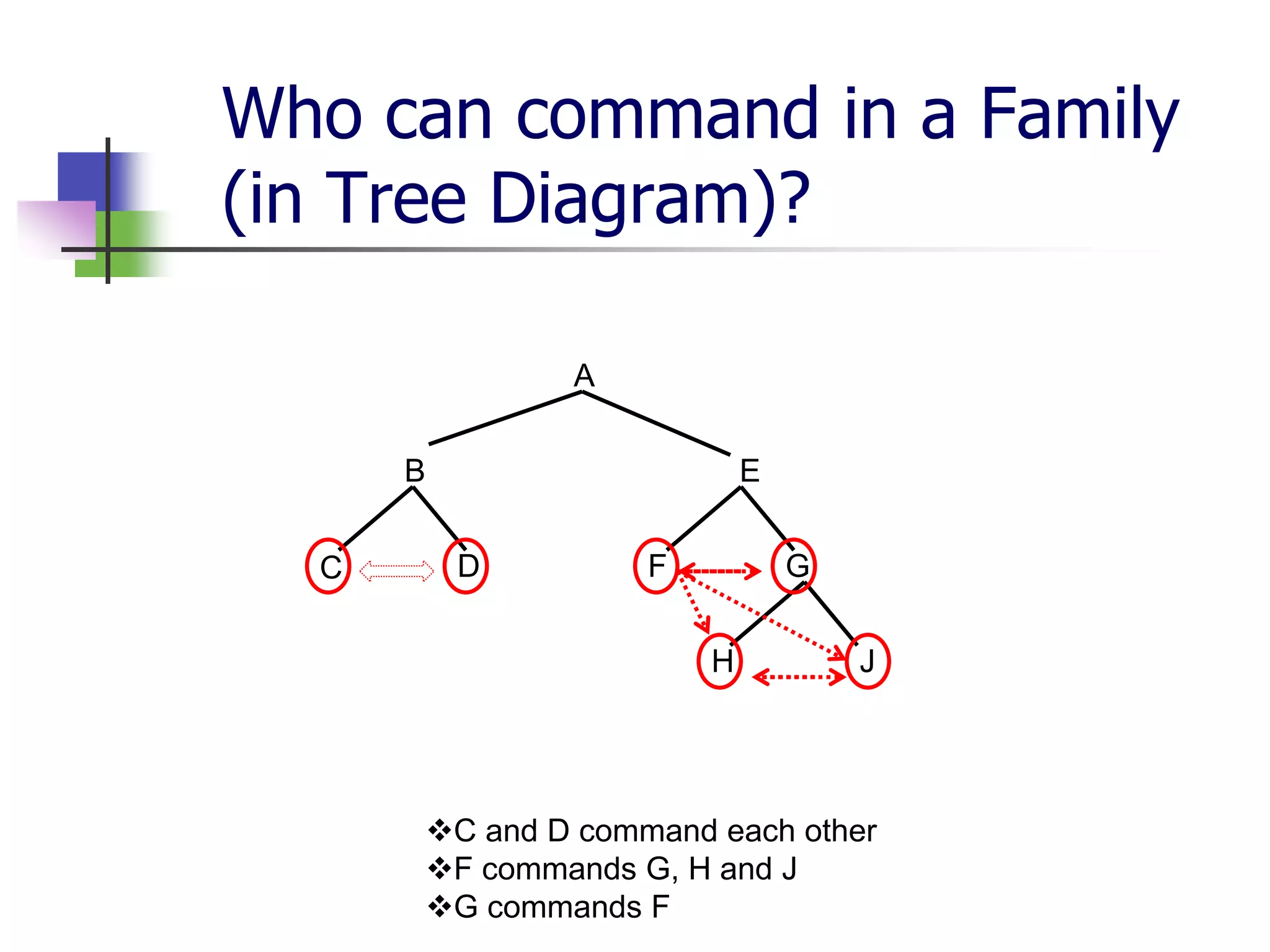
C and D command each other
F commands G, H and J
G commands F
What is CONSTITUENT
COMMAND or C-COMMAND?
From the above examples, C-Command can
be defined as follows:
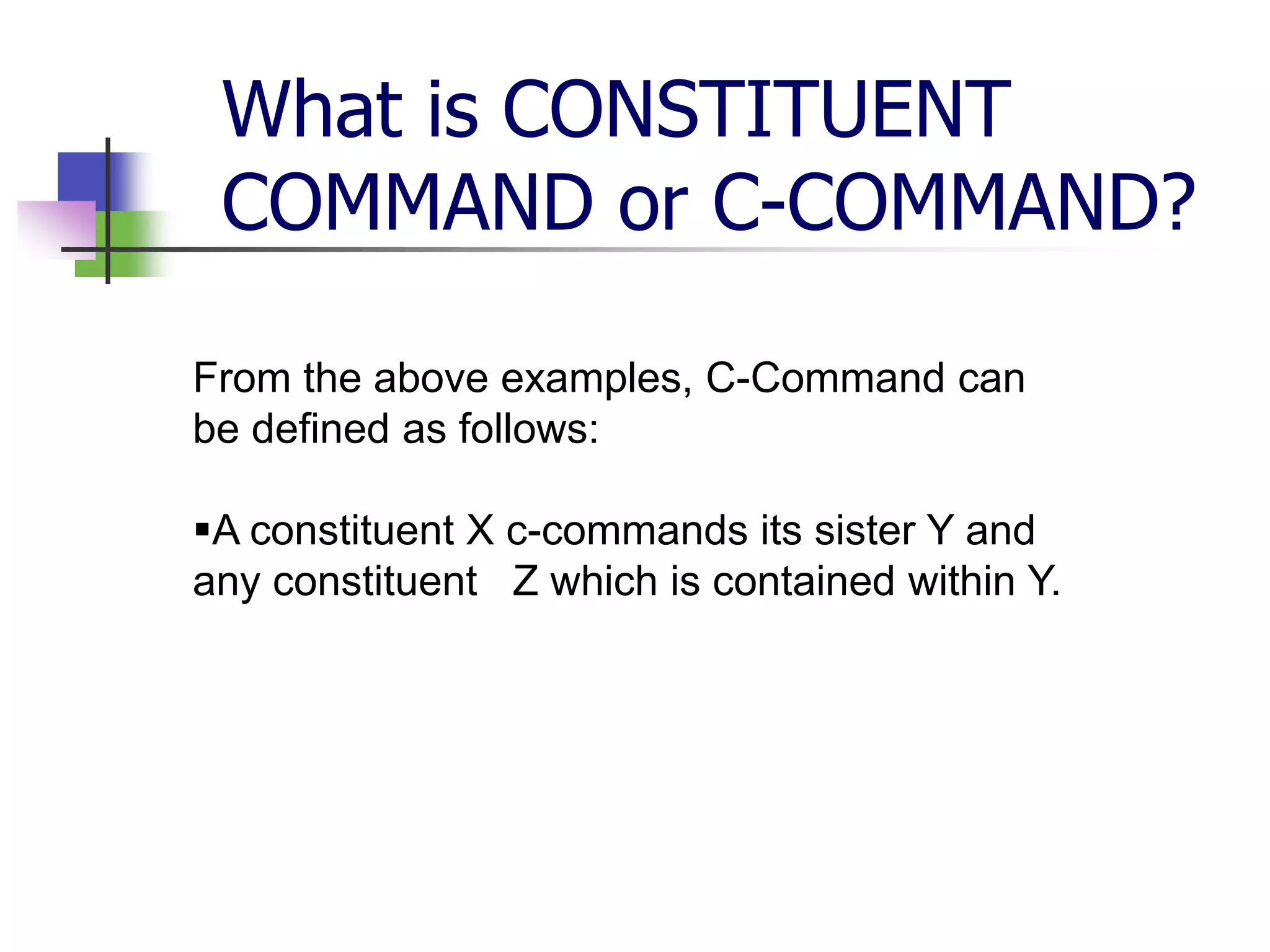
A constituent X c-commands its sister Y and
any constituent Z which is contained within Y.
Explanation of CONSTITUENT
COMMAND or C-COMMAND
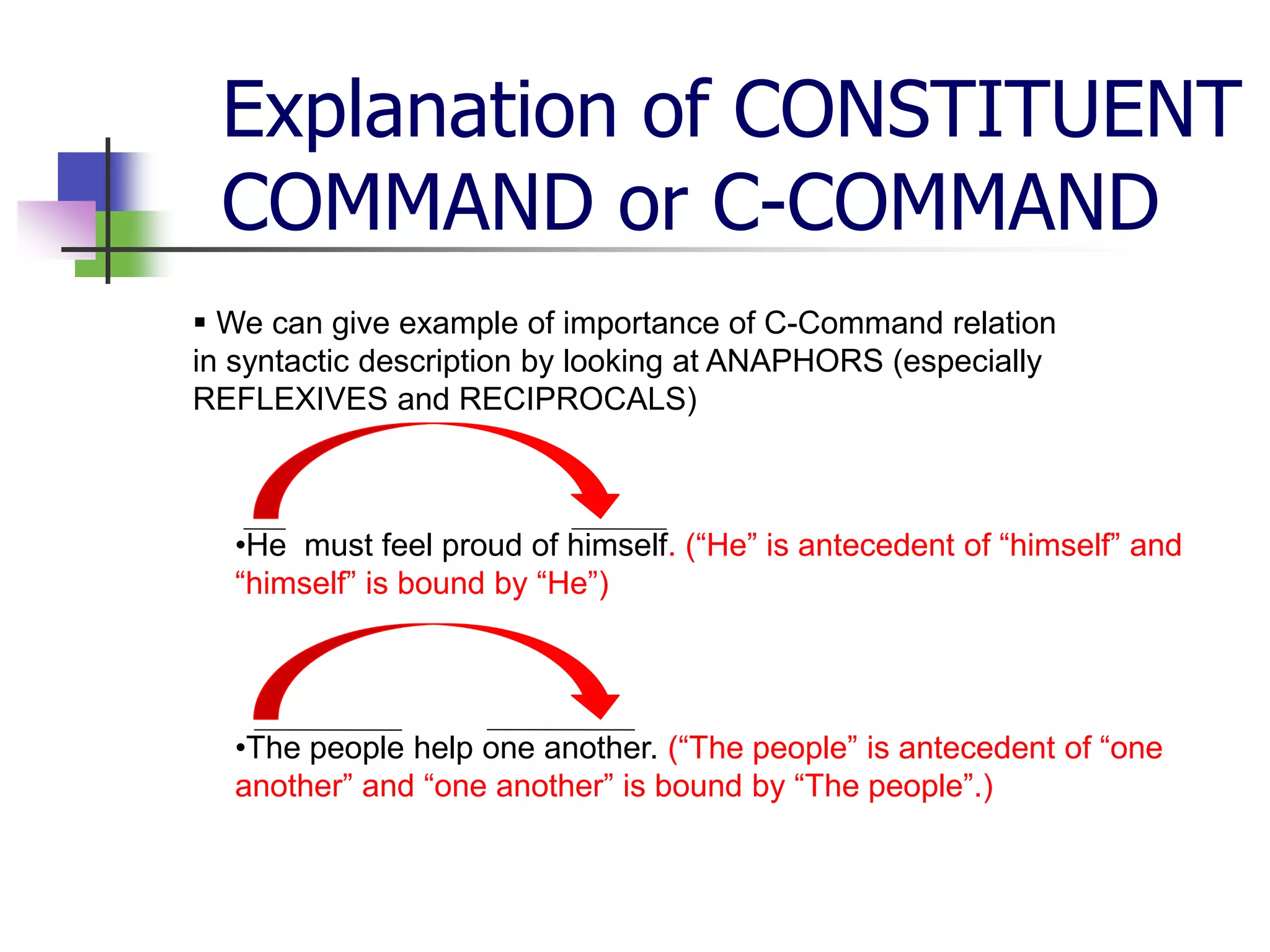
 We can give example of importance of C-Command relation
in syntactic description by looking at ANAPHORS (especially
REFLEXIVES and RECIPROCALS)
•He must feel proud of himself. (“He” is antecedent of “himself” and
“himself” is bound by “He”)
•The people help one another. (“The people” is antecedent of “one
another” and “one another” is bound by “The people”.)
Explanation of CONSTITUENT
COMMAND or C-COMMAND
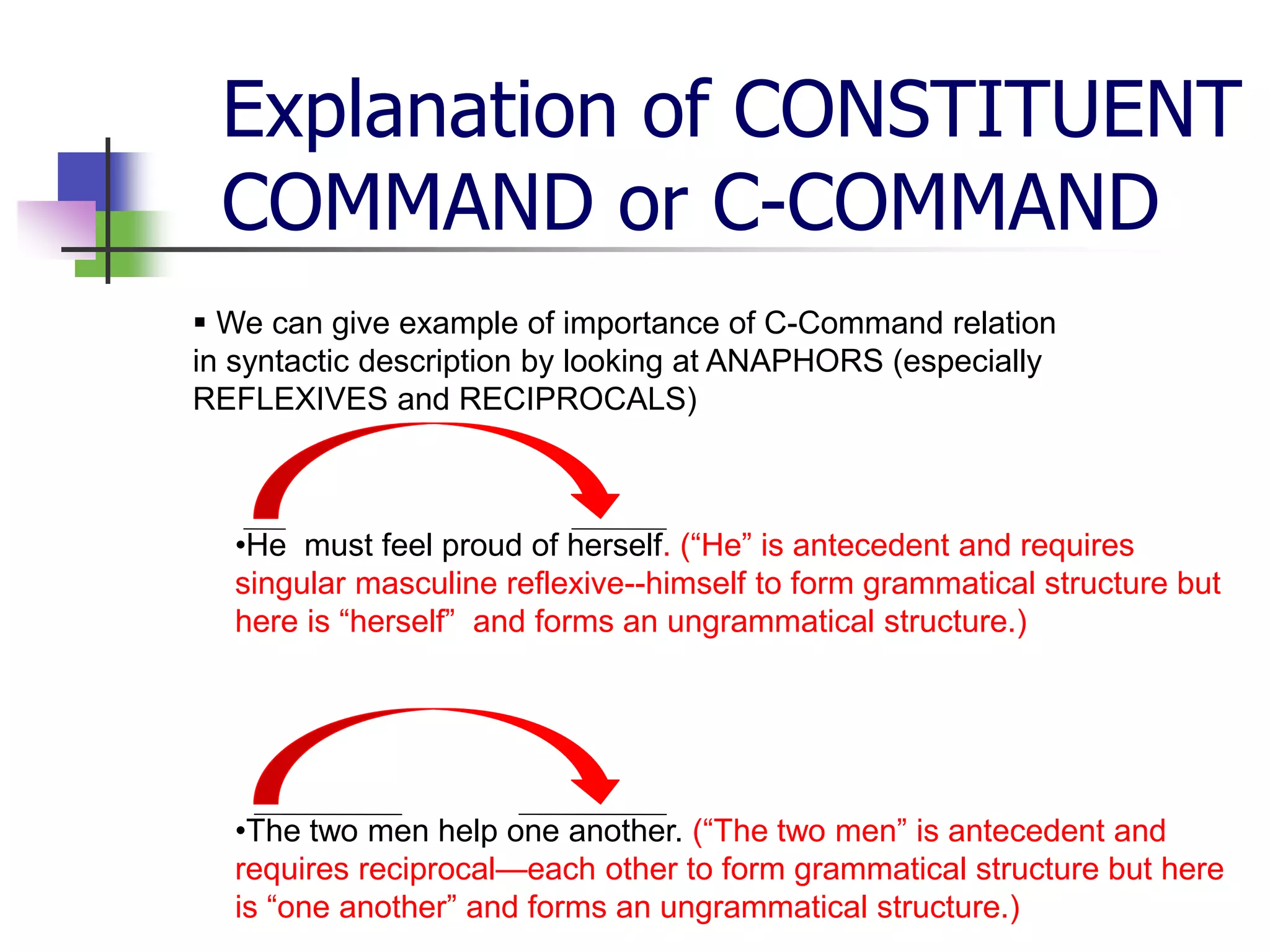
 We can give example of importance of C-Command relation
in syntactic description by looking at ANAPHORS (especially
REFLEXIVES and RECIPROCALS)
•He must feel proud of herself. (“He” is antecedent and requires
singular masculine reflexive--himself to form grammatical structure but
here is “herself” and forms an ungrammatical structure.)
•The two men help one another. (“The two men” is antecedent and
requires reciprocal—each other to form grammatical structure but here
is “one another” and forms an ungrammatical structure.)
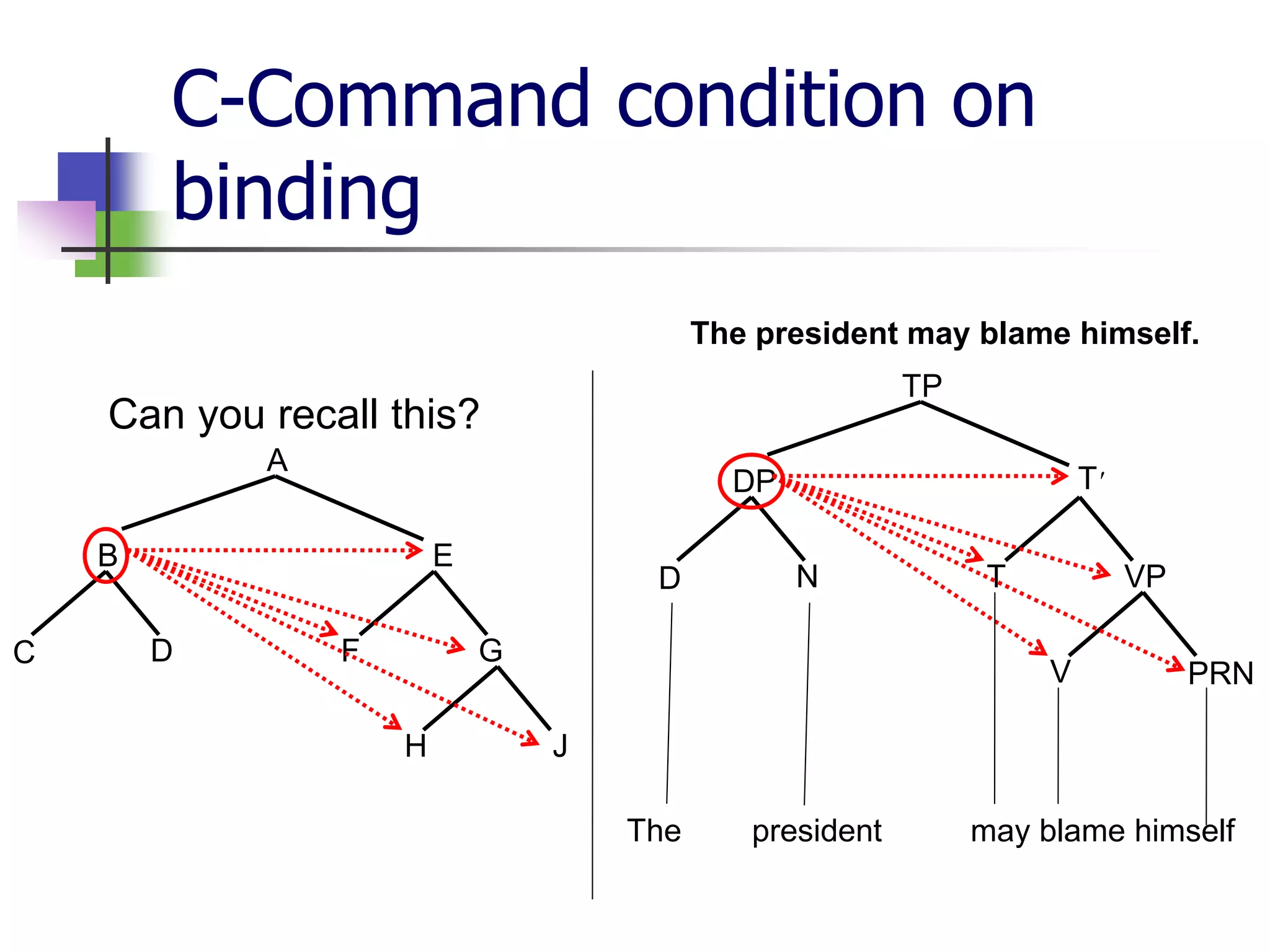
C-Command condition on
binding
Can you recall this?
A
B E
C D F G
H J
The president may blame himself.
TP
DP T'
D N T VP
V PRN
The president may blame himself
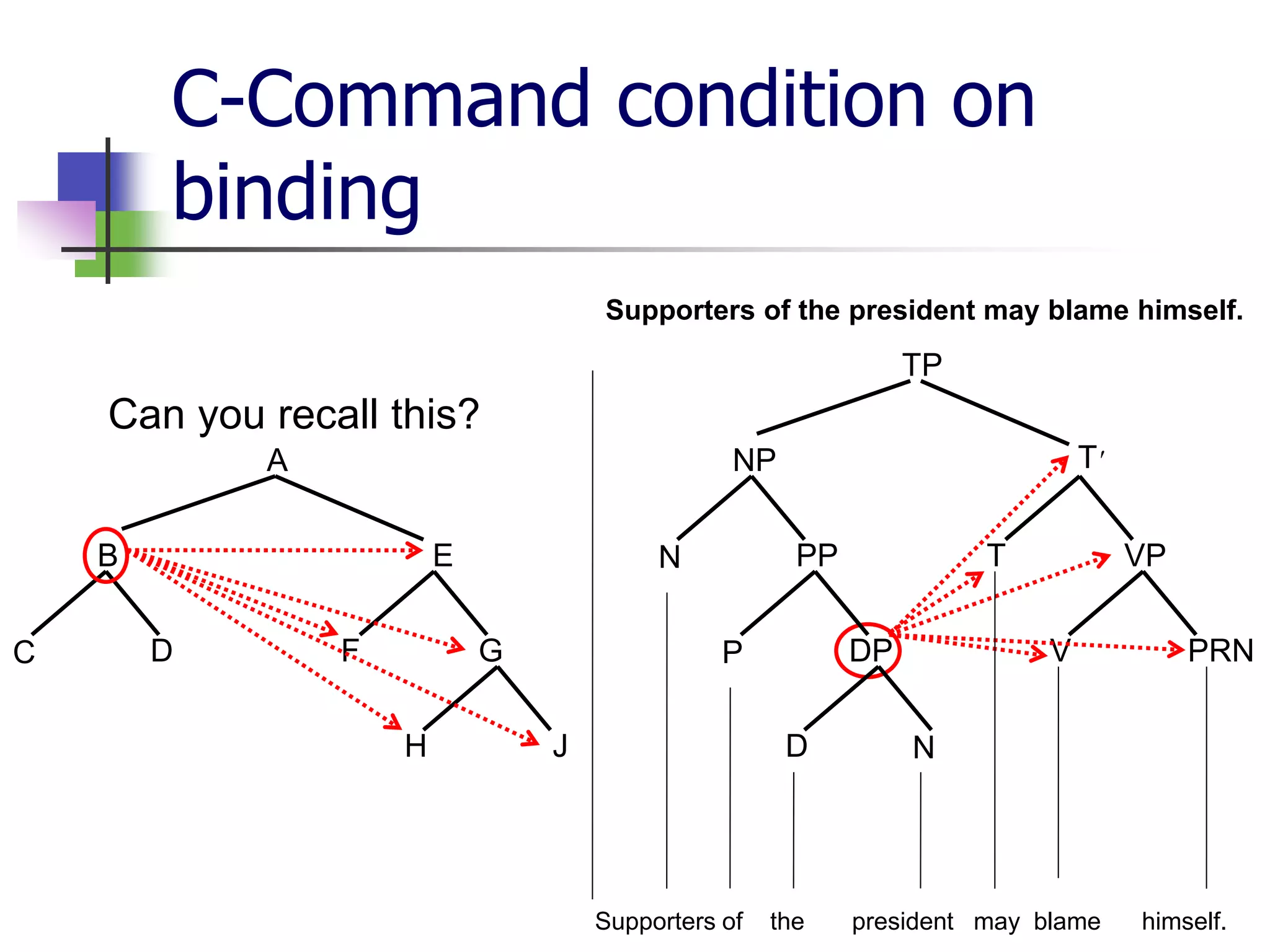
C-Command condition on
binding
Can you recall this?
A
B E
C D F G
H J
Supporters of the president may blame himself.
TP
NP T'
N PP T VP
V PRN
Supporters of the president may blame himself.
P DP
ND
Query Session
Thanks
Wish you best of luck in every sphere of life!
You may download this presentation form here:
http://www.slideshare.net/AsifAliRaza/syntactic-relations
Readings
 English Syntax by Andrew Radford
 English Syntax and Argumentation by Bas Aarts
 Syntax by Andrew Carnie
 An Introduction to English Syntax by Jim Miller
 Ling 201 – Basic Concepts of Linguistics Jirka Hana – March 25, 2006
 How Many Word-Classes Are There After All? István Kenesei Research
Institute for Linguistics, HAS, & University of Szeged IMM14, Budapest, May
13-16, 2010
 INTRODUCTION TO LINGUISTICS BA Modul 1 Institut für Anglistik nd
Amerikanistik Humboldt-Universität zu Berlin
 Bauer, L. 1983. English Word-Formation. Cambridge: Cambridge University
Press; 13-18; 20-22.
 Brown, K. & J.E. Miller 19912. Syntax: a Linguistic Introduction to Sentence
Structure. London: Harpercollins; 155-172.
 Matthews, P.H. 19912. Morphology. Cambridge: Cambridge University Press;
24-40.

Basic terms of tree diagram

  • 1.
    In the nameof Allah, the most Beneficent, the most Merciful.
  • 2.
    Syntactic Relations Presented to:Miss Madeeha Khan Presented by: Asif Ali Raza asifalirazzza@yahoo.com +92-300-4626234
  • 3.
    Points to bediscussed  What are Syntactic Relations?  What is Tree Diagram?  Basic Terms regarding Tree Diagram  Constituent Command or C-Command  C-Command condition on binding
  • 4.
    What are SyntacticRelations?  In linguistics, syntactic relations (= grammatical functions, grammatical roles, syntactic functions, grammatical relations) refer to functional relationships between constituents in a clause or phrase.  Relation between the constituents of various types of phrases or sentences is called Syntactic Relations.
  • 5.
    What is TreeDiagram?  A tree diagram is a way of representing the hierarchical nature of a structure in a graphical form. It is named a "tree diagram" because the classic representation resembles a tree, even though the chart is generally upside down compared to an actual tree, with the "root" at the top and the "leaves" at the bottom.  Tree diagram provides us visual representation of the constituents of the corresponding expression. It looks like a family tree.
  • 6.
    What is TreeDiagram?  E.g. The child can kick a football. Tree diagrams are referred to in the relevant literature as Phrase Markers (P-Markers) A child can kick footballa S NP Aux VP N V NPArt NArt
  • 7.
    What is TreeDiagram?  E.g. The child can kick a football. TP DP T' D N T VP V NP The child can kick football Tree diagrams are referred to in the relevant literature as Phrase Markers (P-Markers) NV a
  • 8.
    Terms regarding TreeDiagram  Constituent  Sub-Constituent  Root/Mother, Sister, Daughter, Grand Daughter etc  Node, Terminal Node, Non-terminal Node, Labeled Node  Branch/Solid Line
  • 9.
    Terms regarding TreeDiagram A B E C D F G H J Labeled Nodes Solid Lines/Branches
  • 10.
    Terms regarding TreeDiagram A B E C D F G H J i-Constituent ii-Non-Terminal Node i-Sub-Constituent ii-Non-Terminal Node Terminal Nodes Terminal Nodes contain any lexical item
  • 11.
    Terms regarding TreeDiagram A B E C D F G H J Terminal Nodes Terminal Nodes contain any lexical item The president may blame himself. TP DP T' D N T VP V The president may blame himself NP
  • 12.
    Terms regarding TreeDiagram A B E C D F G H J Mother/Root i-Daughters of A ii-Sisters i-Grand Daughters of A ii-Sisters—CD (daughters of B) and FG(daughters of E) iii-Cousins CD to FG and FG to CD i-Daughters of G ii-Sisters to each other iii-they have no cousin iv-Grand grand daughters of A v-Grand daughters of E
  • 13.
    Who can commandin a Family (in Tree Diagram)? A B E C D F G H J Mother or Root A dominates everyone.
  • 14.
    Who can commandin a Family (in Tree Diagram)? A B E C D F G H J B commands E, F, G, H and J
  • 15.
    Who can commandin a Family (in Tree Diagram)? A B E C D F G H J E commands B, C and D
  • 16.
    Who can commandin a Family (in Tree Diagram)? A B E C D F G H J C and D command each other F commands G, H and J G commands F
  • 17.
    What is CONSTITUENT COMMANDor C-COMMAND? From the above examples, C-Command can be defined as follows: A constituent X c-commands its sister Y and any constituent Z which is contained within Y.
  • 18.
    Explanation of CONSTITUENT COMMANDor C-COMMAND  We can give example of importance of C-Command relation in syntactic description by looking at ANAPHORS (especially REFLEXIVES and RECIPROCALS) •He must feel proud of himself. (“He” is antecedent of “himself” and “himself” is bound by “He”) •The people help one another. (“The people” is antecedent of “one another” and “one another” is bound by “The people”.)
  • 19.
    Explanation of CONSTITUENT COMMANDor C-COMMAND  We can give example of importance of C-Command relation in syntactic description by looking at ANAPHORS (especially REFLEXIVES and RECIPROCALS) •He must feel proud of herself. (“He” is antecedent and requires singular masculine reflexive--himself to form grammatical structure but here is “herself” and forms an ungrammatical structure.) •The two men help one another. (“The two men” is antecedent and requires reciprocal—each other to form grammatical structure but here is “one another” and forms an ungrammatical structure.)
  • 20.
    C-Command condition on binding Canyou recall this? A B E C D F G H J The president may blame himself. TP DP T' D N T VP V PRN The president may blame himself
  • 21.
    C-Command condition on binding Canyou recall this? A B E C D F G H J Supporters of the president may blame himself. TP NP T' N PP T VP V PRN Supporters of the president may blame himself. P DP ND
  • 22.
  • 23.
    Thanks Wish you bestof luck in every sphere of life! You may download this presentation form here: http://www.slideshare.net/AsifAliRaza/syntactic-relations
  • 24.
    Readings  English Syntaxby Andrew Radford  English Syntax and Argumentation by Bas Aarts  Syntax by Andrew Carnie  An Introduction to English Syntax by Jim Miller  Ling 201 – Basic Concepts of Linguistics Jirka Hana – March 25, 2006  How Many Word-Classes Are There After All? István Kenesei Research Institute for Linguistics, HAS, & University of Szeged IMM14, Budapest, May 13-16, 2010  INTRODUCTION TO LINGUISTICS BA Modul 1 Institut für Anglistik nd Amerikanistik Humboldt-Universität zu Berlin  Bauer, L. 1983. English Word-Formation. Cambridge: Cambridge University Press; 13-18; 20-22.  Brown, K. & J.E. Miller 19912. Syntax: a Linguistic Introduction to Sentence Structure. London: Harpercollins; 155-172.  Matthews, P.H. 19912. Morphology. Cambridge: Cambridge University Press; 24-40.

Editor's Notes