UNIT 2
MORPHOLOGY
By: Hamza Ali & Nur-Aldin Aboujilah 1
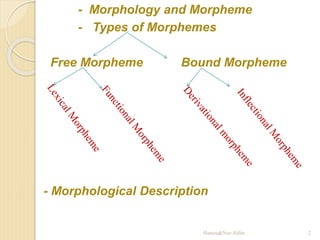
- Morphology and Morpheme
- Types of Morphemes
Free Morpheme Bound Morpheme
- Morphological Description
Hamza&Nur-Aldin 2
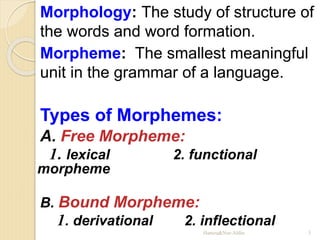
Morphology: The study of structure of
the words and word formation.
Morpheme: The smallest meaningful
unit in the grammar of a language.
Types of Morphemes:
A. Free Morpheme:
1. lexical 2. functional
morpheme
B. Bound Morpheme:
1. derivational 2. inflectional
Hamza&Nur-Aldin 3
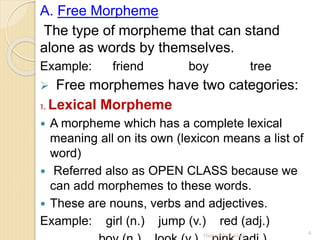
A. Free Morpheme
The type of morpheme that can stand
alone as words by themselves.
Example: friend boy tree
 Free morphemes have two categories:
1. Lexical Morpheme
 A morpheme which has a complete lexical
meaning all on its own (lexicon means a list of
word)
 Referred also as OPEN CLASS because we
can add morphemes to these words.
 These are nouns, verbs and adjectives.
Example: girl (n.) jump (v.) red (adj.)
Hamza&Nur-Aldin 4
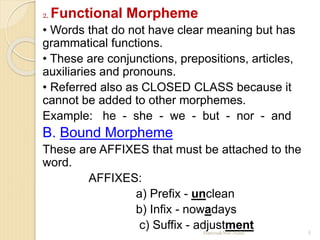
2. Functional Morpheme
• Words that do not have clear meaning but has
grammatical functions.
• These are conjunctions, prepositions, articles,
auxiliaries and pronouns.
• Referred also as CLOSED CLASS because it
cannot be added to other morphemes.
Example: he - she - we - but - nor - and
B. Bound Morpheme
These are AFFIXES that must be attached to the
word.
AFFIXES:
a) Prefix - unclean
b) Infix - nowadays
c) Suffix - adjustment
Hamza&Nur-Aldin 5
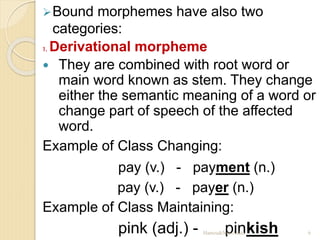
Bound morphemes have also two
categories:
1. Derivational morpheme
 They are combined with root word or
main word known as stem. They change
either the semantic meaning of a word or
change part of speech of the affected
word.
Example of Class Changing:
pay (v.) - payment (n.)
pay (v.) - payer (n.)
Example of Class Maintaining:
pink (adj.) - pinkish
Hamza&Nur-Aldin 6
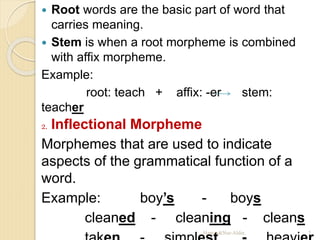
 Root words are the basic part of word that
carries meaning.
 Stem is when a root morpheme is combined
with affix morpheme.
Example:
root: teach + affix: -er stem:
teacher
2. Inflectional Morpheme
Morphemes that are used to indicate
aspects of the grammatical function of a
word.
Example: boy’s - boys
cleaned - cleaning - cleans
Hamza&Nur-Aldin 7
Morphological Description
The difference between Inflectional and
Derivational Morpheme is:
 Inflectional morpheme never change the
grammatical category of the word.
Example: old (adj.) - older
(adj.)
 While Derivational Morpheme can
change the grammatical category of a
word.
Example: play (v.) - player (n.)
Hamza&Nur-Aldin 8
THANK YOU
Yun-Pi Yuan 9

morphology .ppt

  • 1.
    UNIT 2 MORPHOLOGY By: HamzaAli & Nur-Aldin Aboujilah 1
  • 2.
    - Morphology andMorpheme - Types of Morphemes Free Morpheme Bound Morpheme - Morphological Description Hamza&Nur-Aldin 2
  • 3.
    Morphology: The studyof structure of the words and word formation. Morpheme: The smallest meaningful unit in the grammar of a language. Types of Morphemes: A. Free Morpheme: 1. lexical 2. functional morpheme B. Bound Morpheme: 1. derivational 2. inflectional Hamza&Nur-Aldin 3
  • 4.
    A. Free Morpheme Thetype of morpheme that can stand alone as words by themselves. Example: friend boy tree  Free morphemes have two categories: 1. Lexical Morpheme  A morpheme which has a complete lexical meaning all on its own (lexicon means a list of word)  Referred also as OPEN CLASS because we can add morphemes to these words.  These are nouns, verbs and adjectives. Example: girl (n.) jump (v.) red (adj.) Hamza&Nur-Aldin 4
  • 5.
    2. Functional Morpheme •Words that do not have clear meaning but has grammatical functions. • These are conjunctions, prepositions, articles, auxiliaries and pronouns. • Referred also as CLOSED CLASS because it cannot be added to other morphemes. Example: he - she - we - but - nor - and B. Bound Morpheme These are AFFIXES that must be attached to the word. AFFIXES: a) Prefix - unclean b) Infix - nowadays c) Suffix - adjustment Hamza&Nur-Aldin 5
  • 6.
    Bound morphemes havealso two categories: 1. Derivational morpheme  They are combined with root word or main word known as stem. They change either the semantic meaning of a word or change part of speech of the affected word. Example of Class Changing: pay (v.) - payment (n.) pay (v.) - payer (n.) Example of Class Maintaining: pink (adj.) - pinkish Hamza&Nur-Aldin 6
  • 7.
     Root wordsare the basic part of word that carries meaning.  Stem is when a root morpheme is combined with affix morpheme. Example: root: teach + affix: -er stem: teacher 2. Inflectional Morpheme Morphemes that are used to indicate aspects of the grammatical function of a word. Example: boy’s - boys cleaned - cleaning - cleans Hamza&Nur-Aldin 7
  • 8.
    Morphological Description The differencebetween Inflectional and Derivational Morpheme is:  Inflectional morpheme never change the grammatical category of the word. Example: old (adj.) - older (adj.)  While Derivational Morpheme can change the grammatical category of a word. Example: play (v.) - player (n.) Hamza&Nur-Aldin 8
  • 9.