Inflection
Bayu Jaka Magistra
180120130006
Indah Mustika S. M.
180120130003
Inflection
Inflection
• What is Inflection ?
• Regular
& Irregular
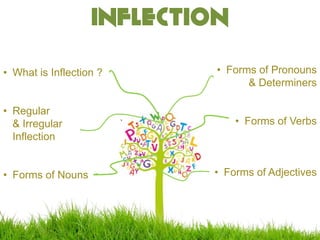
Inflection
• Forms of Nouns
• Forms of Pronouns
& Determiners
• Forms of Verbs
• Forms of Adjectives
`
• What is Inflection ?
What is Inflection?
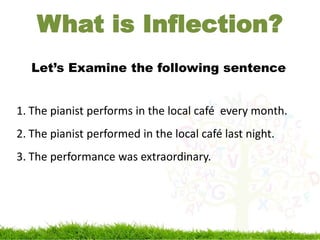
Let’s Examine the following sentence
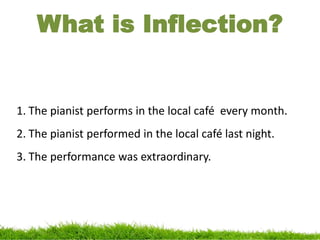
1. The pianist performs in the local café every month.
2. The pianist performed in the local café last night.
3. The performance was extraordinary.
What is Inflection?
1. The pianist performs in the local café every month.
2. The pianist performed in the local café last night.
3. The performance was extraordinary.
What is Inflection?
1. The pianist performs in the local café every month.
2. The pianist performed in the local café last night.
3. The performance was extraordinary.
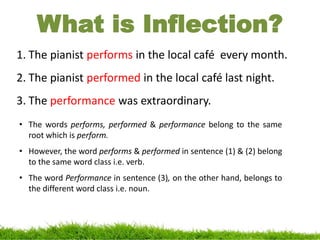
• The words performs, performed & performance belong to the same
root which is perform.
• However, the word performs & performed in sentence (1) & (2) belong
to the same word class i.e. verb.
• The word Performance in sentence (3), on the other hand, belongs to
the different word class i.e. noun.
What is Inflection?
1. The pianist performs in the local café every month.
2. The pianist performed in the local café last night.
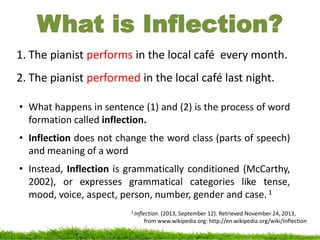
• What happens in sentence (1) and (2) is the process of word
formation called inflection.
• Inflection does not change the word class (parts of speech)
and meaning of a word
• Instead, Inflection is grammatically conditioned (McCarthy,
2002), or expresses grammatical categories like tense,
mood, voice, aspect, person, number, gender and case.1
1 Inflection. (2013, September 12). Retrieved November 24, 2013,
from www.wikipedia.org: http://en.wikipedia.org/wiki/Inflection
What is Inflection?
1. The pianist performs in the local café every month.
2. The pianist performed in the local café last night.
Grammatically condition or expresses grammatical categories like
tense, mood, voice, aspect, person, number, gender and case.
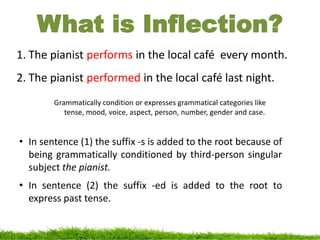
• In sentence (1) the suffix -s is added to the root because of
being grammatically conditioned by third-person singular
subject the pianist.
• In sentence (2) the suffix -ed is added to the root to
express past tense.
What is Inflection?
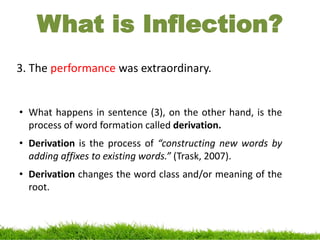
3. The performance was extraordinary.
• What happens in sentence (3), on the other hand, is the
process of word formation called derivation.
• Derivation is the process of “constructing new words by
adding affixes to existing words.” (Trask, 2007).
• Derivation changes the word class and/or meaning of the
root.
What is Inflection?
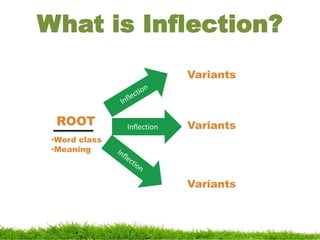
ROOT
•Word class
•Meaning
Inflection
Variants
Variants
Variants
What is Inflection?
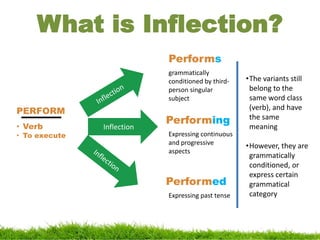
PERFORM
• Verb
• To execute
Inflection
Performs
Performing
Performed
•The variants still
belong to the
same word class
(verb), and have
the same
meaning
•However, they are
grammatically
conditioned, or
express certain
grammatical
category
grammatically
conditioned by third-
person singular
subject
Expressing continuous
and progressive
aspects
Expressing past tense
What is Inflection?
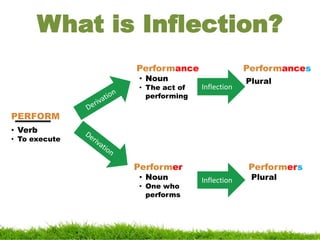
PERFORM
• Verb
• To execute
Performance
• Noun
• The act of
performing
Performer
• Noun
• One who
performs
Inflection
Inflection
Performances
Plural
Performers
Plural
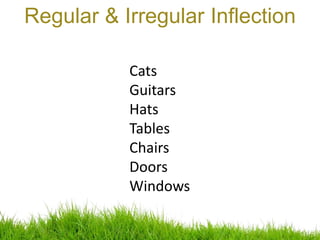
Regular & Irregular Inflection
Cats
Guitars
Hats
Tables
Chairs
Doors
Windows
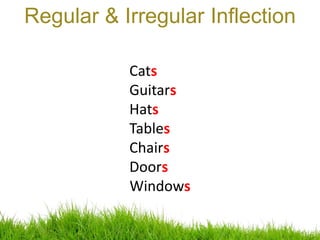
Regular & Irregular Inflection
Cats
Guitars
Hats
Tables
Chairs
Doors
Windows
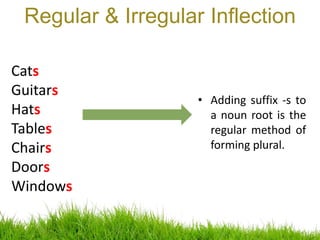
Regular & Irregular Inflection
Cats
Guitars
Hats
Tables
Chairs
Doors
Windows
• Adding suffix -s to
a noun root is the
regular method of
forming plural.
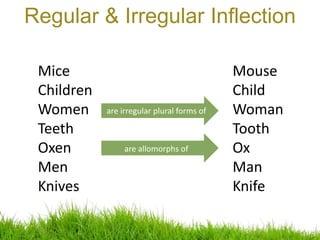
Regular & Irregular Inflection
Mice
Children
Women
Teeth
Oxen
Men
Knives
are irregular plural forms of
Mouse
Child
Woman
Tooth
Ox
Man
Knife
are allomorphs of
Regular & Irregular Inflection
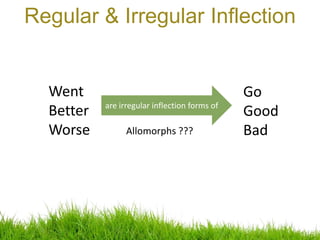
Went
Better
Worse
are irregular inflection forms of
Go
Good
BadAllomorphs ???
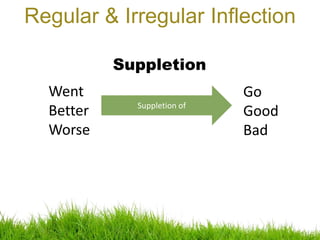
Regular & Irregular Inflection
Went
Better
Worse
Suppletion of
Go
Good
Bad
Suppletion
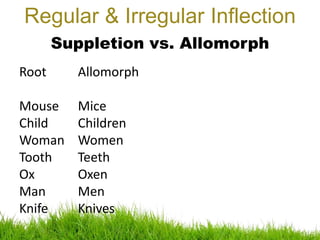
Regular & Irregular Inflection
Suppletion vs. Allomorph
Allomorph
Mice
Children
Women
Teeth
Oxen
Men
Knives
Root
Mouse
Child
Woman
Tooth
Ox
Man
Knife
Regular & Irregular Inflection
Suppletion vs. Allomorph
Allomorph
Mice
Children
Women
Teeth
Oxen
Men
Knives
Root
Mouse
Child
Woman
Tooth
Ox
Man
Knife
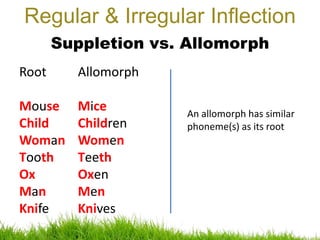
An allomorph has similar
phoneme(s) as its root
Regular & Irregular Inflection
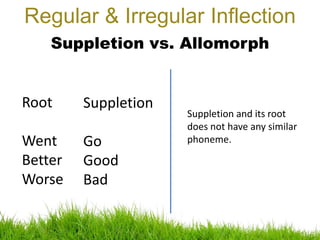
Suppletion vs. Allomorph
Root
Went
Better
Worse
Suppletion
Go
Good
Bad
Suppletion and its root
does not have any similar
phoneme.
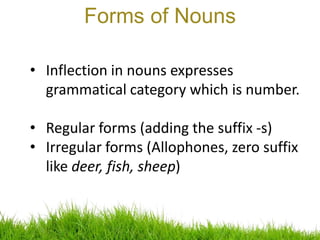
Forms of Nouns
• Inflection in nouns expresses
grammatical category which is number.
• Regular forms (adding the suffix -s)
• Irregular forms (Allophones, zero suffix
like deer, fish, sheep)
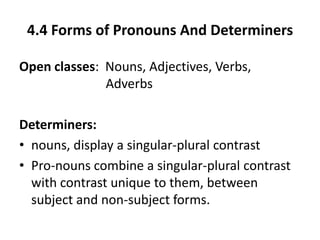
4.4 Forms of Pronouns And Determiners
Open classes: Nouns, Adjectives, Verbs,
Adverbs
Determiners:
• nouns, display a singular-plural contrast
• Pro-nouns combine a singular-plural contrast
with contrast unique to them, between
subject and non-subject forms.
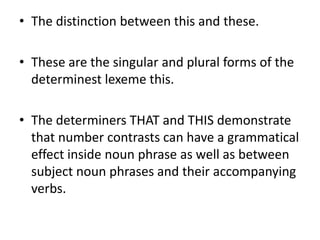
• The distinction between this and these.
• These are the singular and plural forms of the
determinest lexeme this.
• The determiners THAT and THIS demonstrate
that number contrasts can have a grammatical
effect inside noun phrase as well as between
subject noun phrases and their accompanying
verbs.
• In English, the same technique is used for one
small closed class of lexemes, namely personal
pronouns.
• If one replaces John and Mary with the
appropriate pronouns in these two examples,
the outcome is as in:
1. He loves her.
2. She loves him.
• He and him are sometimes said to contrast in
case.
1. He belonging to the nominative case
2. Him belonging to the accusative case.
• It is striking that the relationship between
nominative and accusative forms is
consistently suppletive.
>> I/me, she/her, we/us, and they/them.
• Corresponding words with a possessive
meaning: his and our, as well as my, her, your
and their.
• Syntactically and semantically, these words
fulfill just the same role as noun phrases with
the apostrophe-s:
1. His bicycle means the bicycle belonging
to him.
2. That man’s bicycle means the bicycle
belonging to that man.
4.5 Forms of Verbs
• In English, a verb lexeme has at most five distinct
forms, as illustrated here with GIVE.
• Third person singular present tense
e.g. Marry gives a lecture every year.
• Past tense
e.g. Marry gave a lecture last week.
• Progressive participle
e.g. Mary is giving a lecture today.
• Perfect or passive participle
e.g. Mary has given a lecture today.
• Basic form (used everywhere else)
e.g Mary wants to give a lecture.
4.6 Forms of Adjectives
• Many English adjectives exhibit three forms,
for example GREEN here:
1. Grass is green.
2. The grass is greener now than in winter.
3. The grass is greenest in early summer.
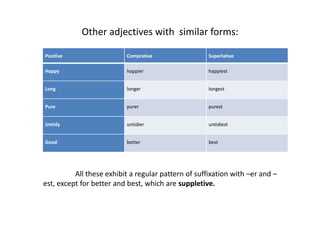
Other adjectives with similar forms:
Positive Comprative Superlative
Happy happier happiest
Long longer longest
Pure purer purest
Untidy untidier untidiest
Good better best
All these exhibit a regular pattern of suffixation with –er and –
est, except for better and best, which are suppletive.

Inflection in Morphology (Linguistics)

  • 1.
  • 2.
  • 3.
    Inflection • What isInflection ? • Regular & Irregular Inflection • Forms of Nouns • Forms of Pronouns & Determiners • Forms of Verbs • Forms of Adjectives `
  • 4.
    • What isInflection ?
  • 5.
    What is Inflection? Let’sExamine the following sentence 1. The pianist performs in the local café every month. 2. The pianist performed in the local café last night. 3. The performance was extraordinary.
  • 6.
    What is Inflection? 1.The pianist performs in the local café every month. 2. The pianist performed in the local café last night. 3. The performance was extraordinary.
  • 7.
    What is Inflection? 1.The pianist performs in the local café every month. 2. The pianist performed in the local café last night. 3. The performance was extraordinary. • The words performs, performed & performance belong to the same root which is perform. • However, the word performs & performed in sentence (1) & (2) belong to the same word class i.e. verb. • The word Performance in sentence (3), on the other hand, belongs to the different word class i.e. noun.
  • 8.
    What is Inflection? 1.The pianist performs in the local café every month. 2. The pianist performed in the local café last night. • What happens in sentence (1) and (2) is the process of word formation called inflection. • Inflection does not change the word class (parts of speech) and meaning of a word • Instead, Inflection is grammatically conditioned (McCarthy, 2002), or expresses grammatical categories like tense, mood, voice, aspect, person, number, gender and case.1 1 Inflection. (2013, September 12). Retrieved November 24, 2013, from www.wikipedia.org: http://en.wikipedia.org/wiki/Inflection
  • 9.
    What is Inflection? 1.The pianist performs in the local café every month. 2. The pianist performed in the local café last night. Grammatically condition or expresses grammatical categories like tense, mood, voice, aspect, person, number, gender and case. • In sentence (1) the suffix -s is added to the root because of being grammatically conditioned by third-person singular subject the pianist. • In sentence (2) the suffix -ed is added to the root to express past tense.
  • 10.
    What is Inflection? 3.The performance was extraordinary. • What happens in sentence (3), on the other hand, is the process of word formation called derivation. • Derivation is the process of “constructing new words by adding affixes to existing words.” (Trask, 2007). • Derivation changes the word class and/or meaning of the root.
  • 11.
    What is Inflection? ROOT •Wordclass •Meaning Inflection Variants Variants Variants
  • 12.
    What is Inflection? PERFORM •Verb • To execute Inflection Performs Performing Performed •The variants still belong to the same word class (verb), and have the same meaning •However, they are grammatically conditioned, or express certain grammatical category grammatically conditioned by third- person singular subject Expressing continuous and progressive aspects Expressing past tense
  • 13.
    What is Inflection? PERFORM •Verb • To execute Performance • Noun • The act of performing Performer • Noun • One who performs Inflection Inflection Performances Plural Performers Plural
  • 14.
    Regular & IrregularInflection Cats Guitars Hats Tables Chairs Doors Windows
  • 15.
    Regular & IrregularInflection Cats Guitars Hats Tables Chairs Doors Windows
  • 16.
    Regular & IrregularInflection Cats Guitars Hats Tables Chairs Doors Windows • Adding suffix -s to a noun root is the regular method of forming plural.
  • 17.
    Regular & IrregularInflection Mice Children Women Teeth Oxen Men Knives are irregular plural forms of Mouse Child Woman Tooth Ox Man Knife are allomorphs of
  • 18.
    Regular & IrregularInflection Went Better Worse are irregular inflection forms of Go Good BadAllomorphs ???
  • 19.
    Regular & IrregularInflection Went Better Worse Suppletion of Go Good Bad Suppletion
  • 20.
    Regular & IrregularInflection Suppletion vs. Allomorph Allomorph Mice Children Women Teeth Oxen Men Knives Root Mouse Child Woman Tooth Ox Man Knife
  • 21.
    Regular & IrregularInflection Suppletion vs. Allomorph Allomorph Mice Children Women Teeth Oxen Men Knives Root Mouse Child Woman Tooth Ox Man Knife An allomorph has similar phoneme(s) as its root
  • 22.
    Regular & IrregularInflection Suppletion vs. Allomorph Root Went Better Worse Suppletion Go Good Bad Suppletion and its root does not have any similar phoneme.
  • 23.
    Forms of Nouns •Inflection in nouns expresses grammatical category which is number. • Regular forms (adding the suffix -s) • Irregular forms (Allophones, zero suffix like deer, fish, sheep)
  • 24.
    4.4 Forms ofPronouns And Determiners Open classes: Nouns, Adjectives, Verbs, Adverbs Determiners: • nouns, display a singular-plural contrast • Pro-nouns combine a singular-plural contrast with contrast unique to them, between subject and non-subject forms.
  • 25.
    • The distinctionbetween this and these. • These are the singular and plural forms of the determinest lexeme this. • The determiners THAT and THIS demonstrate that number contrasts can have a grammatical effect inside noun phrase as well as between subject noun phrases and their accompanying verbs.
  • 26.
    • In English,the same technique is used for one small closed class of lexemes, namely personal pronouns. • If one replaces John and Mary with the appropriate pronouns in these two examples, the outcome is as in: 1. He loves her. 2. She loves him.
  • 27.
    • He andhim are sometimes said to contrast in case. 1. He belonging to the nominative case 2. Him belonging to the accusative case. • It is striking that the relationship between nominative and accusative forms is consistently suppletive. >> I/me, she/her, we/us, and they/them.
  • 28.
    • Corresponding wordswith a possessive meaning: his and our, as well as my, her, your and their. • Syntactically and semantically, these words fulfill just the same role as noun phrases with the apostrophe-s: 1. His bicycle means the bicycle belonging to him. 2. That man’s bicycle means the bicycle belonging to that man.
  • 29.
    4.5 Forms ofVerbs • In English, a verb lexeme has at most five distinct forms, as illustrated here with GIVE. • Third person singular present tense e.g. Marry gives a lecture every year. • Past tense e.g. Marry gave a lecture last week. • Progressive participle e.g. Mary is giving a lecture today. • Perfect or passive participle e.g. Mary has given a lecture today. • Basic form (used everywhere else) e.g Mary wants to give a lecture.
  • 30.
    4.6 Forms ofAdjectives • Many English adjectives exhibit three forms, for example GREEN here: 1. Grass is green. 2. The grass is greener now than in winter. 3. The grass is greenest in early summer.
  • 31.
    Other adjectives withsimilar forms: Positive Comprative Superlative Happy happier happiest Long longer longest Pure purer purest Untidy untidier untidiest Good better best All these exhibit a regular pattern of suffixation with –er and – est, except for better and best, which are suppletive.