Introduction to Morphology
(Level-5)
MORPHOLOGY
What is Morphology?
Morphology is the study of the forms and formation of
words in a language.
Scope: Types of words, Morpheme types,
Morphological processes and word-formation.
Words in a language consist of one element or
elements of meaning which are called morphemes.
What is a morpheme?
• A morpheme is the smallest unit of meaning
or grammatical function.
• A single word may be composed of one or
more morphemes.
EX/She looked unhappier than the day
before
un+ happy+er (can be analyzed into 3
morphemes)
MORPHEMES
free morphemes bound morphemes
(basic word forms) (prefixes and
suffixes)
Free Morphemes: Morphemes which can be
used as a word on their own. They generally
consist of separate English word forms such as
nouns,verbs and adjectives.
EX: girl, system, happy, act, plane, etc.
Bound morphemes
• Morphemes which can not occur on their own as an
independent word.They are generally prefixes and
suffixes like re-,-ist,-ed,-s in the words reprint, typist,
talked and boys, for example and are attached to
other forms which are described as stems- basic
word forms
Ex: un + happy + er(unhappier)
prefix stem suffix
bound free bound
Free Morphemes
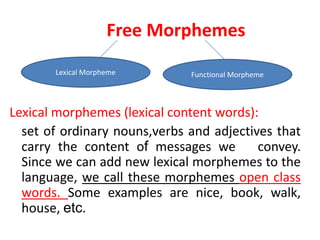
Lexical morphemes (lexical content words):
set of ordinary nouns,verbs and adjectives that
carry the content of messages we convey.
Since we can add new lexical morphemes to the
language, we call these morphemes open class
words. Some examples are nice, book, walk,
house, etc.
Lexical Morpheme Functional Morpheme
Functional morphemes
(Grammatical words)
The class of words which consist largely of functional
words in a language. We also call them closed class words
because we can not add new lexical morphemes to a
language.
Determiners- the,a/an
Preposition- in,of
Auxiliary- can,could
Intensifier- very,too
Connectors- and,or
Pronouns- I,me,he
sub.conj- while,because
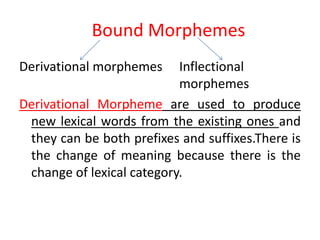
Bound Morphemes
Derivational morphemes Inflectional
morphemes
Derivational Morpheme are used to produce
new lexical words from the existing ones and
they can be both prefixes and suffixes.There is
the change of meaning because there is the
change of lexical category.
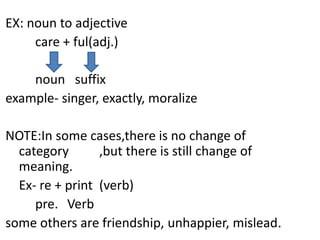
EX: noun to adjective
care + ful(adj.)
noun suffix
example- singer, exactly, moralize
NOTE:In some cases,there is no change of
category ,but there is still change of
meaning.
Ex- re + print (verb)
pre. Verb
some others are friendship, unhappier, mislead.
Inflectional morphemes
 Used to signal grammatical function of a word,not
to produce new words in a language.
 They are only found in suffixes and there is no
change of meaning or lexical category.
 These morphemes always come after the
derivational morphemes.
For Example:
-s(third person singular):She waits at home.
-ed(past tense):She cooked at home.
-ing(progressive):She is eating apple.
-en(past part.):Mary has eaten the apple.
• -s(plural):She ate the donuts.
• -’s(possessive):Sara’s hair is short.
• -er(comp.):Nina has shorter hair than Karin.
• -est(super.): Leena has the shortest hair.
Find the inflectional and derivational
morphemes in the sentences below
1) John has finished his homework.
2)I could feel the warmth of the fire
3)That is the biggest fish I have ever seen.
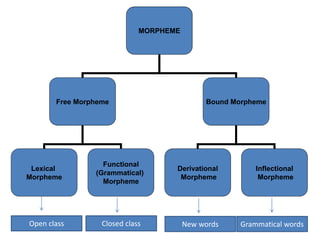
MORPHEME
Free Morpheme Bound Morpheme
Lexical
Morpheme
Functional
(Grammatical)
Morpheme
Derivational
Morpheme
Inflectional
Morpheme
Open class Closed class New words Grammatical words
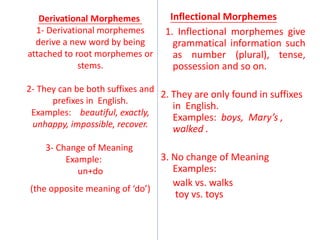
Derivational Morphemes
1- Derivational morphemes
derive a new word by being
attached to root morphemes or
stems.
2- They can be both suffixes and
prefixes in English.
Examples: beautiful, exactly,
unhappy, impossible, recover.
3- Change of Meaning
Example:
un+do
(the opposite meaning of ‘do’)
Inflectional Morphemes
1. Inflectional morphemes give
grammatical information such
as number (plural), tense,
possession and so on.
2. They are only found in suffixes
in English.
Examples: boys, Mary’s ,
walked .
3. No change of Meaning
Examples:
walk vs. walks
toy vs. toys
4. Change grammatical category
of words.
Example:
teach + er = teacher
verb + suffix =noun
4. Never change grammatical
category of words.
Example:
Walk – walks – walking - walked

Morphology introduction

  • 1.
  • 2.
    MORPHOLOGY What is Morphology? Morphologyis the study of the forms and formation of words in a language. Scope: Types of words, Morpheme types, Morphological processes and word-formation. Words in a language consist of one element or elements of meaning which are called morphemes.
  • 3.
    What is amorpheme? • A morpheme is the smallest unit of meaning or grammatical function. • A single word may be composed of one or more morphemes. EX/She looked unhappier than the day before un+ happy+er (can be analyzed into 3 morphemes)
  • 4.
    MORPHEMES free morphemes boundmorphemes (basic word forms) (prefixes and suffixes) Free Morphemes: Morphemes which can be used as a word on their own. They generally consist of separate English word forms such as nouns,verbs and adjectives. EX: girl, system, happy, act, plane, etc.
  • 5.
    Bound morphemes • Morphemeswhich can not occur on their own as an independent word.They are generally prefixes and suffixes like re-,-ist,-ed,-s in the words reprint, typist, talked and boys, for example and are attached to other forms which are described as stems- basic word forms Ex: un + happy + er(unhappier) prefix stem suffix bound free bound
  • 6.
    Free Morphemes Lexical morphemes(lexical content words): set of ordinary nouns,verbs and adjectives that carry the content of messages we convey. Since we can add new lexical morphemes to the language, we call these morphemes open class words. Some examples are nice, book, walk, house, etc. Lexical Morpheme Functional Morpheme
  • 7.
    Functional morphemes (Grammatical words) Theclass of words which consist largely of functional words in a language. We also call them closed class words because we can not add new lexical morphemes to a language. Determiners- the,a/an Preposition- in,of Auxiliary- can,could Intensifier- very,too Connectors- and,or Pronouns- I,me,he sub.conj- while,because
  • 8.
    Bound Morphemes Derivational morphemesInflectional morphemes Derivational Morpheme are used to produce new lexical words from the existing ones and they can be both prefixes and suffixes.There is the change of meaning because there is the change of lexical category.
  • 9.
    EX: noun toadjective care + ful(adj.) noun suffix example- singer, exactly, moralize NOTE:In some cases,there is no change of category ,but there is still change of meaning. Ex- re + print (verb) pre. Verb some others are friendship, unhappier, mislead.
  • 10.
    Inflectional morphemes  Usedto signal grammatical function of a word,not to produce new words in a language.  They are only found in suffixes and there is no change of meaning or lexical category.  These morphemes always come after the derivational morphemes. For Example: -s(third person singular):She waits at home. -ed(past tense):She cooked at home. -ing(progressive):She is eating apple. -en(past part.):Mary has eaten the apple.
  • 11.
    • -s(plural):She atethe donuts. • -’s(possessive):Sara’s hair is short. • -er(comp.):Nina has shorter hair than Karin. • -est(super.): Leena has the shortest hair. Find the inflectional and derivational morphemes in the sentences below 1) John has finished his homework. 2)I could feel the warmth of the fire 3)That is the biggest fish I have ever seen.
  • 12.
    MORPHEME Free Morpheme BoundMorpheme Lexical Morpheme Functional (Grammatical) Morpheme Derivational Morpheme Inflectional Morpheme Open class Closed class New words Grammatical words
  • 13.
    Derivational Morphemes 1- Derivationalmorphemes derive a new word by being attached to root morphemes or stems. 2- They can be both suffixes and prefixes in English. Examples: beautiful, exactly, unhappy, impossible, recover. 3- Change of Meaning Example: un+do (the opposite meaning of ‘do’) Inflectional Morphemes 1. Inflectional morphemes give grammatical information such as number (plural), tense, possession and so on. 2. They are only found in suffixes in English. Examples: boys, Mary’s , walked . 3. No change of Meaning Examples: walk vs. walks toy vs. toys
  • 14.
    4. Change grammaticalcategory of words. Example: teach + er = teacher verb + suffix =noun 4. Never change grammatical category of words. Example: Walk – walks – walking - walked