4.2: Morphology
Unit 4: Rules of Language Components
Group members: Aqsa Mehsood, Hira Eman, Areeba Noor, Umme
Habiba, Noor ul Huda, Emaan Fatima
Session: PGD-SLT (2024-25) 2ND
SEMESTER
Subject: (SPED3153) Linguistics and Phonetics
Course Instructor: Ms. Zaeema
Points to study:
• Historical Introduction
• What is Morphology?
• Types of Morphemes
• What is a “Word”?
• Lexemes and Word Forms
• Morphological rules of lexemes
• Internal Structures of Words and it’s key components
• Lexical and Grammatical Words
• Types of Words Formation
• Linguistic Paradigm
• Importance of Morphology in Linguistics
Introduction
In Historical Perspective (Derivation):
• Combination of two Greek words Morph (shape /form) and ology (the
study of something) is known as Morphology.
• The word was introduced in 1859 for the first time by German linguist
August Schleicher as sub- discipline of linguistics.
• He coined the word for the study of the form of words.
• It can be said that morphology studies the internal construct of words.
• Morphology is the branch of linguistics that examines the structure
and formation of words.
What is Morphology?
• The study of words is known as morphology in linguistics.
• Whereas morphemes stand for the smallest units of words, as small as
further division of these units is not possible, without destroying their
meanings.
• The study, structure and relationship of words with other words in similar
language fall under the heading of morphology in linguistics. For example,
othe examination of stem and root words;
oprefixes and suffixes or any other word structure or sections of words.
oParts of speech, intonation and stress of words.
oIt also studies the effect similar words in different context on its
meaning.
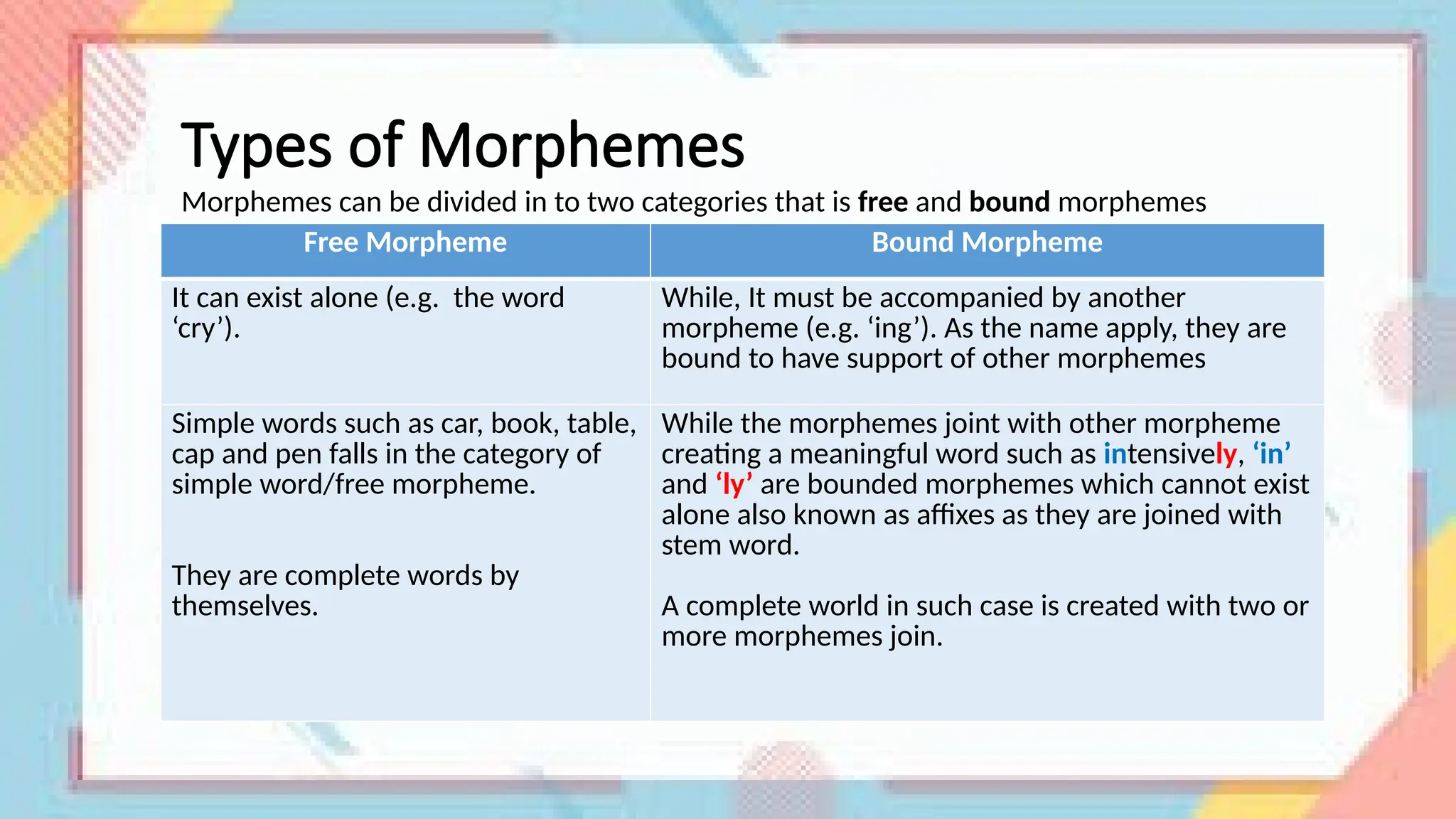
Types of Morphemes
Free Morpheme Bound Morpheme
It can exist alone (e.g. the word
‘cry’).
While, It must be accompanied by another
morpheme (e.g. ‘ing’). As the name apply, they are
bound to have support of other morphemes
Simple words such as car, book, table,
cap and pen falls in the category of
simple word/free morpheme.
They are complete words by
themselves.
While the morphemes joint with other morpheme
creating a meaningful word such as intensively, ‘in’
and ‘ly’ are bounded morphemes which cannot exist
alone also known as affixes as they are joined with
stem word.
A complete world in such case is created with two or
more morphemes join.
Morphemes can be divided in to two categories that is free and bound morphemes
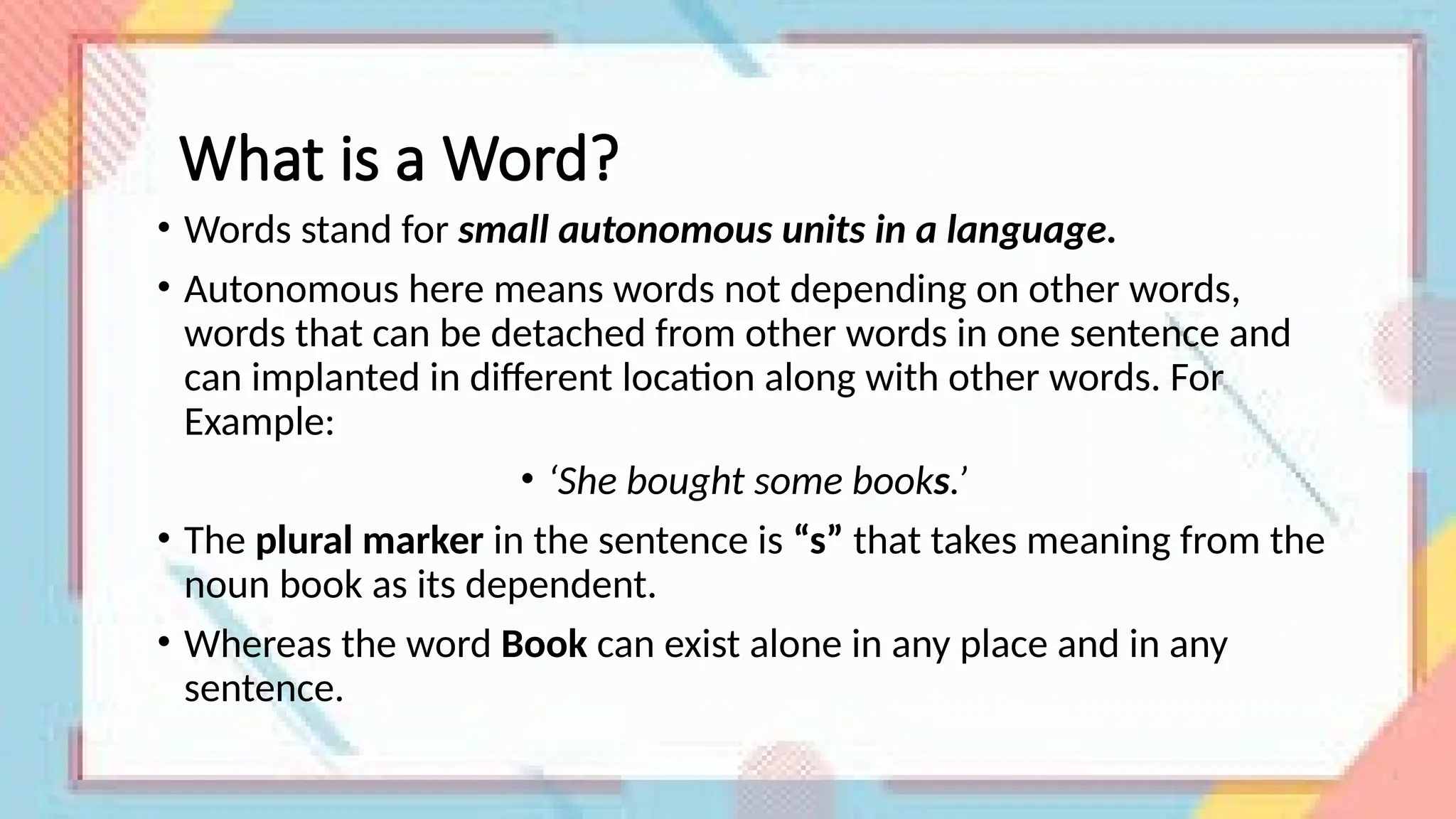
What is a Word?
• Words stand for small autonomous units in a language.
• Autonomous here means words not depending on other words,
words that can be detached from other words in one sentence and
can implanted in different location along with other words. For
Example:
• ‘She bought some books.’
• The plural marker in the sentence is “s” that takes meaning from the
noun book as its dependent.
• Whereas the word Book can exist alone in any place and in any
sentence.
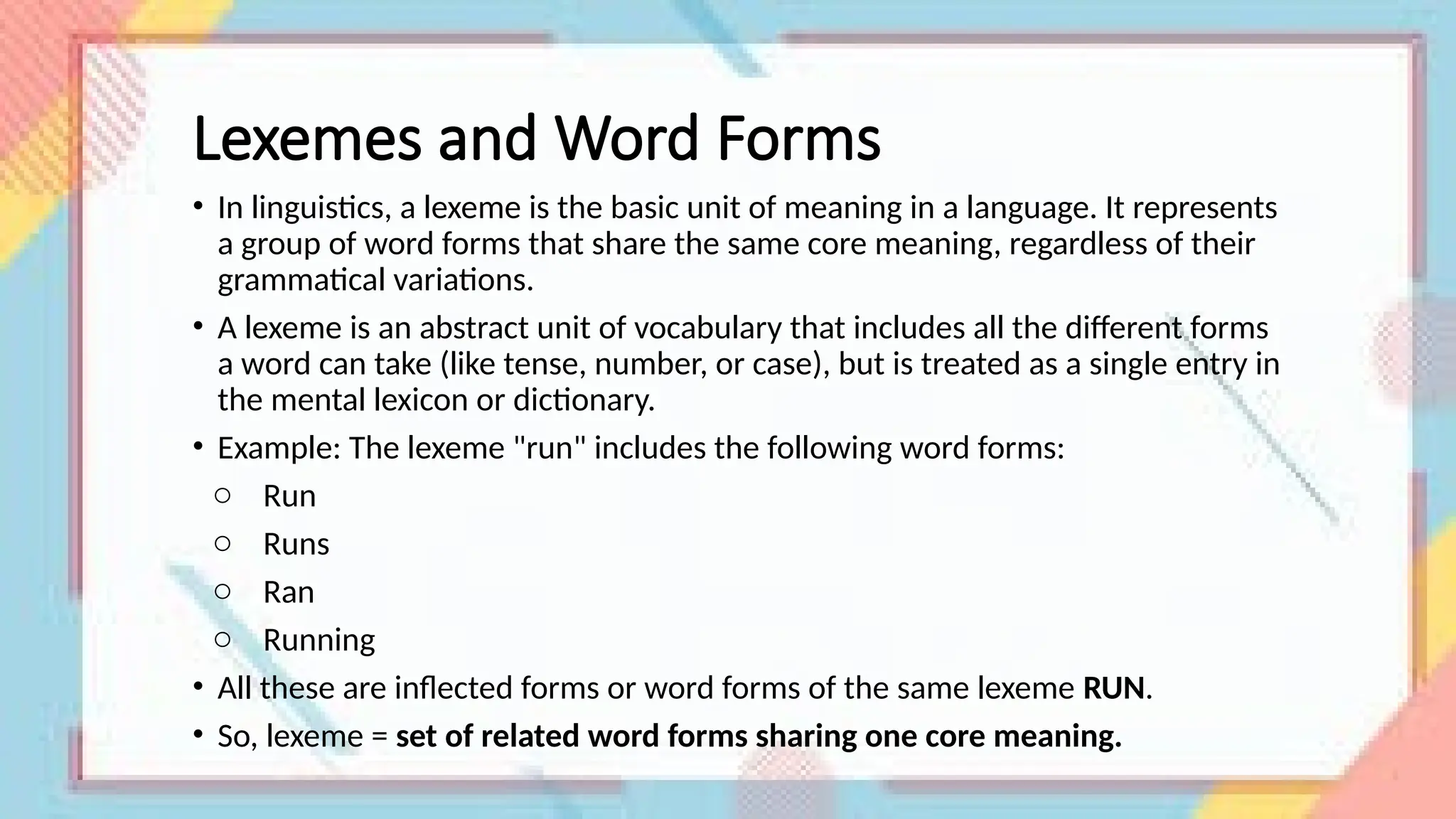
Lexemes and Word Forms
• In linguistics, a lexeme is the basic unit of meaning in a language. It represents
a group of word forms that share the same core meaning, regardless of their
grammatical variations.
• A lexeme is an abstract unit of vocabulary that includes all the different forms
a word can take (like tense, number, or case), but is treated as a single entry in
the mental lexicon or dictionary.
• Example: The lexeme "run" includes the following word forms:
o Run
o Runs
o Ran
o Running
• All these are inflected forms or word forms of the same lexeme RUN.
• So, lexeme = set of related word forms sharing one core meaning.
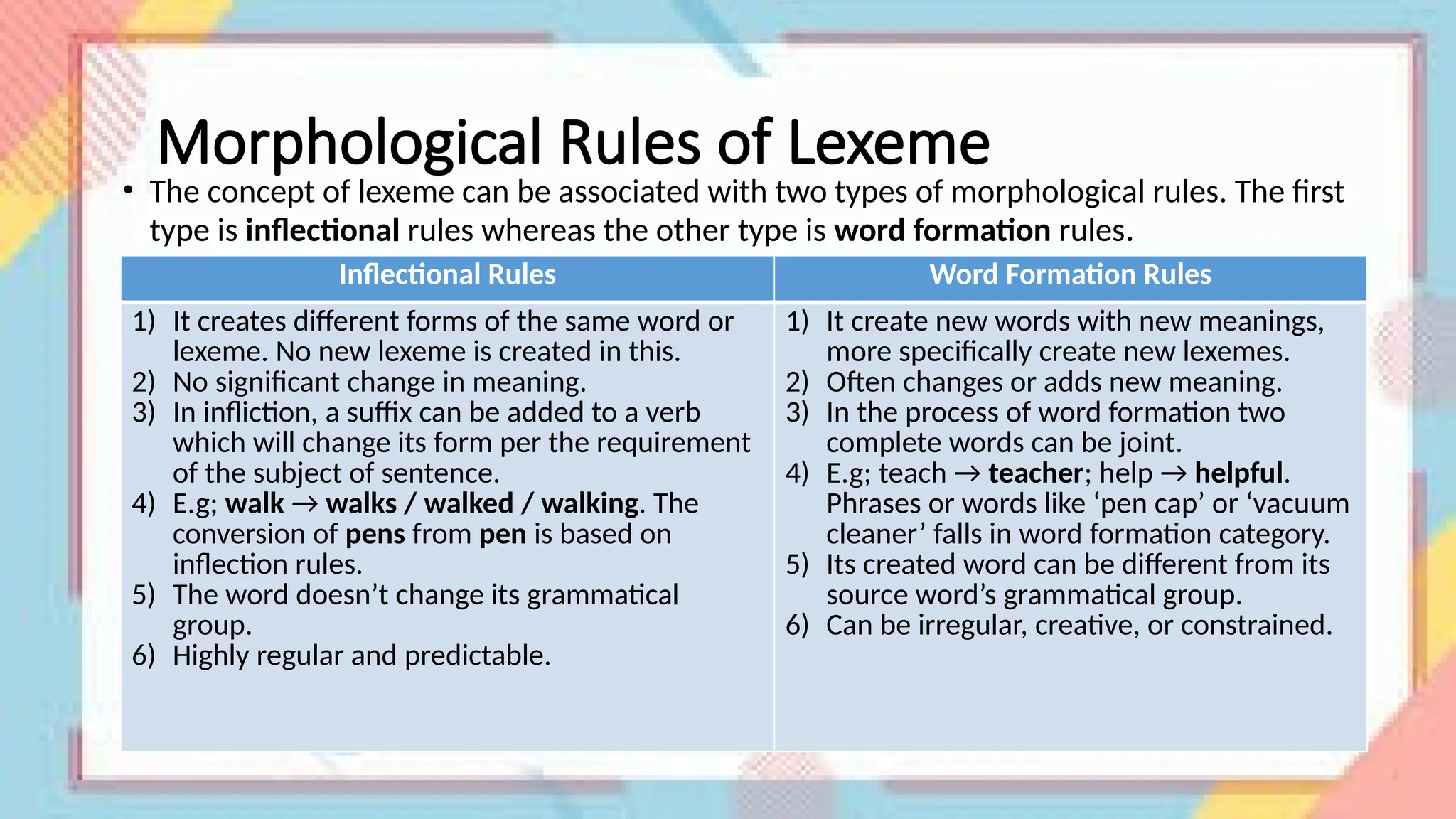
Morphological Rules of Lexeme
• The concept of lexeme can be associated with two types of morphological rules. The first
type is inflectional rules whereas the other type is word formation rules.
Inflectional Rules Word Formation Rules
1) It creates different forms of the same word or
lexeme. No new lexeme is created in this.
2) No significant change in meaning.
3) In infliction, a suffix can be added to a verb
which will change its form per the requirement
of the subject of sentence.
4) E.g; walk → walks / walked / walking. The
conversion of pens from pen is based on
inflection rules.
5) The word doesn’t change its grammatical
group.
6) Highly regular and predictable.
1) It create new words with new meanings,
more specifically create new lexemes.
2) Often changes or adds new meaning.
3) In the process of word formation two
complete words can be joint.
4) E.g; teach → teacher; help → helpful.
Phrases or words like ‘pen cap’ or ‘vacuum
cleaner’ falls in word formation category.
5) Its created word can be different from its
source word’s grammatical group.
6) Can be irregular, creative, or constrained.
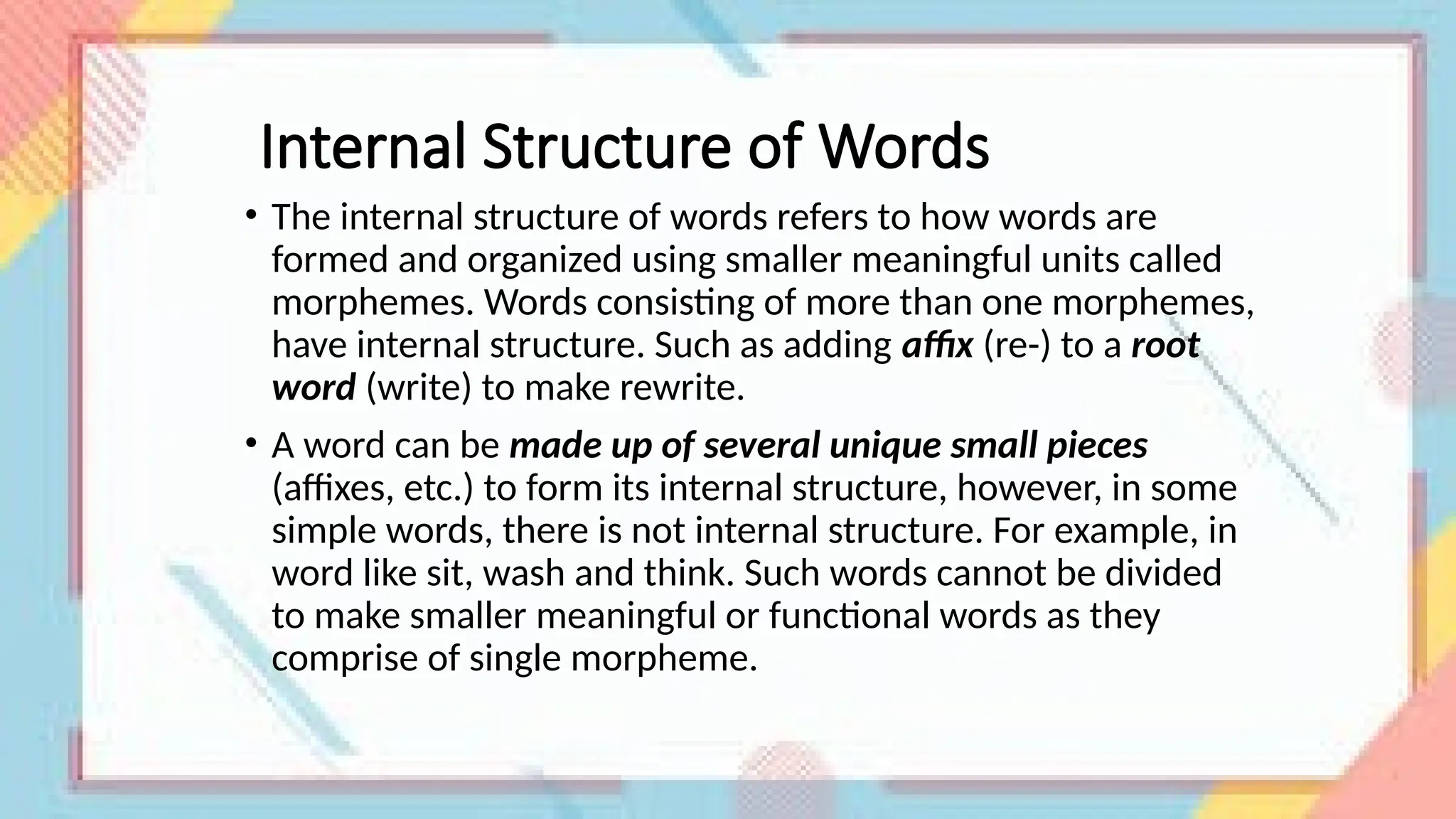
Internal Structure of Words
• The internal structure of words refers to how words are
formed and organized using smaller meaningful units called
morphemes. Words consisting of more than one morphemes,
have internal structure. Such as adding affix (re-) to a root
word (write) to make rewrite.
• A word can be made up of several unique small pieces
(affixes, etc.) to form its internal structure, however, in some
simple words, there is not internal structure. For example, in
word like sit, wash and think. Such words cannot be divided
to make smaller meaningful or functional words as they
comprise of single morpheme.
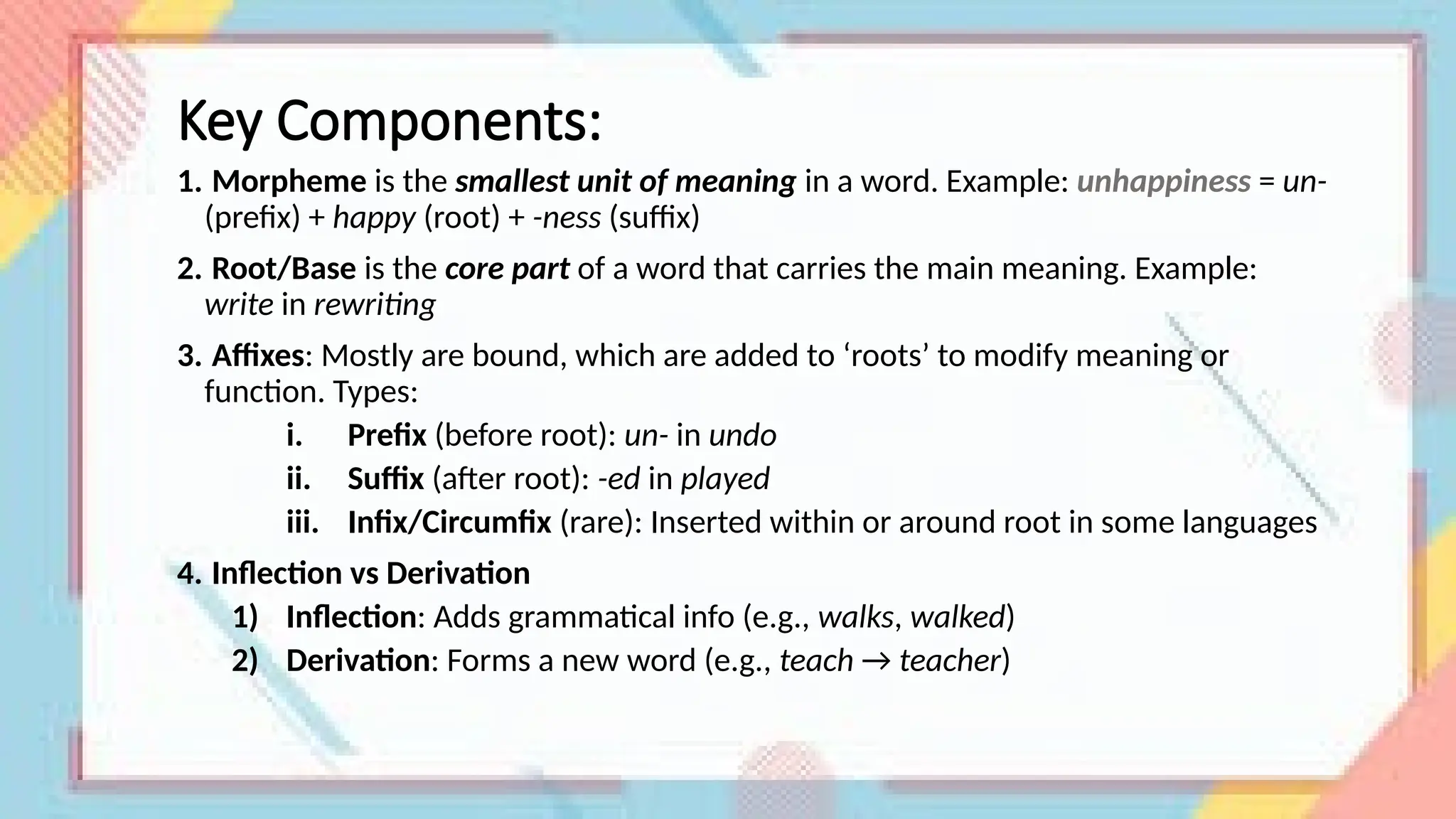
Key Components:
1. Morpheme is the smallest unit of meaning in a word. Example: unhappiness = un-
(prefix) + happy (root) + -ness (suffix)
2. Root/Base is the core part of a word that carries the main meaning. Example:
write in rewriting
3. Affixes: Mostly are bound, which are added to ‘roots’ to modify meaning or
function. Types:
i. Prefix (before root): un- in undo
ii. Suffix (after root): -ed in played
iii. Infix/Circumfix (rare): Inserted within or around root in some languages
4. Inflection vs Derivation
1) Inflection: Adds grammatical info (e.g., walks, walked)
2) Derivation: Forms a new word (e.g., teach → teacher)
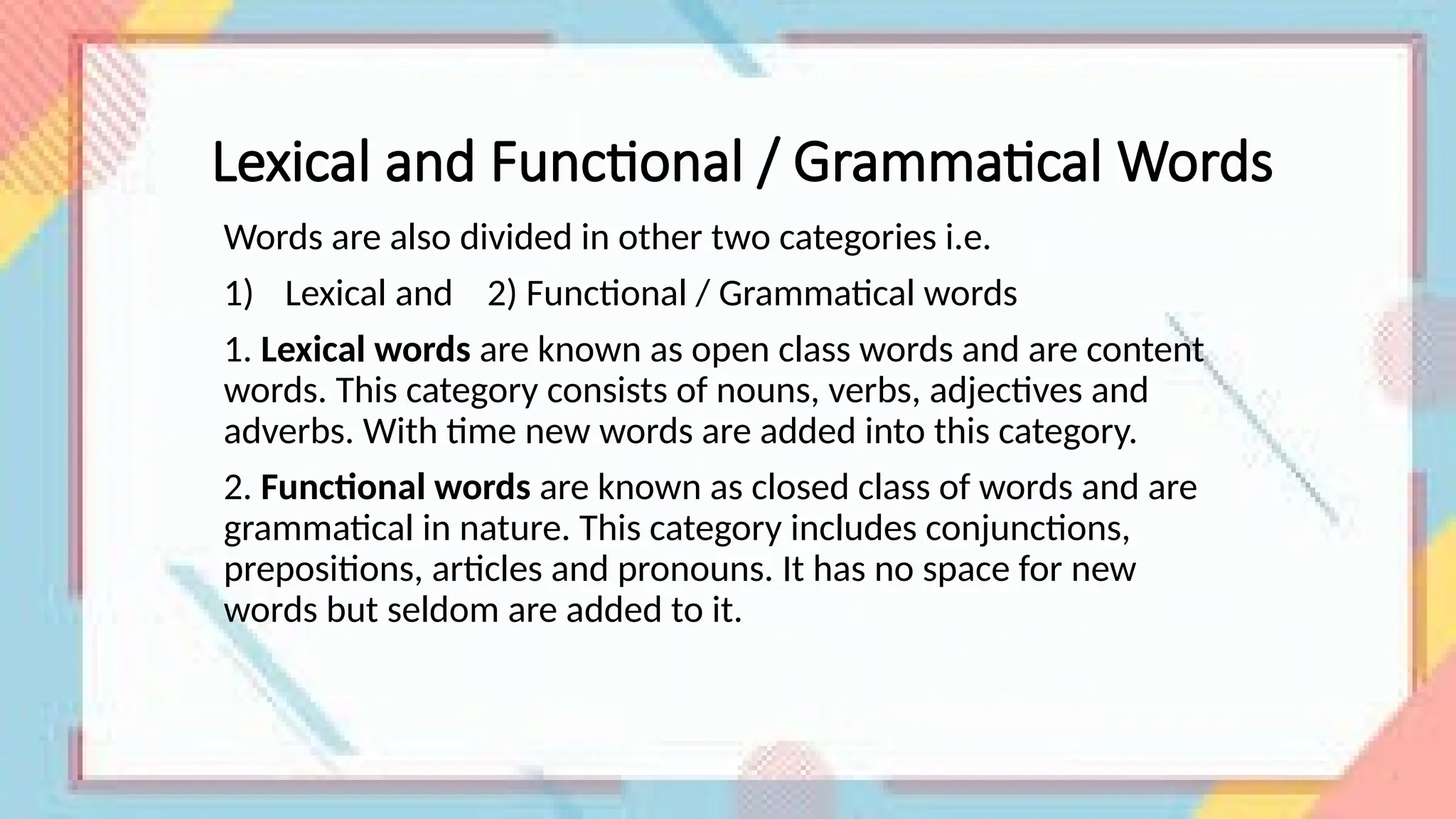
Lexical and Functional / Grammatical Words
Words are also divided in other two categories i.e.
1) Lexical and 2) Functional / Grammatical words
1. Lexical words are known as open class words and are content
words. This category consists of nouns, verbs, adjectives and
adverbs. With time new words are added into this category.
2. Functional words are known as closed class of words and are
grammatical in nature. This category includes conjunctions,
prepositions, articles and pronouns. It has no space for new
words but seldom are added to it.
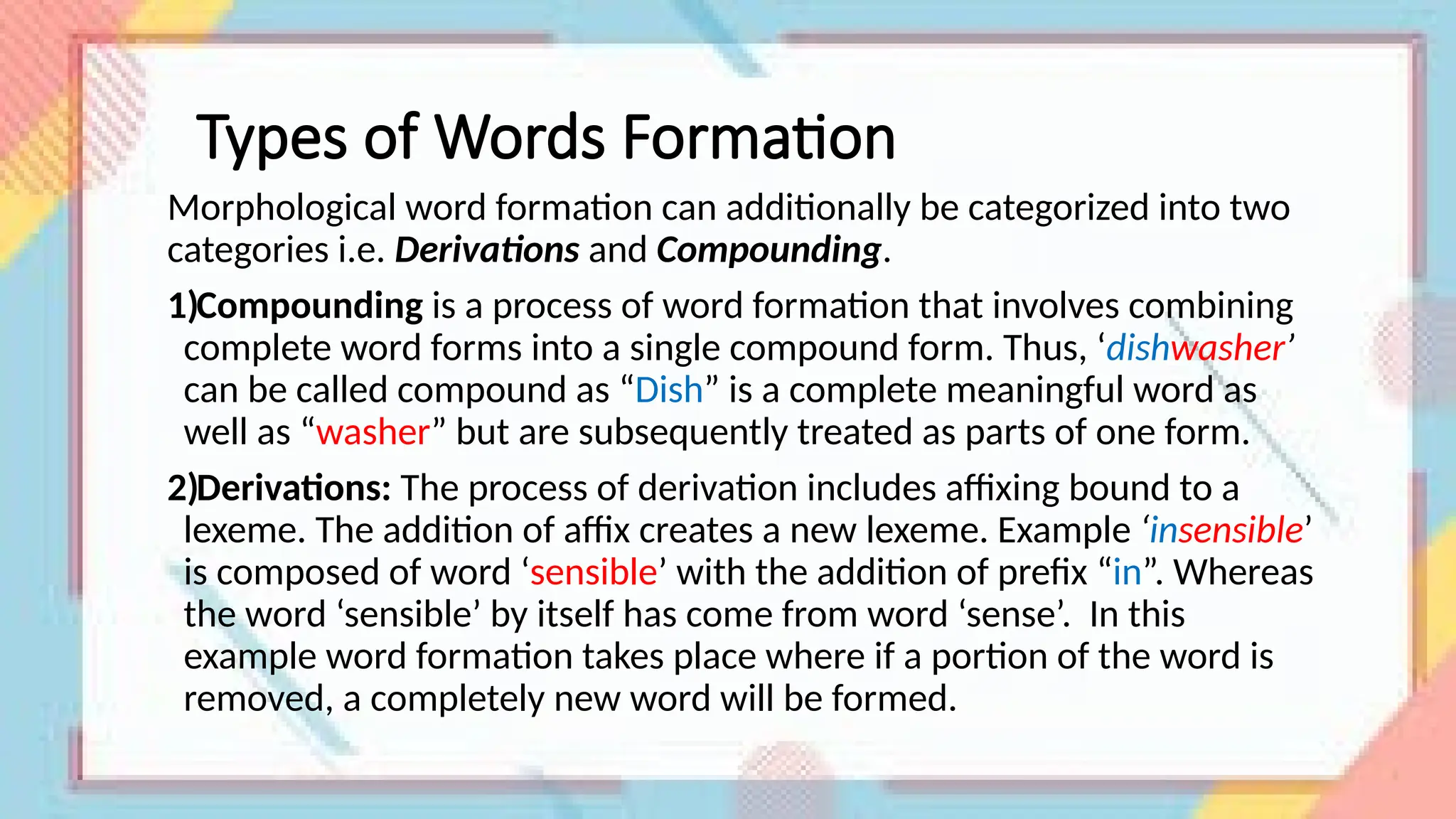
Types of Words Formation
Morphological word formation can additionally be categorized into two
categories i.e. Derivations and Compounding.
1)Compounding is a process of word formation that involves combining
complete word forms into a single compound form. Thus, ‘dishwasher’
can be called compound as “Dish” is a complete meaningful word as
well as “washer” but are subsequently treated as parts of one form.
2)Derivations: The process of derivation includes affixing bound to a
lexeme. The addition of affix creates a new lexeme. Example ‘insensible’
is composed of word ‘sensible’ with the addition of prefix “in”. Whereas
the word ‘sensible’ by itself has come from word ‘sense’. In this
example word formation takes place where if a portion of the word is
removed, a completely new word will be formed.
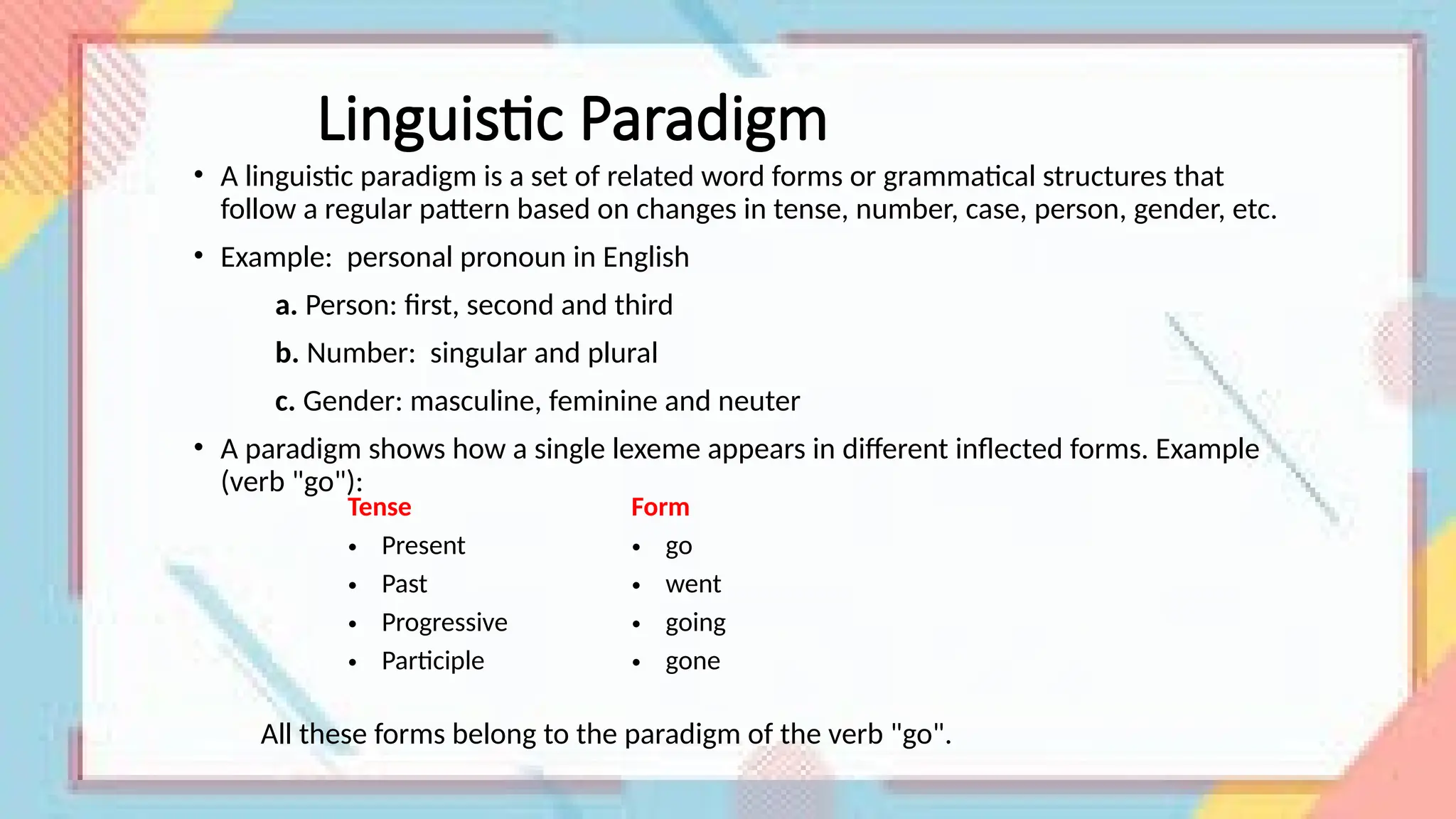
Linguistic Paradigm
• A linguistic paradigm is a set of related word forms or grammatical structures that
follow a regular pattern based on changes in tense, number, case, person, gender, etc.
• Example: personal pronoun in English
a. Person: first, second and third
b. Number: singular and plural
c. Gender: masculine, feminine and neuter
• A paradigm shows how a single lexeme appears in different inflected forms. Example
(verb "go"):
Tense Form
• Present • go
• Past • went
• Progressive • going
• Participle • gone
All these forms belong to the paradigm of the verb "go".
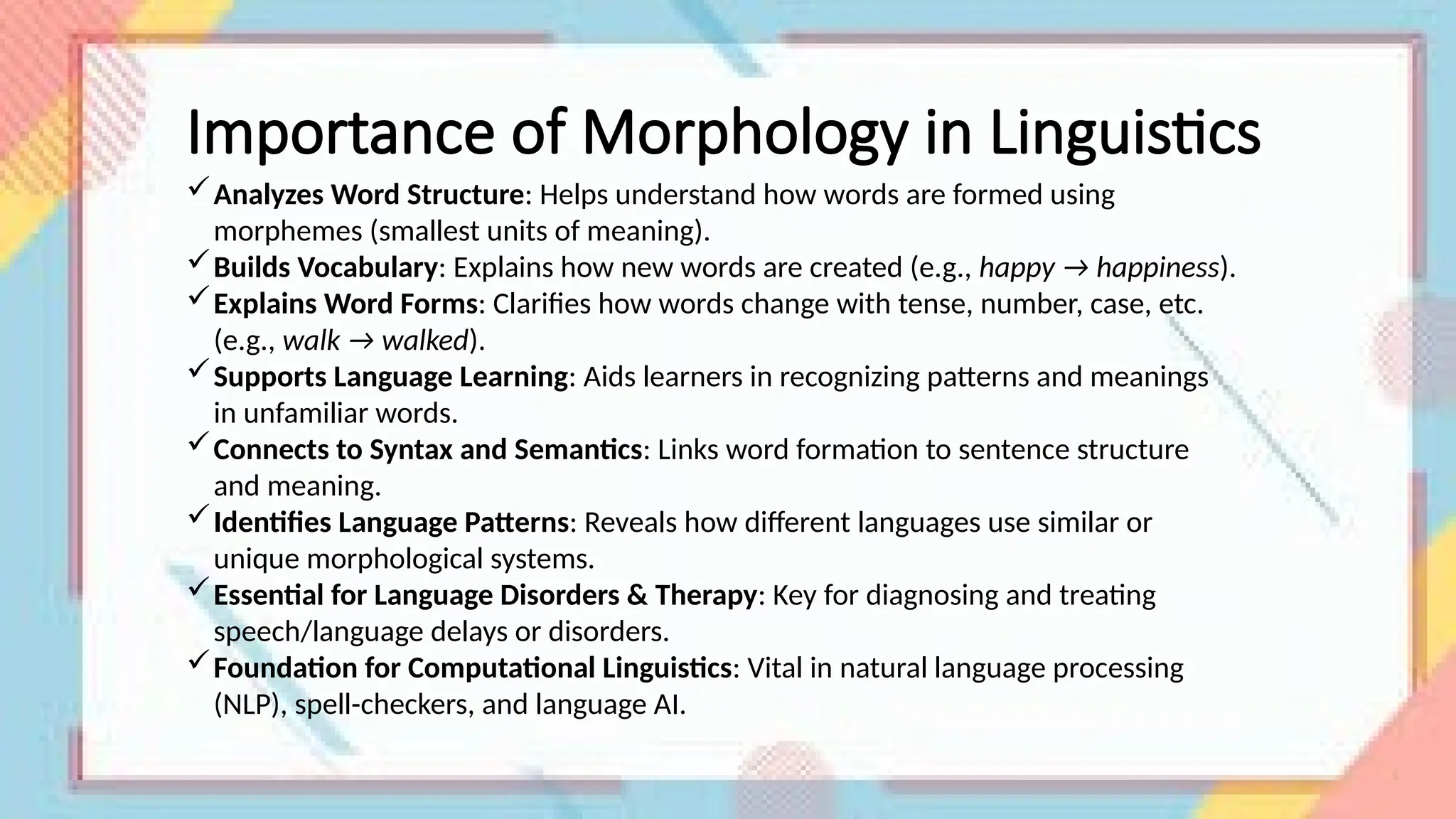
Importance of Morphology in Linguistics
Analyzes Word Structure: Helps understand how words are formed using
morphemes (smallest units of meaning).
Builds Vocabulary: Explains how new words are created (e.g., happy → happiness).
Explains Word Forms: Clarifies how words change with tense, number, case, etc.
(e.g., walk → walked).
Supports Language Learning: Aids learners in recognizing patterns and meanings
in unfamiliar words.
Connects to Syntax and Semantics: Links word formation to sentence structure
and meaning.
Identifies Language Patterns: Reveals how different languages use similar or
unique morphological systems.
Essential for Language Disorders & Therapy: Key for diagnosing and treating
speech/language delays or disorders.
Foundation for Computational Linguistics: Vital in natural language processing
(NLP), spell-checkers, and language AI.
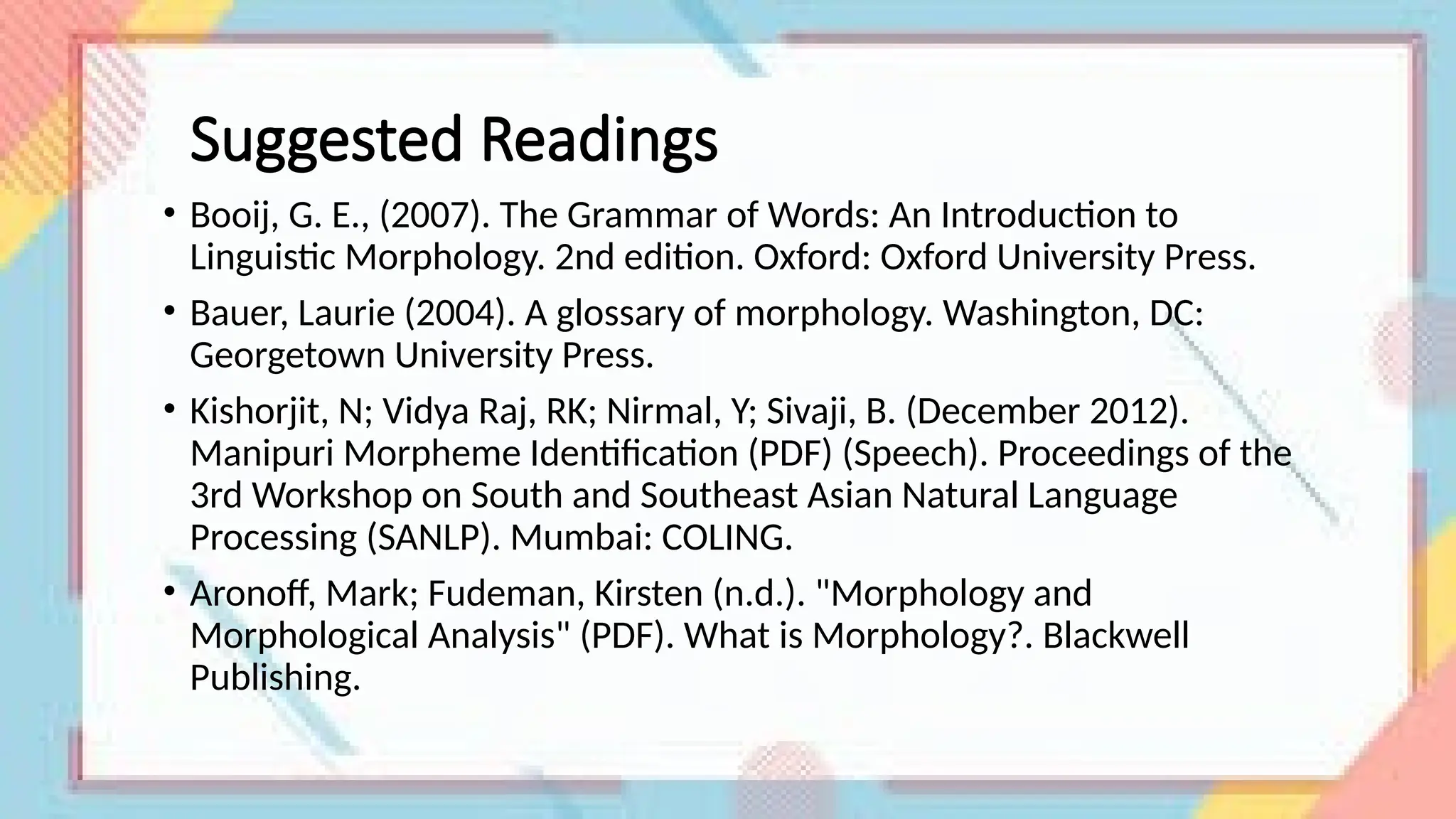
Suggested Readings
• Booij, G. E., (2007). The Grammar of Words: An Introduction to
Linguistic Morphology. 2nd edition. Oxford: Oxford University Press.
• Bauer, Laurie (2004). A glossary of morphology. Washington, DC:
Georgetown University Press.
• Kishorjit, N; Vidya Raj, RK; Nirmal, Y; Sivaji, B. (December 2012).
Manipuri Morpheme Identification (PDF) (Speech). Proceedings of the
3rd Workshop on South and Southeast Asian Natural Language
Processing (SANLP). Mumbai: COLING.
• Aronoff, Mark; Fudeman, Kirsten (n.d.). "Morphology and
Morphological Analysis" (PDF). What is Morphology?. Blackwell
Publishing.
Thank you!
Any Question?

4.2 Morphological Rules & Components: Lexemes & Types of Morphemes

  • 1.
    4.2: Morphology Unit 4:Rules of Language Components Group members: Aqsa Mehsood, Hira Eman, Areeba Noor, Umme Habiba, Noor ul Huda, Emaan Fatima Session: PGD-SLT (2024-25) 2ND SEMESTER Subject: (SPED3153) Linguistics and Phonetics Course Instructor: Ms. Zaeema
  • 2.
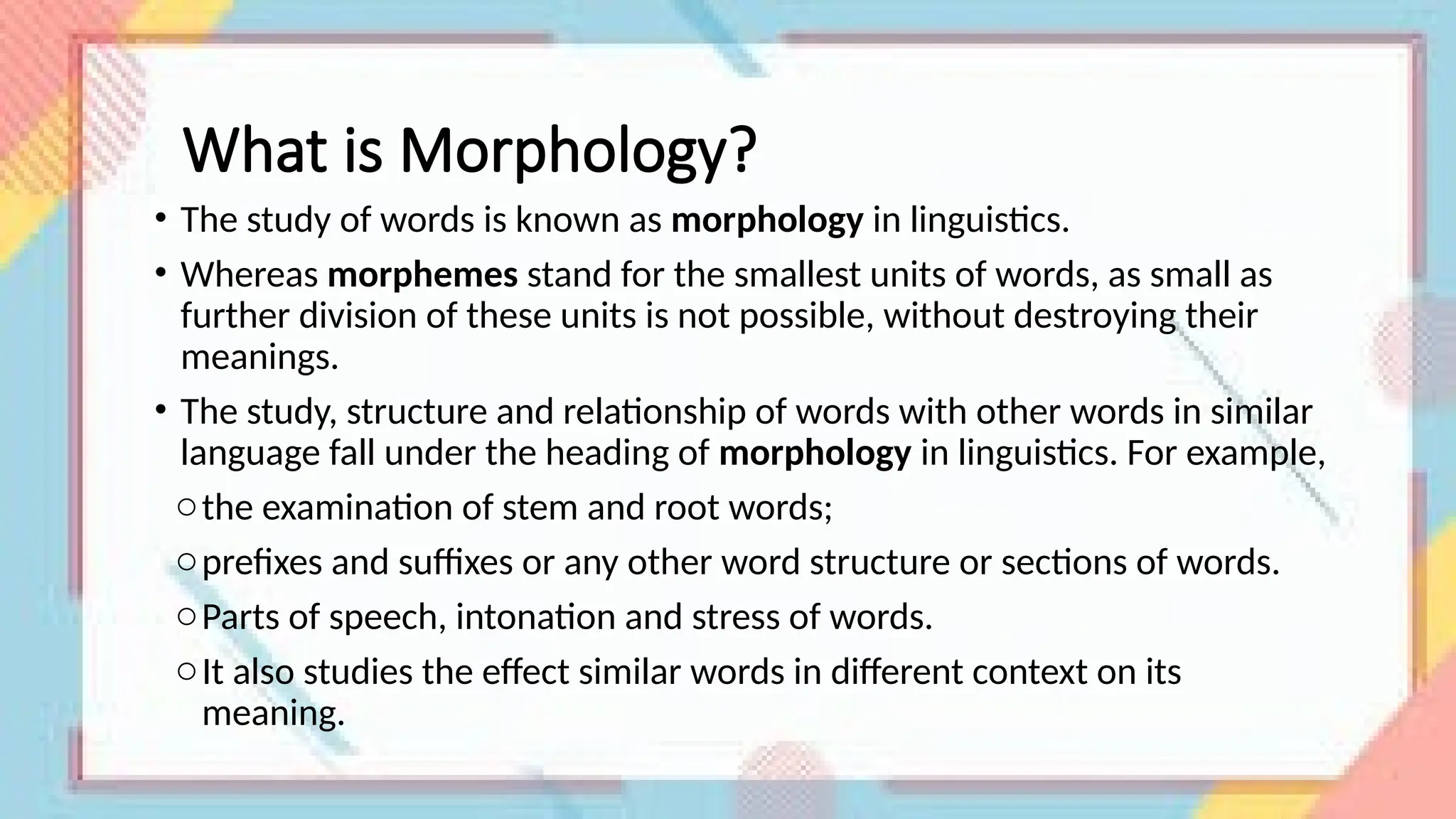
    Points to study: •Historical Introduction • What is Morphology? • Types of Morphemes • What is a “Word”? • Lexemes and Word Forms • Morphological rules of lexemes • Internal Structures of Words and it’s key components • Lexical and Grammatical Words • Types of Words Formation • Linguistic Paradigm • Importance of Morphology in Linguistics
  • 3.
    Introduction In Historical Perspective(Derivation): • Combination of two Greek words Morph (shape /form) and ology (the study of something) is known as Morphology. • The word was introduced in 1859 for the first time by German linguist August Schleicher as sub- discipline of linguistics. • He coined the word for the study of the form of words. • It can be said that morphology studies the internal construct of words. • Morphology is the branch of linguistics that examines the structure and formation of words.
  • 4.
    What is Morphology? •The study of words is known as morphology in linguistics. • Whereas morphemes stand for the smallest units of words, as small as further division of these units is not possible, without destroying their meanings. • The study, structure and relationship of words with other words in similar language fall under the heading of morphology in linguistics. For example, othe examination of stem and root words; oprefixes and suffixes or any other word structure or sections of words. oParts of speech, intonation and stress of words. oIt also studies the effect similar words in different context on its meaning.
  • 5.
    Types of Morphemes FreeMorpheme Bound Morpheme It can exist alone (e.g. the word ‘cry’). While, It must be accompanied by another morpheme (e.g. ‘ing’). As the name apply, they are bound to have support of other morphemes Simple words such as car, book, table, cap and pen falls in the category of simple word/free morpheme. They are complete words by themselves. While the morphemes joint with other morpheme creating a meaningful word such as intensively, ‘in’ and ‘ly’ are bounded morphemes which cannot exist alone also known as affixes as they are joined with stem word. A complete world in such case is created with two or more morphemes join. Morphemes can be divided in to two categories that is free and bound morphemes
  • 6.
    What is aWord? • Words stand for small autonomous units in a language. • Autonomous here means words not depending on other words, words that can be detached from other words in one sentence and can implanted in different location along with other words. For Example: • ‘She bought some books.’ • The plural marker in the sentence is “s” that takes meaning from the noun book as its dependent. • Whereas the word Book can exist alone in any place and in any sentence.
  • 7.
    Lexemes and WordForms • In linguistics, a lexeme is the basic unit of meaning in a language. It represents a group of word forms that share the same core meaning, regardless of their grammatical variations. • A lexeme is an abstract unit of vocabulary that includes all the different forms a word can take (like tense, number, or case), but is treated as a single entry in the mental lexicon or dictionary. • Example: The lexeme "run" includes the following word forms: o Run o Runs o Ran o Running • All these are inflected forms or word forms of the same lexeme RUN. • So, lexeme = set of related word forms sharing one core meaning.
  • 8.
    Morphological Rules ofLexeme • The concept of lexeme can be associated with two types of morphological rules. The first type is inflectional rules whereas the other type is word formation rules. Inflectional Rules Word Formation Rules 1) It creates different forms of the same word or lexeme. No new lexeme is created in this. 2) No significant change in meaning. 3) In infliction, a suffix can be added to a verb which will change its form per the requirement of the subject of sentence. 4) E.g; walk → walks / walked / walking. The conversion of pens from pen is based on inflection rules. 5) The word doesn’t change its grammatical group. 6) Highly regular and predictable. 1) It create new words with new meanings, more specifically create new lexemes. 2) Often changes or adds new meaning. 3) In the process of word formation two complete words can be joint. 4) E.g; teach → teacher; help → helpful. Phrases or words like ‘pen cap’ or ‘vacuum cleaner’ falls in word formation category. 5) Its created word can be different from its source word’s grammatical group. 6) Can be irregular, creative, or constrained.
  • 9.
    Internal Structure ofWords • The internal structure of words refers to how words are formed and organized using smaller meaningful units called morphemes. Words consisting of more than one morphemes, have internal structure. Such as adding affix (re-) to a root word (write) to make rewrite. • A word can be made up of several unique small pieces (affixes, etc.) to form its internal structure, however, in some simple words, there is not internal structure. For example, in word like sit, wash and think. Such words cannot be divided to make smaller meaningful or functional words as they comprise of single morpheme.
  • 10.
    Key Components: 1. Morphemeis the smallest unit of meaning in a word. Example: unhappiness = un- (prefix) + happy (root) + -ness (suffix) 2. Root/Base is the core part of a word that carries the main meaning. Example: write in rewriting 3. Affixes: Mostly are bound, which are added to ‘roots’ to modify meaning or function. Types: i. Prefix (before root): un- in undo ii. Suffix (after root): -ed in played iii. Infix/Circumfix (rare): Inserted within or around root in some languages 4. Inflection vs Derivation 1) Inflection: Adds grammatical info (e.g., walks, walked) 2) Derivation: Forms a new word (e.g., teach → teacher)
  • 11.
    Lexical and Functional/ Grammatical Words Words are also divided in other two categories i.e. 1) Lexical and 2) Functional / Grammatical words 1. Lexical words are known as open class words and are content words. This category consists of nouns, verbs, adjectives and adverbs. With time new words are added into this category. 2. Functional words are known as closed class of words and are grammatical in nature. This category includes conjunctions, prepositions, articles and pronouns. It has no space for new words but seldom are added to it.
  • 12.
    Types of WordsFormation Morphological word formation can additionally be categorized into two categories i.e. Derivations and Compounding. 1)Compounding is a process of word formation that involves combining complete word forms into a single compound form. Thus, ‘dishwasher’ can be called compound as “Dish” is a complete meaningful word as well as “washer” but are subsequently treated as parts of one form. 2)Derivations: The process of derivation includes affixing bound to a lexeme. The addition of affix creates a new lexeme. Example ‘insensible’ is composed of word ‘sensible’ with the addition of prefix “in”. Whereas the word ‘sensible’ by itself has come from word ‘sense’. In this example word formation takes place where if a portion of the word is removed, a completely new word will be formed.
  • 13.
    Linguistic Paradigm • Alinguistic paradigm is a set of related word forms or grammatical structures that follow a regular pattern based on changes in tense, number, case, person, gender, etc. • Example: personal pronoun in English a. Person: first, second and third b. Number: singular and plural c. Gender: masculine, feminine and neuter • A paradigm shows how a single lexeme appears in different inflected forms. Example (verb "go"): Tense Form • Present • go • Past • went • Progressive • going • Participle • gone All these forms belong to the paradigm of the verb "go".
  • 14.
    Importance of Morphologyin Linguistics Analyzes Word Structure: Helps understand how words are formed using morphemes (smallest units of meaning). Builds Vocabulary: Explains how new words are created (e.g., happy → happiness). Explains Word Forms: Clarifies how words change with tense, number, case, etc. (e.g., walk → walked). Supports Language Learning: Aids learners in recognizing patterns and meanings in unfamiliar words. Connects to Syntax and Semantics: Links word formation to sentence structure and meaning. Identifies Language Patterns: Reveals how different languages use similar or unique morphological systems. Essential for Language Disorders & Therapy: Key for diagnosing and treating speech/language delays or disorders. Foundation for Computational Linguistics: Vital in natural language processing (NLP), spell-checkers, and language AI.
  • 15.
    Suggested Readings • Booij,G. E., (2007). The Grammar of Words: An Introduction to Linguistic Morphology. 2nd edition. Oxford: Oxford University Press. • Bauer, Laurie (2004). A glossary of morphology. Washington, DC: Georgetown University Press. • Kishorjit, N; Vidya Raj, RK; Nirmal, Y; Sivaji, B. (December 2012). Manipuri Morpheme Identification (PDF) (Speech). Proceedings of the 3rd Workshop on South and Southeast Asian Natural Language Processing (SANLP). Mumbai: COLING. • Aronoff, Mark; Fudeman, Kirsten (n.d.). "Morphology and Morphological Analysis" (PDF). What is Morphology?. Blackwell Publishing.
  • 16.