MORPHOLOGY
Morphology in Linguistics
Morphology: is the study of forms.
Morphology: is The branch of linguistics (and one of the
major components of grammar) that studies word
structures, especially in terms of morphemes.
Morphology: is the study and description of word
Formation (as inflection, derivation, and compounding) in
language
Morphology: is the study of word formation, of the
structure of words.
Morphemes
Morpheme is a minimal unit of meaning or
grammatical function.
It is a meaningful linguistic unit consisting of a
word, such as man, or a word element,
such as -ed in walked, that cannot be divided
into smaller meaningful parts.
It is a smallest morphological unit that cannot be
divided into smaller parts.
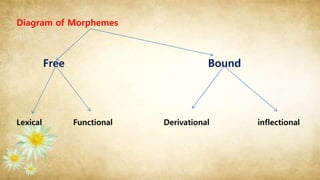
Diagram of Morphemes
Free Bound
Lexical Functional Derivational inflectional
A. Free Morpheme
• The type of morpheme that can stand alone as
words by themselves
EXAMPLE
friend boy tree
*Free morphemes have two categories
Free morphemes are those that can stand alone as words.
They may be lexical morphemes ({serve}, {press}), or
grammatical(functional) morphemes ({at}, {and}).In English,
free morphemes can be identified as the set of separate word
forms such as basic nouns, adjectives,verbs, etc.
e.g. care, teach, help, above….
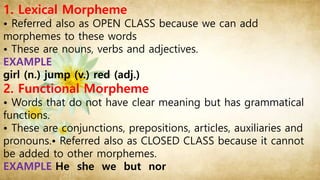
1. Lexical Morpheme
• Referred also as OPEN CLASS because we can add
morphemes to these words
• These are nouns, verbs and adjectives.
EXAMPLE
girl (n.) jump (v.) red (adj.)
2. Functional Morpheme
• Words that do not have clear meaning but has grammatical
functions.
• These are conjunctions, prepositions, articles, auxiliaries and
pronouns.• Referred also as CLOSED CLASS because it cannot
be added to other morphemes.
EXAMPLE He she we but nor
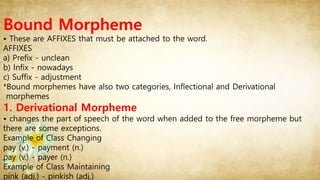
Bound Morpheme
• These are AFFIXES that must be attached to the word.
AFFIXES
a) Prefix - unclean
b) Infix - nowadays
c) Suffix - adjustment
*Bound morphemes have also two categories, Inflectional and Derivational
morphemes
1. Derivational Morpheme
• changes the part of speech of the word when added to the free morpheme but
there are some exceptions.
Example of Class Changing
pay (v.) - payment (n.)
pay (v.) - payer (n.)
Example of Class Maintaining
pink (adj.) - pinkish (adj.)
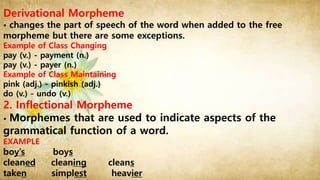
Derivational Morpheme
• changes the part of speech of the word when added to the free
morpheme but there are some exceptions.
Example of Class Changing
pay (v.) - payment (n.)
pay (v.) - payer (n.)
Example of Class Maintaining
pink (adj.) - pinkish (adj.)
do (v.) - undo (v.)
2. Inflectional Morpheme
• Morphemes that are used to indicate aspects of the
grammatical function of a word.
EXAMPLE
boy’s boys
cleaned cleaning cleans
taken simplest heavier
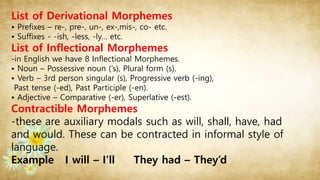
List of Derivational Morphemes
• Prefixes – re-, pre-, un-, ex-,mis-, co- etc.
• Suffixes - -ish, -less, -ly… etc.
List of Inflectional Morphemes
-in English we have 8 Inflectional Morphemes.
• Noun – Possessive noun (‘s), Plural form (s).
• Verb – 3rd person singular (s), Progressive verb (-ing),
Past tense (-ed), Past Participle (-en).
• Adjective – Comparative (-er), Superlative (-est).
Contractible Morphemes
-these are auxiliary modals such as will, shall, have, had
and would. These can be contracted in informal style of
language.
Example I will – I’ll They had – They’d
Root and Stem
• Root words are the basic part of a word that carries meaning.
• Stem is when a root morpheme is combined with affix morpheme.
EXAMPLE
root: teach
affix : -er
stem: teacher
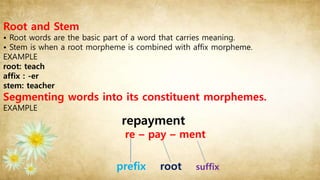
Segmenting words into its constituent morphemes.
EXAMPLE
repayment
re – pay – ment
prefix root suffix
Morphological Description
a) The difference between Inflectional and Derivational Morpheme?
• Inflectional morpheme never change the grammatical category of the word.
Old (adj.) older (adj.)
b) While Derivational Morpheme can change the grammatical category
of a word.
teach (v.) teacher (n.)
Morphs and allomorphs
Allomorph is variant form of a morpheme about the sounds and
phonetic symbol but it doesn’t change the meaning. Allomorph has
different in pronunciation and spelling according to their condition. It
means that allomorph will have different sound, pronunciation or spelling
in different condition.
Morphs and allomorphs(2)
We can propose the morphs as the actual form used to realize morphemes.
Ex Cars= car + s ;
buses= bus + es. If we lose –s or –es it will change the
meaning.
• Allomorphs
men man
Summing up
• Morphology is the study of word structure and word
formation.
• The smallest meaningful part of the word is called
morpheme.
• Morphemes have two classification
these are Free and Bound Morphemes.
• Free morphemes categories are Lexical and Functional
Morphemes.
• Bound morphemes includes Inflectional and derivational
morphemes
#Morphology#

#Morphology#

  • 1.
  • 2.
    Morphology in Linguistics Morphology:is the study of forms. Morphology: is The branch of linguistics (and one of the major components of grammar) that studies word structures, especially in terms of morphemes. Morphology: is the study and description of word Formation (as inflection, derivation, and compounding) in language Morphology: is the study of word formation, of the structure of words.
  • 3.
    Morphemes Morpheme is aminimal unit of meaning or grammatical function. It is a meaningful linguistic unit consisting of a word, such as man, or a word element, such as -ed in walked, that cannot be divided into smaller meaningful parts. It is a smallest morphological unit that cannot be divided into smaller parts.
  • 4.
    Diagram of Morphemes FreeBound Lexical Functional Derivational inflectional
  • 5.
    A. Free Morpheme •The type of morpheme that can stand alone as words by themselves EXAMPLE friend boy tree *Free morphemes have two categories Free morphemes are those that can stand alone as words. They may be lexical morphemes ({serve}, {press}), or grammatical(functional) morphemes ({at}, {and}).In English, free morphemes can be identified as the set of separate word forms such as basic nouns, adjectives,verbs, etc. e.g. care, teach, help, above….
  • 6.
    1. Lexical Morpheme •Referred also as OPEN CLASS because we can add morphemes to these words • These are nouns, verbs and adjectives. EXAMPLE girl (n.) jump (v.) red (adj.) 2. Functional Morpheme • Words that do not have clear meaning but has grammatical functions. • These are conjunctions, prepositions, articles, auxiliaries and pronouns.• Referred also as CLOSED CLASS because it cannot be added to other morphemes. EXAMPLE He she we but nor
  • 7.
    Bound Morpheme • Theseare AFFIXES that must be attached to the word. AFFIXES a) Prefix - unclean b) Infix - nowadays c) Suffix - adjustment *Bound morphemes have also two categories, Inflectional and Derivational morphemes 1. Derivational Morpheme • changes the part of speech of the word when added to the free morpheme but there are some exceptions. Example of Class Changing pay (v.) - payment (n.) pay (v.) - payer (n.) Example of Class Maintaining pink (adj.) - pinkish (adj.)
  • 8.
    Derivational Morpheme • changesthe part of speech of the word when added to the free morpheme but there are some exceptions. Example of Class Changing pay (v.) - payment (n.) pay (v.) - payer (n.) Example of Class Maintaining pink (adj.) - pinkish (adj.) do (v.) - undo (v.) 2. Inflectional Morpheme • Morphemes that are used to indicate aspects of the grammatical function of a word. EXAMPLE boy’s boys cleaned cleaning cleans taken simplest heavier
  • 9.
    List of DerivationalMorphemes • Prefixes – re-, pre-, un-, ex-,mis-, co- etc. • Suffixes - -ish, -less, -ly… etc. List of Inflectional Morphemes -in English we have 8 Inflectional Morphemes. • Noun – Possessive noun (‘s), Plural form (s). • Verb – 3rd person singular (s), Progressive verb (-ing), Past tense (-ed), Past Participle (-en). • Adjective – Comparative (-er), Superlative (-est). Contractible Morphemes -these are auxiliary modals such as will, shall, have, had and would. These can be contracted in informal style of language. Example I will – I’ll They had – They’d
  • 10.
    Root and Stem •Root words are the basic part of a word that carries meaning. • Stem is when a root morpheme is combined with affix morpheme. EXAMPLE root: teach affix : -er stem: teacher Segmenting words into its constituent morphemes. EXAMPLE repayment re – pay – ment prefix root suffix
  • 11.
    Morphological Description a) Thedifference between Inflectional and Derivational Morpheme? • Inflectional morpheme never change the grammatical category of the word. Old (adj.) older (adj.) b) While Derivational Morpheme can change the grammatical category of a word. teach (v.) teacher (n.) Morphs and allomorphs Allomorph is variant form of a morpheme about the sounds and phonetic symbol but it doesn’t change the meaning. Allomorph has different in pronunciation and spelling according to their condition. It means that allomorph will have different sound, pronunciation or spelling in different condition.
  • 12.
    Morphs and allomorphs(2) Wecan propose the morphs as the actual form used to realize morphemes. Ex Cars= car + s ; buses= bus + es. If we lose –s or –es it will change the meaning. • Allomorphs men man
  • 13.
    Summing up • Morphologyis the study of word structure and word formation. • The smallest meaningful part of the word is called morpheme. • Morphemes have two classification these are Free and Bound Morphemes. • Free morphemes categories are Lexical and Functional Morphemes. • Bound morphemes includes Inflectional and derivational morphemes