0 
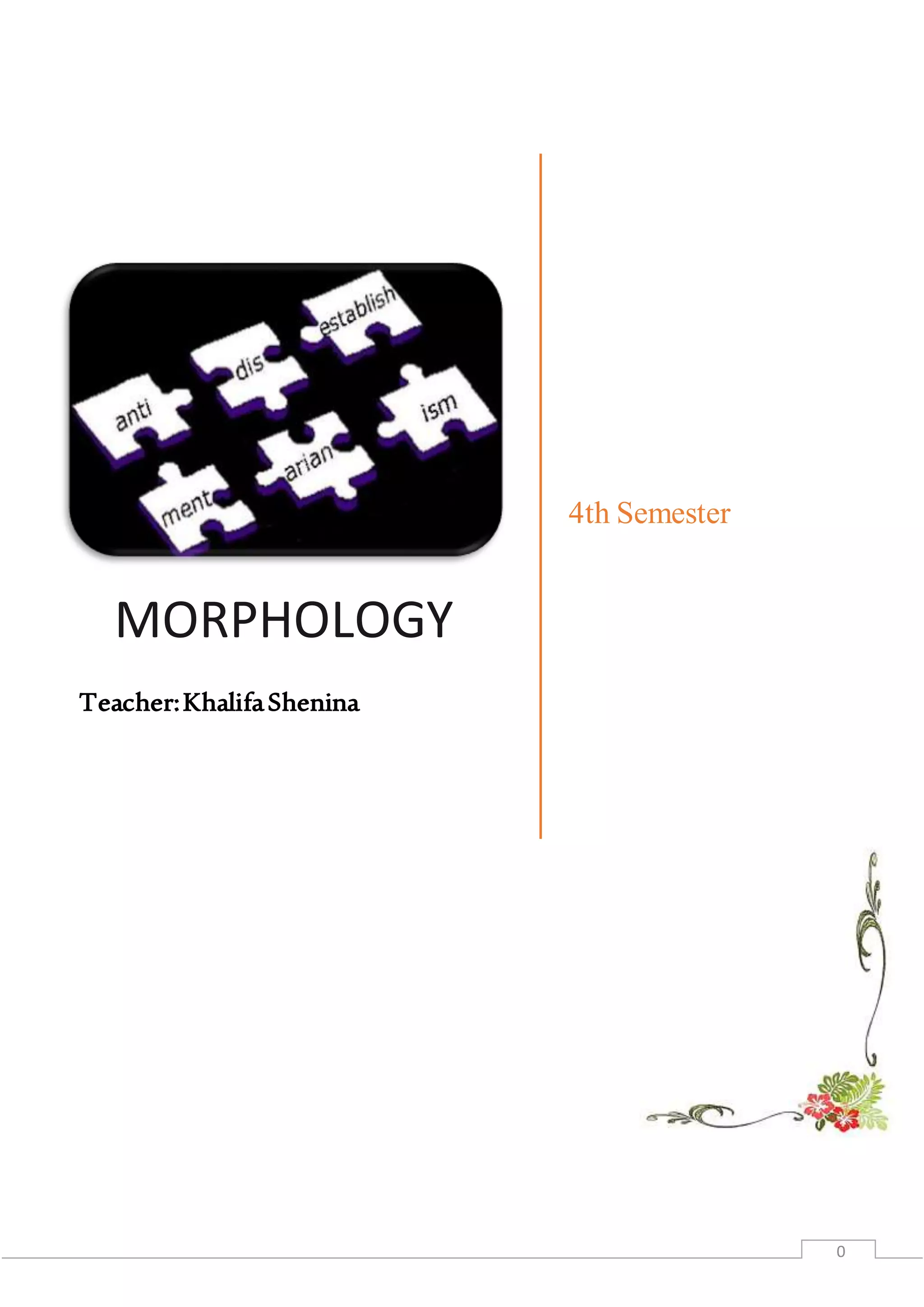
MORPHOLOGY 
Teacher: Khalifa Shenina 
4th Semester
1 
Lecture 1 
What is Morphology? 
Morphology is a branch of linguistics which deals with the internal 
structure of words. It is the study of how words are put together. 
The word itself consists of two morphemes, morph + ology. 
The suffix –ology means "science of" and morph- means "word". 
* A morpheme is the smallest unit of language that has its own 
meaning. Simple words like giraffe, wiggle, or yellow are morphemes, 
but so are prefixes like re- and pre- and suffixes like –ize and –er. 
* General definitions for what a word means: 
- A word is a stretch of letters that occurs between blank spaces. 
- "A word is something small that means something". 
A word is one or more morphemes that can stand alone in a language. 
Simple (simplex) words: are words that consist of only one morpheme, 
like giraffe, fraud, murmur, oops, just, pistachio. 
Complex words: are words that are made up of more than one 
morpheme, like opposition, intellectual, crystallize, prewash, repressive, 
blackboard. 
Words and Lexemes, types and tokens 
How many words occur in the following sentence? 
My friend and I walk to class together, because our classes are in the 
same building and we dislike walking alone. 
When you count words, you may count them in a number of ways. 
Therefore, it's useful to have some special terms for how we count 
words. 
1- If we are counting every instance in a which a word occurs in a 
sentence, regardless of whether that word has occurred before or not, 
we are counting word tokens. If we count word tokens in the sentence 
above, we count 21.
2 
2- If we are counting a word once, no matter how many times it 
occurred in a sentence, we are counting word types. Counting this way, 
we count 20 types in the sentence above the two tokens of the word 
and count as one type. 
3- Another way of counting words is by using lexemes. Lexemes can be 
thought of as families of words that differ only in their grammatical 
endings or grammatical forms. E.g. singular and plural forms of a noun 
(class, classes), present, past and participle forms of verbs (walk, walks, 
walked, walking), different forms of a pronoun (I,me, my, mine) each 
represent a single lexeme. 
One way of thinking about lexemes is that they are the basis of 
dictionary entries: dictionaries typically have a single entry for each 
lexeme. 
So if we are counting lexemes in the sentence above, we would count 
class and classes, walk and walking, I and my, and our and we as single 
lexemes; the sentence then has 16 lexemes. 
*** *** *** *** ***
3 
Lecture 2 
Morpheme is the smallest meaningful unit in the language that meets 
three criteria: 
1- It is a meaningful segment. 
2- It's indivisible. It cannot be cut down into smaller parts. 
If you try to divide a morpheme, you'll end up either with having 
meaningless parts or the meaning of the parts, if any, will not be related 
to the meaning of the whole. 
3- It reoccurs in the language with a relatively stable meaning. 
Types of morphemes: 
Depending on the way morphemes occur in the utterance, they are 
grouped into two large groups: 
1- Free (independent) morphemes: 
They are morphemes which can occur alone as words and have a 
meaning or fulfill a grammatical function. E.g., man, and, run 
It can be divided into two categories: 
a) Lexical (content) morphemes: They are free morphemes that have 
semantic content or meaning, and usually refer to a thing, quality, state 
or action. In the language, these morphemes take the forms of nouns, 
verbs, adjectives and adverbs. 
b) Functional (grammatical) morphemes: They are free morphemes 
which have little or no meaning on their own, but which show 
grammatical relationships in and between sentences. They are 
represented by prepositions, articles, conjunctions, pronouns, 
demonstratives and auxiliary verbs.
4 
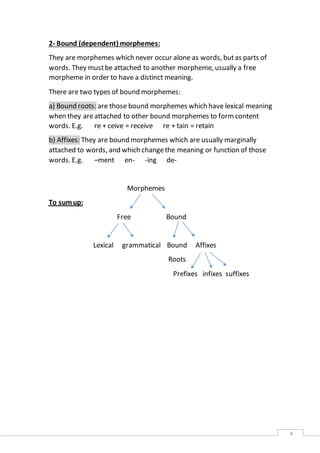
2- Bound (dependent) morphemes: 
They are morphemes which never occur alone as words, but as parts of 
words. They must be attached to another morpheme, usually a free 
morpheme in order to have a distinct meaning. 
There are two types of bound morphemes: 
a) Bound roots: are those bound morphemes which have lexical meaning 
when they are attached to other bound morphemes to form content 
words. E.g. re + ceive = receive re + tain = retain 
b) Affixes: They are bound morphemes which are usually marginally 
attached to words, and which change the meaning or function of those 
words. E.g. –ment en- -ing de- 
Morphemes 
To sum up: 
Free Bound 
Lexical grammatical Bound Affixes 
Roots 
Prefixes infixes suffixes
5 
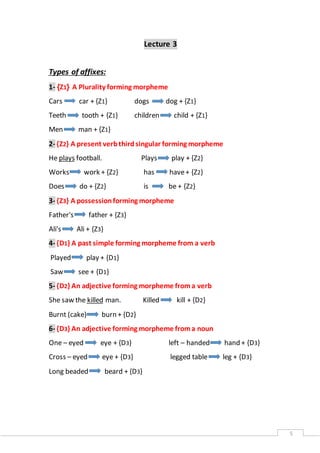
Lecture 3 
Types of affixes: 
1- }Z1{ A Plurality forming morpheme 
Cars car + {Z1} dogs dog + {Z1} 
Teeth tooth + {Z1} children child + {Z1} 
Men man + {Z1} 
2- {Z2} A present verb third singular forming morpheme 
He plays football. Plays play + {Z2} 
Works work + {Z2} has have + {Z2} 
Does do + {Z2} is be + {Z2} 
3- {Z3} A possession forming morpheme 
Father's father + {Z3} 
Ali's Ali + {Z3} 
4- {D1} A past simple forming morpheme from a verb 
Played play + {D1} 
Saw see + {D1} 
5- {D2} An adjective forming morpheme from a verb 
She saw the killed man. Killed kill + {D2} 
Burnt (cake) burn + {D2} 
6- {D3} An adjective forming morpheme from a noun 
One – eyed eye + {D3} left – handed hand + {D3} 
Cross – eyed eye + {D3} legged table leg + {D3} 
Long beaded beard + {D3}
6 
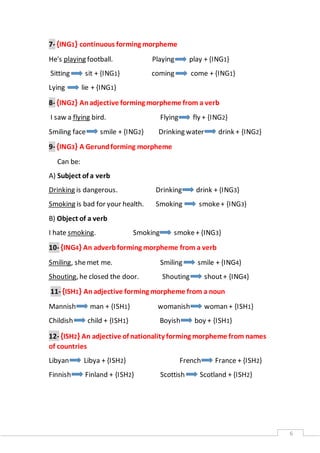
7- {ING1} continuous forming morpheme 
He's playing football. Playing play + {ING1} 
Sitting sit + {ING1} coming come + {ING1} 
Lying lie + {ING1} 
8- {ING2} An adjective forming morpheme from a verb 
I saw a flying bird. Flying fly + {ING2} 
Smiling face smile + {ING2} Drinking water drink + {ING2} 
9- {ING3} A Gerund forming morpheme 
Can be: 
A) Subject of a verb 
Drinking is dangerous. Drinking drink + {ING3} 
Smoking is bad for your health. Smoking smoke + {ING3} 
B) Object of a verb 
I hate smoking. Smoking smoke + {ING3} 
10- {ING4} An adverb forming morpheme from a verb 
Smiling, she met me. Smiling smile + {ING4} 
Shouting, he closed the door. Shouting shout + {ING4} 
11- {ISH1} An adjective forming morpheme from a noun 
Mannish man + {ISH1} womanish woman + {ISH1} 
Childish child + {ISH1} Boyish boy + {ISH1} 
12- {ISH2} An adjective of nationality forming morpheme from names 
of countries 
Libyan Libya + {ISH2} French France + {ISH2} 
Finnish Finland + {ISH2} Scottish Scotland + {ISH2}
7 
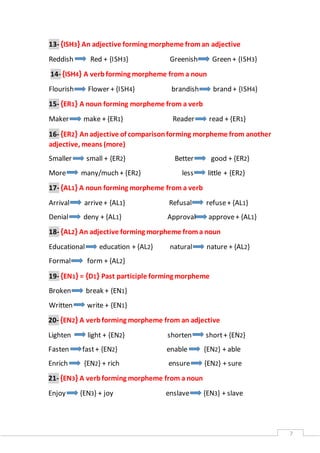
13- {ISH3} An adjective forming morpheme from an adjective 
Reddish Red + {ISH3} Greenish Green + {ISH3} 
14- {ISH4} A verb forming morpheme from a noun 
Flourish Flower + {ISH4} brandish brand + {ISH4} 
15- {ER1} A noun forming morpheme from a verb 
Maker make + {ER1} Reader read + {ER1} 
16- {ER2} An adjective of comparison forming morpheme from another 
adjective, means (more) 
Smaller small + {ER2} Better good + {ER2} 
More many/much + {ER2} less little + {ER2} 
17- {AL1} A noun forming morpheme from a verb 
Arrival arrive + {AL1} Refusal refuse + {AL1} 
Denial deny + {AL1} Approval approve + {AL1} 
18- {AL2} An adjective forming morpheme from a noun 
Educational education + {AL2} natural nature + {AL2} 
Formal form + {AL2} 
19- {EN1} = {D1} Past participle forming morpheme 
Broken break + {EN1} 
Written write + {EN1} 
20- {EN2} A verb forming morpheme from an adjective 
Lighten light + {EN2} shorten short + {EN2} 
Fasten fast + {EN2} enable {EN2} + able 
Enrich {EN2} + rich ensure {EN2} + sure 
21- {EN3} A verb forming morpheme from a noun 
Enjoy {EN3} + joy enslave {EN3} + slave

Morphoogy classroom notes

  • 1.
    0 MORPHOLOGY Teacher:Khalifa Shenina 4th Semester
  • 2.
    1 Lecture 1 What is Morphology? Morphology is a branch of linguistics which deals with the internal structure of words. It is the study of how words are put together. The word itself consists of two morphemes, morph + ology. The suffix –ology means "science of" and morph- means "word". * A morpheme is the smallest unit of language that has its own meaning. Simple words like giraffe, wiggle, or yellow are morphemes, but so are prefixes like re- and pre- and suffixes like –ize and –er. * General definitions for what a word means: - A word is a stretch of letters that occurs between blank spaces. - "A word is something small that means something". A word is one or more morphemes that can stand alone in a language. Simple (simplex) words: are words that consist of only one morpheme, like giraffe, fraud, murmur, oops, just, pistachio. Complex words: are words that are made up of more than one morpheme, like opposition, intellectual, crystallize, prewash, repressive, blackboard. Words and Lexemes, types and tokens How many words occur in the following sentence? My friend and I walk to class together, because our classes are in the same building and we dislike walking alone. When you count words, you may count them in a number of ways. Therefore, it's useful to have some special terms for how we count words. 1- If we are counting every instance in a which a word occurs in a sentence, regardless of whether that word has occurred before or not, we are counting word tokens. If we count word tokens in the sentence above, we count 21.
  • 3.
    2 2- Ifwe are counting a word once, no matter how many times it occurred in a sentence, we are counting word types. Counting this way, we count 20 types in the sentence above the two tokens of the word and count as one type. 3- Another way of counting words is by using lexemes. Lexemes can be thought of as families of words that differ only in their grammatical endings or grammatical forms. E.g. singular and plural forms of a noun (class, classes), present, past and participle forms of verbs (walk, walks, walked, walking), different forms of a pronoun (I,me, my, mine) each represent a single lexeme. One way of thinking about lexemes is that they are the basis of dictionary entries: dictionaries typically have a single entry for each lexeme. So if we are counting lexemes in the sentence above, we would count class and classes, walk and walking, I and my, and our and we as single lexemes; the sentence then has 16 lexemes. *** *** *** *** ***
  • 4.
    3 Lecture 2 Morpheme is the smallest meaningful unit in the language that meets three criteria: 1- It is a meaningful segment. 2- It's indivisible. It cannot be cut down into smaller parts. If you try to divide a morpheme, you'll end up either with having meaningless parts or the meaning of the parts, if any, will not be related to the meaning of the whole. 3- It reoccurs in the language with a relatively stable meaning. Types of morphemes: Depending on the way morphemes occur in the utterance, they are grouped into two large groups: 1- Free (independent) morphemes: They are morphemes which can occur alone as words and have a meaning or fulfill a grammatical function. E.g., man, and, run It can be divided into two categories: a) Lexical (content) morphemes: They are free morphemes that have semantic content or meaning, and usually refer to a thing, quality, state or action. In the language, these morphemes take the forms of nouns, verbs, adjectives and adverbs. b) Functional (grammatical) morphemes: They are free morphemes which have little or no meaning on their own, but which show grammatical relationships in and between sentences. They are represented by prepositions, articles, conjunctions, pronouns, demonstratives and auxiliary verbs.
  • 5.
    4 2- Bound(dependent) morphemes: They are morphemes which never occur alone as words, but as parts of words. They must be attached to another morpheme, usually a free morpheme in order to have a distinct meaning. There are two types of bound morphemes: a) Bound roots: are those bound morphemes which have lexical meaning when they are attached to other bound morphemes to form content words. E.g. re + ceive = receive re + tain = retain b) Affixes: They are bound morphemes which are usually marginally attached to words, and which change the meaning or function of those words. E.g. –ment en- -ing de- Morphemes To sum up: Free Bound Lexical grammatical Bound Affixes Roots Prefixes infixes suffixes
  • 6.
    5 Lecture 3 Types of affixes: 1- }Z1{ A Plurality forming morpheme Cars car + {Z1} dogs dog + {Z1} Teeth tooth + {Z1} children child + {Z1} Men man + {Z1} 2- {Z2} A present verb third singular forming morpheme He plays football. Plays play + {Z2} Works work + {Z2} has have + {Z2} Does do + {Z2} is be + {Z2} 3- {Z3} A possession forming morpheme Father's father + {Z3} Ali's Ali + {Z3} 4- {D1} A past simple forming morpheme from a verb Played play + {D1} Saw see + {D1} 5- {D2} An adjective forming morpheme from a verb She saw the killed man. Killed kill + {D2} Burnt (cake) burn + {D2} 6- {D3} An adjective forming morpheme from a noun One – eyed eye + {D3} left – handed hand + {D3} Cross – eyed eye + {D3} legged table leg + {D3} Long beaded beard + {D3}
  • 7.
    6 7- {ING1}continuous forming morpheme He's playing football. Playing play + {ING1} Sitting sit + {ING1} coming come + {ING1} Lying lie + {ING1} 8- {ING2} An adjective forming morpheme from a verb I saw a flying bird. Flying fly + {ING2} Smiling face smile + {ING2} Drinking water drink + {ING2} 9- {ING3} A Gerund forming morpheme Can be: A) Subject of a verb Drinking is dangerous. Drinking drink + {ING3} Smoking is bad for your health. Smoking smoke + {ING3} B) Object of a verb I hate smoking. Smoking smoke + {ING3} 10- {ING4} An adverb forming morpheme from a verb Smiling, she met me. Smiling smile + {ING4} Shouting, he closed the door. Shouting shout + {ING4} 11- {ISH1} An adjective forming morpheme from a noun Mannish man + {ISH1} womanish woman + {ISH1} Childish child + {ISH1} Boyish boy + {ISH1} 12- {ISH2} An adjective of nationality forming morpheme from names of countries Libyan Libya + {ISH2} French France + {ISH2} Finnish Finland + {ISH2} Scottish Scotland + {ISH2}
  • 8.
    7 13- {ISH3}An adjective forming morpheme from an adjective Reddish Red + {ISH3} Greenish Green + {ISH3} 14- {ISH4} A verb forming morpheme from a noun Flourish Flower + {ISH4} brandish brand + {ISH4} 15- {ER1} A noun forming morpheme from a verb Maker make + {ER1} Reader read + {ER1} 16- {ER2} An adjective of comparison forming morpheme from another adjective, means (more) Smaller small + {ER2} Better good + {ER2} More many/much + {ER2} less little + {ER2} 17- {AL1} A noun forming morpheme from a verb Arrival arrive + {AL1} Refusal refuse + {AL1} Denial deny + {AL1} Approval approve + {AL1} 18- {AL2} An adjective forming morpheme from a noun Educational education + {AL2} natural nature + {AL2} Formal form + {AL2} 19- {EN1} = {D1} Past participle forming morpheme Broken break + {EN1} Written write + {EN1} 20- {EN2} A verb forming morpheme from an adjective Lighten light + {EN2} shorten short + {EN2} Fasten fast + {EN2} enable {EN2} + able Enrich {EN2} + rich ensure {EN2} + sure 21- {EN3} A verb forming morpheme from a noun Enjoy {EN3} + joy enslave {EN3} + slave