1
Bound and free morphemes
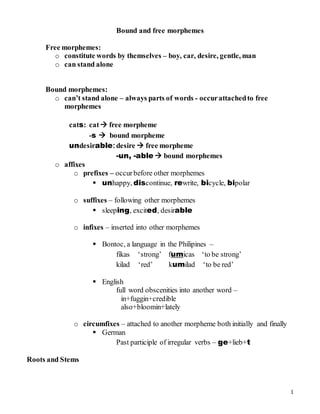
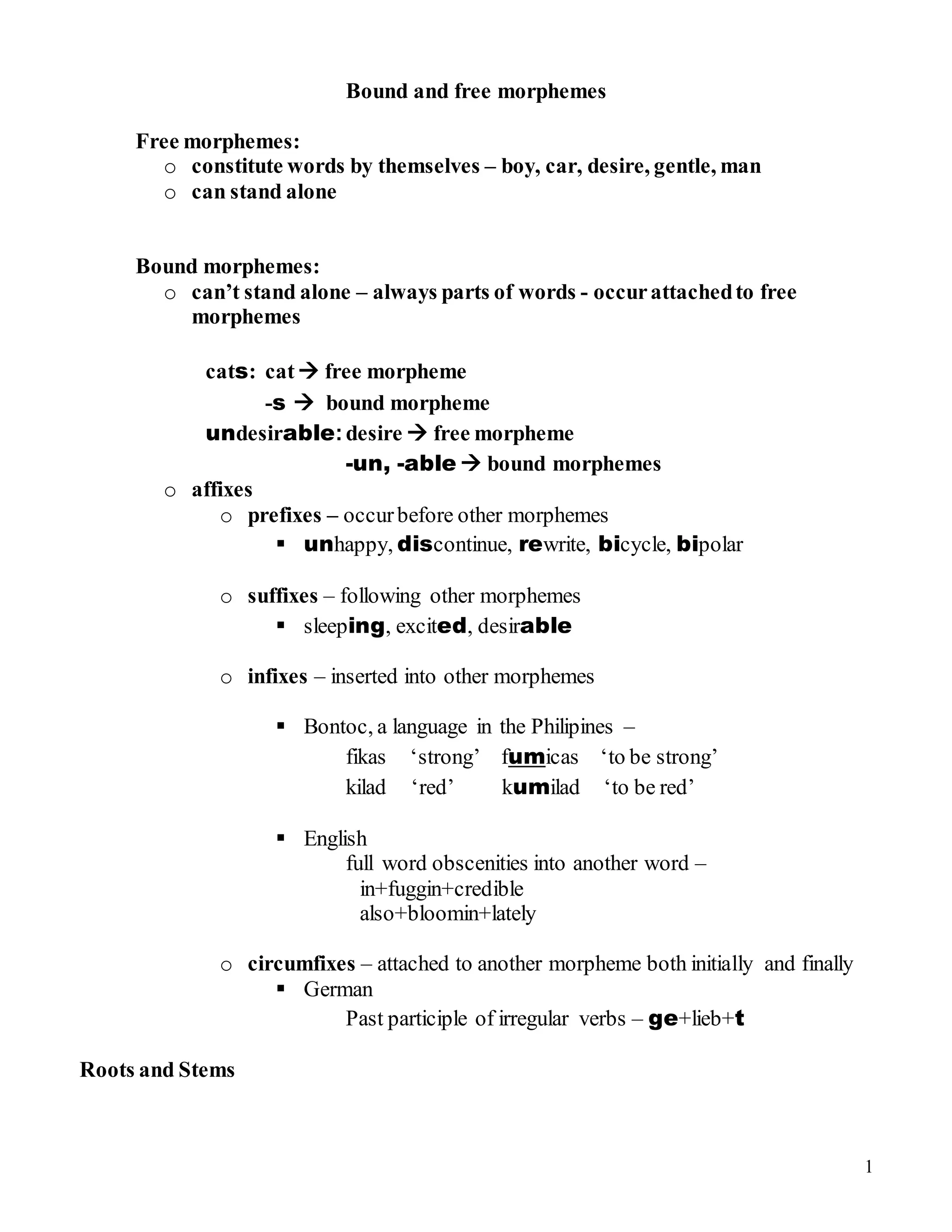
Free morphemes:
o constitute words by themselves – boy, car, desire, gentle, man
o can stand alone
Bound morphemes:
o can’t stand alone – always parts of words - occurattachedto free
morphemes
cats: cat free morpheme
-s  bound morpheme
undesirable:desire  free morpheme
-un, -able  bound morphemes
o affixes
o prefixes – occurbefore other morphemes
 unhappy, discontinue, rewrite, bicycle, bipolar
o suffixes – following other morphemes
 sleeping, excited, desirable
o infixes – inserted into other morphemes
 Bontoc, a language in the Philipines –
fikas ‘strong’ fumicas ‘to be strong’
kilad ‘red’ kumilad ‘to be red’
 English
full word obscenities into another word –
in+fuggin+credible
also+bloomin+lately
o circumfixes – attached to another morpheme both initially and finally
 German
Past participle of irregular verbs – ge+lieb+t
Roots and Stems
2
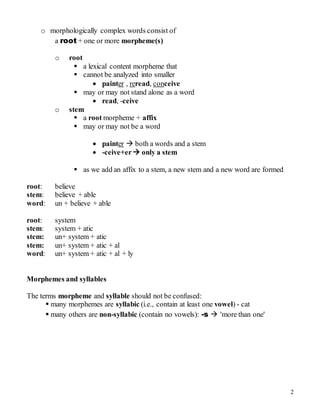
o morphologically complex words consist of
a root + one or more morpheme(s)
o root
 a lexical content morpheme that
 cannot be analyzed into smaller
 painter , reread, conceive
 may or may not stand alone as a word
 read, -ceive
o stem
 a root morpheme + affix
 may or may not be a word
 painter  both a words and a stem
 -ceive+er only a stem
 as we add an affix to a stem, a new stem and a new word are formed
root: believe
stem: believe + able
word: un + believe + able
root: system
stem: system + atic
stem: un+ system + atic
stem: un+ system + atic + al
word: un+ system + atic + al + ly
Morphemes and syllables
The terms morpheme and syllable should not be confused:
 many morphemes are syllabic (i.e., contain at least one vowel) - cat
 many others are non-syllabic (contain no vowels): -s  'more than one'

Bound and free morphemes

  • 1.
    1 Bound and freemorphemes Free morphemes: o constitute words by themselves – boy, car, desire, gentle, man o can stand alone Bound morphemes: o can’t stand alone – always parts of words - occurattachedto free morphemes cats: cat free morpheme -s  bound morpheme undesirable:desire  free morpheme -un, -able  bound morphemes o affixes o prefixes – occurbefore other morphemes  unhappy, discontinue, rewrite, bicycle, bipolar o suffixes – following other morphemes  sleeping, excited, desirable o infixes – inserted into other morphemes  Bontoc, a language in the Philipines – fikas ‘strong’ fumicas ‘to be strong’ kilad ‘red’ kumilad ‘to be red’  English full word obscenities into another word – in+fuggin+credible also+bloomin+lately o circumfixes – attached to another morpheme both initially and finally  German Past participle of irregular verbs – ge+lieb+t Roots and Stems
  • 2.
    2 o morphologically complexwords consist of a root + one or more morpheme(s) o root  a lexical content morpheme that  cannot be analyzed into smaller  painter , reread, conceive  may or may not stand alone as a word  read, -ceive o stem  a root morpheme + affix  may or may not be a word  painter  both a words and a stem  -ceive+er only a stem  as we add an affix to a stem, a new stem and a new word are formed root: believe stem: believe + able word: un + believe + able root: system stem: system + atic stem: un+ system + atic stem: un+ system + atic + al word: un+ system + atic + al + ly Morphemes and syllables The terms morpheme and syllable should not be confused:  many morphemes are syllabic (i.e., contain at least one vowel) - cat  many others are non-syllabic (contain no vowels): -s  'more than one'