MORPHOLOGY What is Morphology? Morphology is a field of linguistics focused on the study of the forms and formation of words in a language. Words in a language consist of one element or elements of meaning which are called   morphemes .
What is a morpheme? The smallest unit of meaning or grammatical function. A single word may be composed of one  or  more morphemes. EX/She  looked  unhappier  than  the  day  before un+ happy+er (can be analyzed into 3  morphemes)
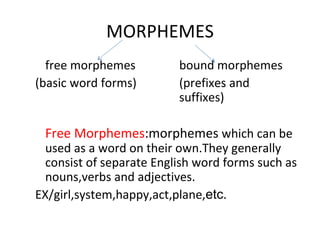
MORPHEMES free morphemes bound morphemes (basic word forms) (prefixes and suffixes) Free Morphemes :morphemes  which can be used as a word on their own.They generally consist of separate English word forms such as nouns,verbs and adjectives. EX/girl,system,happy,act,plane, etc .
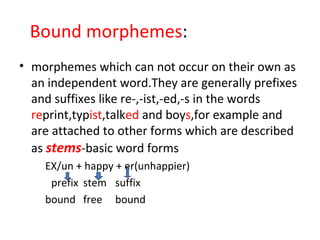
Bound morphemes :   morphemes which can not occur on their own as an independent word.They are generally prefixes and suffixes like re-,-ist,-ed,-s in the words  re print,typ ist ,talk ed  and boy s ,for example and are attached to other forms which are described as  stems -basic word forms EX/un + happy + er(unhappier) prefix stem suffix bound free bound
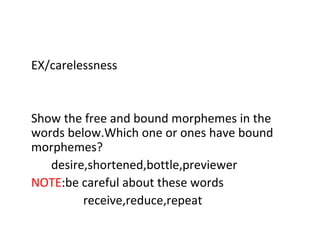
EX/carelessness Show the free and bound morphemes in the words below.Which one or ones have bound morphemes? desire,shortened,bottle,previewer NOTE :be careful about these words receive,reduce,repeat
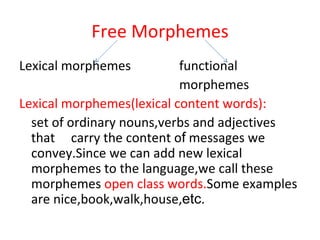
Free Morphemes Lexical morphemes functional  morphemes Lexical morphemes(lexical content words): set of ordinary nouns,verbs and adjectives that  carry the content o f  messages we   convey.Since we can add new lexical morphemes to the language,we call these morphemes  open class words. Some examples are nice,book,walk,house, etc .
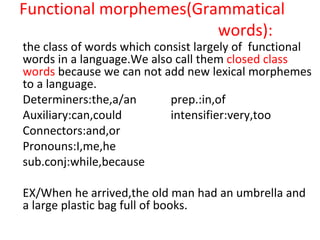
Functional morphemes(Grammatical  words): the class of words which consist largely of  functional words in a language.We also call them  closed class   words  because we can not add new lexical morphemes to a language. Determiners:the,a/an prep.:in,of Auxiliary:can,could intensifier:very,too Connectors:and,or Pronouns:I,me,he sub.conj:while,because EX/When he arrived,the old man had an umbrella and a large plastic bag full of books.
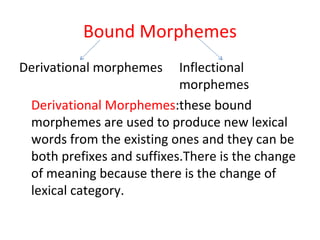
Bound Morphemes Derivational morphemes Inflectional  morphemes Derivational Morphemes :these bound morphemes are used to produce new lexical words from the existing ones and they can be both prefixes and suffixes.There is the change of meaning because there is the change of lexical category.
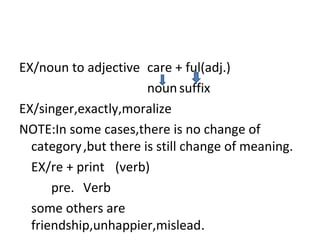
EX/noun to adjective care + ful(adj.) noun suffix EX/singer,exactly,moralize NOTE:In some cases,there is no change of category ,but there is still change of meaning. EX/re + print (verb) pre. Verb some others are friendship,unhappier,mislead .
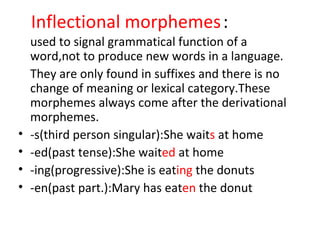
Inflectional morphemes : used to signal grammatical function of a word,not to produce new words in a language. They are only found in suffixes and there is no change of meaning or lexical category.These morphemes always come after the derivational morphemes. -s(third person singular):She wait s  at home  -ed(past tense):She wait ed  at home -ing(progressive):She is eat ing  the donuts -en(past part.):Mary has eat en  the donut
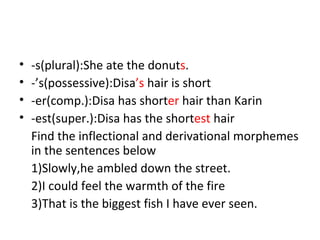
-s(plural):She ate the donut s . -’s(possessive):Disa ’s  hair is short -er(comp.):Disa has short er  hair than Karin -est(super.):Disa has the short est  hair Find the inflectional and derivational morphemes in the sentences below 1)Slowly,he ambled down the street. 2)I could feel the warmth of the fire 3)That is the biggest fish I have ever seen.
Morphological Description
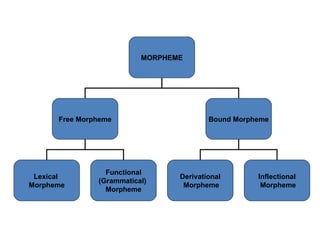
MORPHEME Free Morpheme Bound Morpheme Lexical  Morpheme Functional (Grammatical)  Morpheme Derivational Morpheme Inflectional Morpheme
What is the difference between derivational and inflectional morpheme??
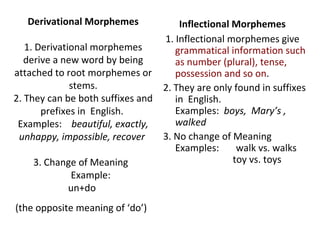
Derivational Morphemes   1. Derivational morphemes derive a new word by being attached to root morphemes or stems. 2. They can be both suffixes and prefixes in  English.  Examples:     beautiful, exactly, unhappy, impossible, recover     3. Change of Meaning   Example:        un+do  (the opposite meaning of ‘do’)                                  Inflectional Morphemes   1. Inflectional morphemes give  grammatical information such as number (plural), tense, possession and so on .  2. They are only found in suffixes in  English.   Examples:   boys,  Mary’s , walked  3. No change of Meaning   Examples:       walk vs. walks                           toy vs. toys 
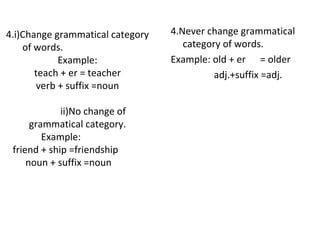
4.i)Change grammatical category of words.  Example: teach + er = teacher verb + suffix =noun   ii)No change of grammatical category.   Example:   friend + ship =friendship    noun + suffix =noun  4.Never change grammatical category of words. Example: old + er  = older  adj.+suffix =adj.
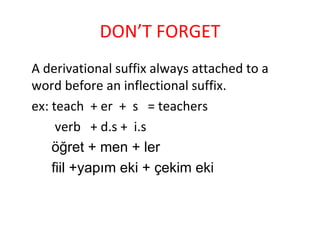
DON’T FORGET A derivational suffix always attached to a word before an inflectional suffix. ex: teach  + er  +  s  = teachers   verb  + d.s +  i.s  öğret + men + ler fiil +yapım eki + çekim eki
Read your sentences and a)say how many morphemes they have b)list all the elements of sentences
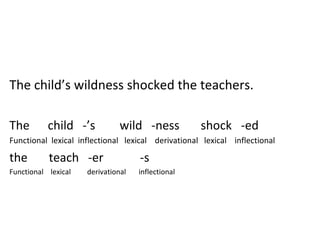
The child’s wildness shocked the teachers. The  child  -’s  wild  -ness  shock  -ed  Functional  lexical  inflectional  lexical  derivational  lexical  inflectional the  teach  -er  -s Functional  lexical  derivational  inflectional
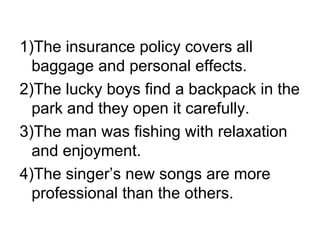
1)The insurance policy covers all baggage and personal effects. 2)The lucky boys find a backpack in the park and they open it carefully. 3)The man was fishing with relaxation and enjoyment. 4)The singer’s new songs are more professional than the others.
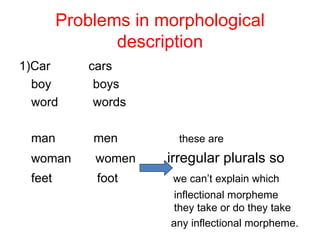
Problems in morphological description 1)Car  cars boy  boys word  words man  men  these are   woman  women   irregular plurals so  feet  foot  we can’t explain which    inflectional morpheme    they take or do they take    any inflectional morpheme.
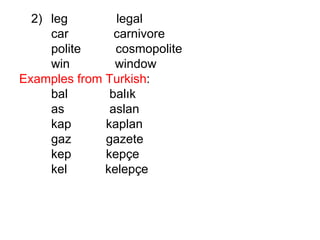
2)  leg  legal  car  carnivore polite  cosmopolite win  window Examples from Turkish : bal  balık as  aslan kap  kaplan gaz  gazete kep  kepçe kel  kelepçe
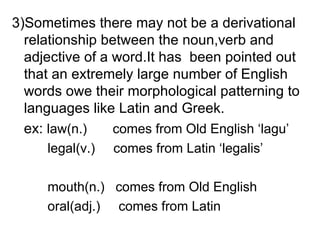
3)Sometimes there may not be a derivational relationship between the noun,verb and adjective of a word.It has  been pointed out that an extremely large number of English words owe their morphological patterning to languages like Latin and Greek. ex:  law(n.)  comes from Old English ‘lagu’   legal(v.)  comes from Latin ‘legalis’   mouth(n.)  comes from Old English   oral(adj.)  comes from Latin
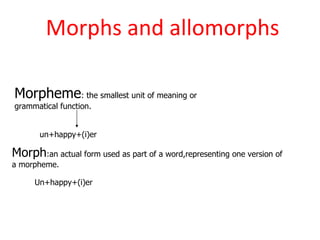
Morphs and allomorphs Morpheme : the smallest unit of meaning or grammatical function. un+happy+(i)er Morph :an actual form used as part of a word,representing one version of a morpheme. Un+happy+(i)er
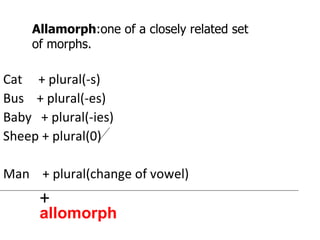
Cat  + plural(-s) Bus  + plural(-es) Baby  + plural(-ies) Sheep + plural(0) Man  + plural(change of vowel)   + Allamorph :one of a closely related set of morphs. allomorph
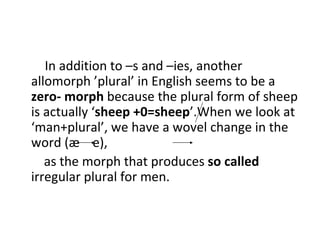
In addition to –s and –ies, another allomorph ’plural’ in English seems to be a  zero- morph  because the plural form of sheep is actually ‘ sheep +0=sheep ’.When we look at ‘man+plural’, we have a wovel change in the word (æ  e),   as the morph that produces  so called  irregular plural for men.
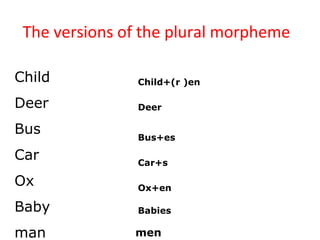
The versions of the plural morpheme Child Deer Bus Car Ox Baby man Child+(r )en Deer  Bus+es Car+s Ox+en Babies men
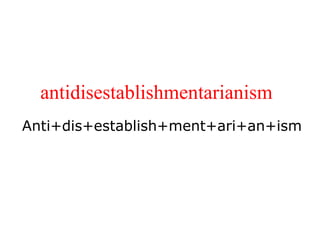
antidisestablishmentarianism Anti+dis+establish+ment+ari+an+ism
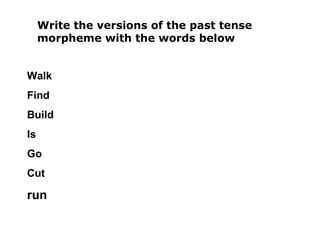
Write the versions of the past tense morpheme with the words below Walk Find Build Is Go Cut run
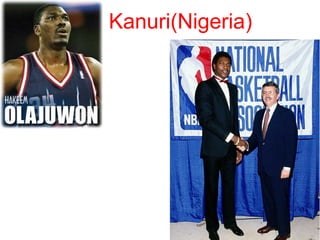
Kanuri(Nigeria)
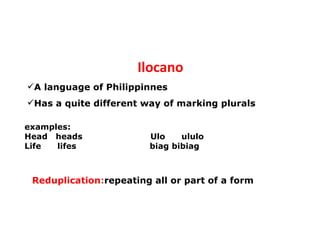
Ilocano A language of Philippinnes Has a quite different way of marking plurals Reduplication : repeating all or part of a form examples: Head  heads  Ulo  ululo  Life  lifes  biag   bibiag
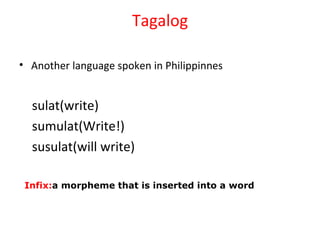
Tagalog Another language spoken in Philippinnes sulat(write) sumulat(Write!) susulat(will write) Infix: a morpheme that is inserted into a word

Morphology Son

  • 1.
    MORPHOLOGY What isMorphology? Morphology is a field of linguistics focused on the study of the forms and formation of words in a language. Words in a language consist of one element or elements of meaning which are called morphemes .
  • 2.
    What is amorpheme? The smallest unit of meaning or grammatical function. A single word may be composed of one or more morphemes. EX/She looked unhappier than the day before un+ happy+er (can be analyzed into 3 morphemes)
  • 3.
    MORPHEMES free morphemesbound morphemes (basic word forms) (prefixes and suffixes) Free Morphemes :morphemes which can be used as a word on their own.They generally consist of separate English word forms such as nouns,verbs and adjectives. EX/girl,system,happy,act,plane, etc .
  • 4.
    Bound morphemes : morphemes which can not occur on their own as an independent word.They are generally prefixes and suffixes like re-,-ist,-ed,-s in the words re print,typ ist ,talk ed and boy s ,for example and are attached to other forms which are described as stems -basic word forms EX/un + happy + er(unhappier) prefix stem suffix bound free bound
  • 5.
    EX/carelessness Show thefree and bound morphemes in the words below.Which one or ones have bound morphemes? desire,shortened,bottle,previewer NOTE :be careful about these words receive,reduce,repeat
  • 6.
    Free Morphemes Lexicalmorphemes functional morphemes Lexical morphemes(lexical content words): set of ordinary nouns,verbs and adjectives that carry the content o f messages we convey.Since we can add new lexical morphemes to the language,we call these morphemes open class words. Some examples are nice,book,walk,house, etc .
  • 7.
    Functional morphemes(Grammatical words): the class of words which consist largely of functional words in a language.We also call them closed class words because we can not add new lexical morphemes to a language. Determiners:the,a/an prep.:in,of Auxiliary:can,could intensifier:very,too Connectors:and,or Pronouns:I,me,he sub.conj:while,because EX/When he arrived,the old man had an umbrella and a large plastic bag full of books.
  • 8.
    Bound Morphemes Derivationalmorphemes Inflectional morphemes Derivational Morphemes :these bound morphemes are used to produce new lexical words from the existing ones and they can be both prefixes and suffixes.There is the change of meaning because there is the change of lexical category.
  • 9.
    EX/noun to adjectivecare + ful(adj.) noun suffix EX/singer,exactly,moralize NOTE:In some cases,there is no change of category ,but there is still change of meaning. EX/re + print (verb) pre. Verb some others are friendship,unhappier,mislead .
  • 10.
    Inflectional morphemes :used to signal grammatical function of a word,not to produce new words in a language. They are only found in suffixes and there is no change of meaning or lexical category.These morphemes always come after the derivational morphemes. -s(third person singular):She wait s at home -ed(past tense):She wait ed at home -ing(progressive):She is eat ing the donuts -en(past part.):Mary has eat en the donut
  • 11.
    -s(plural):She ate thedonut s . -’s(possessive):Disa ’s hair is short -er(comp.):Disa has short er hair than Karin -est(super.):Disa has the short est hair Find the inflectional and derivational morphemes in the sentences below 1)Slowly,he ambled down the street. 2)I could feel the warmth of the fire 3)That is the biggest fish I have ever seen.
  • 12.
  • 13.
    MORPHEME Free MorphemeBound Morpheme Lexical Morpheme Functional (Grammatical) Morpheme Derivational Morpheme Inflectional Morpheme
  • 14.
    What is thedifference between derivational and inflectional morpheme??
  • 15.
    Derivational Morphemes  1. Derivational morphemes derive a new word by being attached to root morphemes or stems. 2. They can be both suffixes and prefixes in  English. Examples:    beautiful, exactly, unhappy, impossible, recover   3. Change of Meaning  Example:       un+do (the opposite meaning of ‘do’)                              Inflectional Morphemes   1. Inflectional morphemes give grammatical information such as number (plural), tense, possession and so on . 2. They are only found in suffixes in  English.  Examples:  boys,  Mary’s , walked  3. No change of Meaning  Examples:       walk vs. walks                          toy vs. toys 
  • 16.
    4.i)Change grammatical categoryof words. Example: teach + er = teacher verb + suffix =noun ii)No change of grammatical category. Example: friend + ship =friendship noun + suffix =noun 4.Never change grammatical category of words. Example: old + er = older adj.+suffix =adj.
  • 17.
    DON’T FORGET Aderivational suffix always attached to a word before an inflectional suffix. ex: teach + er + s = teachers verb + d.s + i.s öğret + men + ler fiil +yapım eki + çekim eki
  • 18.
    Read your sentencesand a)say how many morphemes they have b)list all the elements of sentences
  • 19.
    The child’s wildnessshocked the teachers. The child -’s wild -ness shock -ed Functional lexical inflectional lexical derivational lexical inflectional the teach -er -s Functional lexical derivational inflectional
  • 20.
    1)The insurance policycovers all baggage and personal effects. 2)The lucky boys find a backpack in the park and they open it carefully. 3)The man was fishing with relaxation and enjoyment. 4)The singer’s new songs are more professional than the others.
  • 21.
    Problems in morphologicaldescription 1)Car cars boy boys word words man men these are woman women irregular plurals so feet foot we can’t explain which inflectional morpheme they take or do they take any inflectional morpheme.
  • 22.
    2) leg legal car carnivore polite cosmopolite win window Examples from Turkish : bal balık as aslan kap kaplan gaz gazete kep kepçe kel kelepçe
  • 23.
    3)Sometimes there maynot be a derivational relationship between the noun,verb and adjective of a word.It has been pointed out that an extremely large number of English words owe their morphological patterning to languages like Latin and Greek. ex: law(n.) comes from Old English ‘lagu’ legal(v.) comes from Latin ‘legalis’ mouth(n.) comes from Old English oral(adj.) comes from Latin
  • 24.
    Morphs and allomorphsMorpheme : the smallest unit of meaning or grammatical function. un+happy+(i)er Morph :an actual form used as part of a word,representing one version of a morpheme. Un+happy+(i)er
  • 25.
    Cat +plural(-s) Bus + plural(-es) Baby + plural(-ies) Sheep + plural(0) Man + plural(change of vowel) + Allamorph :one of a closely related set of morphs. allomorph
  • 26.
    In addition to–s and –ies, another allomorph ’plural’ in English seems to be a zero- morph because the plural form of sheep is actually ‘ sheep +0=sheep ’.When we look at ‘man+plural’, we have a wovel change in the word (æ e), as the morph that produces so called irregular plural for men.
  • 27.
    The versions ofthe plural morpheme Child Deer Bus Car Ox Baby man Child+(r )en Deer Bus+es Car+s Ox+en Babies men
  • 28.
  • 29.
    Write the versionsof the past tense morpheme with the words below Walk Find Build Is Go Cut run
  • 30.
  • 31.
    Ilocano A languageof Philippinnes Has a quite different way of marking plurals Reduplication : repeating all or part of a form examples: Head heads Ulo ululo Life lifes biag bibiag
  • 32.
    Tagalog Another languagespoken in Philippinnes sulat(write) sumulat(Write!) susulat(will write) Infix: a morpheme that is inserted into a word