BY:Ropak&Nazik
Morphology:is the study of forms.


Morphology:is The branch of linguistics (and one of the
major components of grammar) that studies word
structures, especially in terms of morphemes. Adjective:
morphological.


Morphology:is the study and description of word formation
(as inflection, derivation, and compounding) in language


Morphology:is the study of word formation, of the
structure of words.
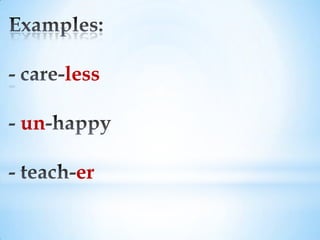
less

un

      er
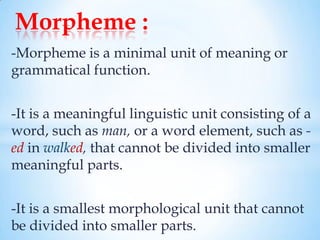
Morpheme :
-Morpheme is a minimal unit of meaning or
grammatical function.


-It is a meaningful linguistic unit consisting of a
word, such as man, or a word element, such as -
ed in walked, that cannot be divided into smaller
meaningful parts.


-It is a smallest morphological unit that cannot
be divided into smaller parts.
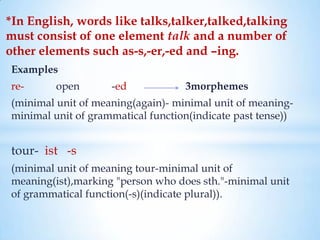
*In English, words like talks,talker,talked,talking
must consist of one element talk and a number of
other elements such as-s,-er,-ed and –ing.
Examples
re-      open       -ed            3morphemes
(minimal unit of meaning(again)- minimal unit of meaning-
minimal unit of grammatical function(indicate past tense))


tour- ist -s
(minimal unit of meaning tour-minimal unit of
meaning(ist),marking "person who does sth."-minimal unit
of grammatical function(-s)(indicate plural)).
   Free Morpheme
   Bound Morpheme
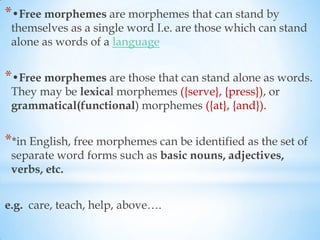
*‱Free morphemes are morphemes that can stand by
 themselves as a single word I.e. are those which can stand
 alone as words of a language


*‱Free morphemes are those that can stand alone as words.
 They may be lexical morphemes ({serve}, {press}), or
 grammatical(functional) morphemes ({at}, {and}).


**in English, free morphemes can be identified as the set of
 separate word forms such as basic nouns, adjectives,
 verbs, etc.


e.g. care, teach, help, above
.
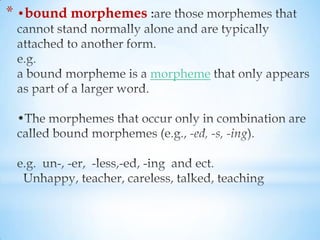
* ‱bound morphemes


                     morpheme
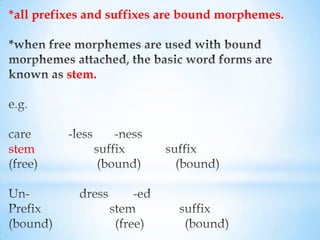
*all prefixes and suffixes are bound morphemes.


         stem.


stem
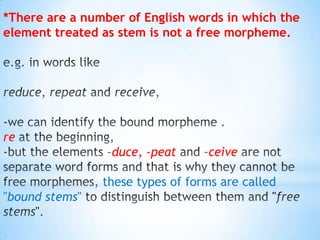
*There are a number of English words in which the
element treated as stem is not a free morpheme.


re
                 duce, -peat      ceive

                these types of forms are called
"bound stems"
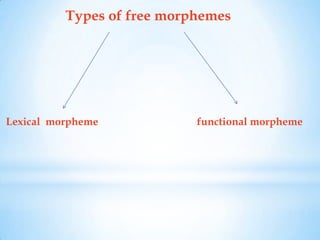
Types of free morphemes


Lexical morpheme            functional morpheme
‱(A)Lexical morphemes


   word                            text
speech act         lexical word.
Q. why are they treated as an
 "open" class of words?


A-They are treated as an "open" class of
words because we can add new lexical
morphemes to the language rather easily.
i.e. we can create new words which are
lexical.
‱(B)functional


e.g.
-why are they called "closed" class of
words?


A.
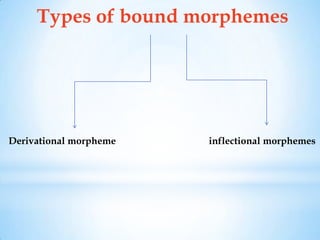
Types of bound morphemes


Derivational morpheme   inflectional morphemes
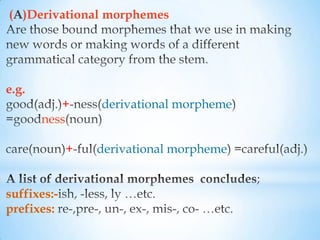
(A)Derivational morphemes


e.g.
          +      derivational morpheme
       ness

             +   derivational morpheme


suffixes:-
prefixes:
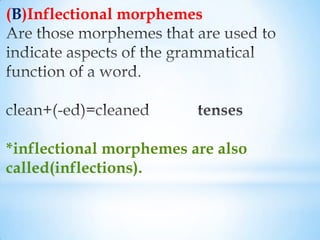
(B)Inflectional morphemes


*inflectional morphemes are also
called(inflections).
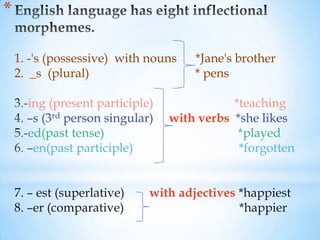
*

    1. -'s (possessive) with nouns   *Jane's brother
    2. _s (plural)                   * pens

      ing (present participle)              *teaching
       s (3rd person singular)   with verbs *she likes
      ed(past tense)                         *played
       en(past participle)                   *forgotten


    7. – est (superlative)   with adjectives *happiest
    8. –er (comparative)                     *happier
Morphological description
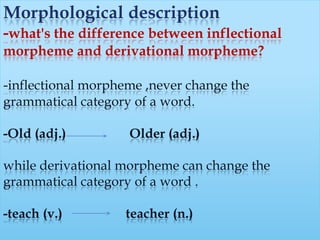
-what's the difference between inflectional
morpheme and derivational morpheme?

-inflectional morpheme ,never change the
grammatical category of a word.

-Old (adj.)         Older (adj.)

while derivational morpheme can change the
grammatical category of a word .

-teach (v.)        teacher (n.)
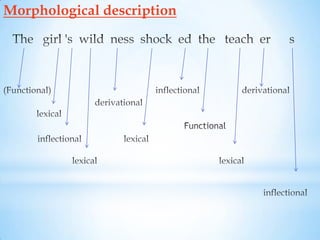
Morphological description
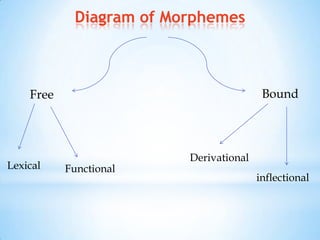
Diagram of Morphemes


    Free                                 Bound


                         Derivational
Lexical    Functional
                                        inflectional
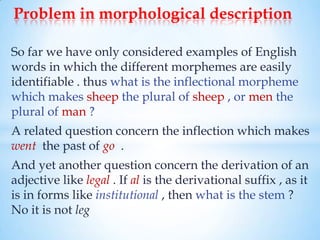
Problem in morphological description

So far we have only considered examples of English
words in which the different morphemes are easily
identifiable . thus what is the inflectional morpheme
which makes sheep the plural of sheep , or men the
plural of man ?
A related question concern the inflection which makes
went the past of go .
And yet another question concern the derivation of an
adjective like legal . If al is the derivational suffix , as it
is in forms like institutional , then what is the stem ?
No it is not leg
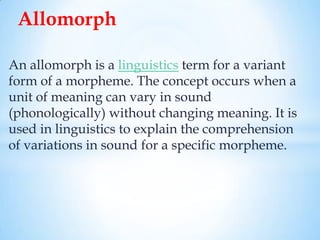
Allomorph

An allomorph is a linguistics term for a variant
form of a morpheme. The concept occurs when a
unit of meaning can vary in sound
(phonologically) without changing meaning. It is
used in linguistics to explain the comprehension
of variations in sound for a specific morpheme.
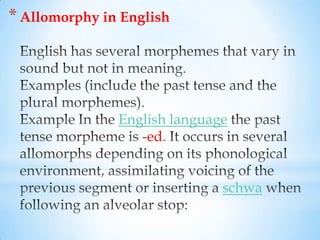
* Allomorphy in English


               English language
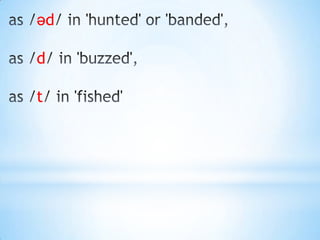
                   ed


                              schwa
əd

d

t

Morphology presentation

  • 1.
  • 2.
    Morphology:is the studyof forms. Morphology:is The branch of linguistics (and one of the major components of grammar) that studies word structures, especially in terms of morphemes. Adjective: morphological. Morphology:is the study and description of word formation (as inflection, derivation, and compounding) in language Morphology:is the study of word formation, of the structure of words.
  • 3.
  • 4.
    Morpheme : -Morpheme isa minimal unit of meaning or grammatical function. -It is a meaningful linguistic unit consisting of a word, such as man, or a word element, such as - ed in walked, that cannot be divided into smaller meaningful parts. -It is a smallest morphological unit that cannot be divided into smaller parts.
  • 5.
    *In English, wordslike talks,talker,talked,talking must consist of one element talk and a number of other elements such as-s,-er,-ed and –ing. Examples re- open -ed 3morphemes (minimal unit of meaning(again)- minimal unit of meaning- minimal unit of grammatical function(indicate past tense)) tour- ist -s (minimal unit of meaning tour-minimal unit of meaning(ist),marking "person who does sth."-minimal unit of grammatical function(-s)(indicate plural)).
  • 6.
     Free Morpheme  Bound Morpheme
  • 7.
    *‱Free morphemes aremorphemes that can stand by themselves as a single word I.e. are those which can stand alone as words of a language *‱Free morphemes are those that can stand alone as words. They may be lexical morphemes ({serve}, {press}), or grammatical(functional) morphemes ({at}, {and}). **in English, free morphemes can be identified as the set of separate word forms such as basic nouns, adjectives, verbs, etc. e.g. care, teach, help, above
.
  • 8.
  • 9.
    *all prefixes andsuffixes are bound morphemes. stem. stem
  • 10.
    *There are anumber of English words in which the element treated as stem is not a free morpheme. re duce, -peat ceive these types of forms are called "bound stems"
  • 11.
    Types of freemorphemes Lexical morpheme functional morpheme
  • 12.
    ‱(A)Lexical morphemes word text speech act lexical word.
  • 13.
    Q. why arethey treated as an "open" class of words? A-They are treated as an "open" class of words because we can add new lexical morphemes to the language rather easily. i.e. we can create new words which are lexical.
  • 14.
  • 15.
    -why are theycalled "closed" class of words? A.
  • 16.
    Types of boundmorphemes Derivational morpheme inflectional morphemes
  • 17.
    (A)Derivational morphemes e.g. + derivational morpheme ness + derivational morpheme suffixes:- prefixes:
  • 18.
  • 19.
    * 1. -'s (possessive) with nouns *Jane's brother 2. _s (plural) * pens ing (present participle) *teaching s (3rd person singular) with verbs *she likes ed(past tense) *played en(past participle) *forgotten 7. – est (superlative) with adjectives *happiest 8. –er (comparative) *happier
  • 20.
    Morphological description -what's thedifference between inflectional morpheme and derivational morpheme? -inflectional morpheme ,never change the grammatical category of a word. -Old (adj.) Older (adj.) while derivational morpheme can change the grammatical category of a word . -teach (v.) teacher (n.)
  • 21.
  • 22.
    Diagram of Morphemes Free Bound Derivational Lexical Functional inflectional
  • 23.
    Problem in morphologicaldescription So far we have only considered examples of English words in which the different morphemes are easily identifiable . thus what is the inflectional morpheme which makes sheep the plural of sheep , or men the plural of man ? A related question concern the inflection which makes went the past of go . And yet another question concern the derivation of an adjective like legal . If al is the derivational suffix , as it is in forms like institutional , then what is the stem ? No it is not leg
  • 24.
    Allomorph An allomorph isa linguistics term for a variant form of a morpheme. The concept occurs when a unit of meaning can vary in sound (phonologically) without changing meaning. It is used in linguistics to explain the comprehension of variations in sound for a specific morpheme.
  • 25.
    * Allomorphy inEnglish English language ed schwa
  • 26.