Let us
pray.
KUMUSTA KA?
Cómo está?
How are you?
Morphology and Syntax
JAY DISCUSSANT
MAED-ENGLISH,
RAMBOYONG,
Checking of
Attendance
Recapitulati
on
Checking of
Assignment
WARM-UP
Read it fast and clear!
Antidisestablishmentarianism
MORPHEMES
• Definition
• Types of Morphemes
• Examples
Are you ready?
Directions: Write TRUE if the statement is correct and FALSE if it is not.
1. Morphemes are the smallest
lexical unit of meaning.
Directions: Write TRUE if the statement is correct and FALSE if it is not.
2. Most words are bound
morphemes, and most affixes
are free morphemes.
Directions: Write TRUE if the statement is correct and FALSE if it is not.
3. There are two types of
morphemes: free morphemes
and bound morphemes.
Directions: Write TRUE if the statement is correct and FALSE if it is not.
4. Morphemes are made up of
two separate classes called
bases (or roots) and affixes.
Directions: Write TRUE if the statement is correct and FALSE if it is not.
5. Free morphemes fall into two categories;
lexical and functional. Lexical morphemes are
words that give us the main meaning of a
sentence, and functional morphemes have a
grammatical purpose.
Checking of
Answers
Directions: Write TRUE if the statement is correct and FALSE if it is not.
1. Morphemes are the smallest
lexical unit of meaning.
Directions: Write TRUE if the statement is correct and FALSE if it is not.
2. Most words are bound
morphemes, and most affixes
are free morphemes.
Directions: Write TRUE if the statement is correct and FALSE if it is not.
3. There are two types of
morphemes: free morphemes
and bound morphemes.
Directions: Write TRUE if the statement is correct and FALSE if it is not.
4. Morphemes are made up of
two separate classes called
bases (or roots) and affixes.
Directions: Write TRUE if the statement is correct and FALSE if it is not.
5. Free morphemes fall into two categories;
lexical and functional. Lexical morphemes are
words that give us the main meaning of a
sentence, and functional morphemes have a
grammatical purpose.
Great job!
MORPHOLOGY
?
?
?
MORPHOLOGY
 The term morphology is Greek and is
a makeup of morph – meaning
‘shape, form,’ and –ology which
means ‘the study of something.’
MORPHOLOGY
 The study of the forms of words.
 It is the study of words, word
formation, and the relationship
between words.
In Morphology, we look at
morphemes - the smallest lexical
items of meaning. Studying
morphemes helps us to understand
the meaning, structure, and
etymology (history) of words.
MORPHEME
 It is a meaningful linguistic unit consisting
of a word such as dog, of a word element,
such as the –s at the end of dogs, that
cannot be divided into smaller meaningful
parts.
 Morphemes are the smallest units of
meaning in a language.
Look at the following examples of morphemes:
•House
•Bed
•Book
•These words cannot be made shorter than they
already are or they would stop being words or lose
their meaning.
•For example, 'house' cannot be split into ho- and -
us' as they are both meaningless.
However, not all morphemes are
words.
•For example, 's' is not a word, but
it is a morpheme; 's' shows
plurality and means 'more than
one'.
The word ‘cats' is made up
of two morphemes:
cat + s
category
=
1 morpheme
categorize
=
2 morphemes
categorized
=
3 morphemes
How many morphemes are there in
each of the following word?
overestimating
keyboard
cranberry
school
antidisestablishmentarianism
Morphemes play a fundamental
role in the structure and meaning of
language, and understanding them
can help us to better understand the
words we use and the rules that
govern their use.
How to identify a morpheme?
•You can identify morphemes by
seeing if the word or letters in
question meet the following
criteria:
1. Morphemes must have meaning.
E.g. the word 'cat' represents a small
furry animal. The suffix '-s' you might
find at the end of the word 'cat'
represents plurality.
2. Morphemes cannot be divided into
smaller parts without losing or
changing their meaning.
E.g. dividing the word 'cat' into 'ca' leaves
us with a meaningless set of letters.
TYPES OF
MORPHEMES
There are two types of
morphemes:
•FREE morphemes
•BOUND morphemes.
FREE MORPHEMES
•Free morphemes can stand alone and
don't need to be attached to any other
morphemes to get their meaning. Most
words are free morphemes, such as the
above-mentioned words house, book,
bed, light, world, people, and so on.
BOUND MORPHEMES
•Bound morphemes, however,
cannot stand alone. The most
common example of bound
morphemes are suffixes, such as -s,
-er, -ing, and -est.
•Let's look at some examples
of FREE and BOUND morphemes:
•Tall
•Tree
•-er
•-s
•We understand
what 'tall' and 'tree' mean; they
don't require extra add-ons. We
can use them to create a simple
sentence like 'That tree is tall.'
•On the other hand, '-er' and
‘-s' are bound morphemes. You
won't see them on their own
because they are suffixes that add
meaning to the words they are
attached to.
•So if we add '-er' to 'tall' we
get the comparative
form 'taller',
while 'tree' plus '-s' becomes
plural: 'trees'.
MORPHEMES: STRUCTURE
•Morphemes are made up of
two separate classes.
•BASES (OR ROOTS)
•AFFIXES
•A morpheme's BASE is the
main root that gives the word
its meaning.
•On the other hand, an AFFIX is a
morpheme we can add
that changes or modifies
the meaning of the base.
•'Kind' is the free base
morpheme in the
word 'kindly'. (kind + -ly)
•'-less' is a bound morpheme
in the word 'careless'.
(Care + -less)
MORPHEMES: AFFIXES
•Affixes are bound morphemes
that occur before or after a base
word. They are made up
of SUFFIXES and PREFIXES.
•SUFFIXES are attached to the
end of the base or root
word. Some of the most
common suffixes include -er, -
or, -ly, -ism, and -less.
•Taller
•Thinner
•Comfortably
•Ageism
•Aimless
•Fearless
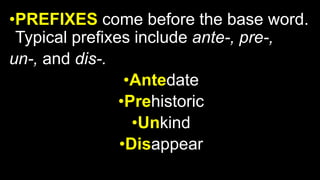
•PREFIXES come before the base word.
Typical prefixes include ante-, pre-,
un-, and dis-.
•Antedate
•Prehistoric
•Unkind
•Disappear
DERIVATIONAL AFFIXES
•Derivational affixes are used
to change the meaning of a word by
building on its base. For instance, by
adding the prefix 'un-' to the word
'kind', we got a new word with a whole
new meaning. In fact, 'unkind' has the
exact opposite meaning of 'kind.’
•Another example is adding
the suffix '-or' to the word 'act' to
create 'actor'. The word 'act' is
a verb, whereas 'actor' is a noun.
INFLECTIONAL AFFIXES
Inflectional affixes only modify the
meaning of words instead of changing
them. This means they modify the words
by making them plural, comparative or
superlative, or by changing
the verb tense.
•book - books
•short - shorter
•quick - quickest
•walk - walked
•climb - climbing
There are many derivational affixes in English, but only eight
inflectional affixes and these are all suffixes.
Word class Modification reason Suffixes
To modify nouns Plural & possessive forms -s (or -es), -'s (or s')
To modify adjectives Comparative & superlative forms -er, -est
To modify verbs
3rd person singular, past tense, present
& past participles
-s, -ed, -ing, -en
All prefixes in English are derivational. However, suffixes may be
either derivational or inflectional.
MORPHEMES: CATEGORIES
•The free morphemes we looked at
earlier (such as tree, book, and tall) fall
into two categories:
•LEXICAL morphemes
•FUNCTIONAL morphemes
LEXICAL MORPHEMES are words that give us the main meaning
of a sentence, text or conversation. These words can be nouns,
adjectives and verbs. Examples of lexical morphemes include:
• HOUSE BOOK TREE
• PANTHER LOUD QUIET
• BIG ORANGE BLUE
• OPEN RUN TALK
• Because we can add new lexical morphemes to a language (new
words get added to the dictionary each year), they are considered
an 'open' class of words.
• FUNCTIONAL (OR GRAMMATICAL) MORPHEMES are
mostly words that have a functional purpose, such as
linking or referencing lexical words. Functional
morphemes include prepositions,
conjunctions, articles and pronouns. Examples of
functional morphemes include:
• AND BUT WHEN
• BECAUSE ON NEAR
• ABOVE IN THE
• THAT IT THEM
• We can rarely add new functional morphemes to the
language, so we call this a 'closed' class of words.
ALLOMORPHS
•Allomorphs are a variant of morphemes. An
allomorph is a unit of meaning that can change its
sound and spelling but doesn't change its
meaning and function.
•In English, the indefinite article morpheme has two
allomorphs. Its two forms are 'a' and 'an'. If the
indefinite article precedes a word beginning with a
consonant sound it is 'a', and if it precedes a word
beginning with a vowel sound, it is 'an'.
PAST TENSE ALLOMORPHS
•In English, regular verbs use the past
tense morpheme -ed; this shows us that
the verb happened in the past. The
pronunciation of this morpheme changes its
sound according to the last consonant of
the verb but always keeps its past
tense function. This is an example of
an allomorph.
•Consider regular verbs ending in t or d,
like 'rent' or 'add'.
•Now look at their past forms: 'rented'
and 'added'. Try pronouncing
them. Notice how the -ed at the end
changes to an /id/ sound (e.g. rent /ɪd/,
add /ɪd/).
•Now consider the past simple forms
of want, rest, print, and plant. When
we pronounce them, we get: wanted
(want /ɪd/), rested (rest /ɪd/), printed
(print /ɪd/), planted (plant /ɪd/).
•Now look at other regular verbs ending
in the following 'voiceless'
phonemes: /p/, /k/, /s/, /h/, /ch/, /sh/, /f/,
/x/. Try pronouncing the past form and
notice how the allomorph '-ed' at the
end changes to a /t/ sound. For
example, dropped, pressed, laughed,
and washed.
PLURAL ALLOMORPHS
•Typically we add 's' or 'es' to most nouns in
English when we want to create the plural form.
The plural forms 's' or 'es' remain the same and
have the same function, but their sound changes
depending on the form of the noun. The plural
morpheme has three allomorphs: [s], [z], and [ɨz].
•When a noun ends in a voiceless consonant (i.e.
ch, f, k, p, s, sh, t, th), the plural allomorph is /s/.
Book becomes books
(pronounced book/s/)
•When a noun ends in a
voiced phoneme (i.e. b, l, r, j, d, v, m, n, g, w,
z, a, e, i, o, u) the plural form remains 's' or
'es' but the allomorph sound changes to /z/.
•Key becomes keys (pronounced key/z/)
•Bee becomes bees (pronounced bee/z/)
•When a noun ends in a sibilant (i.e. s, ss, z),
the sound of the allomorph sound becomes
/iz/.
•Bus becomes buses (bus/iz/)
•House becomes houses (hous/iz/)
•A sibilant is a phonetic sound that makes a
hissing sound, e.g. 's' or 'z'.
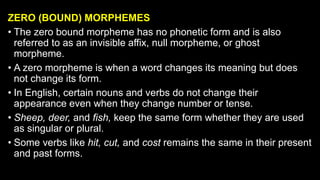
ZERO (BOUND) MORPHEMES
• The zero bound morpheme has no phonetic form and is also
referred to as an invisible affix, null morpheme, or ghost
morpheme.
• A zero morpheme is when a word changes its meaning but does
not change its form.
• In English, certain nouns and verbs do not change their
appearance even when they change number or tense.
• Sheep, deer, and fish, keep the same form whether they are used
as singular or plural.
• Some verbs like hit, cut, and cost remains the same in their present
and past forms.
• MORPHEMES - KEY TAKEAWAYS
• Morphemes are the smallest lexical unit of meaning. Most words
are free morphemes, and most affixes are bound morphemes.
• There are two types of morphemes: free morphemes and bound
morphemes.
• Free morphemes can stand alone, whereas bound morphemes
must be attached to another morpheme to get their meaning.
• Morphemes are made up of two separate classes called bases (or
roots) and affixes.
• Free morphemes fall into two categories; lexical and
functional. Lexical morphemes are words that give us the main
meaning of a sentence, and functional morphemes have a
grammatical purpose.
Short Quiz: Identify the morphemes in
the following words:
Example: cats = cat –s (2 morphemes)
1. unbreakable 6. inadequate
2. shortest 7. category
3. trucks 8. pumpkins
4. rabbit 9. disagreement
5. sharply 10. disqualified
Prepared by:
Jay Viñas Ramboyong,
MAEd-English/Discussant

MORPHEMES.pptx

  • 1.
  • 4.
  • 5.
    Morphology and Syntax JAYDISCUSSANT MAED-ENGLISH, RAMBOYONG,
  • 6.
  • 7.
  • 8.
  • 9.
  • 10.
    Read it fastand clear! Antidisestablishmentarianism
  • 11.
    MORPHEMES • Definition • Typesof Morphemes • Examples
  • 13.
  • 14.
    Directions: Write TRUEif the statement is correct and FALSE if it is not. 1. Morphemes are the smallest lexical unit of meaning.
  • 15.
    Directions: Write TRUEif the statement is correct and FALSE if it is not. 2. Most words are bound morphemes, and most affixes are free morphemes.
  • 16.
    Directions: Write TRUEif the statement is correct and FALSE if it is not. 3. There are two types of morphemes: free morphemes and bound morphemes.
  • 17.
    Directions: Write TRUEif the statement is correct and FALSE if it is not. 4. Morphemes are made up of two separate classes called bases (or roots) and affixes.
  • 18.
    Directions: Write TRUEif the statement is correct and FALSE if it is not. 5. Free morphemes fall into two categories; lexical and functional. Lexical morphemes are words that give us the main meaning of a sentence, and functional morphemes have a grammatical purpose.
  • 19.
  • 20.
    Directions: Write TRUEif the statement is correct and FALSE if it is not. 1. Morphemes are the smallest lexical unit of meaning.
  • 22.
    Directions: Write TRUEif the statement is correct and FALSE if it is not. 2. Most words are bound morphemes, and most affixes are free morphemes.
  • 24.
    Directions: Write TRUEif the statement is correct and FALSE if it is not. 3. There are two types of morphemes: free morphemes and bound morphemes.
  • 26.
    Directions: Write TRUEif the statement is correct and FALSE if it is not. 4. Morphemes are made up of two separate classes called bases (or roots) and affixes.
  • 28.
    Directions: Write TRUEif the statement is correct and FALSE if it is not. 5. Free morphemes fall into two categories; lexical and functional. Lexical morphemes are words that give us the main meaning of a sentence, and functional morphemes have a grammatical purpose.
  • 30.
  • 32.
  • 33.
    MORPHOLOGY  The termmorphology is Greek and is a makeup of morph – meaning ‘shape, form,’ and –ology which means ‘the study of something.’
  • 34.
    MORPHOLOGY  The studyof the forms of words.  It is the study of words, word formation, and the relationship between words.
  • 35.
    In Morphology, welook at morphemes - the smallest lexical items of meaning. Studying morphemes helps us to understand the meaning, structure, and etymology (history) of words.
  • 36.
    MORPHEME  It isa meaningful linguistic unit consisting of a word such as dog, of a word element, such as the –s at the end of dogs, that cannot be divided into smaller meaningful parts.  Morphemes are the smallest units of meaning in a language.
  • 37.
    Look at thefollowing examples of morphemes: •House •Bed •Book •These words cannot be made shorter than they already are or they would stop being words or lose their meaning. •For example, 'house' cannot be split into ho- and - us' as they are both meaningless.
  • 38.
    However, not allmorphemes are words. •For example, 's' is not a word, but it is a morpheme; 's' shows plurality and means 'more than one'.
  • 39.
    The word ‘cats'is made up of two morphemes: cat + s
  • 40.
  • 41.
  • 42.
  • 43.
    How many morphemesare there in each of the following word? overestimating keyboard cranberry school antidisestablishmentarianism
  • 44.
    Morphemes play afundamental role in the structure and meaning of language, and understanding them can help us to better understand the words we use and the rules that govern their use.
  • 45.
    How to identifya morpheme? •You can identify morphemes by seeing if the word or letters in question meet the following criteria:
  • 46.
    1. Morphemes musthave meaning. E.g. the word 'cat' represents a small furry animal. The suffix '-s' you might find at the end of the word 'cat' represents plurality.
  • 47.
    2. Morphemes cannotbe divided into smaller parts without losing or changing their meaning. E.g. dividing the word 'cat' into 'ca' leaves us with a meaningless set of letters.
  • 48.
  • 49.
    There are twotypes of morphemes: •FREE morphemes •BOUND morphemes.
  • 50.
    FREE MORPHEMES •Free morphemescan stand alone and don't need to be attached to any other morphemes to get their meaning. Most words are free morphemes, such as the above-mentioned words house, book, bed, light, world, people, and so on.
  • 51.
    BOUND MORPHEMES •Bound morphemes,however, cannot stand alone. The most common example of bound morphemes are suffixes, such as -s, -er, -ing, and -est.
  • 52.
    •Let's look atsome examples of FREE and BOUND morphemes: •Tall •Tree •-er •-s
  • 53.
    •We understand what 'tall'and 'tree' mean; they don't require extra add-ons. We can use them to create a simple sentence like 'That tree is tall.'
  • 54.
    •On the otherhand, '-er' and ‘-s' are bound morphemes. You won't see them on their own because they are suffixes that add meaning to the words they are attached to.
  • 55.
    •So if weadd '-er' to 'tall' we get the comparative form 'taller', while 'tree' plus '-s' becomes plural: 'trees'.
  • 56.
    MORPHEMES: STRUCTURE •Morphemes aremade up of two separate classes. •BASES (OR ROOTS) •AFFIXES
  • 57.
    •A morpheme's BASEis the main root that gives the word its meaning.
  • 58.
    •On the otherhand, an AFFIX is a morpheme we can add that changes or modifies the meaning of the base.
  • 59.
    •'Kind' is thefree base morpheme in the word 'kindly'. (kind + -ly)
  • 60.
    •'-less' is abound morpheme in the word 'careless'. (Care + -less)
  • 61.
    MORPHEMES: AFFIXES •Affixes arebound morphemes that occur before or after a base word. They are made up of SUFFIXES and PREFIXES.
  • 62.
    •SUFFIXES are attachedto the end of the base or root word. Some of the most common suffixes include -er, - or, -ly, -ism, and -less.
  • 63.
  • 64.
    •PREFIXES come beforethe base word. Typical prefixes include ante-, pre-, un-, and dis-. •Antedate •Prehistoric •Unkind •Disappear
  • 65.
    DERIVATIONAL AFFIXES •Derivational affixesare used to change the meaning of a word by building on its base. For instance, by adding the prefix 'un-' to the word 'kind', we got a new word with a whole new meaning. In fact, 'unkind' has the exact opposite meaning of 'kind.’
  • 66.
    •Another example isadding the suffix '-or' to the word 'act' to create 'actor'. The word 'act' is a verb, whereas 'actor' is a noun.
  • 67.
    INFLECTIONAL AFFIXES Inflectional affixesonly modify the meaning of words instead of changing them. This means they modify the words by making them plural, comparative or superlative, or by changing the verb tense.
  • 68.
    •book - books •short- shorter •quick - quickest •walk - walked •climb - climbing
  • 69.
    There are manyderivational affixes in English, but only eight inflectional affixes and these are all suffixes. Word class Modification reason Suffixes To modify nouns Plural & possessive forms -s (or -es), -'s (or s') To modify adjectives Comparative & superlative forms -er, -est To modify verbs 3rd person singular, past tense, present & past participles -s, -ed, -ing, -en All prefixes in English are derivational. However, suffixes may be either derivational or inflectional.
  • 70.
    MORPHEMES: CATEGORIES •The freemorphemes we looked at earlier (such as tree, book, and tall) fall into two categories: •LEXICAL morphemes •FUNCTIONAL morphemes
  • 71.
    LEXICAL MORPHEMES arewords that give us the main meaning of a sentence, text or conversation. These words can be nouns, adjectives and verbs. Examples of lexical morphemes include: • HOUSE BOOK TREE • PANTHER LOUD QUIET • BIG ORANGE BLUE • OPEN RUN TALK • Because we can add new lexical morphemes to a language (new words get added to the dictionary each year), they are considered an 'open' class of words.
  • 72.
    • FUNCTIONAL (ORGRAMMATICAL) MORPHEMES are mostly words that have a functional purpose, such as linking or referencing lexical words. Functional morphemes include prepositions, conjunctions, articles and pronouns. Examples of functional morphemes include: • AND BUT WHEN • BECAUSE ON NEAR • ABOVE IN THE • THAT IT THEM • We can rarely add new functional morphemes to the language, so we call this a 'closed' class of words.
  • 73.
    ALLOMORPHS •Allomorphs are avariant of morphemes. An allomorph is a unit of meaning that can change its sound and spelling but doesn't change its meaning and function. •In English, the indefinite article morpheme has two allomorphs. Its two forms are 'a' and 'an'. If the indefinite article precedes a word beginning with a consonant sound it is 'a', and if it precedes a word beginning with a vowel sound, it is 'an'.
  • 74.
    PAST TENSE ALLOMORPHS •InEnglish, regular verbs use the past tense morpheme -ed; this shows us that the verb happened in the past. The pronunciation of this morpheme changes its sound according to the last consonant of the verb but always keeps its past tense function. This is an example of an allomorph.
  • 75.
    •Consider regular verbsending in t or d, like 'rent' or 'add'. •Now look at their past forms: 'rented' and 'added'. Try pronouncing them. Notice how the -ed at the end changes to an /id/ sound (e.g. rent /ɪd/, add /ɪd/).
  • 76.
    •Now consider thepast simple forms of want, rest, print, and plant. When we pronounce them, we get: wanted (want /ɪd/), rested (rest /ɪd/), printed (print /ɪd/), planted (plant /ɪd/).
  • 77.
    •Now look atother regular verbs ending in the following 'voiceless' phonemes: /p/, /k/, /s/, /h/, /ch/, /sh/, /f/, /x/. Try pronouncing the past form and notice how the allomorph '-ed' at the end changes to a /t/ sound. For example, dropped, pressed, laughed, and washed.
  • 78.
    PLURAL ALLOMORPHS •Typically weadd 's' or 'es' to most nouns in English when we want to create the plural form. The plural forms 's' or 'es' remain the same and have the same function, but their sound changes depending on the form of the noun. The plural morpheme has three allomorphs: [s], [z], and [ɨz]. •When a noun ends in a voiceless consonant (i.e. ch, f, k, p, s, sh, t, th), the plural allomorph is /s/.
  • 79.
  • 80.
    •When a nounends in a voiced phoneme (i.e. b, l, r, j, d, v, m, n, g, w, z, a, e, i, o, u) the plural form remains 's' or 'es' but the allomorph sound changes to /z/. •Key becomes keys (pronounced key/z/) •Bee becomes bees (pronounced bee/z/)
  • 81.
    •When a nounends in a sibilant (i.e. s, ss, z), the sound of the allomorph sound becomes /iz/. •Bus becomes buses (bus/iz/) •House becomes houses (hous/iz/) •A sibilant is a phonetic sound that makes a hissing sound, e.g. 's' or 'z'.
  • 82.
    ZERO (BOUND) MORPHEMES •The zero bound morpheme has no phonetic form and is also referred to as an invisible affix, null morpheme, or ghost morpheme. • A zero morpheme is when a word changes its meaning but does not change its form. • In English, certain nouns and verbs do not change their appearance even when they change number or tense. • Sheep, deer, and fish, keep the same form whether they are used as singular or plural. • Some verbs like hit, cut, and cost remains the same in their present and past forms.
  • 85.
    • MORPHEMES -KEY TAKEAWAYS • Morphemes are the smallest lexical unit of meaning. Most words are free morphemes, and most affixes are bound morphemes. • There are two types of morphemes: free morphemes and bound morphemes. • Free morphemes can stand alone, whereas bound morphemes must be attached to another morpheme to get their meaning. • Morphemes are made up of two separate classes called bases (or roots) and affixes. • Free morphemes fall into two categories; lexical and functional. Lexical morphemes are words that give us the main meaning of a sentence, and functional morphemes have a grammatical purpose.
  • 102.
    Short Quiz: Identifythe morphemes in the following words: Example: cats = cat –s (2 morphemes) 1. unbreakable 6. inadequate 2. shortest 7. category 3. trucks 8. pumpkins 4. rabbit 9. disagreement 5. sharply 10. disqualified
  • 104.
    Prepared by: Jay ViñasRamboyong, MAEd-English/Discussant