English Morphology – Lecture 
1 
David Brett 
Antonio Pinna 
University of Sassari 2007
A definition of morphology 
• The area of grammar concerned with the 
structure of words and with relationships 
between words involving the morphemes 
that compose them
What is a word? 
• An orthographic definition 
• A phonological definition 
• A semantic definition 
• A syntactic definition
An orthographic definition 
• Words as units in the writing system: 
words are uninterrupted strings of letters 
• For ex. writing is a word because there are 
blank spaces surrounding it
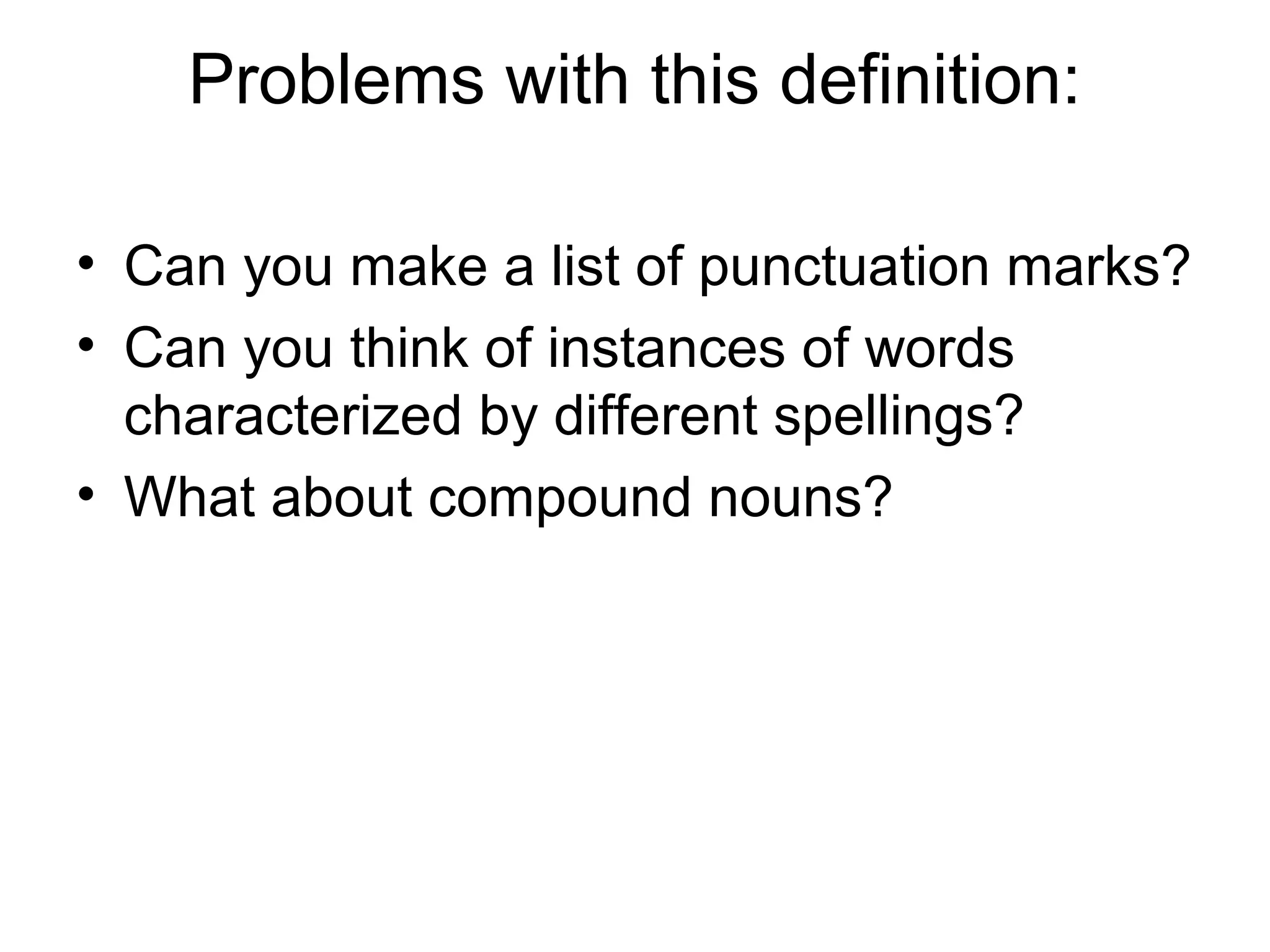
Problems with this definition: 
• Can you make a list of punctuation marks? 
• Can you think of instances of words 
characterized by different spellings? 
• What about compound nouns?
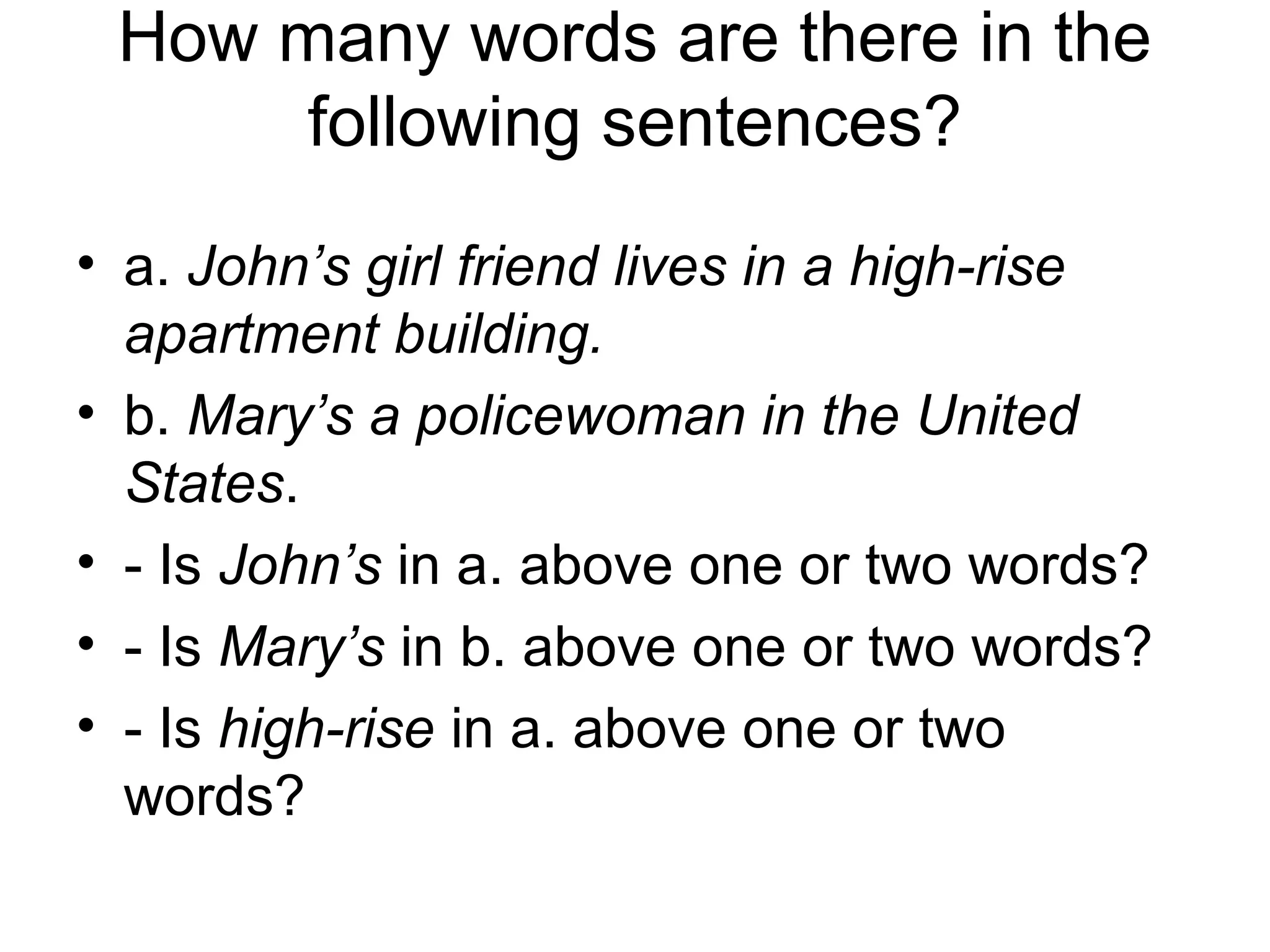
How many words are there in the 
following sentences? 
• a. John’s girl friend lives in a high-rise 
apartment building. 
• b. Mary’s a policewoman in the United 
States. 
• - Is John’s in a. above one or two words? 
• - Is Mary’s in b. above one or two words? 
• - Is high-rise in a. above one or two 
words?
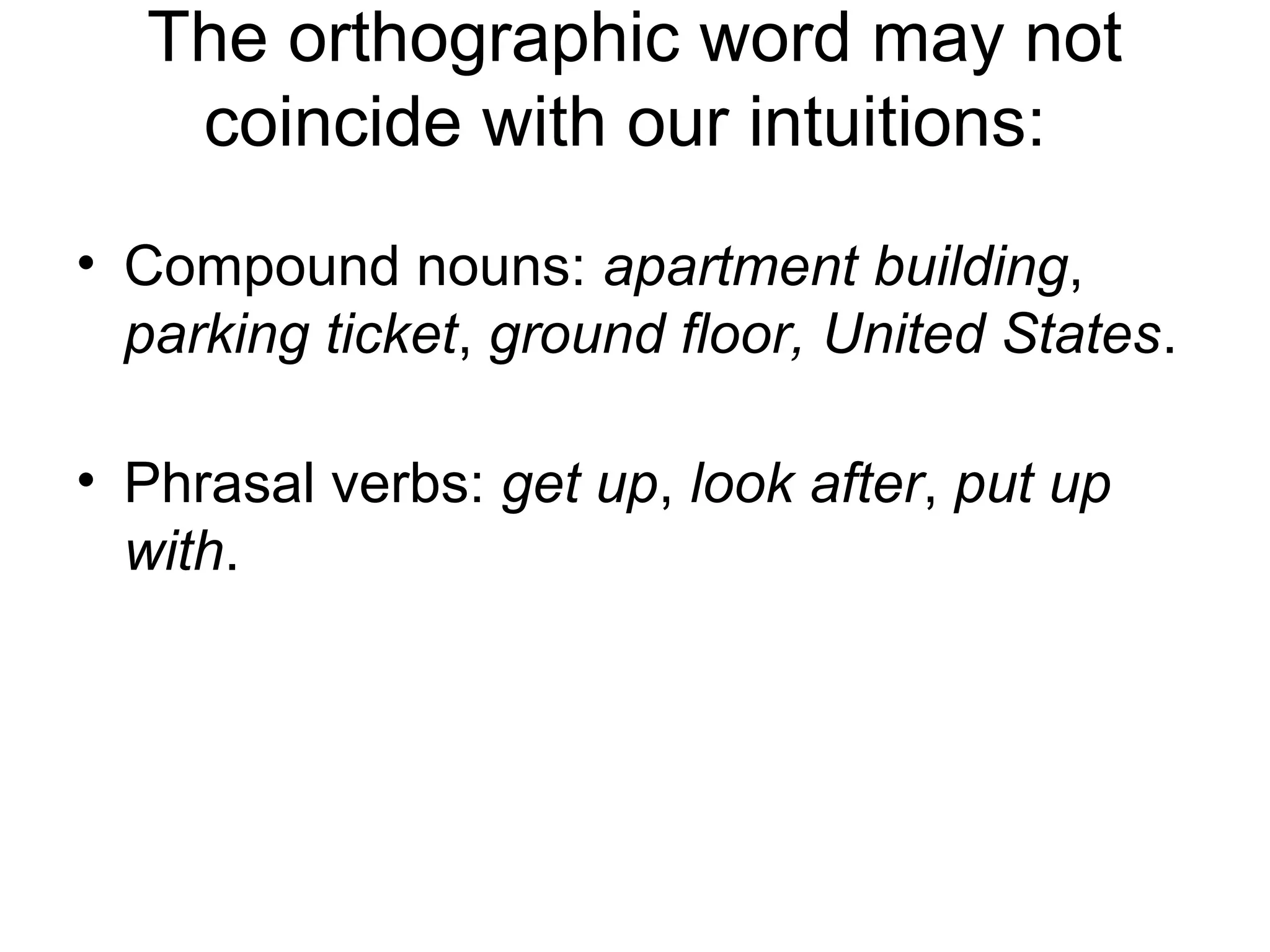
The orthographic word may not 
coincide with our intuitions: 
• Compound nouns: apartment building, 
parking ticket, ground floor, United States. 
• Phrasal verbs: get up, look after, put up 
with.
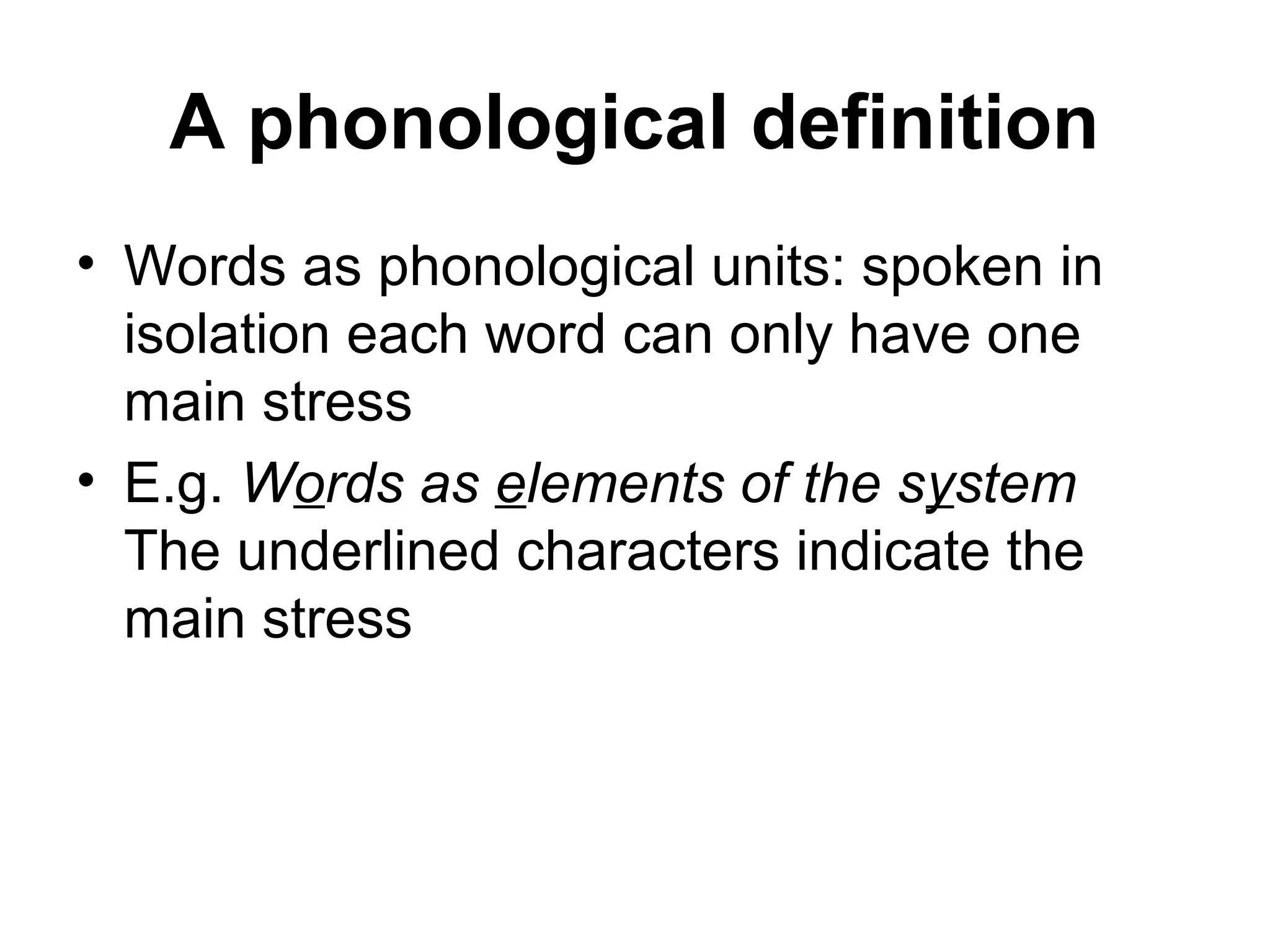
A phonological definition 
• Words as phonological units: spoken in 
isolation each word can only have one 
main stress 
• E.g. Words as elements of the system 
The underlined characters indicate the 
main stress
Problems with this definition: 
• Function words (i.e. words such as as, of, 
the) do not seem to have a main stress; 
• Clitics (i.e. ‘s in the example below) do not 
seem to have a main stress- 
• Ex. Jane’s in the garden: ‘s, in, the are not 
stressed.
A semantic definition 
• Words as meaningful units: 
• a. Words express unified concepts 
• b. Words are the minimum meaningful 
units of a language
Problems with these definitions: 
• Concepts can be expressed by noun 
groups or larger units; for ex. the man who 
lives next door or that beautiful summer 
morning of 1985 when we drove to the 
beach on an old CV2 
• Function words may not have an easily 
identifiable meaning (for ex. can you 
specify the meaning of the?)
4. A syntactic definition #1 
• Words as syntactic units: words are the smallest 
syntactic elements in a sentence: 
• a. They belong to certain word classes (and follow the 
rules of these syntactic categories) 
• Words can be grouped into 2 main categories: 
• 1. Open-class words: classes of words which can 
contain an infinite number of words 
• (i.e. nouns, lexical verbs, adjectives, adverbs) 
• 2. Closed-class words: classes of words which 
contain a limited number of words 
• (i.e. pronouns, prepositions, auxiliary and 
modal verbs, conjunctions, determiners)
4. A syntactic definition #2 
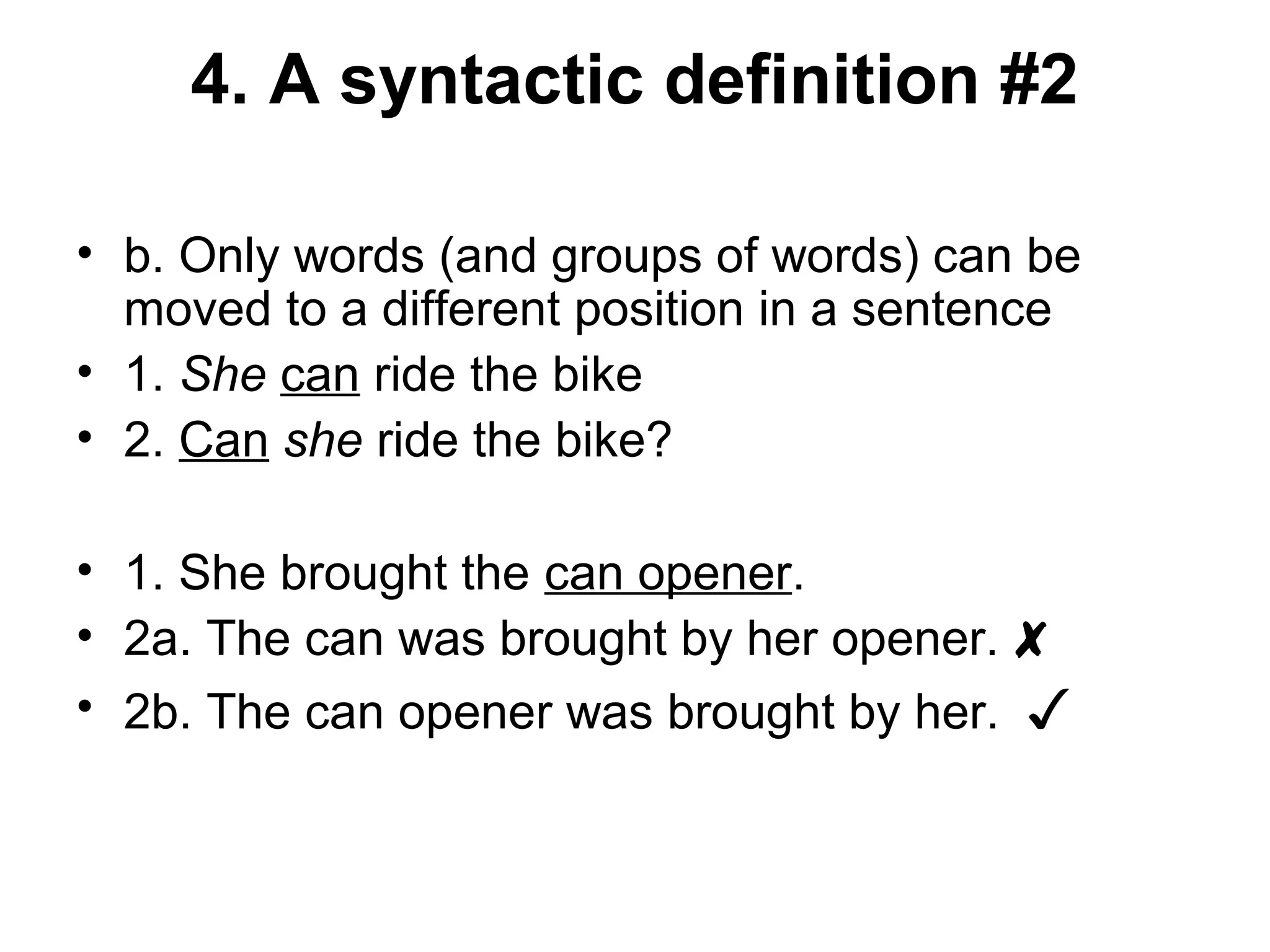
• b. Only words (and groups of words) can be 
moved to a different position in a sentence 
• 1. She can ride the bike 
• 2. Can she ride the bike? 
• 1. She brought the can opener. 
• 2a. The can was brought by her opener. ✘ 
• 2b. The can opener was brought by her. ✓
The relationship between words and 
meanings 
Words with unpredictable meanings: 
dog, door, desk, book, pen, … 
Words with predictable meanings 
Complex words: unhappy, helpful, madly, … 
E.g. The relationship between the sequence of letters cat and its 
meaning [domestic feline] in English is the result of a convention. 
Whenever this association form-meaning is the result of a 
convention, the meaning of a word is unpredictable on the basis of 
its form. 
Exception: onomatopoeic words 
splash resembles the sound of a liquid hitting something; 
beep resembles a short high sound, like the sound of a car horn.
Non-words and meanings 
• entities that are larger than a word with 
unpredictable meanings 
– Idioms: pull someone’s leg; kick the bucket; … 
– Collocations: hard work, white coffee, white-collar 
worker … 
– Proverbs: All work and no play makes Jack a 
dull boy, beauty is in the eye of the beholder, 
birds of a feather flock together, a bad 
workman blames his tools, …
The difference between words and 
lexical items 
Words are the smallest syntactic units in a 
sentence (i.e. words are grammatical 
entities) 
• Lexical items are semantic units whose 
meanings are unpredictable; they may be 
larger than words, but often they can 
coincide with them (i.e. lexical items are 
semantic entities)
Taking words apart 
• Why is the meaning of the following words 
predictable to a certain extent? 
• unbelievable, capitalistic, mismatched, 
disproportional, misunderstanding, 
irregularity. 
• lighthouse, shoplift, team manager, 
apartment building, concentration camp, 
low-flying, cupboard, sickness benefit.
Complex words: affixation 
• Words can be composed of identifiable smaller parts, morphemes, 
put together in a systematic fashion, so that the meaning of the 
whole can reliably be determined on the basis of the meaning of the 
smaller parts. 
• un-believe-able, anti-capital-ist-ic, de-colony-al-ize-ation, dis-proportion- 
al, mis-under-stand-ing, ir-regul-ar-ity. 
• This group contains words which are divisible into: 
• a component that carries most of the meaning (e.g. believe, capital, 
colony, proportion, etc.) 
• other elements that are associated with it to add some other aspects 
of meaning (e.g. –able in believable = something or someone is 
capable of being believed; un- in unbelievable = something or 
someone is not capable of being believed). 
• The process through which these words are formed is called 
affixation.
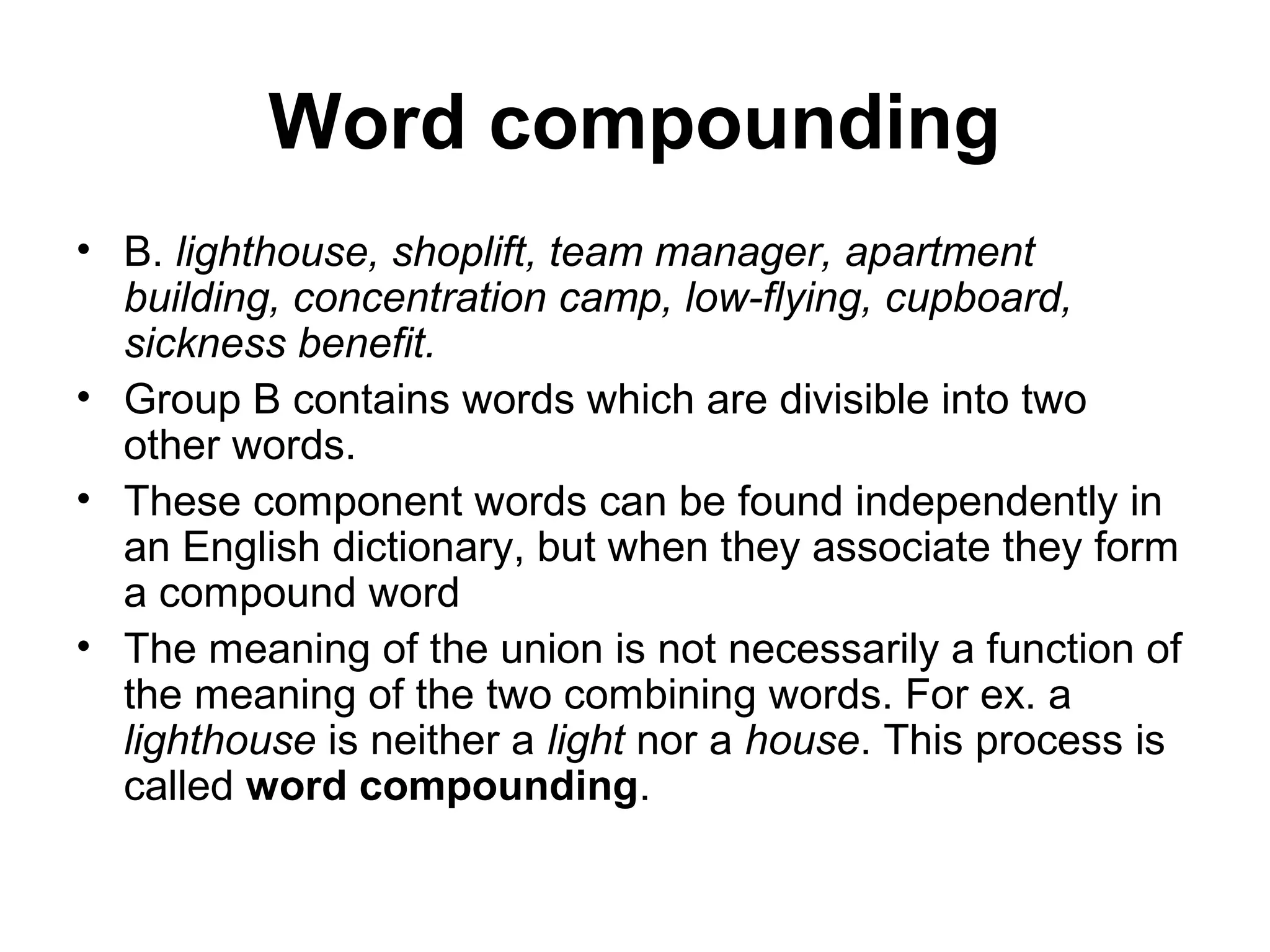
Word compounding 
• B. lighthouse, shoplift, team manager, apartment 
building, concentration camp, low-flying, cupboard, 
sickness benefit. 
• Group B contains words which are divisible into two 
other words. 
• These component words can be found independently in 
an English dictionary, but when they associate they form 
a compound word 
• The meaning of the union is not necessarily a function of 
the meaning of the two combining words. For ex. a 
lighthouse is neither a light nor a house. This process is 
called word compounding.
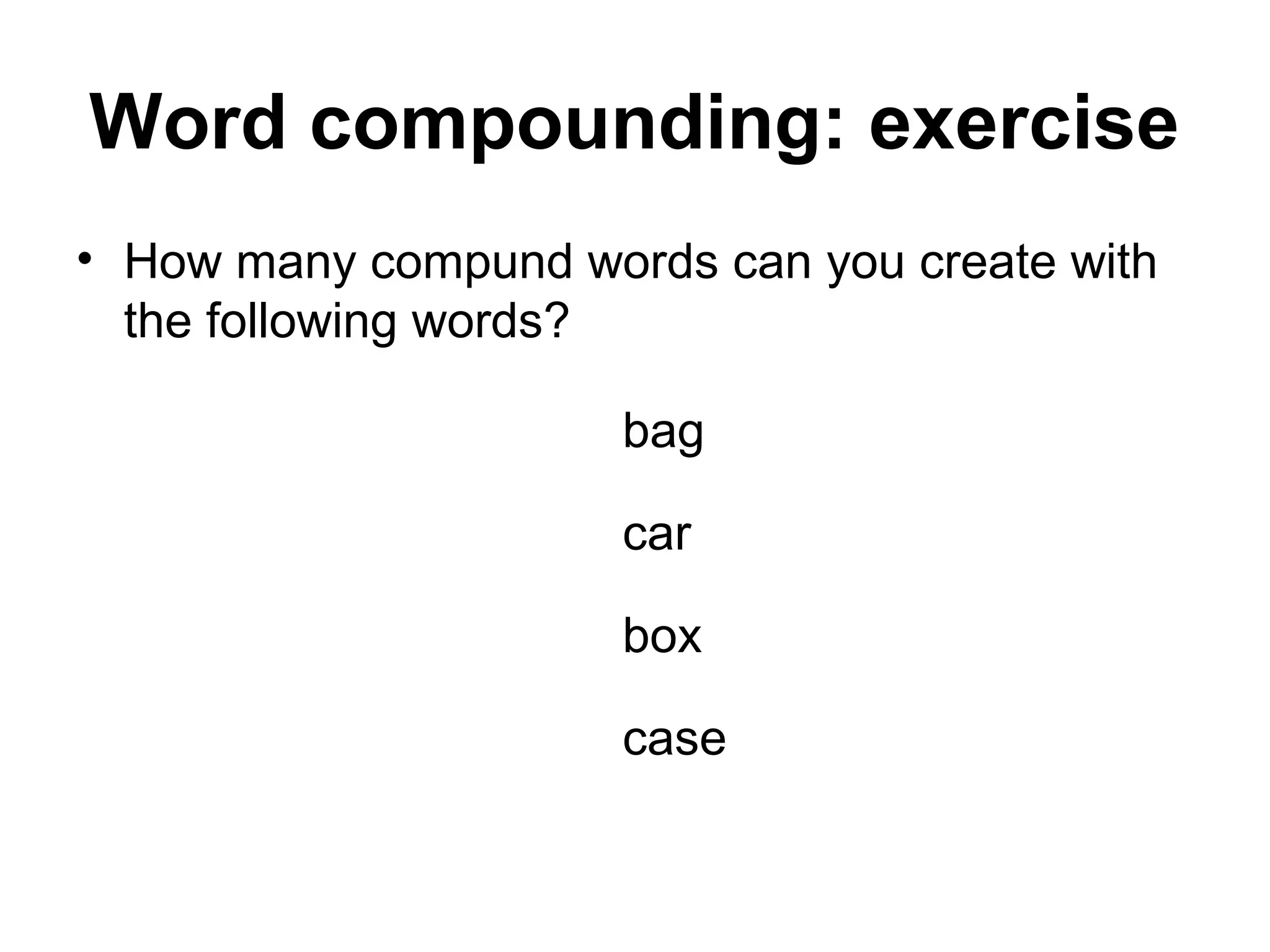
Word compounding: exercise 
• How many compund words can you create with 
the following words? 
bag 
car 
box 
case
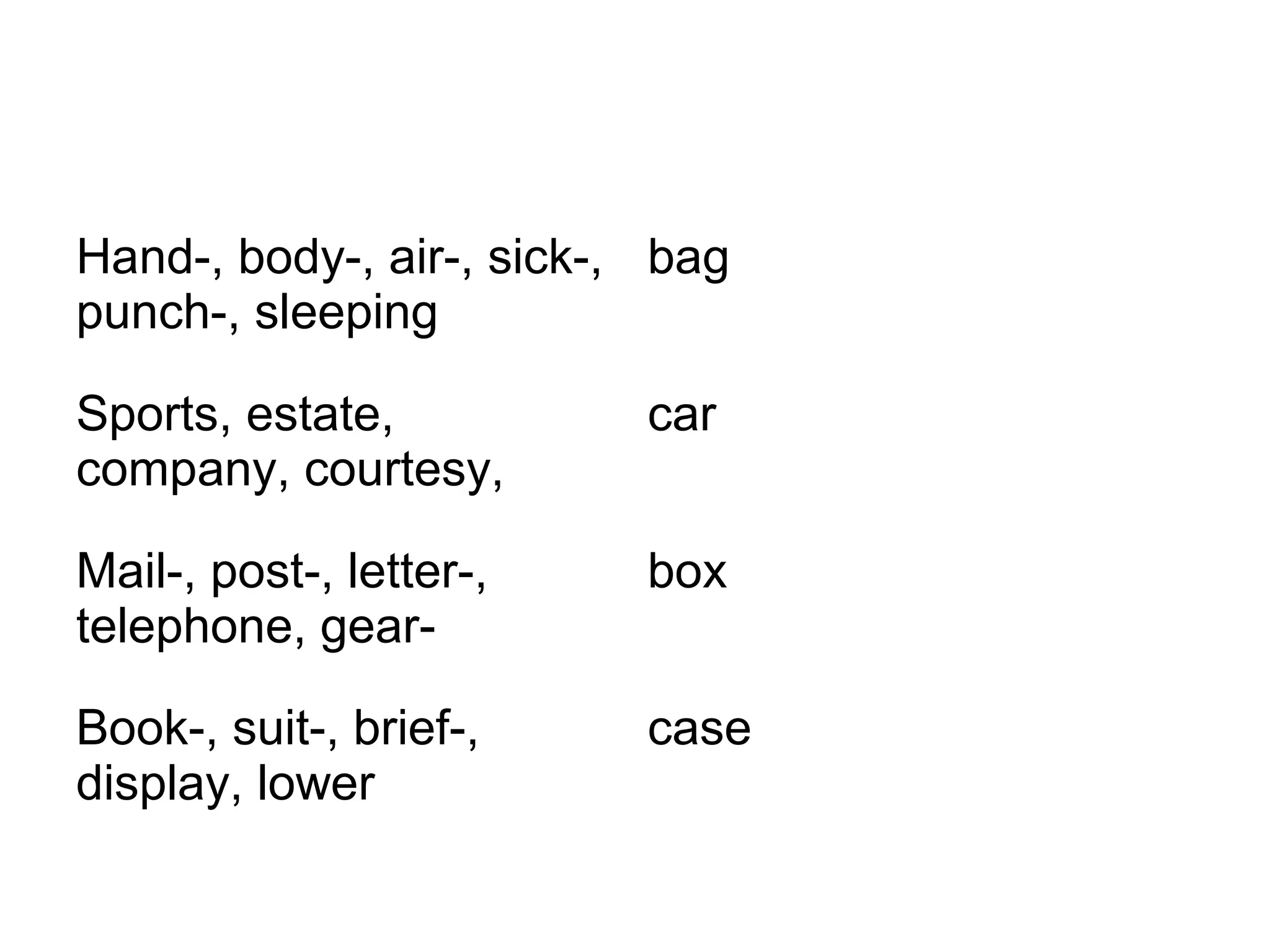
Hand-, body-, air-, sick-, 
punch-, sleeping 
bag 
Sports, estate, 
company, courtesy, 
car 
Mail-, post-, letter-, 
telephone, gear-box 
Book-, suit-, brief-, 
display, lower 
case
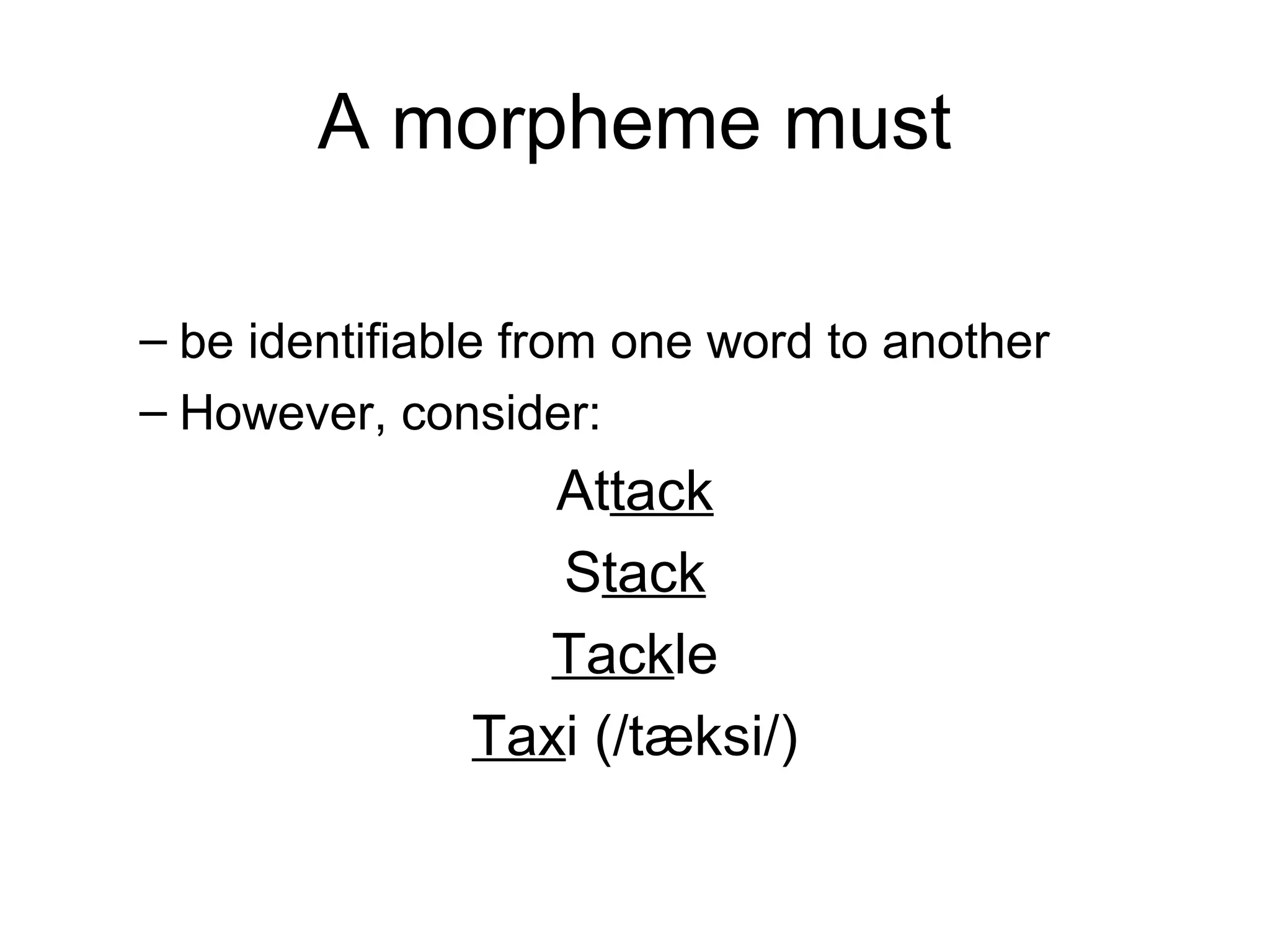
A morpheme must 
– be identifiable from one word to another 
– However, consider: 
Attack 
Stack 
Tackle 
Taxi (/tæksi/)
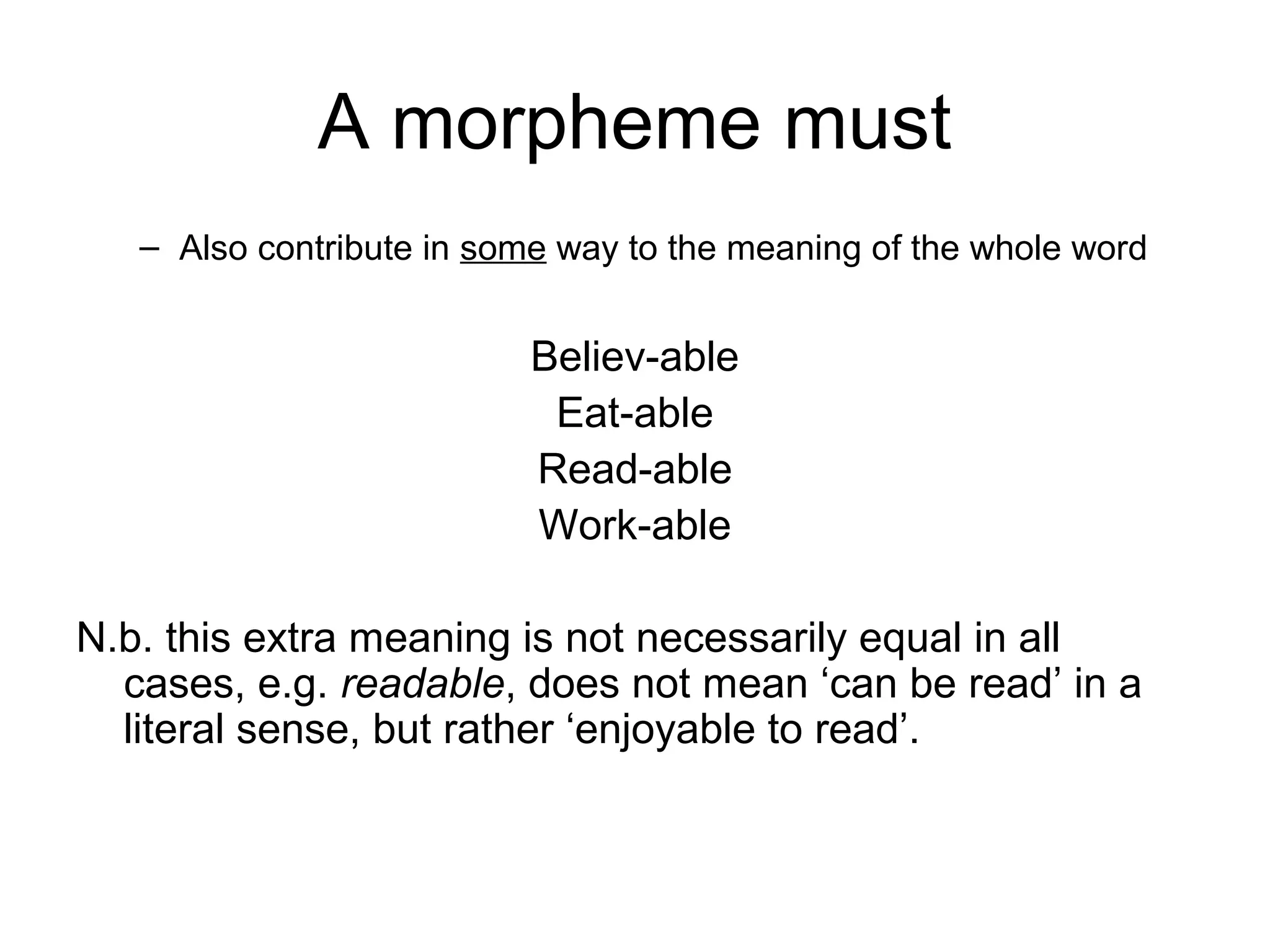
A morpheme must 
– Also contribute in some way to the meaning of the whole word 
Believ-able 
Eat-able 
Read-able 
Work-able 
N.b. this extra meaning is not necessarily equal in all 
cases, e.g. readable, does not mean ‘can be read’ in a 
literal sense, but rather ‘enjoyable to read’.
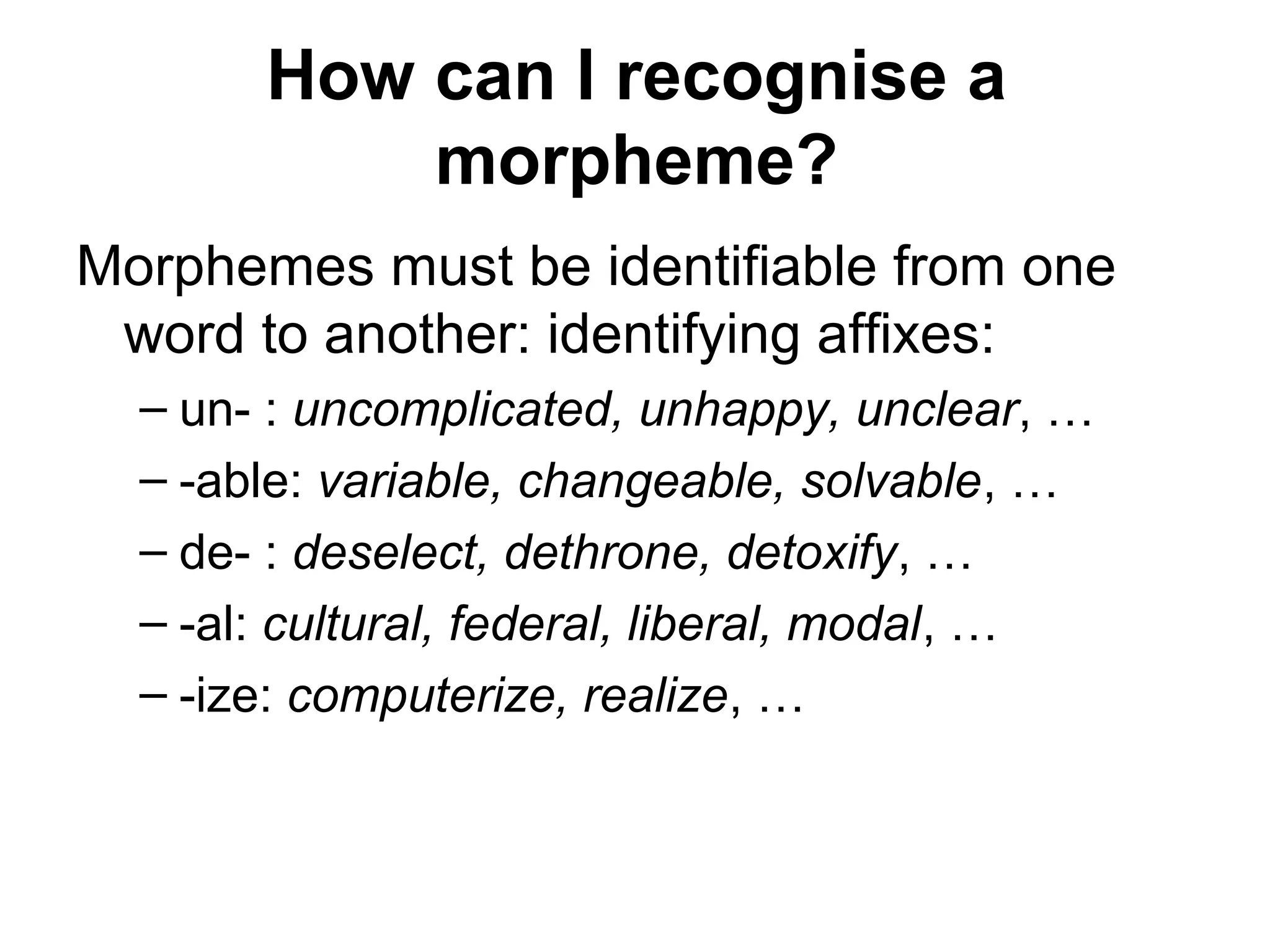
How can I recognise a 
morpheme? 
Morphemes must be identifiable from one 
word to another: identifying affixes: 
– un- : uncomplicated, unhappy, unclear, … 
– -able: variable, changeable, solvable, … 
– de- : deselect, dethrone, detoxify, … 
– -al: cultural, federal, liberal, modal, … 
– -ize: computerize, realize, …
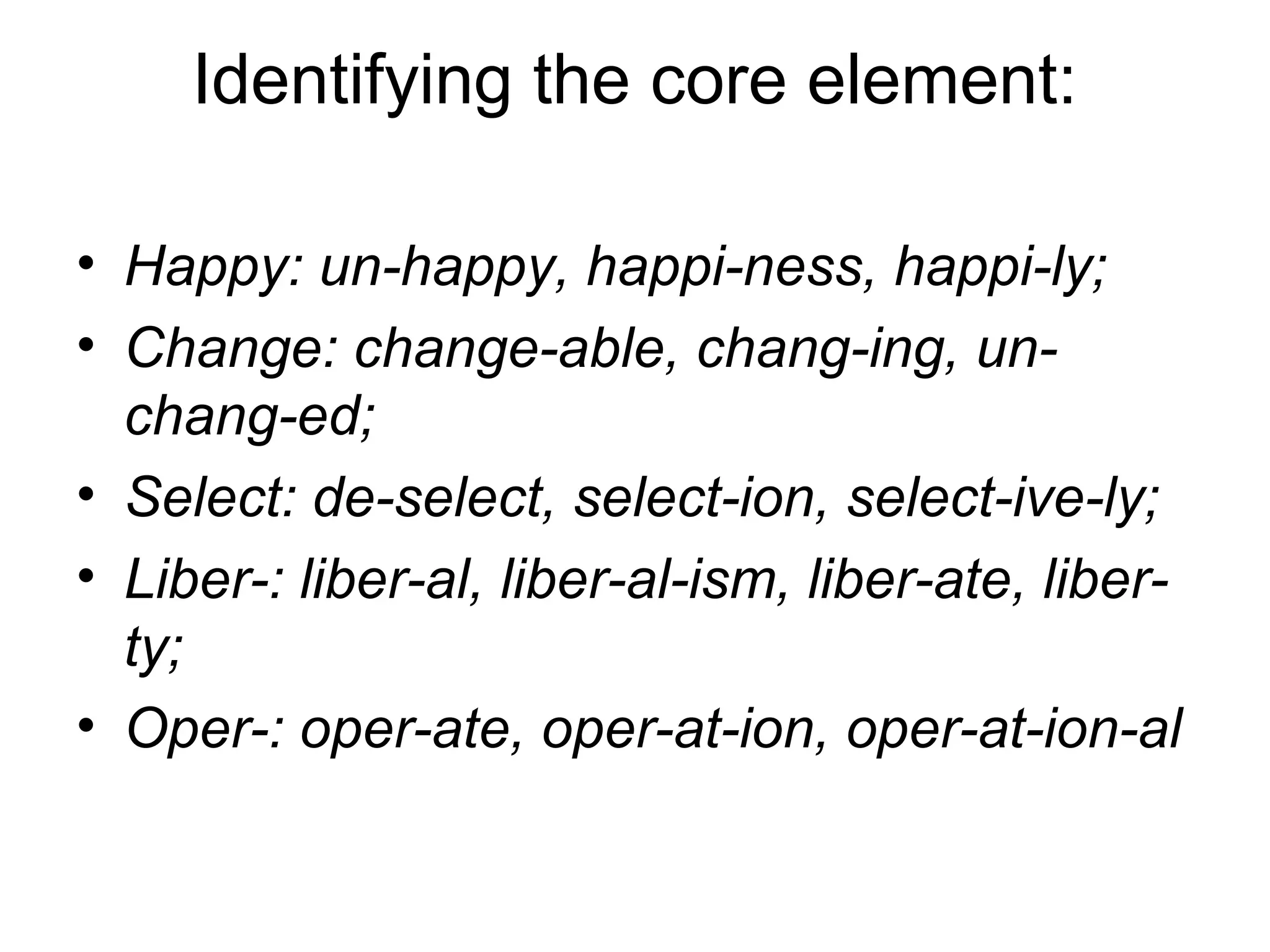
Identifying the core element: 
• Happy: un-happy, happi-ness, happi-ly; 
• Change: change-able, chang-ing, un-chang- 
ed; 
• Select: de-select, select-ion, select-ive-ly; 
• Liber-: liber-al, liber-al-ism, liber-ate, liber-ty; 
• Oper-: oper-ate, oper-at-ion, oper-at-ion-al
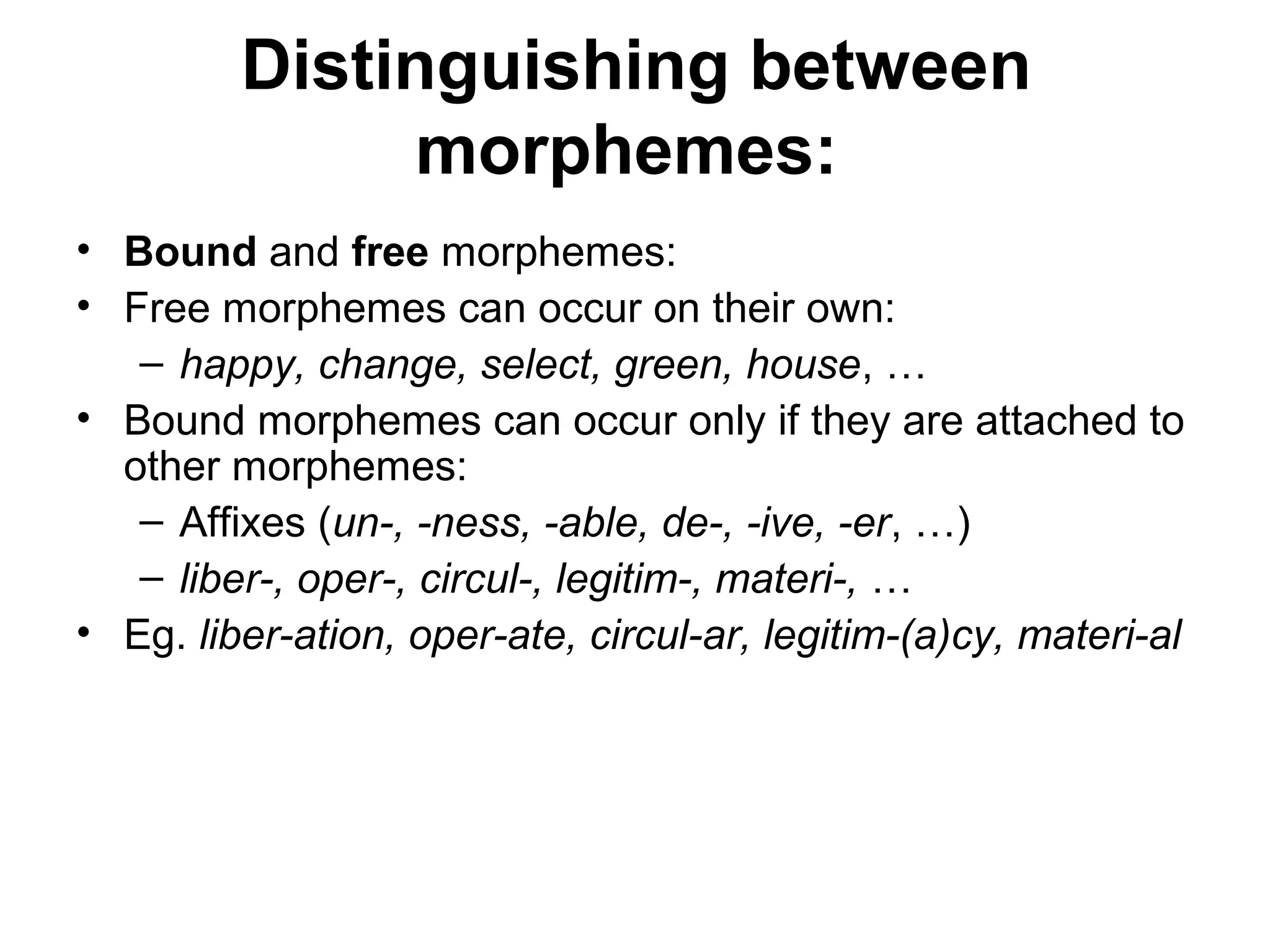
Distinguishing between 
morphemes: 
• Bound and free morphemes: 
• Free morphemes can occur on their own: 
– happy, change, select, green, house, … 
• Bound morphemes can occur only if they are attached to 
other morphemes: 
– Affixes (un-, -ness, -able, de-, -ive, -er, …) 
– liber-, oper-, circul-, legitim-, materi-, … 
• Eg. liber-ation, oper-ate, circul-ar, legitim-(a)cy, materi-al
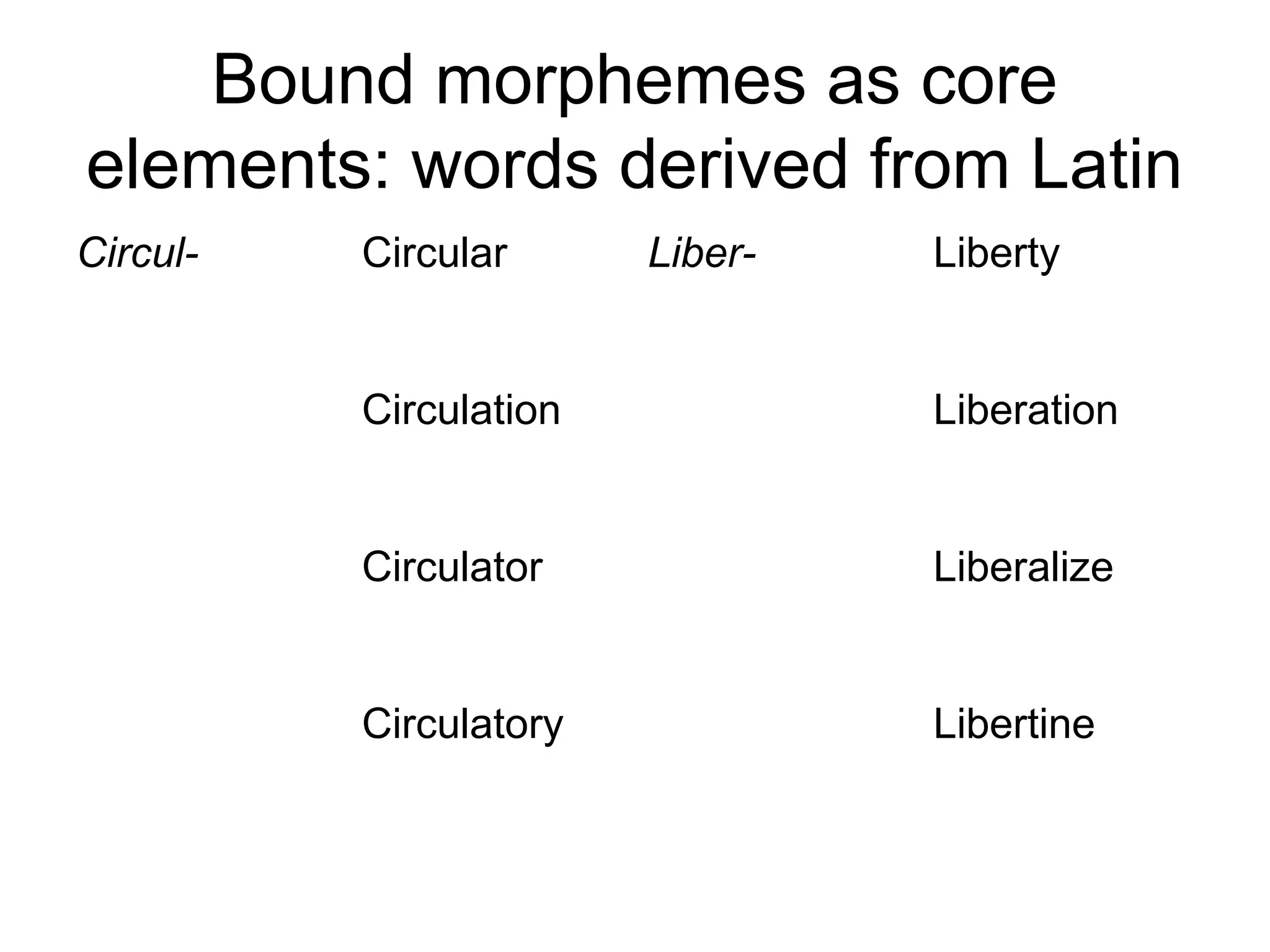
Bound morphemes as core 
elements: words derived from Latin 
Circul- Circular Liber- Liberty 
Circulation Liberation 
Circulator Liberalize 
Circulatory Libertine
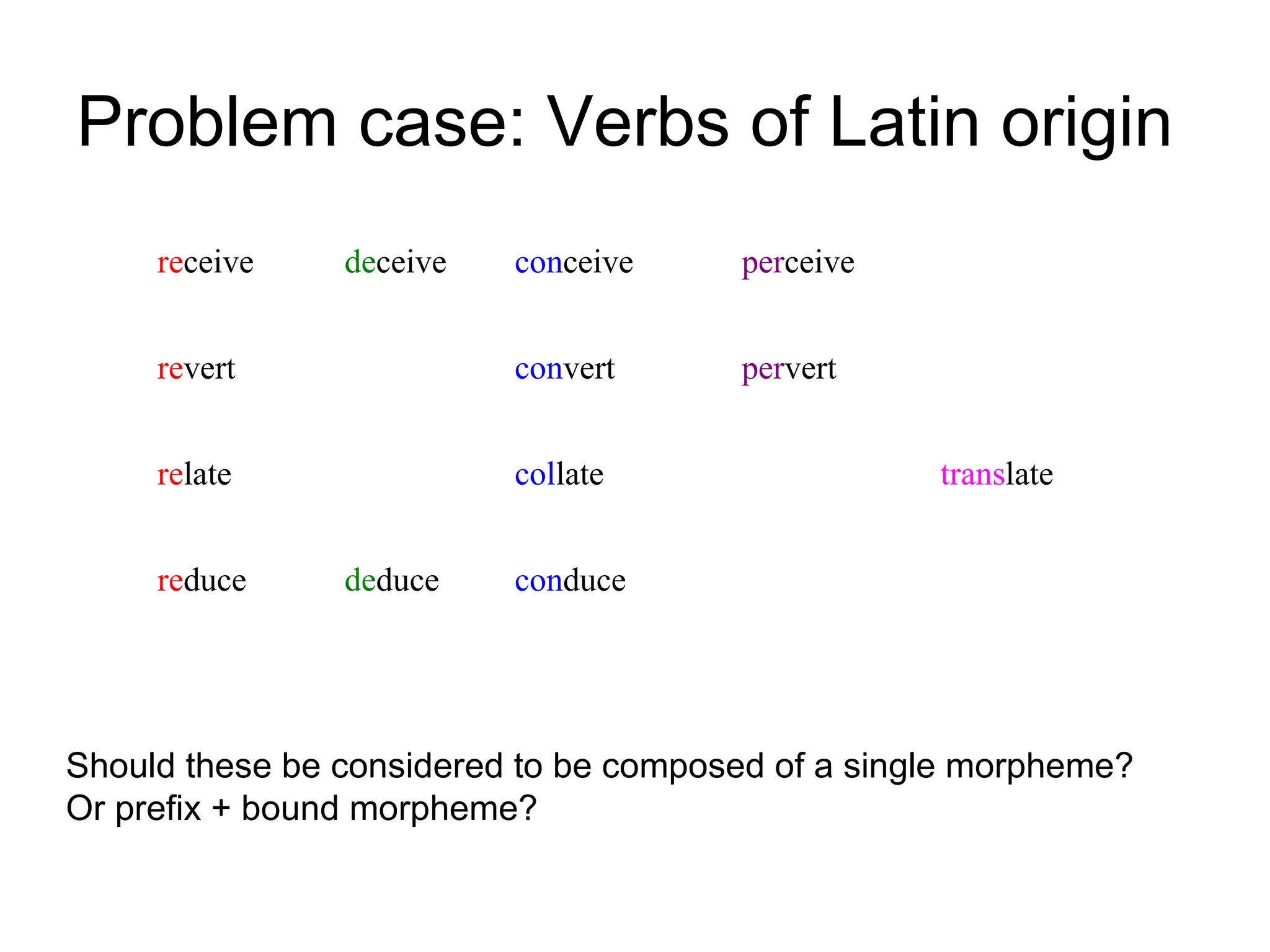
Problem case: Verbs of Latin origin 
receive deceive conceive perceive 
revert convert pervert 
relate collate translate 
reduce deduce conduce 
Should these be considered to be composed of a single morpheme? 
Or prefix + bound morpheme?
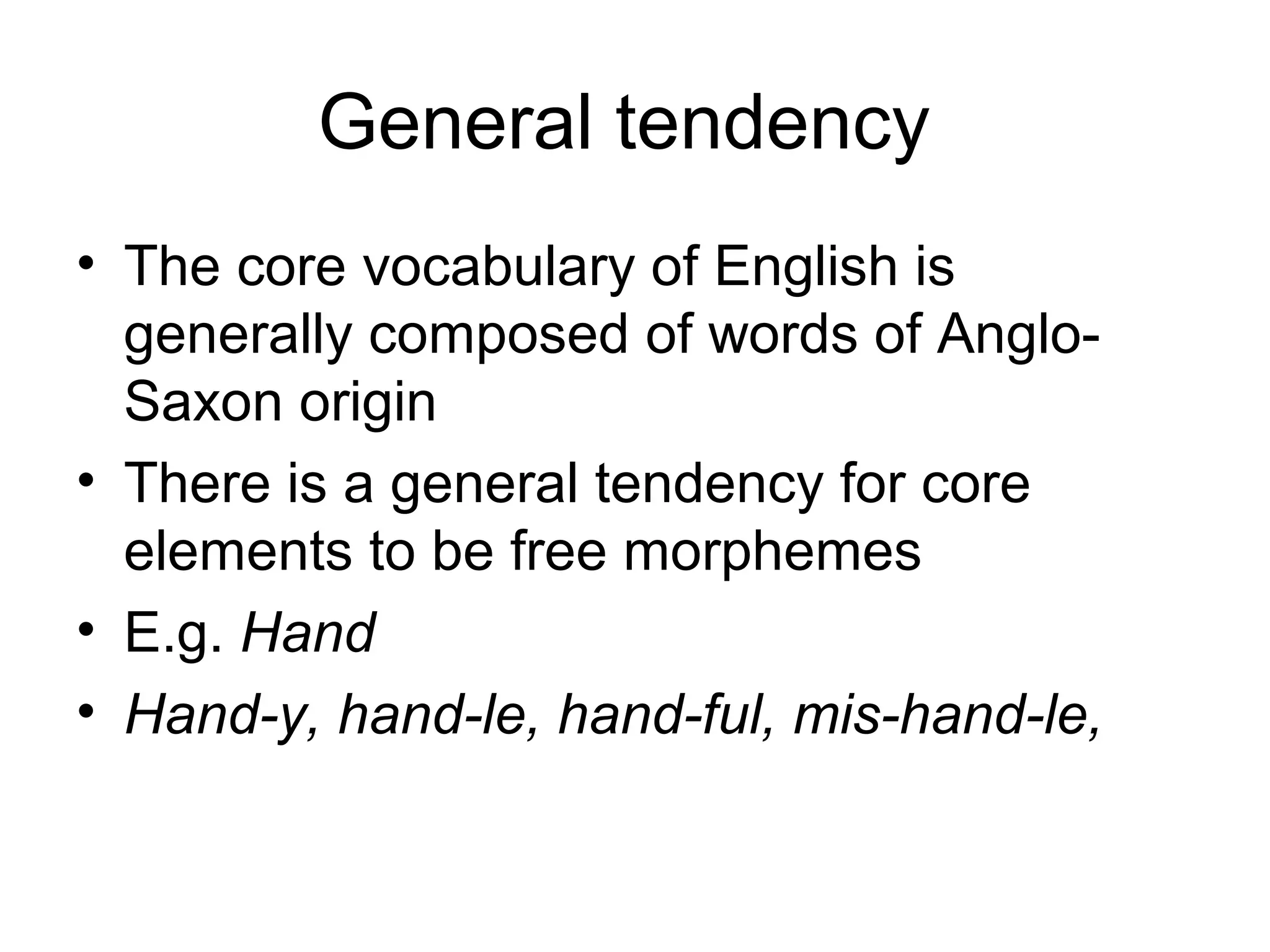
General tendency 
• The core vocabulary of English is 
generally composed of words of Anglo- 
Saxon origin 
• There is a general tendency for core 
elements to be free morphemes 
• E.g. Hand 
• Hand-y, hand-le, hand-ful, mis-hand-le,
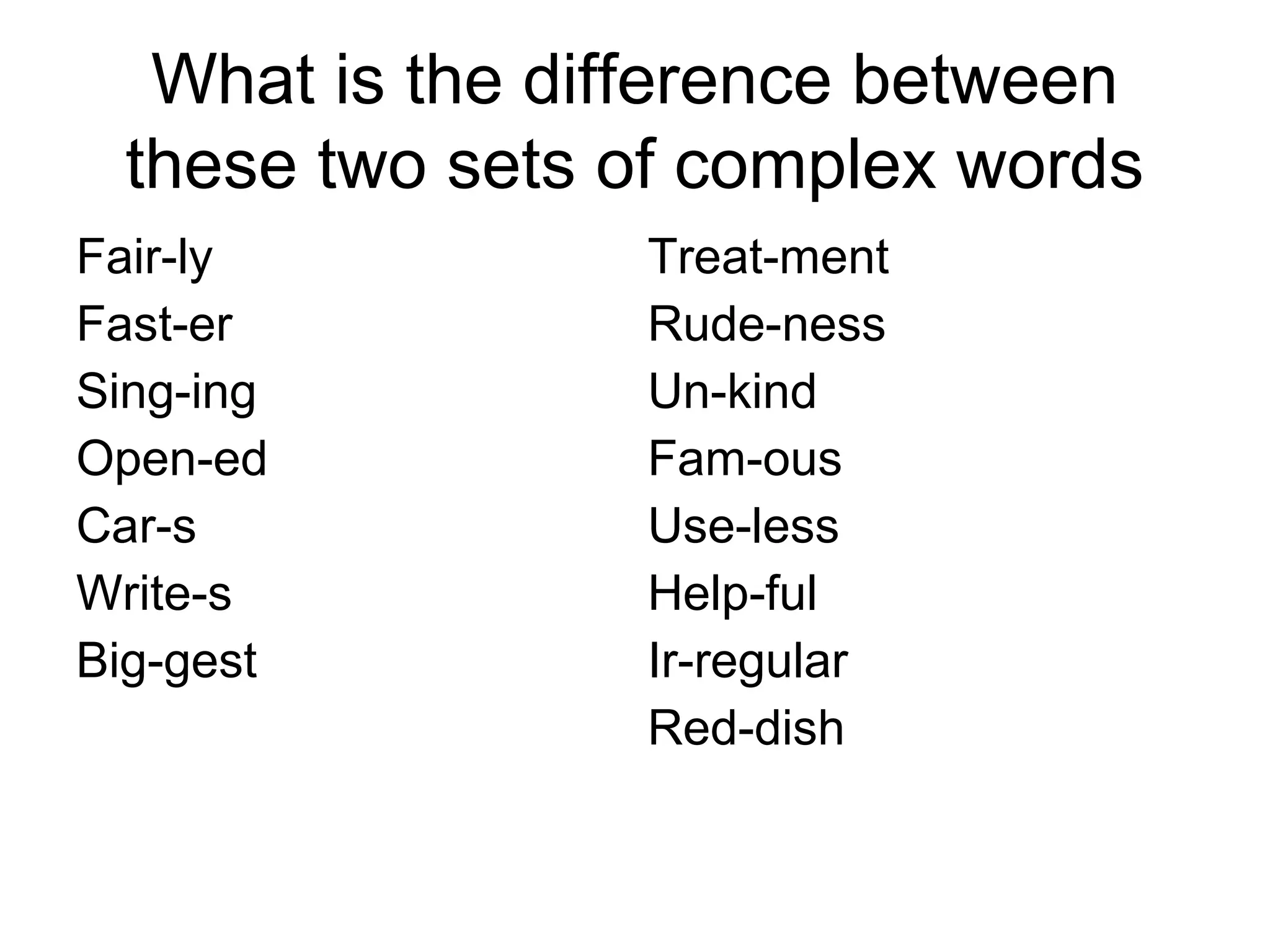
What is the difference between 
these two sets of complex words 
Fair-ly 
Fast-er 
Sing-ing 
Open-ed 
Car-s 
Write-s 
Big-gest 
Treat-ment 
Rude-ness 
Un-kind 
Fam-ous 
Use-less 
Help-ful 
Ir-regular 
Red-dish
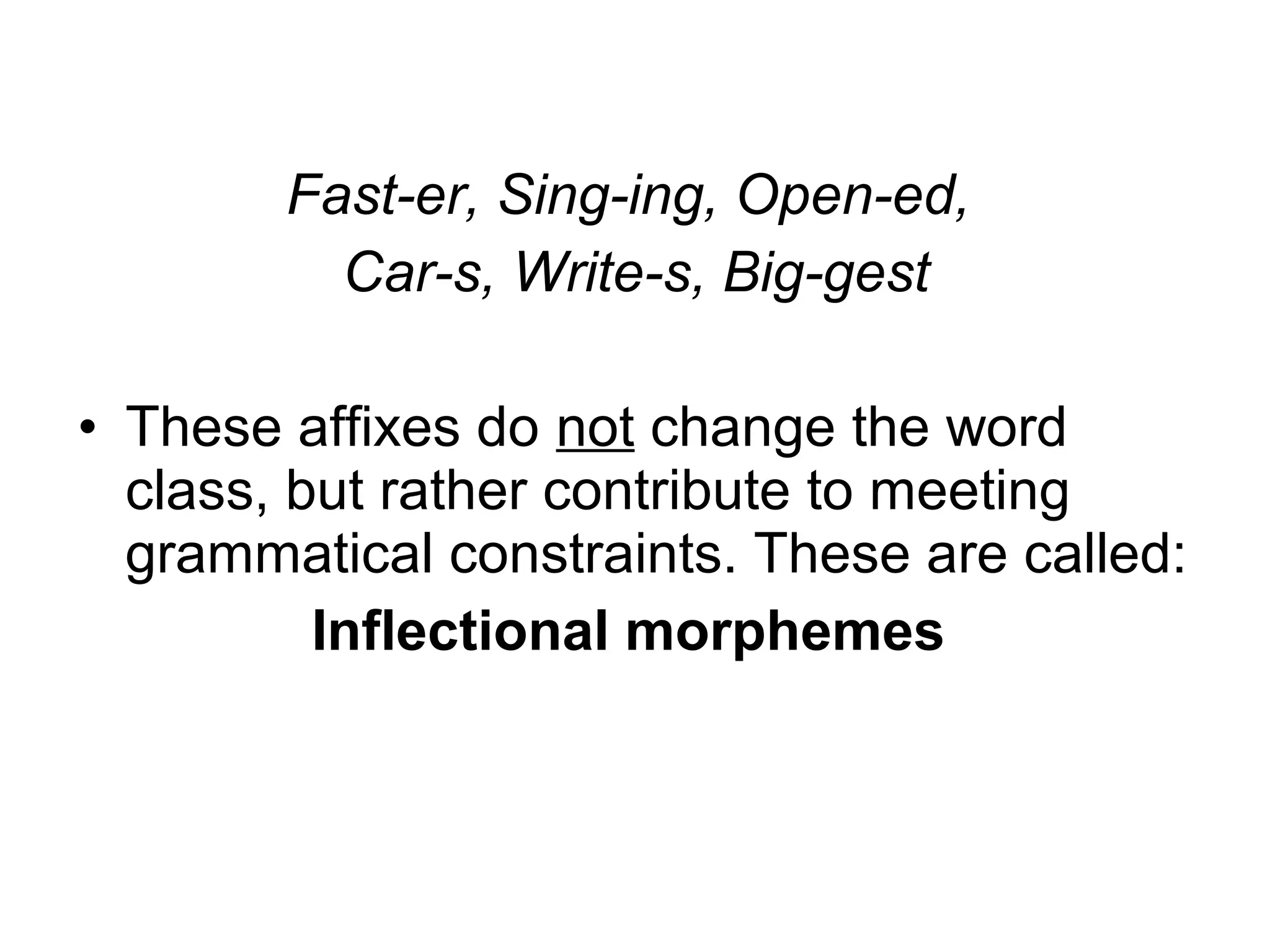
Fast-er, Sing-ing, Open-ed, 
Car-s, Write-s, Big-gest 
• These affixes do not change the word 
class, but rather contribute to meeting 
grammatical constraints. These are called: 
Inflectional morphemes
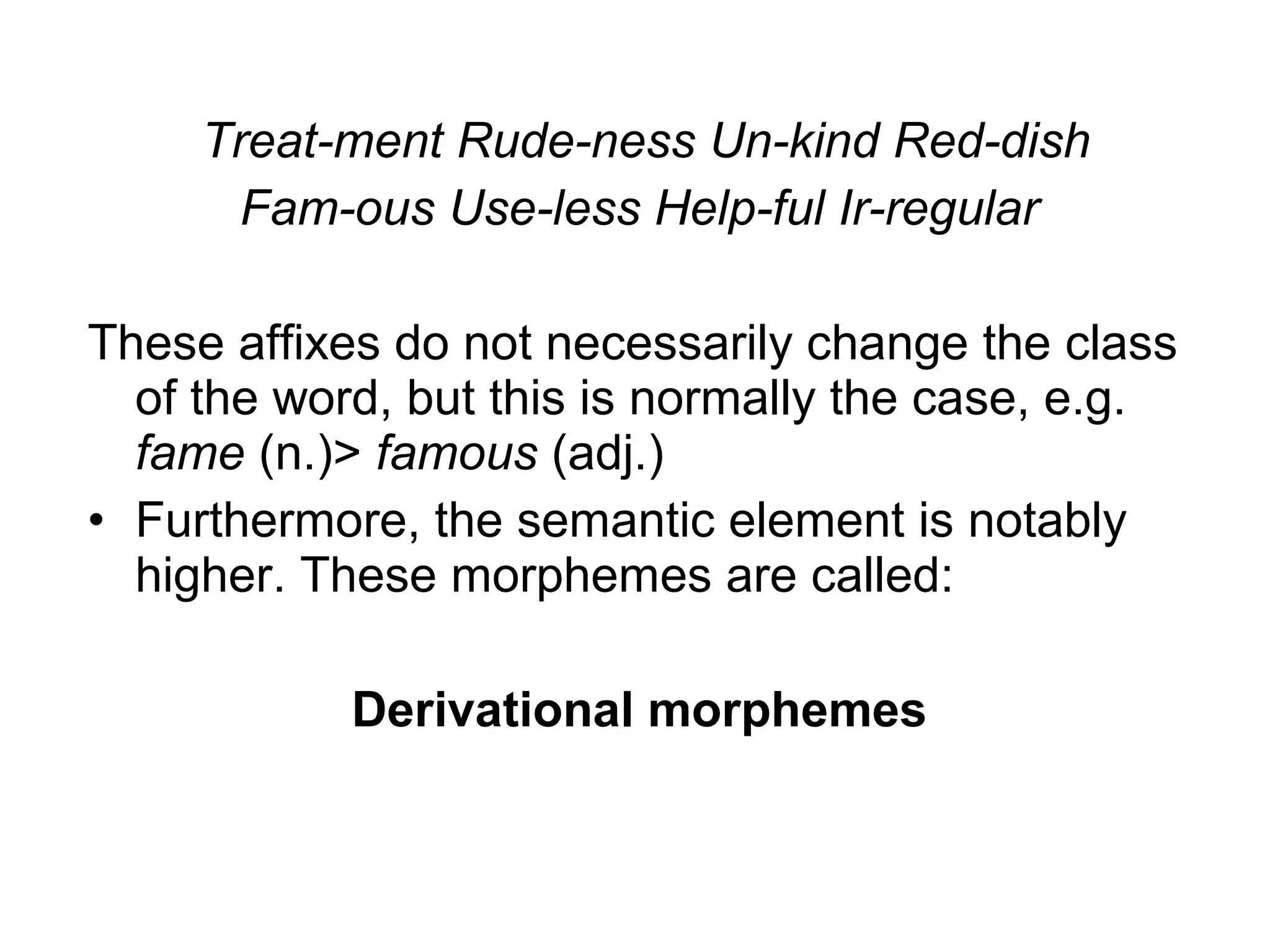
Treat-ment Rude-ness Un-kind Red-dish 
Fam-ous Use-less Help-ful Ir-regular 
These affixes do not necessarily change the class 
of the word, but this is normally the case, e.g. 
fame (n.)> famous (adj.) 
• Furthermore, the semantic element is notably 
higher. These morphemes are called: 
Derivational morphemes
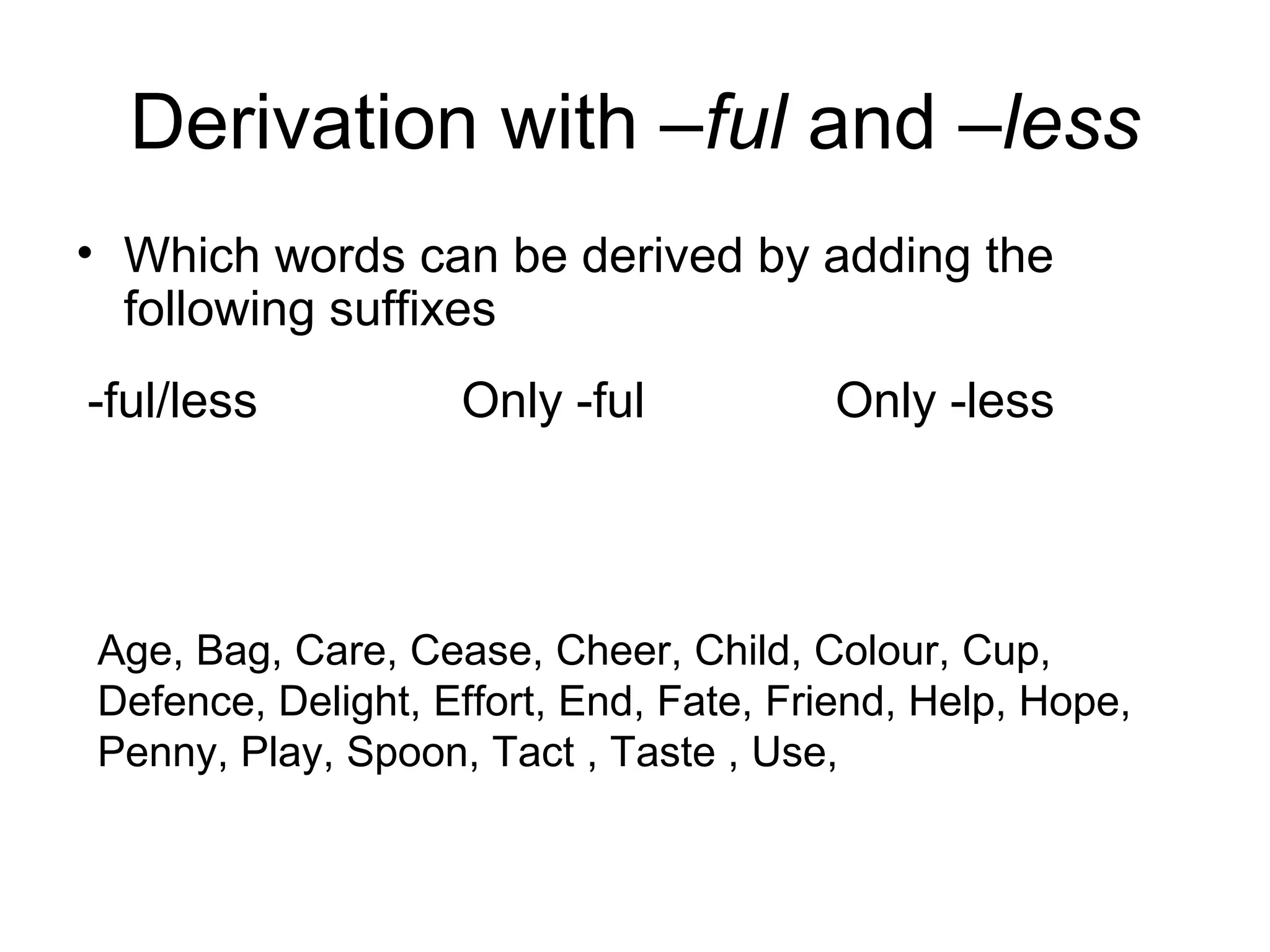
Derivation with –ful and –less 
• Which words can be derived by adding the 
following suffixes 
-ful/less Only -ful Only -less 
Age, Bag, Care, Cease, Cheer, Child, Colour, Cup, 
Defence, Delight, Effort, End, Fate, Friend, Help, Hope, 
Penny, Play, Spoon, Tact , Taste , Use,
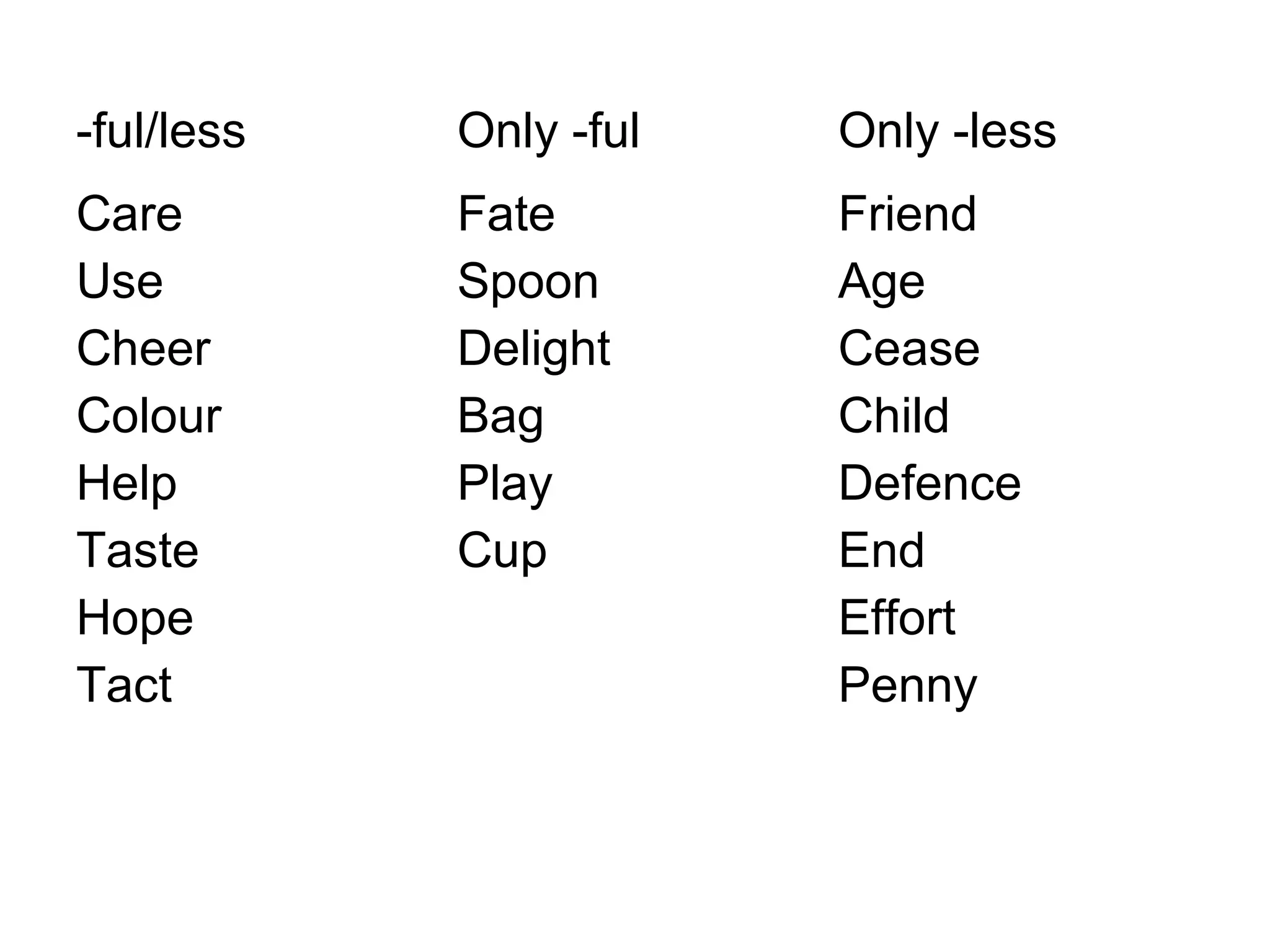
-ful/less Only -ful Only -less 
Care 
Fate 
Friend 
Use 
Spoon 
Age 
Cheer 
Delight 
Cease 
Colour 
Bag 
Child 
Help 
Play 
Defence 
Taste 
Cup 
End 
Hope 
Effort 
Tact 
Penny

English morphology–lecture1

  • 1.
    English Morphology –Lecture 1 David Brett Antonio Pinna University of Sassari 2007
  • 2.
    A definition ofmorphology • The area of grammar concerned with the structure of words and with relationships between words involving the morphemes that compose them
  • 3.
    What is aword? • An orthographic definition • A phonological definition • A semantic definition • A syntactic definition
  • 4.
    An orthographic definition • Words as units in the writing system: words are uninterrupted strings of letters • For ex. writing is a word because there are blank spaces surrounding it
  • 5.
    Problems with thisdefinition: • Can you make a list of punctuation marks? • Can you think of instances of words characterized by different spellings? • What about compound nouns?
  • 6.
    How many wordsare there in the following sentences? • a. John’s girl friend lives in a high-rise apartment building. • b. Mary’s a policewoman in the United States. • - Is John’s in a. above one or two words? • - Is Mary’s in b. above one or two words? • - Is high-rise in a. above one or two words?
  • 7.
    The orthographic wordmay not coincide with our intuitions: • Compound nouns: apartment building, parking ticket, ground floor, United States. • Phrasal verbs: get up, look after, put up with.
  • 8.
    A phonological definition • Words as phonological units: spoken in isolation each word can only have one main stress • E.g. Words as elements of the system The underlined characters indicate the main stress
  • 9.
    Problems with thisdefinition: • Function words (i.e. words such as as, of, the) do not seem to have a main stress; • Clitics (i.e. ‘s in the example below) do not seem to have a main stress- • Ex. Jane’s in the garden: ‘s, in, the are not stressed.
  • 10.
    A semantic definition • Words as meaningful units: • a. Words express unified concepts • b. Words are the minimum meaningful units of a language
  • 11.
    Problems with thesedefinitions: • Concepts can be expressed by noun groups or larger units; for ex. the man who lives next door or that beautiful summer morning of 1985 when we drove to the beach on an old CV2 • Function words may not have an easily identifiable meaning (for ex. can you specify the meaning of the?)
  • 12.
    4. A syntacticdefinition #1 • Words as syntactic units: words are the smallest syntactic elements in a sentence: • a. They belong to certain word classes (and follow the rules of these syntactic categories) • Words can be grouped into 2 main categories: • 1. Open-class words: classes of words which can contain an infinite number of words • (i.e. nouns, lexical verbs, adjectives, adverbs) • 2. Closed-class words: classes of words which contain a limited number of words • (i.e. pronouns, prepositions, auxiliary and modal verbs, conjunctions, determiners)
  • 13.
    4. A syntacticdefinition #2 • b. Only words (and groups of words) can be moved to a different position in a sentence • 1. She can ride the bike • 2. Can she ride the bike? • 1. She brought the can opener. • 2a. The can was brought by her opener. ✘ • 2b. The can opener was brought by her. ✓
  • 14.
    The relationship betweenwords and meanings Words with unpredictable meanings: dog, door, desk, book, pen, … Words with predictable meanings Complex words: unhappy, helpful, madly, … E.g. The relationship between the sequence of letters cat and its meaning [domestic feline] in English is the result of a convention. Whenever this association form-meaning is the result of a convention, the meaning of a word is unpredictable on the basis of its form. Exception: onomatopoeic words splash resembles the sound of a liquid hitting something; beep resembles a short high sound, like the sound of a car horn.
  • 15.
    Non-words and meanings • entities that are larger than a word with unpredictable meanings – Idioms: pull someone’s leg; kick the bucket; … – Collocations: hard work, white coffee, white-collar worker … – Proverbs: All work and no play makes Jack a dull boy, beauty is in the eye of the beholder, birds of a feather flock together, a bad workman blames his tools, …
  • 16.
    The difference betweenwords and lexical items Words are the smallest syntactic units in a sentence (i.e. words are grammatical entities) • Lexical items are semantic units whose meanings are unpredictable; they may be larger than words, but often they can coincide with them (i.e. lexical items are semantic entities)
  • 17.
    Taking words apart • Why is the meaning of the following words predictable to a certain extent? • unbelievable, capitalistic, mismatched, disproportional, misunderstanding, irregularity. • lighthouse, shoplift, team manager, apartment building, concentration camp, low-flying, cupboard, sickness benefit.
  • 18.
    Complex words: affixation • Words can be composed of identifiable smaller parts, morphemes, put together in a systematic fashion, so that the meaning of the whole can reliably be determined on the basis of the meaning of the smaller parts. • un-believe-able, anti-capital-ist-ic, de-colony-al-ize-ation, dis-proportion- al, mis-under-stand-ing, ir-regul-ar-ity. • This group contains words which are divisible into: • a component that carries most of the meaning (e.g. believe, capital, colony, proportion, etc.) • other elements that are associated with it to add some other aspects of meaning (e.g. –able in believable = something or someone is capable of being believed; un- in unbelievable = something or someone is not capable of being believed). • The process through which these words are formed is called affixation.
  • 19.
    Word compounding •B. lighthouse, shoplift, team manager, apartment building, concentration camp, low-flying, cupboard, sickness benefit. • Group B contains words which are divisible into two other words. • These component words can be found independently in an English dictionary, but when they associate they form a compound word • The meaning of the union is not necessarily a function of the meaning of the two combining words. For ex. a lighthouse is neither a light nor a house. This process is called word compounding.
  • 20.
    Word compounding: exercise • How many compund words can you create with the following words? bag car box case
  • 21.
    Hand-, body-, air-,sick-, punch-, sleeping bag Sports, estate, company, courtesy, car Mail-, post-, letter-, telephone, gear-box Book-, suit-, brief-, display, lower case
  • 22.
    A morpheme must – be identifiable from one word to another – However, consider: Attack Stack Tackle Taxi (/tæksi/)
  • 23.
    A morpheme must – Also contribute in some way to the meaning of the whole word Believ-able Eat-able Read-able Work-able N.b. this extra meaning is not necessarily equal in all cases, e.g. readable, does not mean ‘can be read’ in a literal sense, but rather ‘enjoyable to read’.
  • 24.
    How can Irecognise a morpheme? Morphemes must be identifiable from one word to another: identifying affixes: – un- : uncomplicated, unhappy, unclear, … – -able: variable, changeable, solvable, … – de- : deselect, dethrone, detoxify, … – -al: cultural, federal, liberal, modal, … – -ize: computerize, realize, …
  • 25.
    Identifying the coreelement: • Happy: un-happy, happi-ness, happi-ly; • Change: change-able, chang-ing, un-chang- ed; • Select: de-select, select-ion, select-ive-ly; • Liber-: liber-al, liber-al-ism, liber-ate, liber-ty; • Oper-: oper-ate, oper-at-ion, oper-at-ion-al
  • 26.
    Distinguishing between morphemes: • Bound and free morphemes: • Free morphemes can occur on their own: – happy, change, select, green, house, … • Bound morphemes can occur only if they are attached to other morphemes: – Affixes (un-, -ness, -able, de-, -ive, -er, …) – liber-, oper-, circul-, legitim-, materi-, … • Eg. liber-ation, oper-ate, circul-ar, legitim-(a)cy, materi-al
  • 27.
    Bound morphemes ascore elements: words derived from Latin Circul- Circular Liber- Liberty Circulation Liberation Circulator Liberalize Circulatory Libertine
  • 28.
    Problem case: Verbsof Latin origin receive deceive conceive perceive revert convert pervert relate collate translate reduce deduce conduce Should these be considered to be composed of a single morpheme? Or prefix + bound morpheme?
  • 29.
    General tendency •The core vocabulary of English is generally composed of words of Anglo- Saxon origin • There is a general tendency for core elements to be free morphemes • E.g. Hand • Hand-y, hand-le, hand-ful, mis-hand-le,
  • 30.
    What is thedifference between these two sets of complex words Fair-ly Fast-er Sing-ing Open-ed Car-s Write-s Big-gest Treat-ment Rude-ness Un-kind Fam-ous Use-less Help-ful Ir-regular Red-dish
  • 31.
    Fast-er, Sing-ing, Open-ed, Car-s, Write-s, Big-gest • These affixes do not change the word class, but rather contribute to meeting grammatical constraints. These are called: Inflectional morphemes
  • 32.
    Treat-ment Rude-ness Un-kindRed-dish Fam-ous Use-less Help-ful Ir-regular These affixes do not necessarily change the class of the word, but this is normally the case, e.g. fame (n.)> famous (adj.) • Furthermore, the semantic element is notably higher. These morphemes are called: Derivational morphemes
  • 33.
    Derivation with –fuland –less • Which words can be derived by adding the following suffixes -ful/less Only -ful Only -less Age, Bag, Care, Cease, Cheer, Child, Colour, Cup, Defence, Delight, Effort, End, Fate, Friend, Help, Hope, Penny, Play, Spoon, Tact , Taste , Use,
  • 34.
    -ful/less Only -fulOnly -less Care Fate Friend Use Spoon Age Cheer Delight Cease Colour Bag Child Help Play Defence Taste Cup End Hope Effort Tact Penny