Tree Diagrams


Learning Intention:
Draw and use a tree diagram to find conditional probabilities.
Z
Z


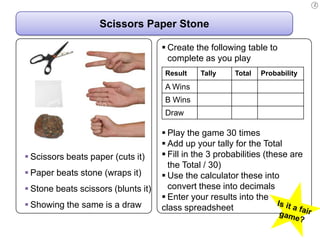
                    Scissors Paper Stone

                                      Create the following table to
                                       complete as you play
                                      Result    Tally    Total   Probability
                                      A Wins
                                      B Wins
                                      Draw

                                      Play the game 30 times
                                      Add up your tally for the Total
 Scissors beats paper (cuts it)      Fill in the 3 probabilities (these are
                                       the Total / 30)
 Paper beats stone (wraps it)        Use the calculator these into
 Stone beats scissors (blunts it)     convert these into decimals
                                      Enter your results into the
 Showing the same is a draw         class spreadsheet
Z


                     Scissors Paper Stone

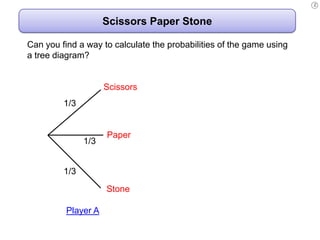
Can you find a way to calculate the probabilities of the game using
a tree diagram?


                     Scissors
         1/3


                     Paper
               1/3


         1/3
                     Stone

          Player A
Z


                         Scissors Paper Stone
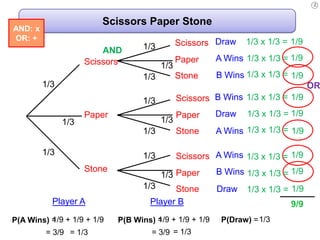
AND: x
OR: +
                                   1/3         Scissors Draw    1/3 x 1/3 = 1/9
                         AND
                     Scissors                  Paper     A Wins 1/3 x 1/3 = 1/9
                                         1/3
                                   1/3         Stone     B Wins 1/3 x 1/3 = 1/9
         1/3                                                                      OR
                                   1/3         Scissors B Wins 1/3 x 1/3 = 1/9
                     Paper                     Paper     Draw   1/3 x 1/3 = 1/9
               1/3                       1/3
                                   1/3         Stone     A Wins 1/3 x 1/3 = 1/9

         1/3                       1/3         Scissors A Wins 1/3 x 1/3 = 1/9
                     Stone                               B Wins 1/3 x 1/3 = 1/9
                                         1/3 Paper
                                   1/3     Stone         Draw   1/3 x 1/3 = 1/9
           Player A                  Player B                               9/9
P(A Wins) = /9 + 1/9 + 1/9
          1                  P(B Wins) =/9 + 1/9 + 1/9
                                       1                  P(Draw) = 1/3
         = 3/9 = 1/3                 = 3/9 = 1/3
Two Dice
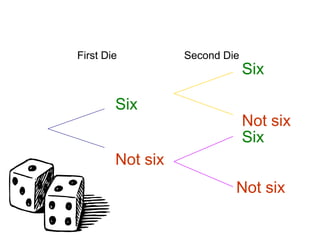
First Die         Second Die
                               Six

        Six
                               Not six
                               Six
        Not six
                           Not six
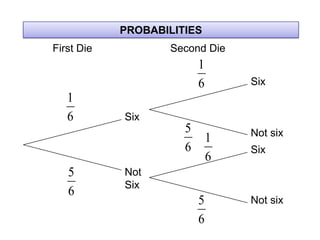
PROBABILITIES
First Die          Second Die
                          1
                          6       Six
   1
   6        Six
                      5           Not six
                              1
                      6           Six
                              6
   5        Not
            Six
   6
                          5       Not six
                          6
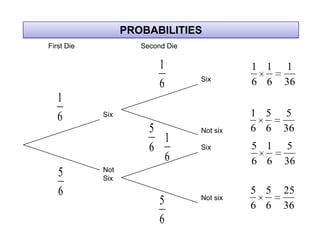
PROBABILITIES
First Die            Second Die

                          1                 1 1   1
                                  Six       6 6   36
                          6
   1
   6        Six                             1 5   5
                       5          Not six   6 6   36
                         1
                       6          Six       5 1   5
                         6                  6 6   36
            Not
   5        Six

   6                              Not six
                                            5 5   25
                          5                 6 6   36
                          6
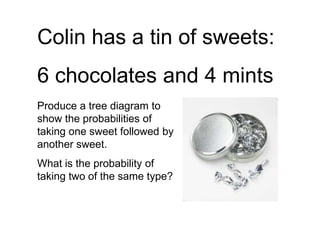
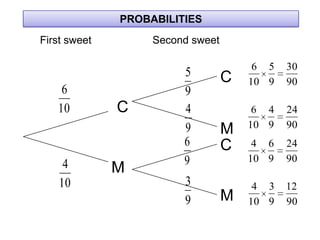
Colin has a tin of sweets:
6 chocolates and 4 mints
Produce a tree diagram to
show the probabilities of
taking one sweet followed by
another sweet.
What is the probability of
taking two of the same type?
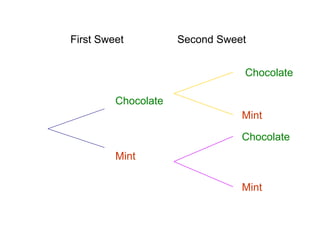
First Sweet          Second Sweet


                                Chocolate

         Chocolate
                                Mint

                                Chocolate
         Mint

                                Mint
PROBABILITIES
First sweet        Second sweet

                                       6 5   30
                        5         C   10 9   90
    6                   9
   10         C         4              6 4   24
                                      10 9   90
                        9         M
                        6         C    4 6   24
                        9             10 9   90
     4        M
    10                  3              4 3   12
                        9         M   10 9   90
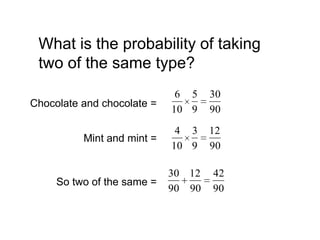
What is the probability of taking
 two of the same type?
                             6 5    30
Chocolate and chocolate =
                            10 9    90
                             4 3    12
          Mint and mint =
                            10 9    90

                            30 12   42
     So two of the same =
                            90 90   90
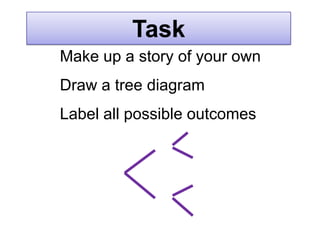
Task
Make up a story of your own
Draw a tree diagram
Label all possible outcomes

Tree diagrams

  • 1.
    Tree Diagrams Learning Intention: Drawand use a tree diagram to find conditional probabilities.
  • 2.
  • 3.
    Z Scissors Paper Stone  Create the following table to complete as you play Result Tally Total Probability A Wins B Wins Draw  Play the game 30 times  Add up your tally for the Total  Scissors beats paper (cuts it)  Fill in the 3 probabilities (these are the Total / 30)  Paper beats stone (wraps it)  Use the calculator these into  Stone beats scissors (blunts it) convert these into decimals  Enter your results into the  Showing the same is a draw class spreadsheet
  • 4.
    Z Scissors Paper Stone Can you find a way to calculate the probabilities of the game using a tree diagram? Scissors 1/3 Paper 1/3 1/3 Stone Player A
  • 5.
    Z Scissors Paper Stone AND: x OR: + 1/3 Scissors Draw 1/3 x 1/3 = 1/9 AND Scissors Paper A Wins 1/3 x 1/3 = 1/9 1/3 1/3 Stone B Wins 1/3 x 1/3 = 1/9 1/3 OR 1/3 Scissors B Wins 1/3 x 1/3 = 1/9 Paper Paper Draw 1/3 x 1/3 = 1/9 1/3 1/3 1/3 Stone A Wins 1/3 x 1/3 = 1/9 1/3 1/3 Scissors A Wins 1/3 x 1/3 = 1/9 Stone B Wins 1/3 x 1/3 = 1/9 1/3 Paper 1/3 Stone Draw 1/3 x 1/3 = 1/9 Player A Player B 9/9 P(A Wins) = /9 + 1/9 + 1/9 1 P(B Wins) =/9 + 1/9 + 1/9 1 P(Draw) = 1/3 = 3/9 = 1/3 = 3/9 = 1/3
  • 6.
  • 7.
    First Die Second Die Six Six Not six Six Not six Not six
  • 8.
    PROBABILITIES First Die Second Die 1 6 Six 1 6 Six 5 Not six 1 6 Six 6 5 Not Six 6 5 Not six 6
  • 9.
    PROBABILITIES First Die Second Die 1 1 1 1 Six 6 6 36 6 1 6 Six 1 5 5 5 Not six 6 6 36 1 6 Six 5 1 5 6 6 6 36 Not 5 Six 6 Not six 5 5 25 5 6 6 36 6
  • 10.
    Colin has atin of sweets: 6 chocolates and 4 mints Produce a tree diagram to show the probabilities of taking one sweet followed by another sweet. What is the probability of taking two of the same type?
  • 11.
    First Sweet Second Sweet Chocolate Chocolate Mint Chocolate Mint Mint
  • 12.
    PROBABILITIES First sweet Second sweet 6 5 30 5 C 10 9 90 6 9 10 C 4 6 4 24 10 9 90 9 M 6 C 4 6 24 9 10 9 90 4 M 10 3 4 3 12 9 M 10 9 90
  • 13.
    What is theprobability of taking two of the same type? 6 5 30 Chocolate and chocolate = 10 9 90 4 3 12 Mint and mint = 10 9 90 30 12 42 So two of the same = 90 90 90
  • 14.
    Task Make up astory of your own Draw a tree diagram Label all possible outcomes