




Ctenophores

          Phylum Cteno • phora
(Greek: comb bearing) • teen´-ō-for´-ah
Defining Characteristics:
1.) Plates of Fused cilia arranged in rows.

2.)Adhesive prey capturing cells
          (colloblasts).
General Description
- Ctenophores are major predators upon larval
  fish and zooplankton. They may prey on small
  crustaceans (phylum Arthropoda) and the
  larval stage of various fish and jellyfish
  species, and oysters. Some are carnivorous
  on other ctenophores or gelatinous animals in
  other groups. They play a role in estuarine
  ecology.
- Most are nearly transparent
- The 100 or so described species are
  exclusively marine and most are planktonic. A
  member of most species are weak swimmers,
  carried about by ocean current
- The ctenophore’s tentacles are solid rather
  than hollow
- Ctenophores have left a poor fossil record
- There is an evolutionary relationship between
  Ctenophora and Cnidaria.
- Nearly all ctenophores are bioluminescent.
  They give off excess energy in the form of
  light instead of heat.The functional
  significance of bioluminescence includes
  mate location and species recognition, luring
  of prey, and the startling of would-be
  predators.
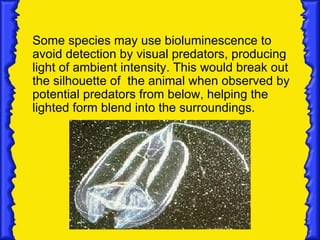
Some species may use bioluminescence to
avoid detection by visual predators, producing
light of ambient intensity. This would break out
the silhouette of the animal when observed by
potential predators from below, helping the
lighted form blend into the surroundings.
Body Architecture
A. Body Covering

• Its body covering is somewhat
  reminiscent of Cnidarian medusae.
• The body consists of an outer
  epidermis, an inner gastrodermis, a
  thick, middle mesoglea layer.
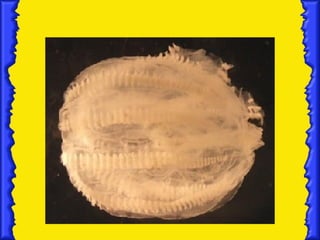
• It has a basic radial symmetry, with oral
  and aboral surfaces.
B. Digestive System

• The mouth leads into a pharynx called a
  stomodeum, which serves as a site for
  extracellular digestion.
• It goes through a stomach into a series
  of gastrovascular canals, where
  digestion is completed intracellularly.
C. Excretory and Respiratory System


• There are no functional Excretory and
  Respiratory organs found in
  Ctenophores.
D. Nervous System

• It takes the form of Subepidermal nerve
  network.
E. Development Stages

• At lest one ctenophore species has a
  planula larval stage in its life history.
• During embryogenesis, Ctenophores
  form no distinct mesodermal layer.
  Thus, they are termed as dipoblastic.
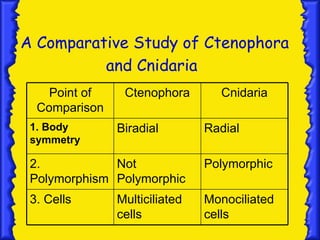
A Comparative Study of Ctenophora
          and Cnidaria
    Point of    Ctenophora       Cnidaria
  Comparison
 1. Body       Biradial        Radial
 symmetry

 2.           Not              Polymorphic
 Polymorphism Polymorphic
 3. Cells      Multiciliated   Monociliated
               cells           cells
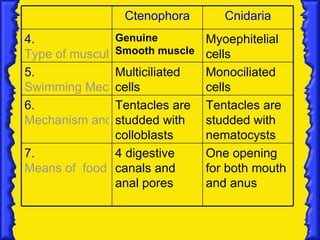
Ctenophora       Cnidaria
4.             Genuine        Myoephitelial
               Smooth muscle cells
Type of musculature
5.             Multiciliated  Monociliated
Swimming Mechanism
               cells          cells
6.             Tentacles are Tentacles are
Mechanism and studded with capture
               mode of food studded with
               colloblasts    nematocysts
7.             4 digestive    One opening
Means of food digestion and waste both mouth
               canals and     for elimination
               anal pores     and anus
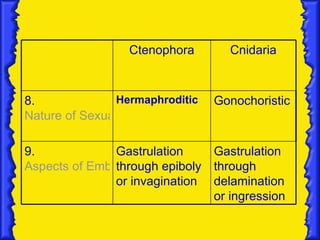
Ctenophora       Cnidaria


8.              Hermaphroditic   Gonochoristic
Nature of Sexuality

9.             Gastrulation    Gastrulation
Aspects of Embryonic Development
               through epiboly through
               or invagination delamination
                               or ingression
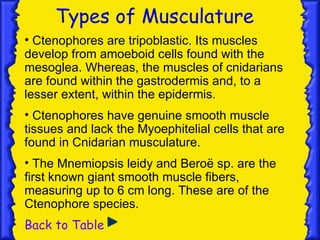
Types of Musculature
• Ctenophores are tripoblastic. Its muscles
develop from amoeboid cells found with the
mesoglea. Whereas, the muscles of cnidarians
are found within the gastrodermis and, to a
lesser extent, within the epidermis.
• Ctenophores have genuine smooth muscle
tissues and lack the Myoephitelial cells that are
found in Cnidarian musculature.
• The Mnemiopsis leidy and Beroë sp. are the
first known giant smooth muscle fibers,
measuring up to 6 cm long. These are of the
Ctenophore species.
Back to Table
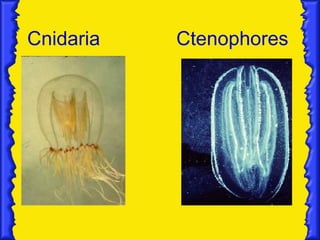
Cnidaria   Ctenophores
Swimming Mechanism
• Ctenophores swim through the activity of
  many bands of partially fused, remarkably
  long cilia. The power stroke of each cilia is
  towards the aboral surface, so that it swims
  mouth first. Cnidarians, however, swim by
  means of jet propulsion.

• Back to Table
The Ctene
• Each band of Cilia is fused to a ctene (Gk.
Comb) because of its resemblance to a comb.


• The ctene is organized into 8 distinct rows
called costae which extends from the oral to
the aboral surface of the animal.
• The intensity of activity in the different comb
rows is under the control of an apical sense
organ at the aboral end of the ctenophore.
Together with an epidermal nerve, It
synchronizes the coordination of ciliary
beating in different comb rows.
• A single sphere of calcium Carbonate, called
  statolith, sits atop 4 tufts of fused cilia called
  balancers, or springs. Each balancer is
  composed of several hundred cilia.

  • A ciliated groove radiates from each
  balancer and bifurcates to service two other
  adjacent rows. These serve as agents of
  nerve impulse conduction from the apicak
  sense organ to the ctenes of the comb rows.


Back
Mechanism and Mode
         of Food capture
• The tentacles of ctenophores can be
  completely retracted into proximal pits
  or sheaths, unlike that of the cnidarians.
• Its general epidermis are studded with
  colloblasts, whereas the tentacles of
  cnidarians are surfaced with
  nematocysts.

Back to Table
Mode of Food Capture
• Each colloblast cell consists of a bulbous,
sticky head connected to a long, straight
filament. Prey organisms become stuck to the
tentacles which are then retracted. In other
species, the body rotates to bring the mouth in
contact with the tentacles.

 • In other species, the body surface are used
 as the major organ of food collection. The
 body surface area is increased by lateral
 compression and is major areas are coated
 with a sticky mucus and colloblast cells.
Back
Means of Food Digestion and
           Waste Elimination
• Ctenophores have 4 digestive canals which
  lead from the roof of the stomach to the
  animal’s aboral surface. 2 of these digestive
  canal terminate as blind sacs, while the other
  2 canals open wide outside.Undigested
  wastes are discharged through anal pores .
  Cnidarians, on the other hand, has but one
  opening which serves as both mouth and
  anus.

 Back to Table
Nature of Sexuality
• Ctenophores are hermaphrodites; that
  is, a single individual has both male and
  female gonads. In contrast, Cnidarians
  are gonochoristic, with one sex per
  individual.


 Back to Table
• A few species reproduce asexually through
  fragmentation and the subsequent
  development of missing body parts by each
  fragment.
• Gonads are located on the walls of some or
  all of the gastrovascular canals, so that
  gametes are liberated into the digestive tract
  and are discharged through the mouth.
• Eggs are fertilized externally.


Back
Aspects of Embryonic
    Development
• Ctenophore cleavage is highly determinate;
  cell fates are fixed at the first cell division.
  Cell fates of Cnidarian embryos become fixed
  later in development.
• Gastrulation,or the formation of distinct inner
  and outer germs, are achieve by ctenophores
  either by epiboly or by invagination.
  Cnidarians gastrulate either through the
  process of delamination or by ingression
• Ctenophore embryos develop directly into a
  cydippid, while Cnidarians develop into a
  ciliated planula larvae
 Back to Table
Definition of Terms
• Epiboly : A process in which a sheet of
  micromeres spreads over what were the
  adjacent macromeres
• Invagination :Process by which groups of
  cells push into the blastocoelic space. This
  may also be exhibited by some Cnidarians
• Delamination :The cells of the blastula divide
  with the cleavage plane approximately
  parallel to the surface of the embryo. Thus,
  the cells divide into the blastocoel, forming an
  inner and outer cell layer, between which the
  mesoglea is later secreted
Back
• Ingression :Certain cells become detached
  from their neighbors and simply move into the
  blastocoel, creating a second layer of cells.
• Cydippid :A miniature ctenophore which is
  approximately spherical in shape; is endowed
  with 8 comb rows, a fully formed apical sense
  organ, and a pharynx; and usually bears a
  pair of branched tentacles. It may closely
  resemble an adult, though in other modern
  species, the cydippid undergoes
  metamorphosis before attaining its adult form

Back
Ctenophore
 Diversity
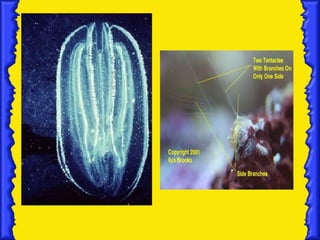
Class Tentaculata
A. Order Cydippida
• Tentaculate species closely resemble the
  cydippid larvae except that the functional
  gonads are present.
• Food is capture through long retractable
  tentacles and their side branches.
B. Lobata
• Body is compressed laterally, only 4 comb
  rows are fully developed, and the tentacles
  are generally much reduced in length.
• Large oral lobes, covered with mucus and
  colloblasts, constitute the primary food
  collection surface.
• The muscular cavity of the 2 oral lobes aids
  locomotion in some species. 2 pairs of
  ciliated, paddle- or tentacle-like
  structure,auricles, assist in prey capture
C. Cestida
• The body is so compressed laterally that it
  forms a long ribbon, with the mouth and
  apical sense organ on opposite sides of its
  midpoint.
• Cestids swim through a combination of ctene
  activity and sinuous, muscular movements of
  the body; only 4 of the comb rows are well
  developed in adults.
• Prey are captured by the numerous short
  tentacles extending along the extensive oral
  edge of the ctenophore.
D. Platyctenida
• The oral and aboral surfaces have moved
  towards each other, so the body forms a
  flattened plate.
• The bottom of the plate is formed largely by a
  pharynx, which is extensively and
  permanently everted.
• Some species simply float in the water while
  others creep slowly over solid substrates
  through pharyngeal cilia and muscular
  contractions or by muscular flapping of the
  lateral lobes of the body..
• The only non-planktatonic ctenophores.
• Has 2 long tentacles.
Class Nuda
Beroida
• Has no tentacles and oral lobes.
• Has 8 well developed comb rows.
• Captures and engulfs prey, including other
  ctenophores, through muscular lips
  surrounding the mouth. The mouth can be
  widened to accommodate prey substantially
  larger than the predator.
• Thousands of 9 + 2 axonemes enclosed by a
  single membrane, Macrocilia, are located just
  inside the mouth. These Macrocilia are used
  as teeth to chop large prey into bite-size
  pieces.

Ctenophores pp

  • 1.
    Ctenophores Phylum Cteno • phora (Greek: comb bearing) • teen´-ō-for´-ah
  • 2.
    Defining Characteristics: 1.) Platesof Fused cilia arranged in rows. 2.)Adhesive prey capturing cells (colloblasts).
  • 5.
    General Description - Ctenophoresare major predators upon larval fish and zooplankton. They may prey on small crustaceans (phylum Arthropoda) and the larval stage of various fish and jellyfish species, and oysters. Some are carnivorous on other ctenophores or gelatinous animals in other groups. They play a role in estuarine ecology. - Most are nearly transparent - The 100 or so described species are exclusively marine and most are planktonic. A member of most species are weak swimmers, carried about by ocean current
  • 6.
    - The ctenophore’stentacles are solid rather than hollow - Ctenophores have left a poor fossil record - There is an evolutionary relationship between Ctenophora and Cnidaria. - Nearly all ctenophores are bioluminescent. They give off excess energy in the form of light instead of heat.The functional significance of bioluminescence includes mate location and species recognition, luring of prey, and the startling of would-be predators.
  • 7.
    Some species mayuse bioluminescence to avoid detection by visual predators, producing light of ambient intensity. This would break out the silhouette of the animal when observed by potential predators from below, helping the lighted form blend into the surroundings.
  • 8.
  • 9.
    A. Body Covering •Its body covering is somewhat reminiscent of Cnidarian medusae. • The body consists of an outer epidermis, an inner gastrodermis, a thick, middle mesoglea layer. • It has a basic radial symmetry, with oral and aboral surfaces.
  • 11.
    B. Digestive System •The mouth leads into a pharynx called a stomodeum, which serves as a site for extracellular digestion. • It goes through a stomach into a series of gastrovascular canals, where digestion is completed intracellularly.
  • 12.
    C. Excretory andRespiratory System • There are no functional Excretory and Respiratory organs found in Ctenophores.
  • 13.
    D. Nervous System •It takes the form of Subepidermal nerve network.
  • 14.
    E. Development Stages •At lest one ctenophore species has a planula larval stage in its life history. • During embryogenesis, Ctenophores form no distinct mesodermal layer. Thus, they are termed as dipoblastic.
  • 15.
    A Comparative Studyof Ctenophora and Cnidaria Point of Ctenophora Cnidaria Comparison 1. Body Biradial Radial symmetry 2. Not Polymorphic Polymorphism Polymorphic 3. Cells Multiciliated Monociliated cells cells
  • 16.
    Ctenophora Cnidaria 4. Genuine Myoephitelial Smooth muscle cells Type of musculature 5. Multiciliated Monociliated Swimming Mechanism cells cells 6. Tentacles are Tentacles are Mechanism and studded with capture mode of food studded with colloblasts nematocysts 7. 4 digestive One opening Means of food digestion and waste both mouth canals and for elimination anal pores and anus
  • 17.
    Ctenophora Cnidaria 8. Hermaphroditic Gonochoristic Nature of Sexuality 9. Gastrulation Gastrulation Aspects of Embryonic Development through epiboly through or invagination delamination or ingression
  • 18.
    Types of Musculature •Ctenophores are tripoblastic. Its muscles develop from amoeboid cells found with the mesoglea. Whereas, the muscles of cnidarians are found within the gastrodermis and, to a lesser extent, within the epidermis. • Ctenophores have genuine smooth muscle tissues and lack the Myoephitelial cells that are found in Cnidarian musculature. • The Mnemiopsis leidy and Beroë sp. are the first known giant smooth muscle fibers, measuring up to 6 cm long. These are of the Ctenophore species. Back to Table
  • 19.
    Cnidaria Ctenophores
  • 20.
    Swimming Mechanism • Ctenophoresswim through the activity of many bands of partially fused, remarkably long cilia. The power stroke of each cilia is towards the aboral surface, so that it swims mouth first. Cnidarians, however, swim by means of jet propulsion. • Back to Table
  • 22.
    The Ctene • Eachband of Cilia is fused to a ctene (Gk. Comb) because of its resemblance to a comb. • The ctene is organized into 8 distinct rows called costae which extends from the oral to the aboral surface of the animal. • The intensity of activity in the different comb rows is under the control of an apical sense organ at the aboral end of the ctenophore. Together with an epidermal nerve, It synchronizes the coordination of ciliary beating in different comb rows.
  • 23.
    • A singlesphere of calcium Carbonate, called statolith, sits atop 4 tufts of fused cilia called balancers, or springs. Each balancer is composed of several hundred cilia. • A ciliated groove radiates from each balancer and bifurcates to service two other adjacent rows. These serve as agents of nerve impulse conduction from the apicak sense organ to the ctenes of the comb rows. Back
  • 24.
    Mechanism and Mode of Food capture • The tentacles of ctenophores can be completely retracted into proximal pits or sheaths, unlike that of the cnidarians. • Its general epidermis are studded with colloblasts, whereas the tentacles of cnidarians are surfaced with nematocysts. Back to Table
  • 25.
    Mode of FoodCapture • Each colloblast cell consists of a bulbous, sticky head connected to a long, straight filament. Prey organisms become stuck to the tentacles which are then retracted. In other species, the body rotates to bring the mouth in contact with the tentacles. • In other species, the body surface are used as the major organ of food collection. The body surface area is increased by lateral compression and is major areas are coated with a sticky mucus and colloblast cells. Back
  • 26.
    Means of FoodDigestion and Waste Elimination • Ctenophores have 4 digestive canals which lead from the roof of the stomach to the animal’s aboral surface. 2 of these digestive canal terminate as blind sacs, while the other 2 canals open wide outside.Undigested wastes are discharged through anal pores . Cnidarians, on the other hand, has but one opening which serves as both mouth and anus. Back to Table
  • 27.
    Nature of Sexuality •Ctenophores are hermaphrodites; that is, a single individual has both male and female gonads. In contrast, Cnidarians are gonochoristic, with one sex per individual. Back to Table
  • 28.
    • A fewspecies reproduce asexually through fragmentation and the subsequent development of missing body parts by each fragment. • Gonads are located on the walls of some or all of the gastrovascular canals, so that gametes are liberated into the digestive tract and are discharged through the mouth. • Eggs are fertilized externally. Back
  • 29.
  • 30.
    • Ctenophore cleavageis highly determinate; cell fates are fixed at the first cell division. Cell fates of Cnidarian embryos become fixed later in development. • Gastrulation,or the formation of distinct inner and outer germs, are achieve by ctenophores either by epiboly or by invagination. Cnidarians gastrulate either through the process of delamination or by ingression • Ctenophore embryos develop directly into a cydippid, while Cnidarians develop into a ciliated planula larvae Back to Table
  • 31.
    Definition of Terms •Epiboly : A process in which a sheet of micromeres spreads over what were the adjacent macromeres • Invagination :Process by which groups of cells push into the blastocoelic space. This may also be exhibited by some Cnidarians • Delamination :The cells of the blastula divide with the cleavage plane approximately parallel to the surface of the embryo. Thus, the cells divide into the blastocoel, forming an inner and outer cell layer, between which the mesoglea is later secreted Back
  • 32.
    • Ingression :Certaincells become detached from their neighbors and simply move into the blastocoel, creating a second layer of cells. • Cydippid :A miniature ctenophore which is approximately spherical in shape; is endowed with 8 comb rows, a fully formed apical sense organ, and a pharynx; and usually bears a pair of branched tentacles. It may closely resemble an adult, though in other modern species, the cydippid undergoes metamorphosis before attaining its adult form Back
  • 33.
  • 34.
    Class Tentaculata A. OrderCydippida • Tentaculate species closely resemble the cydippid larvae except that the functional gonads are present. • Food is capture through long retractable tentacles and their side branches.
  • 35.
    B. Lobata • Bodyis compressed laterally, only 4 comb rows are fully developed, and the tentacles are generally much reduced in length. • Large oral lobes, covered with mucus and colloblasts, constitute the primary food collection surface. • The muscular cavity of the 2 oral lobes aids locomotion in some species. 2 pairs of ciliated, paddle- or tentacle-like structure,auricles, assist in prey capture
  • 36.
    C. Cestida • Thebody is so compressed laterally that it forms a long ribbon, with the mouth and apical sense organ on opposite sides of its midpoint. • Cestids swim through a combination of ctene activity and sinuous, muscular movements of the body; only 4 of the comb rows are well developed in adults. • Prey are captured by the numerous short tentacles extending along the extensive oral edge of the ctenophore.
  • 37.
    D. Platyctenida • Theoral and aboral surfaces have moved towards each other, so the body forms a flattened plate. • The bottom of the plate is formed largely by a pharynx, which is extensively and permanently everted. • Some species simply float in the water while others creep slowly over solid substrates through pharyngeal cilia and muscular contractions or by muscular flapping of the lateral lobes of the body.. • The only non-planktatonic ctenophores. • Has 2 long tentacles.
  • 38.
    Class Nuda Beroida • Hasno tentacles and oral lobes. • Has 8 well developed comb rows. • Captures and engulfs prey, including other ctenophores, through muscular lips surrounding the mouth. The mouth can be widened to accommodate prey substantially larger than the predator. • Thousands of 9 + 2 axonemes enclosed by a single membrane, Macrocilia, are located just inside the mouth. These Macrocilia are used as teeth to chop large prey into bite-size pieces.