Phylum Mollusca
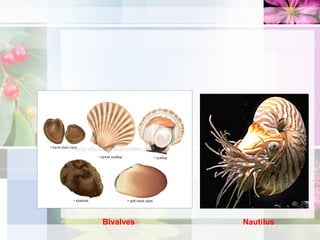
Bivalves Nautilus
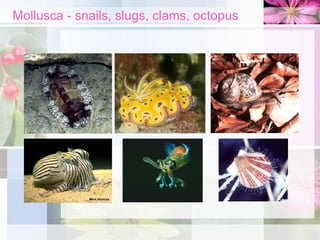
Mollusca - snails, slugs, clams, octopus
Mollusca - What makes them all molluscs?
Molluscs
• triploblastic
• soft bodied animals
• protected by or possess a hard calcium carbonate shell
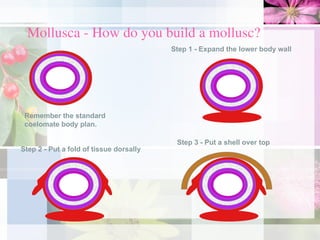
Mollusca - How do you build a mollusc?
Remember the standard
coelomate body plan.
Step 2 - Put a fold of tissue dorsally
Step 1 - Expand the lower body wall
Step 3 - Put a shell over top
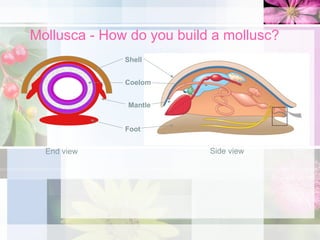
Mollusca - How do you build a mollusc?
End view Side view
Coelom
Shell
Mantle
Foot
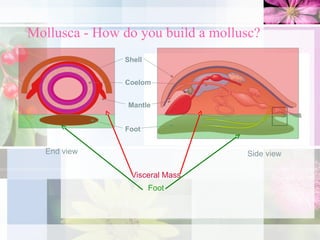
Mollusca - How do you build a mollusc?
End view Side view
Coelom
Shell
Mantle
Foot
Visceral Mass
Foot
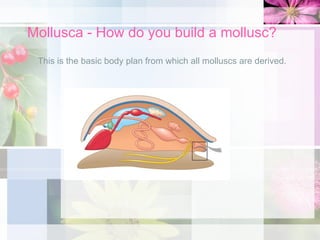
Mollusca - How do you build a mollusc?
This is the basic body plan from which all molluscs are derived.
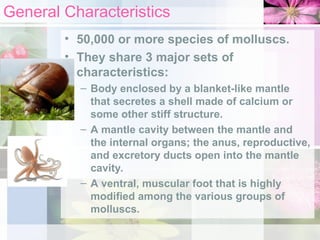
General Characteristics
• 50,000 or more species of molluscs.
• They share 3 major sets of
characteristics:
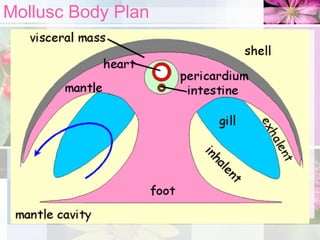
– Body enclosed by a blanket-like mantle
that secretes a shell made of calcium or
some other stiff structure.
– A mantle cavity between the mantle and
the internal organs; the anus, reproductive,
and excretory ducts open into the mantle
cavity.
– A ventral, muscular foot that is highly
modified among the various groups of
molluscs.
Mollusc Body Plan
General Characteristics Cont’d
• Free-living, multicellular animals
• Invertebrates (lack a backbone)
• Unsegmented
• Have a true coelom
• Bilateral symmetry
• Have a true heart
• Simple to complex nervous
system
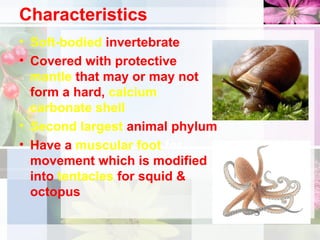
• Soft-bodied invertebrate
• Covered with protective
mantle that may or may not
form a hard, calcium
carbonate shell
• Second largest animal phylum
• Have a muscular foot for
movement which is modified
into tentacles for squid &
octopus
Characteristics
Characteristics
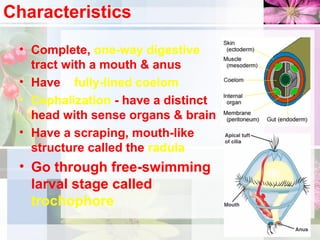
• Complete, one-way digestive
tract with a mouth & anus
• Have a fully-lined coelom
• Cephalization - have a distinct
head with sense organs & brain
• Have a scraping, mouth-like
structure called the radula
• Go through free-swimming
larval stage called
trochophore
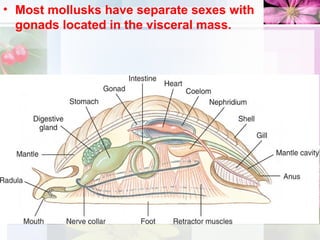
• Most mollusks have separate sexes with
gonads located in the visceral mass.
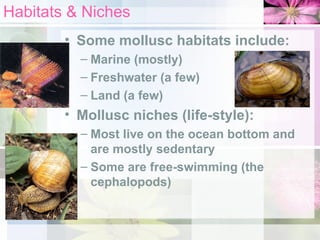
Habitats & Niches
• Some mollusc habitats include:
– Marine (mostly)
– Freshwater (a few)
– Land (a few)
• Mollusc niches (life-style):
– Most live on the ocean bottom and
are mostly sedentary
– Some are free-swimming (the
cephalopods)
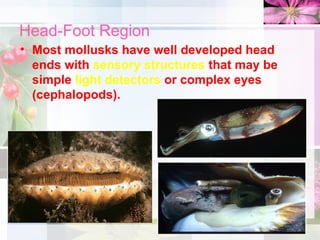
Head-Foot Region
• Most mollusks have well developed head
ends with sensory structures that may be
simple light detectors or complex eyes
(cephalopods).
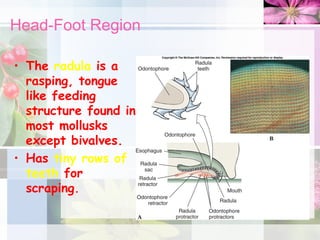
Head-Foot Region
• The radula is a
rasping, tongue
like feeding
structure found in
most mollusks
except bivalves.
• Has tiny rows of
teeth for
scraping.
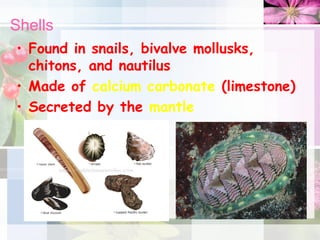
Shells
• Found in snails, bivalve mollusks,
chitons, and nautilus
• Made of calcium carbonate (limestone)
• Secreted by the mantle
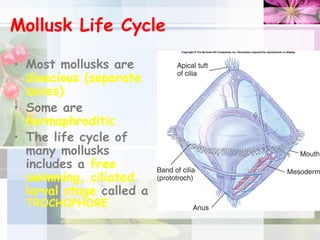
Mollusk Life Cycle
• Most mollusks are
dioecious (separate
sexes)
• Some are
hermaphroditic
• The life cycle of
many mollusks
includes a free
swimming, ciliated
larval stage called a
TROCHOPHORE
The six major mollusc classes
• There are seven mollusc classes.
• Those 6 classes are:
– Monoplacophora (mono=single; placo=shell;
phora=bearing)
• Ex. Neopilina
– Aplacophora (a=without)
• Ex. Neomenia
– Polyplacophora (poly=many)
• Ex. Chitons
– Gastropoda (gastro=body cavity; poda=foot)
• Ex. Common garden snail, abalone, turban snail
– Bivalvia (bi=two; valvia=valves)
• Ex. Clam
– Cephalopoda (cephalo=dealing with head; poda=foot)
• Ex. Squid, octopus, etc.
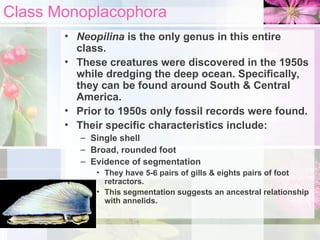
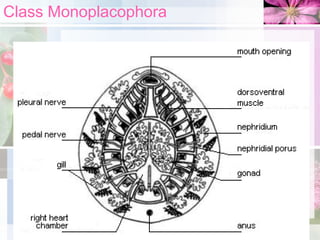
Class Monoplacophora
• Neopilina is the only genus in this entire
class.
• These creatures were discovered in the 1950s
while dredging the deep ocean. Specifically,
they can be found around South & Central
America.
• Prior to 1950s only fossil records were found.
• Their specific characteristics include:
– Single shell
– Broad, rounded foot
– Evidence of segmentation
• They have 5-6 pairs of gills & eights pairs of foot
retractors.
• This segmentation suggests an ancestral relationship
with annelids.
Class Monoplacophora
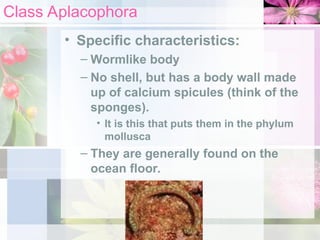
Class Aplacophora
• Specific characteristics:
– Wormlike body
– No shell, but has a body wall made
up of calcium spicules (think of the
sponges).
• It is this that puts them in the phylum
mollusca
– They are generally found on the
ocean floor.
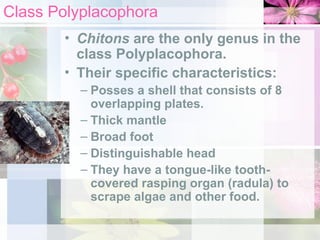
Class Polyplacophora
• Chitons are the only genus in the
class Polyplacophora.
• Their specific characteristics:
– Posses a shell that consists of 8
overlapping plates.
– Thick mantle
– Broad foot
– Distinguishable head
– They have a tongue-like tooth-
covered rasping organ (radula) to
scrape algae and other food.
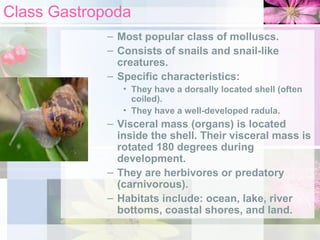
Class Gastropoda
– Most popular class of molluscs.
– Consists of snails and snail-like
creatures.
– Specific characteristics:
• They have a dorsally located shell (often
coiled).
• They have a well-developed radula.
– Visceral mass (organs) is located
inside the shell. Their visceral mass is
rotated 180 degrees during
development.
– They are herbivores or predatory
(carnivorous).
– Habitats include: ocean, lake, river
bottoms, coastal shores, and land.
Class Bivalvia
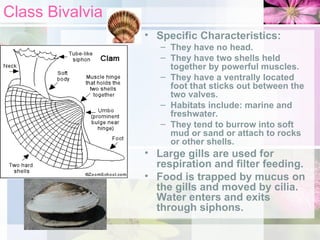
• Specific Characteristics:
– They have no head.
– They have two shells held
together by powerful muscles.
– They have a ventrally located
foot that sticks out between the
two valves.
– Habitats include: marine and
freshwater.
– They tend to burrow into soft
mud or sand or attach to rocks
or other shells.
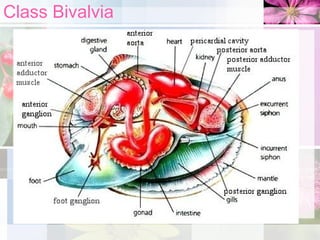
• Large gills are used for
respiration and filter feeding.
• Food is trapped by mucus on
the gills and moved by cilia.
Water enters and exits
through siphons.
Class Bivalvia
Class Cephalopoda
• Contains the largest molluscs.
• Specific Characteristics:
– May lack a shell (like an octopus)
– Shell may be reduced to a stiffening rod (like the
squid or nautilus)
– The foot is highly modified to form a group of
tentacles around the mouth.
– They are found in deep and shallow waters along
many coasts.
– Squids & Nautilus are free-swimming and move
very quickly. Octopuses are found among rocks or
crawling on the bottom of the ocean.
– Complex brain, two lateral eyes, excellent eyesight.
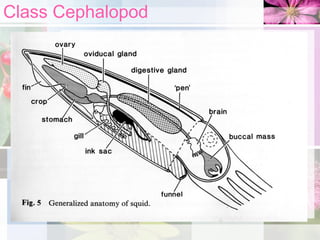
• We will dissect a squid. If you are allergic to
shellfish then speak up now!!!
Class Cephalopod
Humans & Mollusks
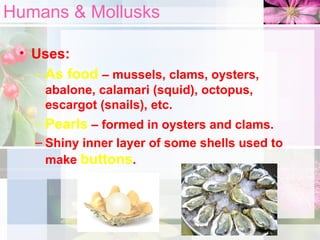
• Uses:
–As food – mussels, clams, oysters,
abalone, calamari (squid), octopus,
escargot (snails), etc.
–Pearls – formed in oysters and clams.
– Shiny inner layer of some shells used to
make buttons.
Mollusk Pests
• Shipworms – burrow through wood,
including docks & ships.
• Terrestrial snails and slugs damage
garden plants.
• Mollusks serve as an intermediate host
for many parasites.
• Zebra mussels – accidentally
introduced into the Great Lakes and
reeking havoc with the ecosystem.
Economic Importance of Molluscs
Some Mollusca are indirectly harmful to man but most of them are beneficial.
The harmful molluscs are slugs and shipworms. Slugs are injurious in gardens
and cultivations, they not only eat the leaves but also destroy plants by cutting
up their roots and stems.
Teredo, the shipworm burrows into wooden structures immersed in the sea, it
causes serious damage to wharves, piers and ships. But molluscs are a great
source of human food in various parts of world, millions of maunds of clams,
oysters, scallops and mussels are eaten in China, Japan, Malaya, Europe and
America, oysters being regarded as a delicacy.
Other bivalves, octopuses and cuttlefishes furnish large quantities of food in
Europe. Shells of freshwater mussels are used in the pearl button industry in all
parts of the world, they are made from the nacreous layer of shells, no other
material stands laundering as these buttons.
Shells of oysters are mixed with tar for making roads in America and lime from
these shells is used in feeding poultry for formation of their egg shells. Lime is
also used in buildings.
In many parts of the world molluscan shells are used for making ornaments and
jewellery, in some parts shells of Cypraea (cowrie) are used as money and as
ornaments.
Economic Importance of Molluscs
Many freshwater clams and marine oysters produce pearls, but the most
valuable natural pearls are produced by pearl oysters Pinctada margaritifera
and Pinctada mertensi which inhabit the warmer parts of Indian and Pacific
Oceans along the coasts of China, India, Sri Lanka and Japan. A pearl is made
when a small foreign object, such as a particle of sand or a parasite, lodges
between the shell and the mantle.
The foreign object becomes a nucleus around which concentric layers of
nacreous are laid by the mantle, in this manner a pearl is formed. But pearls
are also produced by most pelecypods including freshwater clams.
In Japan pearl culture is practiced by artificially introducing a small solid or
liquid irritant below the mantle of the oyster, the resultant one year old pearl is
then transplanted to another oyster, a pearl of good size is obtained in three
years after transplanting.

Lecture Phylum Mollusca by TPC123456.ppt

  • 1.
  • 2.
  • 3.
    Mollusca - snails,slugs, clams, octopus
  • 4.
    Mollusca - Whatmakes them all molluscs? Molluscs • triploblastic • soft bodied animals • protected by or possess a hard calcium carbonate shell
  • 5.
    Mollusca - Howdo you build a mollusc? Remember the standard coelomate body plan. Step 2 - Put a fold of tissue dorsally Step 1 - Expand the lower body wall Step 3 - Put a shell over top
  • 6.
    Mollusca - Howdo you build a mollusc? End view Side view Coelom Shell Mantle Foot
  • 7.
    Mollusca - Howdo you build a mollusc? End view Side view Coelom Shell Mantle Foot Visceral Mass Foot
  • 8.
    Mollusca - Howdo you build a mollusc? This is the basic body plan from which all molluscs are derived.
  • 9.
    General Characteristics • 50,000or more species of molluscs. • They share 3 major sets of characteristics: – Body enclosed by a blanket-like mantle that secretes a shell made of calcium or some other stiff structure. – A mantle cavity between the mantle and the internal organs; the anus, reproductive, and excretory ducts open into the mantle cavity. – A ventral, muscular foot that is highly modified among the various groups of molluscs.
  • 10.
  • 11.
    General Characteristics Cont’d •Free-living, multicellular animals • Invertebrates (lack a backbone) • Unsegmented • Have a true coelom • Bilateral symmetry • Have a true heart • Simple to complex nervous system
  • 12.
    • Soft-bodied invertebrate •Covered with protective mantle that may or may not form a hard, calcium carbonate shell • Second largest animal phylum • Have a muscular foot for movement which is modified into tentacles for squid & octopus Characteristics
  • 13.
    Characteristics • Complete, one-waydigestive tract with a mouth & anus • Have a fully-lined coelom • Cephalization - have a distinct head with sense organs & brain • Have a scraping, mouth-like structure called the radula • Go through free-swimming larval stage called trochophore
  • 14.
    • Most molluskshave separate sexes with gonads located in the visceral mass.
  • 15.
    Habitats & Niches •Some mollusc habitats include: – Marine (mostly) – Freshwater (a few) – Land (a few) • Mollusc niches (life-style): – Most live on the ocean bottom and are mostly sedentary – Some are free-swimming (the cephalopods)
  • 16.
    Head-Foot Region • Mostmollusks have well developed head ends with sensory structures that may be simple light detectors or complex eyes (cephalopods).
  • 17.
    Head-Foot Region • Theradula is a rasping, tongue like feeding structure found in most mollusks except bivalves. • Has tiny rows of teeth for scraping.
  • 18.
    Shells • Found insnails, bivalve mollusks, chitons, and nautilus • Made of calcium carbonate (limestone) • Secreted by the mantle
  • 19.
    Mollusk Life Cycle •Most mollusks are dioecious (separate sexes) • Some are hermaphroditic • The life cycle of many mollusks includes a free swimming, ciliated larval stage called a TROCHOPHORE
  • 20.
    The six majormollusc classes • There are seven mollusc classes. • Those 6 classes are: – Monoplacophora (mono=single; placo=shell; phora=bearing) • Ex. Neopilina – Aplacophora (a=without) • Ex. Neomenia – Polyplacophora (poly=many) • Ex. Chitons – Gastropoda (gastro=body cavity; poda=foot) • Ex. Common garden snail, abalone, turban snail – Bivalvia (bi=two; valvia=valves) • Ex. Clam – Cephalopoda (cephalo=dealing with head; poda=foot) • Ex. Squid, octopus, etc.
  • 21.
    Class Monoplacophora • Neopilinais the only genus in this entire class. • These creatures were discovered in the 1950s while dredging the deep ocean. Specifically, they can be found around South & Central America. • Prior to 1950s only fossil records were found. • Their specific characteristics include: – Single shell – Broad, rounded foot – Evidence of segmentation • They have 5-6 pairs of gills & eights pairs of foot retractors. • This segmentation suggests an ancestral relationship with annelids.
  • 22.
  • 23.
    Class Aplacophora • Specificcharacteristics: – Wormlike body – No shell, but has a body wall made up of calcium spicules (think of the sponges). • It is this that puts them in the phylum mollusca – They are generally found on the ocean floor.
  • 24.
    Class Polyplacophora • Chitonsare the only genus in the class Polyplacophora. • Their specific characteristics: – Posses a shell that consists of 8 overlapping plates. – Thick mantle – Broad foot – Distinguishable head – They have a tongue-like tooth- covered rasping organ (radula) to scrape algae and other food.
  • 25.
    Class Gastropoda – Mostpopular class of molluscs. – Consists of snails and snail-like creatures. – Specific characteristics: • They have a dorsally located shell (often coiled). • They have a well-developed radula. – Visceral mass (organs) is located inside the shell. Their visceral mass is rotated 180 degrees during development. – They are herbivores or predatory (carnivorous). – Habitats include: ocean, lake, river bottoms, coastal shores, and land.
  • 26.
    Class Bivalvia • SpecificCharacteristics: – They have no head. – They have two shells held together by powerful muscles. – They have a ventrally located foot that sticks out between the two valves. – Habitats include: marine and freshwater. – They tend to burrow into soft mud or sand or attach to rocks or other shells. • Large gills are used for respiration and filter feeding. • Food is trapped by mucus on the gills and moved by cilia. Water enters and exits through siphons.
  • 27.
  • 28.
    Class Cephalopoda • Containsthe largest molluscs. • Specific Characteristics: – May lack a shell (like an octopus) – Shell may be reduced to a stiffening rod (like the squid or nautilus) – The foot is highly modified to form a group of tentacles around the mouth. – They are found in deep and shallow waters along many coasts. – Squids & Nautilus are free-swimming and move very quickly. Octopuses are found among rocks or crawling on the bottom of the ocean. – Complex brain, two lateral eyes, excellent eyesight. • We will dissect a squid. If you are allergic to shellfish then speak up now!!!
  • 29.
  • 30.
    Humans & Mollusks •Uses: –As food – mussels, clams, oysters, abalone, calamari (squid), octopus, escargot (snails), etc. –Pearls – formed in oysters and clams. – Shiny inner layer of some shells used to make buttons.
  • 31.
    Mollusk Pests • Shipworms– burrow through wood, including docks & ships. • Terrestrial snails and slugs damage garden plants. • Mollusks serve as an intermediate host for many parasites. • Zebra mussels – accidentally introduced into the Great Lakes and reeking havoc with the ecosystem.
  • 32.
    Economic Importance ofMolluscs Some Mollusca are indirectly harmful to man but most of them are beneficial. The harmful molluscs are slugs and shipworms. Slugs are injurious in gardens and cultivations, they not only eat the leaves but also destroy plants by cutting up their roots and stems. Teredo, the shipworm burrows into wooden structures immersed in the sea, it causes serious damage to wharves, piers and ships. But molluscs are a great source of human food in various parts of world, millions of maunds of clams, oysters, scallops and mussels are eaten in China, Japan, Malaya, Europe and America, oysters being regarded as a delicacy. Other bivalves, octopuses and cuttlefishes furnish large quantities of food in Europe. Shells of freshwater mussels are used in the pearl button industry in all parts of the world, they are made from the nacreous layer of shells, no other material stands laundering as these buttons. Shells of oysters are mixed with tar for making roads in America and lime from these shells is used in feeding poultry for formation of their egg shells. Lime is also used in buildings. In many parts of the world molluscan shells are used for making ornaments and jewellery, in some parts shells of Cypraea (cowrie) are used as money and as ornaments.
  • 33.
    Economic Importance ofMolluscs Many freshwater clams and marine oysters produce pearls, but the most valuable natural pearls are produced by pearl oysters Pinctada margaritifera and Pinctada mertensi which inhabit the warmer parts of Indian and Pacific Oceans along the coasts of China, India, Sri Lanka and Japan. A pearl is made when a small foreign object, such as a particle of sand or a parasite, lodges between the shell and the mantle. The foreign object becomes a nucleus around which concentric layers of nacreous are laid by the mantle, in this manner a pearl is formed. But pearls are also produced by most pelecypods including freshwater clams. In Japan pearl culture is practiced by artificially introducing a small solid or liquid irritant below the mantle of the oyster, the resultant one year old pearl is then transplanted to another oyster, a pearl of good size is obtained in three years after transplanting.