c. cataloctocan
 As in all higher vertebrates, receptors of hearing and

balance in fishes are concentrated in the ear.
 Only the inner ear is present in fishes
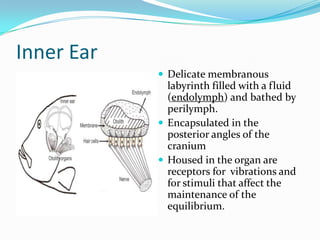
Inner Ear
 Delicate membranous

labyrinth filled with a fluid
(endolymph) and bathed by
perilymph.
 Encapsulated in the
posterior angles of the
cranium
 Housed in the organ are
receptors for vibrations and
for stimuli that affect the
maintenance of the
equilibrium.
Parts
 Otolith

- "earstones" or "fish ear bones.“
- hard, calcium carbonate structures located directly
behind the brain of teleost (bony) fish.
- they are not attached to the skull, but "float"
beneath the brain inside the soft, transparent inner
ear canals.
 3 main pockets
-utriculus
-sacculus
-lagena
Parts

Figure 1.
Inner Ear of Fishes, Lateral
View. SC= Semicircular Canals,
U= Utriculus, UO=Utricular
Otolith or Lapillus, M=Macula,
SU=Sulcus, S=Sacculus,
SO=Saccular Otolith or Sagitta,
L=Lagena, LO=Lagenar Otolith
or Asteriscus. Modified from
Popper and Coombs (1982).
Labyrinth
 Pars superior

- composed of three major
canals collectively known
as semicircular canals and
their ampullae
-One sac like structure
(utriculus)

 Pars inferior

- composed of two
vesicles, the sacculus
and lagena
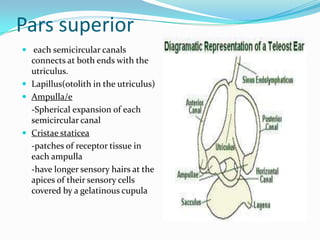
Pars superior
 each semicircular canals

connects at both ends with the
utriculus.
 Lapillus(otolith in the utriculus)
 Ampulla/e
-Spherical expansion of each
semicircular canal
 Cristae staticea
-patches of receptor tissue in
each ampulla
-have longer sensory hairs at the
apices of their sensory cells
covered by a gelatinous cupula
Pars inferior
 the sacculus and the lagena, function primarily in

sound reception
 Asteriscus and sagitta(otolith in the sacculus and
lagena)
Bony fishes

Sharks and rays

 The utriculus contains an

 An endolymphatic duct leads

otolith (lapillus)

from the inner ear to the
outside
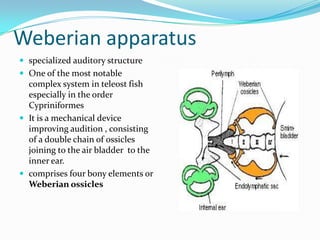
Weberian apparatus
 specialized auditory structure
 One of the most notable

complex system in teleost fish
especially in the order
Cypriniformes
 It is a mechanical device
improving audition , consisting
of a double chain of ossicles
joining to the air bladder to the
inner ear.
 comprises four bony elements or
Weberian ossicles
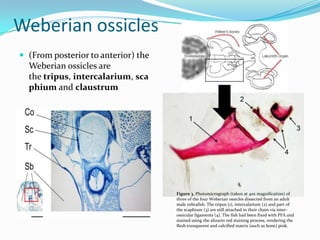
Weberian ossicles
 (From posterior to anterior) the

Weberian ossicles are
the tripus, intercalarium, sca
phium and claustrum

Figure 3. Photomicrograph (taken at 40x magnification) of
three of the four Weberian ossicles dissected from an adult
male zebrafish. The tripus (1), intercalarium (2) and part of
the scaphium (3) are still attached in their chain via interossicular ligaments (4). The fish had been fixed with PFA and
stained using the alizarin red staining process, rendering the
flesh transparent and calcified matrix (such as bone) pink.
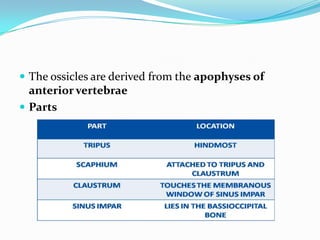
 The ossicles are derived from the apophyses of

anterior vertebrae
 Parts
Volume changes of the gas bladder cause the
Weberian ossicles to move in such a manner that
pressure changes are transmitted to the
perilymph and thence to the sensory cells of the
inferior portion of the labyrinth which is the seat
of sound reception.
Reference
 http://global.britannica.com/EBchecked/topic/638599

/Weberian-apparatus
 http://life.bio.sunysb.edu/ee/seatrout/fish_otoliths.ht
ml
 Lagler, K.
 http://www.pdn.cam.ac.uk/staff/mason_ma/Popup_
Weberian.htm