• Spiny skin.
• sea-star, sea-urchins, sea-cucumbers, sand
dollars, sea-lilies.
• Larval stage bilateral.
• Adult stage Pentaradial.
• Arms are movable appendages radiating
around central disk.
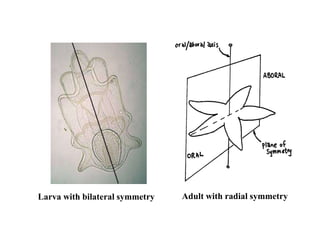
Larva with bilateral symmetry Adult with radial symmetry
Skeleton:
• Internal
• Mesodermal in origin.
• Consist ossicles covered by epidermis.
• Ossicles enclosing other tissues in flexible and
tough covering.
Water Vascular System
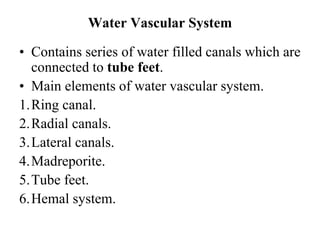
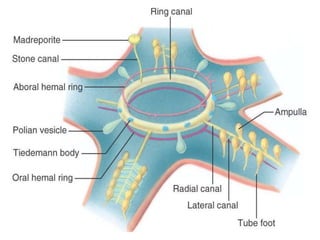
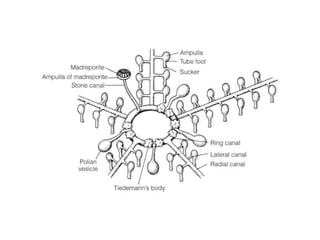
• Contains series of water filled canals which are
connected to tube feet.
• Main elements of water vascular system.
1.Ring canal.
2.Radial canals.
3.Lateral canals.
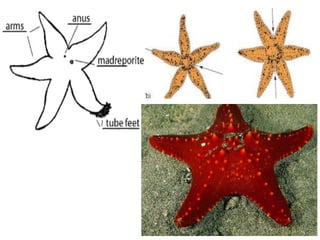
4.Madreporite.
5.Tube feet.
6.Hemal system.
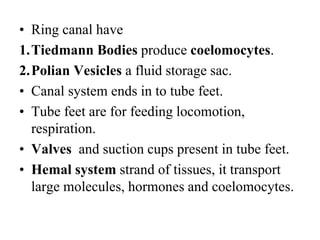
• Ring canal have
1.Tiedmann Bodies produce coelomocytes.
2.Polian Vesicles a fluid storage sac.
• Canal system ends in to tube feet.
• Tube feet are for feeding locomotion,
respiration.
• Valves and suction cups present in tube feet.
• Hemal system strand of tissues, it transport
large molecules, hormones and coelomocytes.
Functions of Water Vascular System
Water vascular system perform many functions
in echinoderms like:
• Locomotion.
• Respiration.
• Attachment.
• Feeding.
• Exchange to environment.
• No excretory organs.
• No respiratory system.
• No well developed head.
• Poorly developed brain.
• Complete digestive tract.
• Ability to regenerate.
• Reproduced asexually and sexually.
Phylum echinodermata is divided into five
classes:
1. Class Asteroidea (sea stars).
2. Class Ophiuroidea (brittle star).
3. Class Echinoidea (sea urchin).
4. Class Holothuroidea (sea cucumber).
5. Class Crinoidea (sea lilies, feather stars).
Class Asteroidea
• Common member sea-stars.
• Mostly marine, may live in sandy/muddy area.
• Pentagonal/star-shaped body plan.
• Large coelome.
• Oral surface oriented downward.
• Aboral surface directed upward.
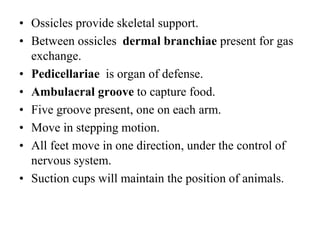
• Ossicles provide skeletal support.
• Between ossicles dermal branchiae present for gas
exchange.
• Pedicellariae is organ of defense.
• Ambulacral groove to capture food.
• Five groove present, one on each arm.
• Move in stepping motion.
• All feet move in one direction, under the control of
nervous system.
• Suction cups will maintain the position of animals.
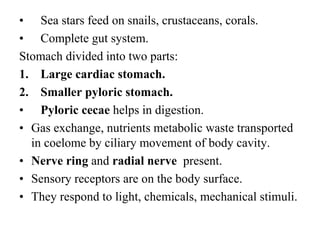
• Sea stars feed on snails, crustaceans, corals.
• Complete gut system.
Stomach divided into two parts:
1. Large cardiac stomach.
2. Smaller pyloric stomach.
• Pyloric cecae helps in digestion.
• Gas exchange, nutrients metabolic waste transported
in coelome by ciliary movement of body cavity.
• Nerve ring and radial nerve present.
• Sensory receptors are on the body surface.
• They respond to light, chemicals, mechanical stimuli.
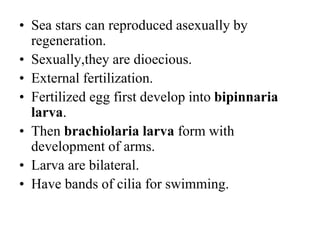
• Sea stars can reproduced asexually by
regeneration.
• Sexually,they are dioecious.
• External fertilization.
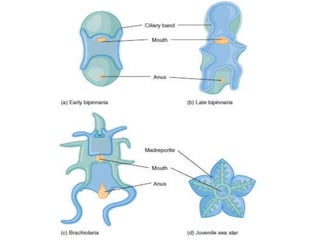
• Fertilized egg first develop into bipinnaria
larva.
• Then brachiolaria larva form with
development of arms.
• Larva are bilateral.
• Have bands of cilia for swimming.
• Larva undergoes metamorphosis and grows
into adult.
• Left side of larva become oral surface of adult,
and faces down.
• Right side become aboral surface, faces
upward.
• Larva settled to sea floor.
• Adapt adult radial symmetry.
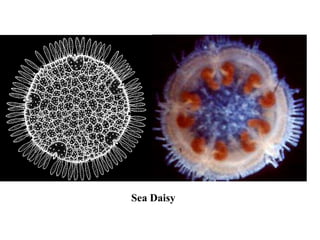
Sea Daisy
• Unusual group.
• Tiny animals.
• Upper surface made of scales lined by spines.
• Lacks arms.
• No internal digestive system.
• Thin membrane Velum cover the outer surface,
through which nutrients absorbed & digested.
• Internal pouch to hold embryo during development.
• Free swimming larval stage absent.
Sea Daisy
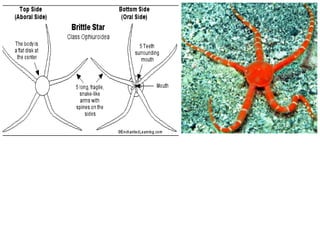
Class Ophiuroidea
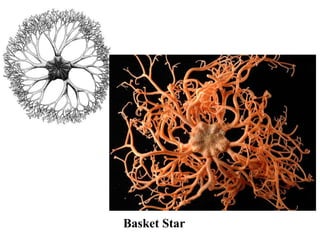
• Include basket star, brittle star.
• All are marine.
• Brittle stars have unbranched arms.
• Basket stars have branched arms.
• Dermal branches, pedicellariae absent.
• Tube feet lacks suction cups.
• Madreporite present on oral surface.
• Arms & tube feet used to sweep food to mouth.
• Mouth located in centre and surrounded by
five jaws for chewing.
• Mouth lead to stomach.
• No other digestive part extended into arms.
• Reduced coelome.
• Ammonia is primary waste product.
Basket Star
Class Echinoidea
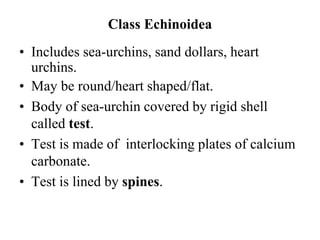
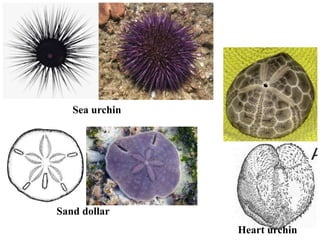
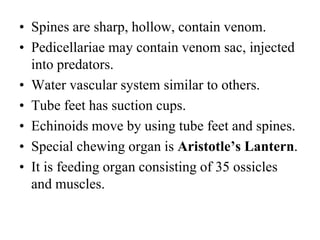
• Includes sea-urchins, sand dollars, heart
urchins.
• May be round/heart shaped/flat.
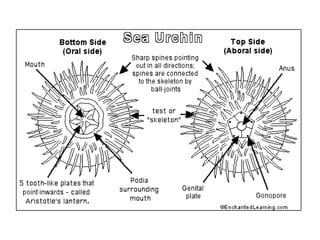
• Body of sea-urchin covered by rigid shell
called test.
• Test is made of interlocking plates of calcium
carbonate.
• Test is lined by spines.
Sea urchin
Heart urchin
Sand dollar
• Spines are sharp, hollow, contain venom.
• Pedicellariae may contain venom sac, injected
into predators.
• Water vascular system similar to others.
• Tube feet has suction cups.
• Echinoids move by using tube feet and spines.
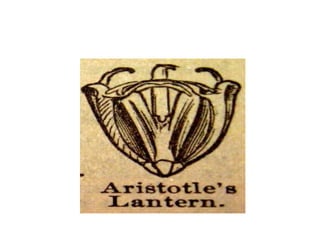
• Special chewing organ is Aristotle’s Lantern.
• It is feeding organ consisting of 35 ossicles
and muscles.
• Large coelome present.
• Small gills present.
• Gas exchange through gills.
• They are dioecious.
• Coelome filled with gametes during breeding
season.
• Fertilization external.
• Early development lead to larval stage.
• Larva undergo metamorphosis and develop
into adult.
Class Holothuroidea
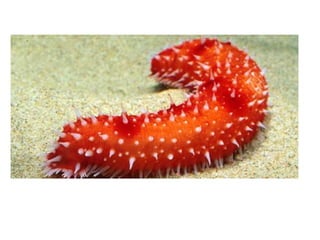
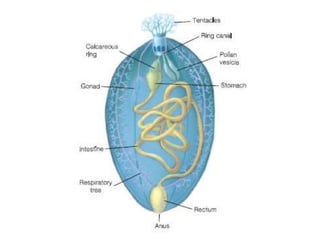
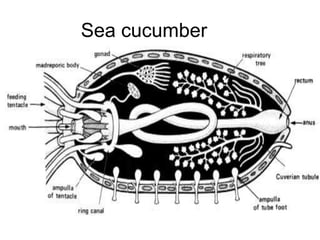
• They are sea cucumber.
• Arms absent.
• Tube feet modified into tentacles.
• Body wall thick, lacks spines and pedicellaries.
• Ossicles embedded in dermis.
• Ossicles may be microscopic or large.
• Large ossicles form calcareous ring around oral end
of digestive tract.
• Ring serve as attachment organ.
• Madreporite is internal.
• Water vascular system filled with coelomic fluid.
• Ring canal, radial canal lateral canals and an
additional canals for tentacles.
• Tube feet have suction cups.
• Three rows of tube feet used for attachment.
• Two other rows are reduced/absent.
Sea cucumber
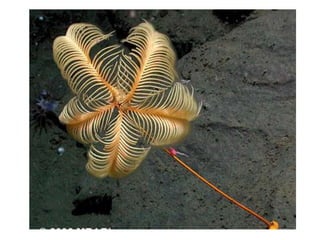
Class Crionoidea
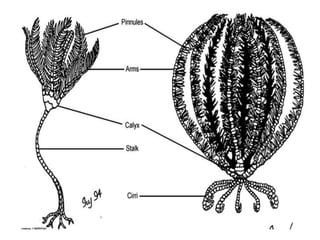
• Sea lilies with long stalk.
• Unattached end is Crown.
• Aboral end of crown has calyx.
• Five arms attached to calyx.
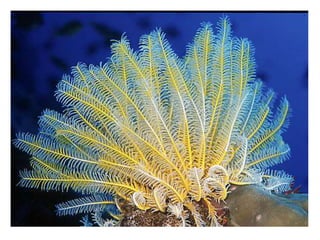
• Arms are branched giving feather like
appearance.
• Arms supported by ossicles.
• Tube feet present along each arm.
• Feather-star lack stalk.
• They have cirri for attachment.
• Gas exchange & excretion similar to
echinoderms.
• Trap prey by tube feet.
• Nerve ring absent.
• Cup-shaped nervous mass below calyx, which
give radial nerve, that control the movement of
tube feet.
• Dioecious/monoecious.
• External fertilization.
• Metamorphosis occurs.
• Larval stage develop to adult stage.
• They reproduced asexually by regeneration

Phylum Echinodermata Presentation

  • 2.
    • Spiny skin. •sea-star, sea-urchins, sea-cucumbers, sand dollars, sea-lilies. • Larval stage bilateral. • Adult stage Pentaradial. • Arms are movable appendages radiating around central disk.
  • 3.
    Larva with bilateralsymmetry Adult with radial symmetry
  • 4.
    Skeleton: • Internal • Mesodermalin origin. • Consist ossicles covered by epidermis. • Ossicles enclosing other tissues in flexible and tough covering.
  • 5.
    Water Vascular System •Contains series of water filled canals which are connected to tube feet. • Main elements of water vascular system. 1.Ring canal. 2.Radial canals. 3.Lateral canals. 4.Madreporite. 5.Tube feet. 6.Hemal system.
  • 6.
    • Ring canalhave 1.Tiedmann Bodies produce coelomocytes. 2.Polian Vesicles a fluid storage sac. • Canal system ends in to tube feet. • Tube feet are for feeding locomotion, respiration. • Valves and suction cups present in tube feet. • Hemal system strand of tissues, it transport large molecules, hormones and coelomocytes.
  • 9.
    Functions of WaterVascular System Water vascular system perform many functions in echinoderms like: • Locomotion. • Respiration. • Attachment. • Feeding. • Exchange to environment.
  • 10.
    • No excretoryorgans. • No respiratory system. • No well developed head. • Poorly developed brain. • Complete digestive tract. • Ability to regenerate. • Reproduced asexually and sexually.
  • 11.
    Phylum echinodermata isdivided into five classes: 1. Class Asteroidea (sea stars). 2. Class Ophiuroidea (brittle star). 3. Class Echinoidea (sea urchin). 4. Class Holothuroidea (sea cucumber). 5. Class Crinoidea (sea lilies, feather stars).
  • 12.
    Class Asteroidea • Commonmember sea-stars. • Mostly marine, may live in sandy/muddy area. • Pentagonal/star-shaped body plan. • Large coelome. • Oral surface oriented downward. • Aboral surface directed upward.
  • 14.
    • Ossicles provideskeletal support. • Between ossicles dermal branchiae present for gas exchange. • Pedicellariae is organ of defense. • Ambulacral groove to capture food. • Five groove present, one on each arm. • Move in stepping motion. • All feet move in one direction, under the control of nervous system. • Suction cups will maintain the position of animals.
  • 15.
    • Sea starsfeed on snails, crustaceans, corals. • Complete gut system. Stomach divided into two parts: 1. Large cardiac stomach. 2. Smaller pyloric stomach. • Pyloric cecae helps in digestion. • Gas exchange, nutrients metabolic waste transported in coelome by ciliary movement of body cavity. • Nerve ring and radial nerve present. • Sensory receptors are on the body surface. • They respond to light, chemicals, mechanical stimuli.
  • 16.
    • Sea starscan reproduced asexually by regeneration. • Sexually,they are dioecious. • External fertilization. • Fertilized egg first develop into bipinnaria larva. • Then brachiolaria larva form with development of arms. • Larva are bilateral. • Have bands of cilia for swimming.
  • 17.
    • Larva undergoesmetamorphosis and grows into adult. • Left side of larva become oral surface of adult, and faces down. • Right side become aboral surface, faces upward. • Larva settled to sea floor. • Adapt adult radial symmetry.
  • 19.
    Sea Daisy • Unusualgroup. • Tiny animals. • Upper surface made of scales lined by spines. • Lacks arms. • No internal digestive system. • Thin membrane Velum cover the outer surface, through which nutrients absorbed & digested. • Internal pouch to hold embryo during development. • Free swimming larval stage absent.
  • 20.
  • 21.
    Class Ophiuroidea • Includebasket star, brittle star. • All are marine. • Brittle stars have unbranched arms. • Basket stars have branched arms. • Dermal branches, pedicellariae absent. • Tube feet lacks suction cups. • Madreporite present on oral surface. • Arms & tube feet used to sweep food to mouth.
  • 22.
    • Mouth locatedin centre and surrounded by five jaws for chewing. • Mouth lead to stomach. • No other digestive part extended into arms. • Reduced coelome. • Ammonia is primary waste product.
  • 24.
  • 25.
    Class Echinoidea • Includessea-urchins, sand dollars, heart urchins. • May be round/heart shaped/flat. • Body of sea-urchin covered by rigid shell called test. • Test is made of interlocking plates of calcium carbonate. • Test is lined by spines.
  • 26.
  • 27.
    • Spines aresharp, hollow, contain venom. • Pedicellariae may contain venom sac, injected into predators. • Water vascular system similar to others. • Tube feet has suction cups. • Echinoids move by using tube feet and spines. • Special chewing organ is Aristotle’s Lantern. • It is feeding organ consisting of 35 ossicles and muscles.
  • 30.
    • Large coelomepresent. • Small gills present. • Gas exchange through gills. • They are dioecious. • Coelome filled with gametes during breeding season. • Fertilization external. • Early development lead to larval stage. • Larva undergo metamorphosis and develop into adult.
  • 31.
    Class Holothuroidea • Theyare sea cucumber. • Arms absent. • Tube feet modified into tentacles. • Body wall thick, lacks spines and pedicellaries. • Ossicles embedded in dermis. • Ossicles may be microscopic or large. • Large ossicles form calcareous ring around oral end of digestive tract. • Ring serve as attachment organ. • Madreporite is internal.
  • 33.
    • Water vascularsystem filled with coelomic fluid. • Ring canal, radial canal lateral canals and an additional canals for tentacles. • Tube feet have suction cups. • Three rows of tube feet used for attachment. • Two other rows are reduced/absent.
  • 35.
  • 36.
    Class Crionoidea • Sealilies with long stalk. • Unattached end is Crown. • Aboral end of crown has calyx. • Five arms attached to calyx. • Arms are branched giving feather like appearance.
  • 38.
    • Arms supportedby ossicles. • Tube feet present along each arm. • Feather-star lack stalk. • They have cirri for attachment. • Gas exchange & excretion similar to echinoderms. • Trap prey by tube feet. • Nerve ring absent.
  • 41.
    • Cup-shaped nervousmass below calyx, which give radial nerve, that control the movement of tube feet. • Dioecious/monoecious. • External fertilization. • Metamorphosis occurs. • Larval stage develop to adult stage. • They reproduced asexually by regeneration