NAME                              MATRIC NO
NIK SYARIHAH BT NIK MUHAMAD ZIN   D20101037454
CHANG PEI XIAN                    D20101037455
NURSYAHIRA AYUNI BT AHMAD ZAMRI   D20101037457
NUR ASHIKIN BT ALIAS              D20101037459
AIN NABILA BT ABD. MALEK          D20101037463
UMI NABILAH BT ISMAIL             D20101037464
Range in size from tiny
                             They are bivalved (two
Also called Pelecypoda                                 seed shells 1-2mm in
                               shelled) mollucs
                                                        length to giant size


  Mostly are sedentary
  suspension feeders
                              No head, no radula
 that depend on ciliary                                The heaviest bivalve
                                and very little
 currents produced by                                 was recorded at 300kg
                                cephalization
the gills to collect their
           food.
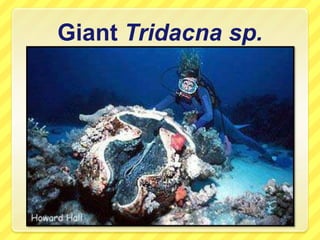
Giant Tridacna sp.
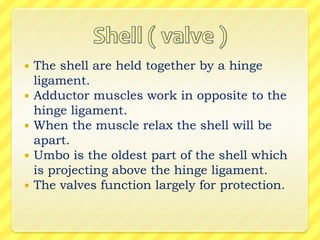
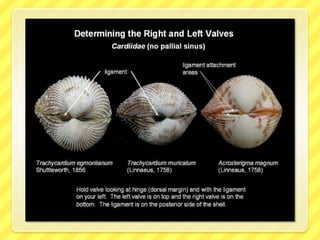
   The shell are held together by a hinge
    ligament.
   Adductor muscles work in opposite to the
    hinge ligament.
   When the muscle relax the shell will be
    apart.
   Umbo is the oldest part of the shell which
    is projecting above the hinge ligament.
   The valves function largely for protection.
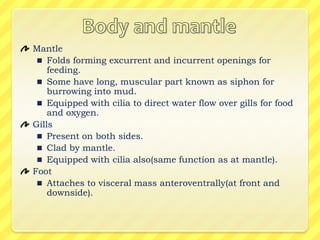
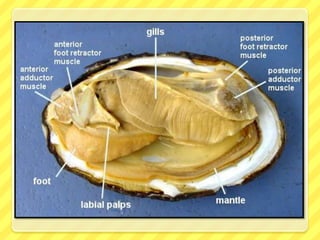
Mantle
  Folds forming excurrent and incurrent openings for
    feeding.
  Some have long, muscular part known as siphon for
    burrowing into mud.
  Equipped with cilia to direct water flow over gills for food
    and oxygen.
Gills
  Present on both sides.
  Clad by mantle.
  Equipped with cilia also(same function as at mantle).
Foot
  Attaches to visceral mass anteroventrally(at front and
    downside).
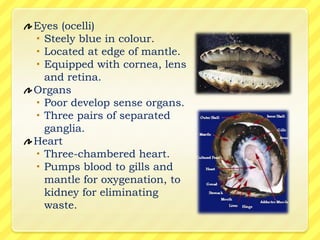
Eyes (ocelli)
 Steely blue in colour.
 Located at edge of mantle.
 Equipped with cornea, lens
  and retina.
Organs
 Poor develop sense organs.
 Three pairs of separated
  ganglia.
Heart
 Three-chambered heart.
 Pumps blood to gills and
  mantle for oxygenation, to
  kidney for eliminating
  waste.
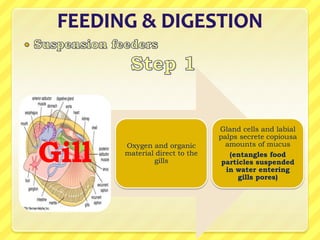
Gland cells and labial
                                palps secrete copiousa


Gill   Oxygen and organic         amounts of mucus
       material direct to the      (entangles food
               gills             particles suspended
                                  in water entering
                                      gills pores)
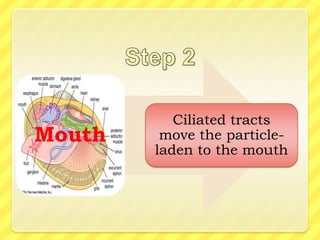
Ciliated tracts
Mouth    move the particle-
        laden to the mouth
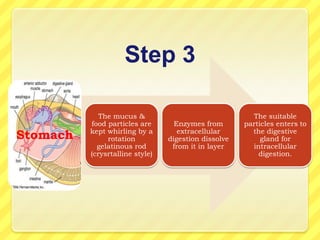
Step 3

             The mucus &                                The suitable
          food particles are       Enzymes from       particles enters to
          kept whirling by a        extracellular       the digestive
Stomach        rotation          digestion dissolve        gland for
            gelatinous rod        from it in layer      intracellular
          (crysrtalline style)                            digestion.
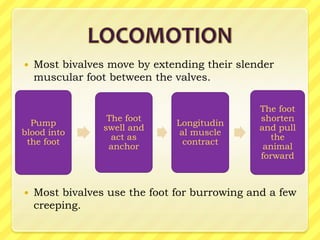
   Most bivalves move by extending their slender
    muscular foot between the valves.

                                              The foot
                  The foot                    shorten
  Pump                         Longitudin
                 swell and                    and pull
blood into                      al muscle
                   act as                       the
 the foot                        contract
                  anchor                       animal
                                              forward


   Most bivalves use the foot for burrowing and a few
    creeping.






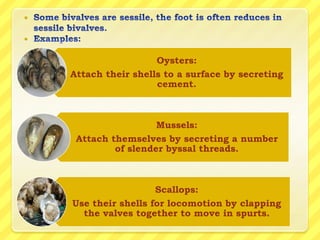
                      Oysters:
    Attach their shells to a surface by secreting
                      cement.


                      Mussels:
     Attach themselves by secreting a number
             of slender byssal threads.


                      Scallops:
    Use their shells for locomotion by clapping
      the valves together to move in spurts.
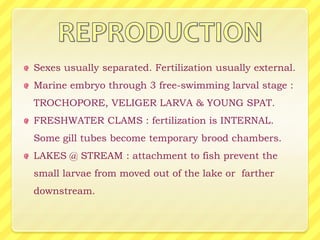
Sexes usually separated. Fertilization usually external.
Marine embryo through 3 free-swimming larval stage :
TROCHOPORE, VELIGER LARVA & YOUNG SPAT.
FRESHWATER CLAMS : fertilization is INTERNAL.
Some gill tubes become temporary brood chambers.
LAKES @ STREAM : attachment to fish prevent the
small larvae from moved out of the lake or farther
downstream.
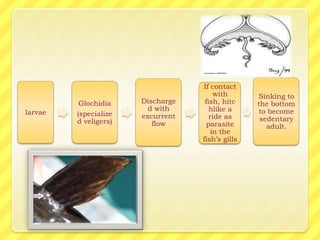
If contact
                                       with       Sinking to
          Glochidia    Discharge    fish, hitc    the bottom
                         d with       hlike a     to become
larvae   (specialize   excurrent      ride as      sedentary
         d veligers)      flow       parasite        adult.
                                      in the
                                   fish’s gills
Unique info »
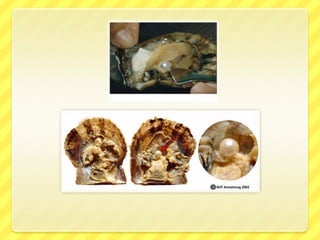
   Some can produce pearl when foreign objects
    lodges(stays) in between shell and mantle.
   Mantle will secrete layers of nacre(calcium
    carbonate sheets) around the object as a protection
    layer.
   Pearl form when small spheres(shells of clams) are
    insert together while nacre was secreted.
Class Bivalvia

Class Bivalvia

  • 1.
    NAME MATRIC NO NIK SYARIHAH BT NIK MUHAMAD ZIN D20101037454 CHANG PEI XIAN D20101037455 NURSYAHIRA AYUNI BT AHMAD ZAMRI D20101037457 NUR ASHIKIN BT ALIAS D20101037459 AIN NABILA BT ABD. MALEK D20101037463 UMI NABILAH BT ISMAIL D20101037464
  • 2.
    Range in sizefrom tiny They are bivalved (two Also called Pelecypoda seed shells 1-2mm in shelled) mollucs length to giant size Mostly are sedentary suspension feeders No head, no radula that depend on ciliary The heaviest bivalve and very little currents produced by was recorded at 300kg cephalization the gills to collect their food.
  • 3.
  • 4.
    The shell are held together by a hinge ligament.  Adductor muscles work in opposite to the hinge ligament.  When the muscle relax the shell will be apart.  Umbo is the oldest part of the shell which is projecting above the hinge ligament.  The valves function largely for protection.
  • 6.
    Mantle  Foldsforming excurrent and incurrent openings for feeding.  Some have long, muscular part known as siphon for burrowing into mud.  Equipped with cilia to direct water flow over gills for food and oxygen. Gills  Present on both sides.  Clad by mantle.  Equipped with cilia also(same function as at mantle). Foot  Attaches to visceral mass anteroventrally(at front and downside).
  • 8.
    Eyes (ocelli)  Steelyblue in colour.  Located at edge of mantle.  Equipped with cornea, lens and retina. Organs  Poor develop sense organs.  Three pairs of separated ganglia. Heart  Three-chambered heart.  Pumps blood to gills and mantle for oxygenation, to kidney for eliminating waste.
  • 9.
    Gland cells andlabial palps secrete copiousa Gill Oxygen and organic amounts of mucus material direct to the (entangles food gills particles suspended in water entering gills pores)
  • 10.
    Ciliated tracts Mouth move the particle- laden to the mouth
  • 11.
    Step 3 The mucus & The suitable food particles are Enzymes from particles enters to kept whirling by a extracellular the digestive Stomach rotation digestion dissolve gland for gelatinous rod from it in layer intracellular (crysrtalline style) digestion.
  • 12.
    Most bivalves move by extending their slender muscular foot between the valves. The foot The foot shorten Pump Longitudin swell and and pull blood into al muscle act as the the foot contract anchor animal forward  Most bivalves use the foot for burrowing and a few creeping.
  • 13.
      Oysters: Attach their shells to a surface by secreting cement. Mussels: Attach themselves by secreting a number of slender byssal threads. Scallops: Use their shells for locomotion by clapping the valves together to move in spurts.
  • 15.
    Sexes usually separated.Fertilization usually external. Marine embryo through 3 free-swimming larval stage : TROCHOPORE, VELIGER LARVA & YOUNG SPAT. FRESHWATER CLAMS : fertilization is INTERNAL. Some gill tubes become temporary brood chambers. LAKES @ STREAM : attachment to fish prevent the small larvae from moved out of the lake or farther downstream.
  • 16.
    If contact with Sinking to Glochidia Discharge fish, hitc the bottom d with hlike a to become larvae (specialize excurrent ride as sedentary d veligers) flow parasite adult. in the fish’s gills
  • 17.
    Unique info »  Some can produce pearl when foreign objects lodges(stays) in between shell and mantle.  Mantle will secrete layers of nacre(calcium carbonate sheets) around the object as a protection layer.  Pearl form when small spheres(shells of clams) are insert together while nacre was secreted.